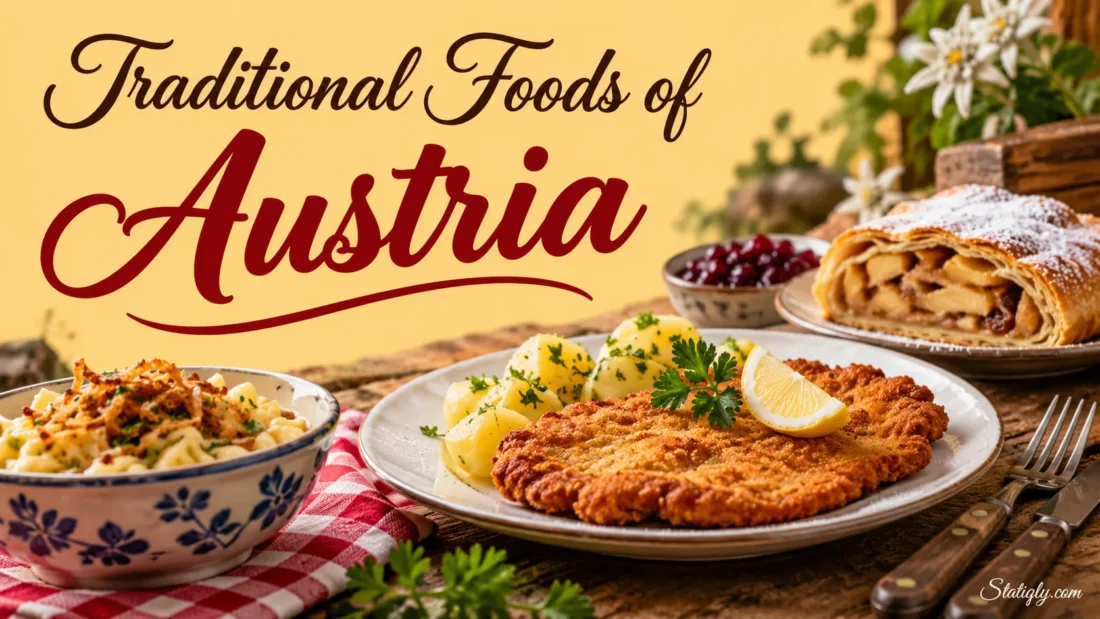
Austria’s traditional food is built around hearty main dishes, soft dumplings, fresh breads, alpine cheeses, pastries, and desserts that often feel just as important as the main course. Vienna has its famous schnitzel and cakes, while the western mountain regions lean toward cheese, potatoes, and filling dumplings. Travel south to Carinthia or Styria and the flavors change again. Austrian food is regional, practical, and closely tied to local ingredients.
For visitors, many Austrian dishes are also easy to recognize once you know a few German food names. Wiener Schnitzel, Tafelspitz, Käsespätzle, Tiroler Gröstl, Kaiserschmarrn, and Apfelstrudel are among the foods most closely associated with the country.
Traditional Austrian Foods Worth Knowing
| Food | What It Is | Commonly Associated With |
|---|---|---|
| Wiener Schnitzel | Thin breaded veal cutlet, fried until crisp | Vienna |
| Tafelspitz | Beef gently boiled with vegetables and served with sauces | Vienna and eastern Austria |
| Käsespätzle | Small egg noodles mixed with melted cheese | Vorarlberg and western Austria |
| Tiroler Gröstl | Pan-fried potatoes, onions, and meat, often topped with egg | Tyrol |
| Kärntner Kasnudeln | Filled pasta pockets with a soft cheese and herb filling | Carinthia |
| Semmelknödel | Bread dumplings served with many savory dishes | Across Austria |
| Kaiserschmarrn | Fluffy torn pancake served as a sweet dish | Across Austria |
| Apfelstrudel | Thin pastry rolled around a spiced apple filling | Vienna and across Austria |
| Sachertorte | Chocolate cake with a thin layer of apricot preserve | Vienna |
| Salzburger Nockerl | Light baked soufflé-style dessert | Salzburg |
Wiener Schnitzel
Wiener Schnitzel is probably Austria’s best-known savory dish. A traditional Wiener Schnitzel is made from veal. The meat is pounded until thin, coated in flour, egg, and breadcrumbs, then fried so the coating becomes crisp while remaining slightly separated from the meat.
Its simplicity is part of the appeal. A good schnitzel does not need a heavy sauce. It is commonly served with lemon and a potato-based or leafy side salad. You may also see schnitzels made with other meats, but these are normally identified differently on Austrian menus rather than simply being presented as traditional Wiener Schnitzel.
Tafelspitz
Tafelspitz shows a different side of Austrian cooking. Instead of frying meat, beef is gently simmered until tender, usually together with root vegetables and seasonings. The cooking broth can also form part of the meal.
The beef is often served with potatoes and condiments such as Apfelkren, a mixture based on apple and horseradish. Chive sauce is another familiar accompaniment. The result is mild, warming, and focused on the flavor of the beef rather than heavy seasoning.
Käsespätzle
Anyone who likes cheese and soft egg noodles will quickly understand the appeal of Käsespätzle. Spätzle are small pieces of egg-based dough cooked in water until tender. For Käsespätzle, they are layered or mixed with melted cheese and commonly finished with fried onions.
The dish is especially closely associated with western Austria, including Vorarlberg, where regional mountain cheeses give it a distinct flavor. Similar versions are found across the Alpine region, but Austrian preparations reflect the cheeses made locally.
Tiroler Gröstl
Tiroler Gröstl is classic Tyrolean comfort food: potatoes, onions, and pieces of meat cooked together in a pan. A fried egg is often placed on top.
It is the kind of meal that makes sense in an Alpine setting. The ingredients are familiar, filling, and well suited to a hearty lunch. Crisp edges on the potatoes add texture, while the onions bring sweetness as they cook.
Kärntner Kasnudeln
Carinthia has one of Austria’s most recognizable filled pasta dishes: Kärntner Kasnudeln. They are larger pasta pockets filled with a mixture that commonly includes soft cheese, potatoes, and herbs.
The edges are traditionally sealed with a decorative crimping technique known locally as krendeln. That folded edge is more than decoration; it is one of the visual traits that makes properly formed Kasnudeln easy to recognize.
Austrian Dumplings
Dumplings appear in many forms across Austrian cooking. Some accompany meat dishes, some contain fillings, and others become sweet dishes. The word visitors will see most often is Knödel.
Semmelknödel
Semmelknödel are bread dumplings made from pieces of bread or rolls combined with ingredients such as milk, egg, onion, and herbs. They are soft enough to absorb sauces and juices, which is why they work so well beside savory dishes.
Speckknödel
Speckknödel are savory dumplings containing pieces of cured pork. They are especially associated with Alpine cooking and can appear in broth or as part of a larger meal.
Marillenknödel
Austrian dumplings can be sweet too. Marillenknödel contain apricots wrapped in soft dough. After cooking, they are commonly rolled in buttery toasted breadcrumbs and served warm.
The apricot-growing area around the Wachau is particularly well known for Marillen, the Austrian German word for apricots.
Gulasch in Austrian Cooking
Gulasch has Central European roots beyond Austria, yet it has long had a place in Austrian cooking, especially in Vienna. Austrian versions usually focus on slowly cooked meat and plenty of onion, creating a thick, deeply flavored sauce.
Menus may offer several forms rather than one fixed recipe. Rindsgulasch refers to beef goulash, while other variations use different ingredients or serving styles.
Leberkäse
Leberkäse is a popular everyday food rather than a formal restaurant centerpiece. It is a finely ground meat mixture baked in a loaf until it develops a browned crust. Thick warm slices are often placed inside a bread roll and served as a simple meal.
You may encounter it at food counters, markets, bakeries, and casual takeaway spots. It is straightforward, filling, and part of ordinary Austrian eating rather than something reserved for celebrations.
Brettljause
Brettljause is a cold meal traditionally arranged on a wooden board. The exact selection varies, but it may contain sliced meats, cheeses, spreads, bread, pickled vegetables, and other regional foods.
The name gives away the idea: Brettl refers to the board, while Jause is an Austrian term for a snack or light meal. There is no single required combination. Regional ingredients shape the board.
Styrian Pumpkin Seed Oil
In Styria, one ingredient stands out immediately: pumpkin seed oil, known in German as Kürbiskernöl. It has a very dark green appearance and a nutty flavor.
Rather than treating it like an ordinary frying oil, Austrians often use it as a finishing ingredient. It is especially familiar on salads, though it can appear in other dishes too. A little goes a long way.
Austrian Bread and Bakery Foods
Bread matters in Austrian daily food culture. Bakeries sell an assortment of rolls, loaves, pastries, and small savory foods, making them useful places for breakfast or a light meal.
- Kaisersemmel: A round bread roll with a characteristic segmented top.
- Schwarzbrot: A broad term used for darker breads, often containing rye.
- Kornspitz: A seeded or grain-based pointed roll commonly found in bakeries.
- Mohnflesserl: A braided or twisted roll topped with poppy seeds.
Austria also has many regional breads, so the bakery selection can change noticeably from one area to another.
Kaiserschmarrn
Kaiserschmarrn sits somewhere between pancake, dessert, and sweet meal. A thick, fluffy pancake is cooked, torn into irregular pieces, and lightly browned. Powdered sugar is commonly scattered over the top.
It is often served with a fruit accompaniment such as plum compote. The uneven pieces are intentional. Neat circles are not the point here; the torn texture creates soft centers and browned edges.
Apfelstrudel
Apfelstrudel is one of Austria’s most familiar pastries. Thin strudel dough is wrapped around an apple filling that commonly includes sugar, cinnamon, and breadcrumbs. Raisins may also be included depending on the recipe.
The classic texture depends heavily on the dough. Proper strudel dough is stretched very thin before the filling is rolled inside it. Once baked, the outside becomes delicate while the apples soften within the layered roll.
Sachertorte
Vienna is closely linked with Sachertorte, a dense chocolate cake paired with a thin layer of apricot preserve and covered with chocolate icing. The original version was created in Vienna in the 19th century by Franz Sacher.
Sachertorte is generally served in modest slices because of its dense texture. Unsweetened whipped cream commonly appears beside it, balancing the chocolate rather than making the cake sweeter.
Salzburger Nockerl
Salzburger Nockerl comes from Salzburg and looks unlike most other Austrian desserts. It is a light, baked soufflé-style sweet shaped into soft peaks before it goes into the oven.
It is best eaten soon after baking because its airy structure naturally settles over time. This is one dessert where timing matters.
Palatschinken
Palatschinken are thin pancakes, closer to crêpes than to thick breakfast pancakes. Sweet versions may be spread with apricot preserve or other fillings, rolled, and dusted with sugar.
They are not limited to dessert. Savory fillings also appear, making Palatschinken a flexible part of Austrian home cooking.
Germknödel
Germknödel is a large steamed yeast dumpling with a sweet filling, usually plum preserve. It is commonly topped with melted butter or another creamy topping along with a mixture of ground poppy seeds and sugar.
Soft, warm, and extremely filling, it can feel more like a full meal than a small dessert. It is especially familiar in Alpine areas and mountain restaurants.
Topfenstrudel
Visitors who enjoy cheesecake-like fillings may want to try Topfenstrudel. Topfen is the Austrian German term for quark, a fresh dairy product used widely in both sweet and savory cooking.
In Topfenstrudel, the soft filling is wrapped in strudel pastry and baked. It has a milder fruit presence than Apfelstrudel and puts the creamy dairy filling at the center of the dish.
Buchteln
Buchteln are soft yeast buns baked closely together so their sides remain tender. They can contain a fruit filling, often plum preserve, and are usually pulled apart after baking rather than cut into individual pieces beforehand.
The contrast is simple but satisfying: lightly browned tops, soft bread-like interiors, and a sweet center.
Regional Foods Across Austria
Austrian food changes with the landscape. The dishes found in Vienna do not fully represent what is eaten in Tyrol, Vorarlberg, Styria, Salzburg, or Carinthia.
- Vienna: Wiener Schnitzel, Tafelspitz, Sachertorte, Apfelstrudel, and a strong café and pastry tradition.
- Tyrol: Tiroler Gröstl, dumplings, potatoes, cheeses, and filling mountain dishes.
- Vorarlberg: Cheese-centered foods such as Käsespätzle, often made with regional cheeses.
- Styria: Pumpkin seed oil and foods featuring local pumpkin seeds.
- Carinthia: Kärntner Kasnudeln and other dishes influenced by local Alpine ingredients.
- Salzburg: Salzburger Nockerl and a mixture of Alpine savory foods and baked sweets.
- Lower Austria: Apricot dishes are especially familiar in areas such as the Wachau.
Useful Austrian Food Words on a Menu
| German Word | Meaning |
|---|---|
| Erdäpfel | Potatoes |
| Marille | Apricot |
| Topfen | Quark or fresh curd cheese |
| Obers | Cream |
| Knödel | Dumpling |
| Semmel | Bread roll |
| Kren | Horseradish |
| Schlagobers | Whipped cream |
| Jause | Snack or light meal |
| Mehlspeise | Austrian term often used for sweet pastry or flour-based dessert dishes |
What to Try for a First Taste of Austrian Food
A visitor does not need to order every famous dish to understand Austrian cooking. A small selection already shows how varied it can be.
- Start with Wiener Schnitzel for one of Vienna’s most recognizable dishes.
- Try Tafelspitz if you prefer gently cooked beef rather than fried food.
- Choose Käsespätzle for a filling Alpine cheese dish.
- Order Kärntner Kasnudeln when visiting Carinthia.
- Try Tiroler Gröstl in Tyrol for a potato-based mountain meal.
- Finish with Kaiserschmarrn, Apfelstrudel, or a slice of Sachertorte.
The best Austrian food experience often comes from following the region rather than looking for the same famous dish everywhere. Vienna is a natural place for schnitzel and cakes. Western Austria is ideal for cheese, dumplings, and potato dishes. Carinthia brings filled pasta, while Styria has its unmistakable pumpkin seed oil. Different regions, different plates—and that is exactly what makes traditional Austrian food so interesting.