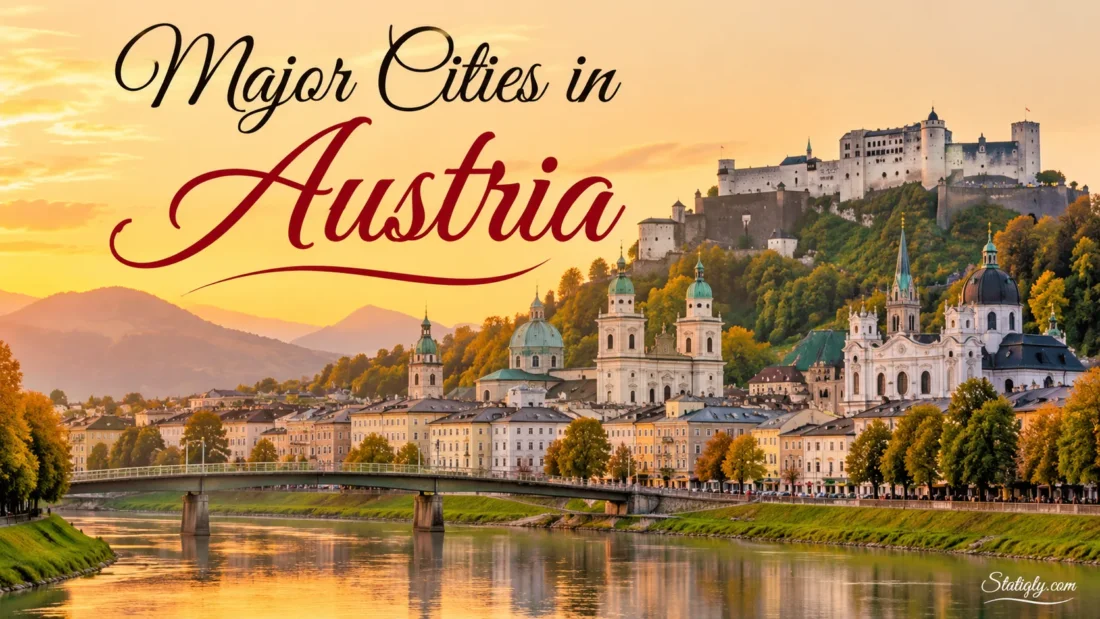
Austria has a compact urban network, yet its cities feel remarkably different from one another. Vienna dominates by population, while Graz, Linz, Salzburg, Innsbruck, and Klagenfurt form the country’s other large urban centers. Beyond them are several smaller cities that play important regional roles. Some sit beside Alpine peaks, others grew along major rivers, and a few connect city life directly with lakes and countryside.
Austria had more than 9.2 million residents at the beginning of 2026. Vienna alone is home to more than two million people. The jump from Vienna to the country’s next-largest city is striking: Graz has a little over 300,000 residents. This creates an urban pattern where one very large capital sits alongside a collection of medium-sized regional centers.
Austria’s Largest Cities by Population
Population figures can vary slightly according to the reporting date and whether a source counts registered main residences or uses the national statistical population method. The figures below are rounded 2026 city populations to make comparison easier.
| City | Federal State | Approx. Population | Known For |
|---|---|---|---|
| Vienna | Vienna | 2.04 million | National capital, museums, music, historic architecture |
| Graz | Styria | 307,000 | Historic center, universities, design |
| Linz | Upper Austria | 214,000 | Danube, technology, industry, digital arts |
| Salzburg | Salzburg | 158,000 | Mozart, baroque architecture, Alpine setting |
| Innsbruck | Tyrol | 133,000 | Alps, mountain access, historic center |
| Klagenfurt am Wörthersee | Carinthia | 106,000 | Wörthersee, Renaissance center, lakeside recreation |
| Villach | Carinthia | 66,000 | Drava River, lakes, Alpine surroundings |
| Wels | Upper Austria | 66,000 | Regional business, trade fairs, historic center |
| St. Pölten | Lower Austria | 60,000 | Baroque center, cultural district, regional administration |
| Dornbirn | Vorarlberg | 52,000 | Rhine Valley, mountains, industry and design |
What Counts as a Major City in Austria?
Only six Austrian cities have more than 100,000 residents: Vienna, Graz, Linz, Salzburg, Innsbruck, and Klagenfurt am Wörthersee. They form the clearest group of large cities by Austrian standards.
Population is not the only useful measure, though. Villach and Wels are important regional centers despite being much smaller. St. Pölten is the capital of Lower Austria, while Dornbirn is the largest city in Vorarlberg. Bregenz and Eisenstadt are small by population but matter because they are provincial capitals with strong cultural identities.
Vienna: Austria’s Dominant Metropolis
Vienna is in a category of its own within Austria. With roughly 2.04 million residents, it has more than six times the population of Graz. It is both a city and one of Austria’s nine federal states, divided into 23 municipal districts.
The city stretches along the Danube in eastern Austria. Its historic core contains landmarks such as St. Stephen’s Cathedral, the Hofburg, broad nineteenth-century boulevards, museums, theaters, and traditional coffee houses. Farther from the center, Vienna becomes much more varied, shifting from dense residential neighborhoods to parks, vineyards, modern business districts, and areas close to the Danube.
For many visitors, Vienna is the easiest Austrian city in which to spend several days without running short of things to do. Schönbrunn Palace, the Belvedere, the MuseumsQuartier, the Prater, and the historic center are only part of the picture. The city’s extensive U-Bahn, tram, bus, and suburban rail systems also make it easy to explore without a car.
Vienna is also Austria’s largest center for higher education, international business, arts, health services, and cultural institutions. Urban in scale, yet surprisingly green in many districts, it feels different from every other Austrian city.
Graz: Austria’s Second-Largest City
Graz, the capital of Styria, is Austria’s second-largest city with around 307,000 residents. The River Mur passes through its center, while hills rise close to the urban area. The best-known is the Schlossberg, topped by the city’s familiar Clock Tower.
Graz has a well-preserved historic center where narrow lanes, courtyards, red-tiled roofs, and buildings from several architectural periods sit close together. The historic center and Schloss Eggenberg form a UNESCO World Heritage property.
Yet Graz does not live only through its older architecture. Contemporary buildings, design institutions, universities, and a large student population give parts of the city a noticeably younger rhythm. The Kunsthaus Graz, with its unusual curved exterior, is one of the clearest examples of this contrast between old and new.
Graz works especially well for people who want an urban environment that remains manageable on foot and by public transport. Large enough to offer museums, shopping streets, universities, restaurants, and cultural venues; small enough that the center rarely feels overwhelming.
Linz: A Danube City Shaped by Technology and Industry
Linz is the capital of Upper Austria and the country’s third-largest city. Around 214,000 people live here. Its location on both sides of the Danube has shaped its transport links, economy, public spaces, and appearance.
Linz has long been associated with industry, but its modern identity extends well beyond factories. Digital culture, media art, science, and technology have become prominent parts of city life. The Ars Electronica Center reflects that side of Linz, while the Lentos Art Museum adds a strong contemporary-art presence along the river.
The central Hauptplatz presents another face of the city. Historic façades surround the large square, and streets leading away from it connect the old center with shopping areas and the Danube waterfront.
Linz also occupies an important position on Austria’s east-west rail corridor. Vienna lies to the east and Salzburg to the west, making Linz a natural stopping point when traveling across northern Austria.
Salzburg: Historic Streets Beneath Alpine Peaks
Salzburg is smaller than Linz but one of Austria’s most internationally recognized cities. Around 158,000 people live in the city, which spreads along the Salzach River near the northern edge of the Alps.
The historic center is a UNESCO World Heritage Site. Baroque churches, narrow shopping lanes, enclosed squares, and the Hohensalzburg Fortress create a cityscape that is easy to recognize. The fortress sits above the center and remains one of the largest visual landmarks in Salzburg.
Salzburg is closely associated with Wolfgang Amadeus Mozart, who was born here in 1756. His birthplace on Getreidegasse and the Mozart Residence are among the city’s cultural attractions. Music remains part of Salzburg’s identity through concert venues and the Salzburg Festival.
The city also serves as a practical base for exploring nearby lakes and Alpine areas. This combination is unusual: a major cultural destination and mountain landscapes sit remarkably close together.
Innsbruck: A City Surrounded by the Alps
Innsbruck is the capital of Tyrol and has roughly 133,000 residents. Few European cities of its size have mountains pressing so visibly against the urban area. The Inn River crosses the city, while high Alpine ridges rise immediately to the north and south.
The old town centers on streets around the Golden Roof, a landmark whose decorated roof is covered with thousands of fire-gilded copper tiles. Nearby historic buildings, arcaded streets, churches, and cafés create a compact center that can be explored easily on foot.
What separates Innsbruck from Austria’s other large cities is the speed with which city streets give way to mountain terrain. The Nordkette cable-car system links the urban area with high viewpoints above the city, making the surrounding landscape part of everyday life rather than a distant backdrop.
Innsbruck also has a strong university presence and serves as the main transport, educational, and commercial center of Tyrol.
Klagenfurt am Wörthersee: City Life Beside a Lake
Klagenfurt am Wörthersee is the capital of Carinthia and the smallest Austrian city with more than 100,000 residents. Its population is around 106,000.
The city center is known for broad squares, courtyards, and Renaissance-era architecture. Neuer Platz contains the Lindwurm Fountain, the dragon-shaped monument that has become one of Klagenfurt’s most recognizable symbols.
The western side of the city reaches toward Wörthersee, one of Austria’s best-known lakes. Parks, lakeside areas, and recreational routes make the connection between the city and water especially noticeable during warmer months.
Klagenfurt offers a different scale from Vienna or Graz. It functions as a regional capital, university city, and cultural center without losing the relaxed character associated with the Carinthian lake region.
Villach: A Southern Austrian Transport Center
Villach has around 66,000 residents and is Carinthia’s second-largest city. It stands on the Drava River in southern Austria, surrounded by mountains and within easy reach of several lakes.
Its location helps explain its regional importance. Rail and road routes connect the area with other parts of Austria as well as neighboring regions south of the Alps. The compact center includes pedestrian streets, churches, cafés, shops, and riverside areas.
Villach appeals most to people who like having urban services close to outdoor landscapes. Lakes, mountain routes, and thermal-spa areas are all found within the wider region.
Wels: A Busy Regional Center in Upper Austria
Wels has a population of roughly 66,000, placing it close to Villach in size. Although it receives less international attention than Salzburg or Innsbruck, it is an active commercial and regional center in Upper Austria.
The city’s central square is lined with historic buildings, while modern residential and business districts extend well beyond the old center. Wels is also known for exhibitions and trade fairs, which bring visitors from across Austria and neighboring countries.
Its position between Linz and Salzburg adds to its accessibility. For residents, that means a medium-sized city with larger urban centers reachable along the same broad east-west transport corridor.
St. Pölten: The Capital of Lower Austria
St. Pölten has around 60,000 residents. It became the capital of Lower Austria in 1986, giving the city a role much larger than its population might suggest.
Two sides of St. Pölten stand out. The older center contains baroque façades, churches, squares, and pedestrian streets. A newer cultural and administrative district developed around modern buildings farther south.
The city lies west of Vienna on one of Austria’s busiest rail corridors. That makes St. Pölten particularly well connected to the national capital and other cities farther west.
Dornbirn: Vorarlberg’s Largest City
Dornbirn, with about 52,000 residents, is the largest city in Vorarlberg. Interestingly, it is not the state capital; that title belongs to much smaller Bregenz.
Dornbirn sits in the Rhine Valley near Austria’s western border region. The city developed through manufacturing and textile industries, while modern businesses, education, design, and services now form a broader economic mix.
Nearby mountain slopes are easy to reach from the urban area. The Karren mountain overlooks the city, while the inatura museum combines exhibits on nature, science, and technology. Dornbirn feels closely linked to the wider Rhine Valley, where settlements sit relatively near one another.
Two Smaller Provincial Capitals Worth Knowing
Bregenz
Bregenz is the capital of Vorarlberg even though Dornbirn has a larger population. Around 30,000 people live in Bregenz, which occupies a narrow area between Lake Constance and the nearby mountains.
The city is widely known for the Bregenz Festival and its large floating stage on Lake Constance. The Pfänder mountain rises behind the city and provides wide views over the lake and the surrounding border region.
Eisenstadt
Eisenstadt is the capital of Burgenland and, with roughly 16,000 residents, one of Austria’s smallest provincial capitals. Its size makes it feel more like a compact regional town than a large urban center.
Esterházy Palace dominates its cultural identity. The city is also closely linked with composer Joseph Haydn, who spent much of his career working for the Esterházy family. Vineyards and the open landscapes of northern Burgenland begin close to the city.
How Austria’s Main Cities Differ
- Vienna offers the broadest range of museums, universities, neighborhoods, shopping, public transport, and cultural venues.
- Graz combines a large student population with a compact historic center and contemporary design.
- Linz stands out for technology, digital art, industry, and its Danube setting.
- Salzburg is closely tied to classical music, baroque architecture, and international tourism.
- Innsbruck offers the most immediate connection between a large Austrian city and high Alpine terrain.
- Klagenfurt pairs a regional capital with easy access to Wörthersee.
- Villach works well as a southern transport center surrounded by lakes and mountains.
- Wels has a strong regional business and trade-fair role.
- St. Pölten combines a smaller historic center with the functions of a provincial capital.
- Dornbirn is the main population center of Vorarlberg’s Rhine Valley.
Where Austria’s Cities Are Located
Austria’s urban centers form several loose geographic groups. Vienna and St. Pölten lie in the east. Linz and Wels sit farther west in Upper Austria, followed by Salzburg near the German border. Innsbruck lies deep within the Tyrolean Alps, while Dornbirn and Bregenz occupy Austria’s far west.
To the south, Graz is the main urban center of Styria. Klagenfurt and Villach anchor much of urban Carinthia. Eisenstadt lies in eastern Austria, not far from the Lake Neusiedl region.
This spread matters when planning travel. Austria is not a country where every major urban attraction is concentrated around the capital. A journey from Vienna to Innsbruck, for example, moves through several distinct regions and passes close to other important cities along the way.
Traveling Between Austria’s Major Cities
Rail travel is especially useful for moving between the larger cities. The main east-west corridor links Vienna, St. Pölten, Linz, Salzburg, and Innsbruck, making these cities easy to combine in one trip. Other rail routes connect Graz, Klagenfurt, Villach, and cities in western Austria with the wider national network.
Austria also has international airports serving Vienna, Salzburg, Innsbruck, Graz, Linz, and Klagenfurt. Vienna Airport handles the widest range of international connections, while the regional airports serve smaller networks and seasonal routes.
Within the cities, public transport varies with size. Vienna has the country’s largest network, including underground trains, trams, buses, and suburban rail. Graz, Linz, Salzburg, and Innsbruck rely on combinations of trams, buses, and regional rail. Smaller cities often have centers compact enough for many everyday trips to be made on foot.
Choosing an Austrian City by Experience
- Choose Vienna for the largest selection of museums, historic sites, classical music, and big-city neighborhoods.
- Choose Graz for an energetic university atmosphere mixed with a historic center.
- Choose Linz for digital culture, modern museums, and Danube walks.
- Choose Salzburg for music, baroque architecture, and easy access to Alpine scenery.
- Choose Innsbruck when mountain access matters as much as city attractions.
- Choose Klagenfurt for a combination of city streets and lakeside recreation.
- Choose Bregenz for Lake Constance and mountain views in a small provincial capital.
- Choose Eisenstadt for a quieter city experience centered on music, palace architecture, and the landscapes of Burgenland.
No single Austrian city represents the entire country. Vienna has the scale of a European capital, Salzburg feels closely tied to music and its historic center, Innsbruck faces directly into the Alps, and Klagenfurt turns toward one of Austria’s best-known lakes. Travel a few hours, and the urban setting changes again. That variety is one of the most useful ways to understand Austria’s cities.