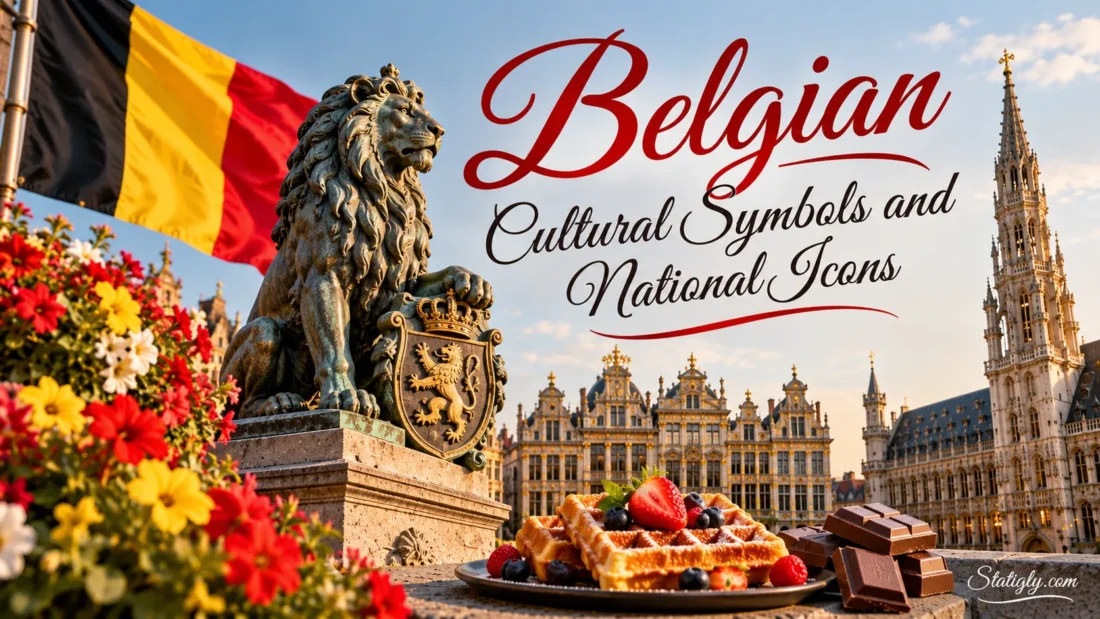
Belgium has a remarkable talent for turning everyday objects, foods, buildings, and artistic traditions into recognizable cultural icons. Some Belgian symbols are official, such as the black, yellow, and red national flag. Others earned their place through daily life: a cone of fries, a crisp Brussels waffle, an ornate piece of lace, or a small bronze fountain figure known around the world. Together, these symbols reveal a country where craftsmanship, humor, design, food, and local traditions remain closely connected.
Not every familiar Belgian image is an official national emblem. The Atomium, Manneken-Pis, Belgian chocolate, comic-strip art, and waffles are cultural icons rather than formal state symbols. That distinction matters. Their meaning comes largely from how Belgians use, preserve, share, and recognize them.
| Belgian Symbol or Icon | Type | What Makes It Recognizable | Strong Association |
|---|---|---|---|
| Black, yellow, and red flag | Official national symbol | Three vertical color bands | Belgium nationwide |
| Belgian Lion | Official heraldic emblem | Yellow lion with red claws and tongue on black | National symbolism |
| Atomium | Architectural icon | Nine connected metallic spheres | Brussels |
| Manneken-Pis | Folklore icon | Small fountain statue with an extensive costume tradition | Brussels |
| Comic-strip art | Popular culture | Characters, murals, books, and illustration | Especially Brussels |
| Belgian chocolate and pralines | Culinary craft | Filled chocolates and specialist chocolate-making | Nationwide, strongly linked with Brussels |
| Brussels and Liège waffles | Culinary icon | Two distinct Belgian waffle traditions | Brussels and Liège |
| Belgian fries | Everyday food culture | Friteries, fritkots, paper cones, and sauces | Nationwide |
| Lace-making | Traditional craft | Detailed handmade textile work | Especially Bruges |
| Carillons | Musical heritage | Music played on tuned tower bells | Historic towns and cities |
| Art Nouveau | Architecture and design | Curved lines, ironwork, glass, light, and integrated decoration | Especially Brussels |
The Black, Yellow, and Red Belgian Flag
The easiest official Belgian symbol to recognize is the national flag. It consists of three vertical bands in black, yellow, and red, arranged from the hoist outward in that order.
Those three colors appear far beyond the flag itself. They are commonly used in national celebrations, sporting events, decorations, souvenirs, and visual references to Belgium. Even without words, the combination of black, yellow, and red can immediately suggest the country.
The colors have a historical heraldic connection with Brabant: a yellow lion set against black, with red details. That older color combination became part of Belgium’s visual identity and remains instantly recognizable today.
The Belgian Lion as a Heraldic Symbol
Another formal emblem is the Belgian Lion, or Leo Belgicus. In the national heraldic design, the lion is yellow with red claws and tongue against a black background.
Lions appear in several European heraldic traditions, so the animal alone does not automatically identify Belgium. The specific combination of the lion with Belgium’s black, yellow, and red colors gives it its national connection.
The Atomium: a Modern Belgian Landmark
Few buildings announce Brussels as quickly as the Atomium. Created for Expo 58, the structure represents an elementary iron crystal enlarged 165 billion times. Its nine connected spheres create a silhouette unlike that of a conventional tower, monument, or museum.
The Atomium belongs to a different visual era from Belgium’s medieval squares and historic belfries. That contrast is part of its appeal. Metallic, geometric, and futuristic in appearance, it became one of the country’s clearest symbols of twentieth-century design.
Its shape is also easy to reproduce in illustrations, models, souvenirs, and graphic design. A cluster of silver spheres joined by tubes is often enough to identify Brussels without adding a label.
Manneken-Pis and Brussels Humor
Manneken-Pis is tiny beside the Atomium, yet it carries an equally strong cultural identity. The fountain has roots in Brussels’ old water system, with references to it reaching back to the fifteenth century. In 1619, Brussels authorities commissioned sculptor Jérôme Duquesnoy to create a new version of the figure.
Why did such a small statue become so famous? Part of the explanation is personality. Manneken-Pis is playful rather than grand. Brussels itself describes the figure as a symbol of local folklore, joy, and self-mockery.
The costume tradition added another layer to the icon. Manneken-Pis has accumulated a vast wardrobe and is dressed for selected occasions according to an established schedule. The changing outfits keep the centuries-old figure connected with living city culture rather than leaving it as a static monument.
Belgium’s Comic-Strip Culture
Belgium has an unusually visible relationship with comic-strip art. Illustrated stories are found not only in books and museums but also across urban streetscapes. Brussels has developed a comic-strip trail with more than 80 murals, turning building walls into a public celebration of illustrated storytelling.
Belgian creators have produced characters known far beyond the country’s borders, while Brussels continues to treat the comic strip as an art form rather than simply children’s entertainment. Museums, specialist bookshops, murals, exhibitions, and street details all reinforce that connection.
The visual style varies widely. Some works use clean lines and simple colors; others are more detailed or experimental. What links them is the unusually strong place that sequential art holds in Belgian cultural life.
Belgian Chocolate and the Praline Tradition
Chocolate existed long before Belgium became associated with it, but Belgian confectioners developed traditions that gave the country a distinct chocolate identity. One famous moment came in Brussels in 1912, when Jean Neuhaus Jr. created the Belgian praline in the modern sense: a chocolate shell containing a filling.
Three years later, Louise Agostini developed the ballotin, a box designed to protect and present pralines. The pairing of carefully made filled chocolates with elegant packaging helped shape the way Belgian pralines are still presented.
The word praline can cause confusion outside Belgium. In Belgian usage, it commonly refers to an individual filled chocolate rather than only a nut-and-sugar confection. Fillings can vary greatly, making the outer chocolate shell and the craft of filling it more useful identifiers than any single flavor.
Brussels Waffles and Liège Waffles
There is no single Belgian waffle style. Two forms are especially famous, and telling them apart makes Belgian food culture much easier to understand.
Brussels Waffles
A Brussels waffle is usually rectangular, light inside, and crisp on the outside. The familiar grid is relatively deep, and a typical Brussels waffle has roughly 20 to 24 openings. It can be eaten simply with powdered sugar or served with additional toppings.
Liège Waffles
The Liège waffle has a different character. It is generally smaller, denser, softer, and more irregular in shape, with rounded edges rather than the neat rectangle associated with Brussels waffles. Pearl sugar in the dough creates sweet, caramelized spots as the waffle cooks.
Both belong to Belgian culinary identity, yet they should not be treated as interchangeable. One is airy and geometric; the other is compact and rich. Seeing both side by side is a simple reminder that Belgian food traditions often change from one city or region to another.
Belgian Fries and Friterie Culture
A serving of Belgian fries may look simple, but the surrounding food culture is highly recognizable. Dedicated fry shops are commonly called friteries in French-speaking areas and frituren or fritkoten in Dutch-speaking areas.
Fries served in a paper cone, often accompanied by a choice of sauces, have become part of the visual language of Belgian street food. They appear at small neighborhood counters, mobile stands, city centers, and local gatherings.
Claims about exactly where fries were first invented are difficult to establish with certainty, and the subject has produced competing stories. Belgium’s cultural connection to fries does not depend on settling that debate. The strong friterie tradition itself is easy to observe and remains part of everyday food life.
Bruges Lace and Fine Textile Craft
Lace-making represents a quieter Belgian icon: patient, precise, and built around skilled handwork. Bruges became especially associated with lace production and education, and the craft still forms part of the city’s cultural identity.
The technique can involve threads arranged into detailed geometric or floral patterns, often with bobbins helping the maker control numerous strands at once. To an unfamiliar eye the process can appear impossibly complex. In practiced hands, repeated movements gradually create a highly ordered textile.
Bruges continues to preserve the tradition through demonstrations, teaching, collections, and specialist institutions. That living element matters: Belgian lace is not merely an old souvenir style but a craft that can still be learned and practiced.
Carillons and the Sound of Historic Belgian Cities
Some cultural symbols are heard rather than seen. Carillons are sets of tuned bells played from a keyboard, commonly installed high in towers and belfries. Their music has long formed part of the soundscape of Belgian towns and cities.
Belgium has made organized efforts to preserve carillon culture through restoration, education, performance, and training. A safeguarding programme recognized by UNESCO has involved dozens of Belgian cities and villages, while the carillon school in Mechelen holds an especially prominent place in teaching the tradition.
A carillon therefore works as both an instrument and a public sound marker. Its music spreads across streets rather than remaining inside a concert hall. Few cultural traditions connect architecture and music so directly.
Art Nouveau and Belgian Design
Brussels is one of the cities most closely associated with Art Nouveau architecture, particularly through the work of Belgian architect Victor Horta. His buildings helped develop an approach in which structure, furniture, decoration, ironwork, glass, and light were treated as parts of a unified design.
Four major Horta town houses in Brussels are recognized as a UNESCO World Heritage property: Hôtel Tassel, Hôtel Solvay, Hôtel van Eetvelde, and the Maison & Atelier Horta.
The style is often recognized by flowing lines, plant-like forms, exposed metalwork, stained or decorative glass, mosaics, and carefully designed interiors. Yet Belgian Art Nouveau was not simply decoration added to ordinary buildings. Architects such as Horta experimented with light, open interior planning, steel, and glass in ways that changed how domestic spaces could work.
Why Belgian Cultural Icons Are So Varied
Belgium does not express its identity through one monument, one food, or one artistic style. Local traditions matter enormously. Brussels, Bruges, Liège, Antwerp, Mechelen, and many smaller places contribute different images, tastes, crafts, and sounds.
This helps explain why some of the country’s strongest icons are closely tied to individual cities:
- Brussels: Atomium, Manneken-Pis, comic-strip murals, pralines, Brussels waffles, and Art Nouveau.
- Liège: the distinctive Liège waffle and its pearl-sugar texture.
- Bruges: lace-making, historic craft traditions, canals, and the belfry landscape.
- Mechelen: a strong connection with carillon music and carillon education.
- Antwerp: fashion, design, historic architecture, and a long-standing diamond-trading identity.
These local associations do not compete with a Belgian identity. They help create it. A visitor can travel a relatively short distance and encounter a noticeably different set of specialties, architectural details, vocabulary, and customs.
Official Symbols Versus Cultural Icons
The term national symbol is sometimes used too loosely. It helps to separate official emblems from popular cultural associations.
- Official national symbols include formal emblems such as the Belgian flag and heraldic lion.
- Cultural icons gain recognition through architecture, food, craft, art, folklore, tourism, and everyday life.
- Regional or city icons may become widely associated with Belgium even though they began as strongly local traditions.
The Atomium is a good example. It is not an official state emblem, yet its outline may be more immediately recognizable to many travelers than formal heraldry. The same is true of Manneken-Pis or a Belgian praline. Cultural recognition follows its own path.
Symbols Visitors Commonly Encounter in Belgium
Belgian cultural identity becomes especially clear when several symbols appear together. A day in Brussels might include Art Nouveau ironwork, a comic mural, a waffle shop, displays of pralines, black-yellow-red decorations, and the metallic spheres of the Atomium. Bruges offers another combination: lace, bells, historic streets, stepped façades, and carefully preserved craft traditions.
That variety makes Belgian symbolism unusually easy to experience in ordinary surroundings. Many icons are not locked away in formal collections. They appear on streets, in shop windows, on public buildings, in bakeries, above city squares, and sometimes in the sound of bells overhead.
Common Questions About Belgian Symbols
What Are Belgium’s Official National Colors?
Belgium’s national colors are black, yellow, and red. On the national flag they appear as three vertical bands, with black nearest the flagpole, followed by yellow and red.
What Is the Most Famous Belgian Landmark?
There is no official ranking, but the Atomium is one of Belgium’s most recognizable modern landmarks. Its nine metallic spheres create a shape that is closely associated with Brussels.
Is Manneken-Pis a National Symbol?
Manneken-Pis is better described as a Brussels folklore and cultural icon than as an official Belgian national emblem. Its fame, however, has made it widely associated with Belgium outside Brussels as well.
Why Is Belgium Associated With Comics?
Belgium has a long and highly visible comic-strip tradition supported by generations of artists, publishers, museums, specialist shops, and public art. Brussels alone has more than 80 comic-strip murals spread across the city.
Which Waffle Is More Traditionally Belgian?
Both the Brussels waffle and the Liège waffle belong to Belgian culinary tradition. They are different regional styles rather than authentic and inauthentic versions of the same food.
Why Is Chocolate So Closely Connected With Belgium?
Belgium developed a strong specialist chocolate-making culture, supported by generations of chocolatiers and confectioners. Brussels also played an important role in the development of the modern Belgian praline, created by Jean Neuhaus Jr. in 1912.
Which Traditional Belgian Craft Is Bruges Known For?
Bruges is particularly known for lace-making. The city preserves the craft through collections, demonstrations, education, and active lace-making workshops.
What Symbol Best Represents Belgian Culture?
No single object captures the full picture. The national flag represents Belgium formally, while the Atomium, Manneken-Pis, pralines, waffles, fries, comics, lace, carillons, and Art Nouveau each express a different part of Belgian cultural life. Their variety is itself one of the most recognizable features of Belgium.