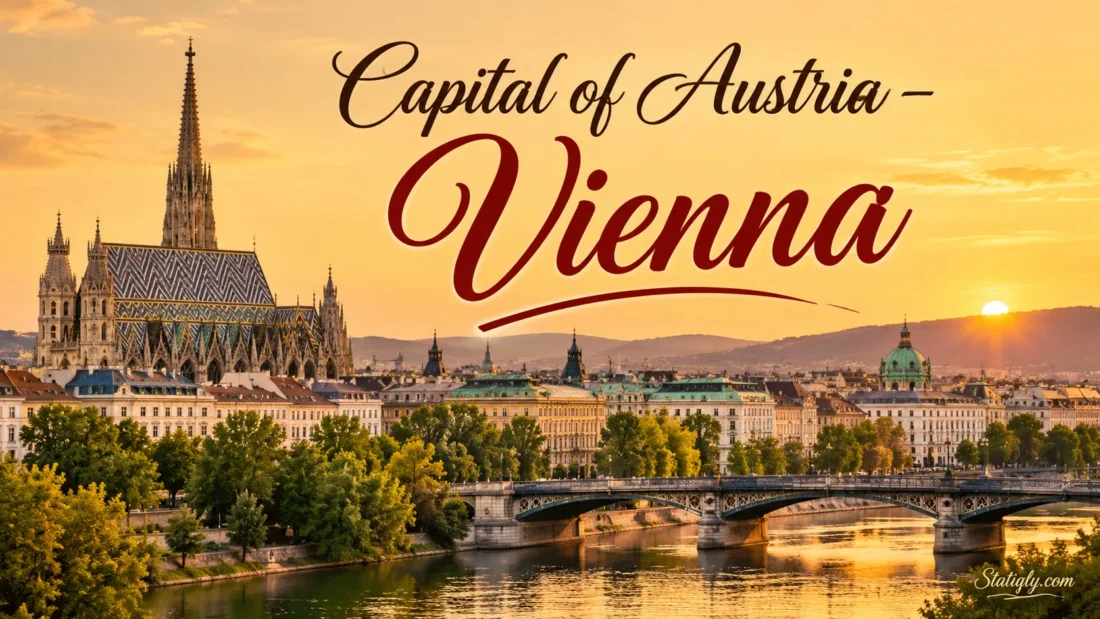
Vienna is the capital of Austria, the country’s largest city by population, and one of its nine federal provinces. Known in German as Wien, the city sits in eastern Austria along the Danube and is home to more than two million people. Vienna combines a historic European city center with large residential districts, green spaces, cultural institutions, universities, and an extensive public transport network.
| Detail | Vienna |
|---|---|
| Country | Austria |
| German Name | Wien |
| Status | Federal capital and one of Austria’s nine federal provinces |
| Population | 2,040,914 (1 January 2026) |
| Area | About 414.9 km² |
| Municipal Districts | 23 |
| Language | German |
| Currency | Euro (€) |
| Time Zone | Central European Time |
| Main River | Danube |
Why Vienna Is The Capital Of Austria
Vienna serves as Austria’s federal capital and the seat of the country’s main national institutions. Its role is unusual in another way: Vienna is not simply a city inside a larger province. The city itself is also one of Austria’s nine federal provinces.
This gives Vienna several identities at once. It is a capital city, a municipality, and a federal province. Since 1 January 1922, Vienna has held its status as a federal province of Austria.
For visitors, these administrative details may not be immediately visible. On the ground, Vienna feels like one connected metropolitan area. Its 23 municipal districts create the local structure that residents use for addresses, services, neighborhoods, and everyday orientation.
Where Vienna Is Located
Vienna lies in eastern Austria, near the country’s borders with several Central European neighbors. The Danube crosses the urban area, while the Vienna Woods reach toward the western side of the city.
The landscape changes noticeably from one part of Vienna to another. The central districts contain dense streets, historic buildings, squares, and shopping areas. Travel outward and the city gradually opens into larger residential neighborhoods, parks, woodland edges, and less densely built areas.
Its position has long helped Vienna function as a meeting point between different parts of Central Europe. Today, rail connections also make the city an easy starting point for journeys to other Austrian cities and nearby European destinations.
How Large Is Vienna?
Vienna covers about 414.9 square kilometers. The city had a registered population of 2,040,914 on 1 January 2026, according to official Vienna population statistics.
That means Vienna is far larger than Austria’s other cities in population. Yet the city does not feel equally dense everywhere. Central neighborhoods can be compact and busy, while outer districts contain large green areas, family neighborhoods, and stretches of open land.
Vienna’s 23 Districts
Vienna is divided into 23 municipal districts, numbered from 1 to 23. The district number often appears in addresses and helps identify where a place is located.
The 1st District, Innere Stadt, forms the historic center. Many famous buildings and streets are concentrated here. The remaining districts extend around it in different directions, forming a much larger city than the historic core alone might suggest.
- Innere Stadt is the historic central district.
- Leopoldstadt lies across the Danube Canal from the old center and includes the Prater area.
- Landstraße includes the Belvedere area.
- Hietzing is associated with Schönbrunn Palace and its surroundings.
- Donaustadt stretches across a large area northeast of the historic center.
- Liesing forms Vienna’s 23rd district in the southwest.
For someone seeing Vienna for the first time, the district system is useful. A place described as being in the “1st” or “7th,” for example, is referring to its municipal district.
The Historic Center Of Vienna
Vienna’s historic center preserves layers of the city’s long development. Streets around St. Stephen’s Cathedral form one of its most recognizable areas, with pedestrian streets, older buildings, courtyards, shops, and cultural sites packed into a relatively compact space.
The Historic Centre of Vienna is included on the UNESCO World Heritage List. Its urban landscape includes medieval elements, Baroque buildings, gardens, and the monumental architecture that developed around the Ringstrasse during the 19th century.
The Ringstrasse is especially useful for understanding Vienna’s shape. It follows the area around the old inner city and passes many prominent buildings, parks, cultural venues, and public spaces. Rather than being a single attraction, it works almost like a circular introduction to central Vienna.
Schönbrunn Palace and Vienna’s Imperial Architecture
Schönbrunn Palace and Gardens form another UNESCO-listed site in Vienna. The palace stands west of the central districts and is one of the city’s best-known architectural landmarks.
Elsewhere, the Hofburg complex, Belvedere, historic churches, formal gardens, and grand residential buildings show how strongly architecture shapes Vienna’s identity. Yet Vienna is not frozen in one architectural period. Modern buildings, contemporary neighborhoods, university campuses, and newer business areas sit alongside the older city.
Vienna and The Danube
The Danube is one of the defining geographical features of Vienna. The river and its related waterways create a very different landscape from the narrow streets of the historic center.
Several waterways appear on a map of the city, so first-time visitors may notice names such as the Danube, Danube Canal, and New Danube. They are not interchangeable. The Danube Canal passes close to the historic center, while the main Danube lies farther northeast.
Large recreational areas also extend along the water. This gives Vienna a balance that surprises some visitors: dense urban streets can be followed quite quickly by broad riverside spaces and greenery.
Vienna Woods and Green Spaces
Vienna is not only stone streets and historic façades. The Vienna Woods reach the western edge of the city, while parks, gardens, riverside areas, and other green spaces are distributed throughout the urban area.
The Prater is among the best-known examples. Although many people associate the name with its amusement area and famous Giant Ferris Wheel, the wider Prater also contains extensive open and green space.
Other well-known green areas include the gardens around Schönbrunn and Belvedere, Stadtpark near the center, and the Danube Island area. Different scenery, same city.
Vienna As A City Of Music and Culture
Music is closely tied to Vienna’s international image. Mozart, Beethoven, Schubert, and other composers lived or worked in the city, and Vienna became one of Europe’s best-known centers for classical music.
That connection remains visible through concert halls, opera, music schools, museums, memorial sites, and performances held throughout the year. The Vienna State Opera and Musikverein are among the names most closely associated with the city’s musical life.
Museums are another major part of Vienna’s cultural landscape. Collections range from fine art and natural history to design, technology, architecture, and the history of the city itself.
Food Closely Associated With Vienna
Viennese food has its own recognizable identity within Austrian cuisine. Several dishes and desserts are strongly associated with the capital.
- Wiener Schnitzel – a thin breaded cutlet traditionally prepared with veal.
- Apfelstrudel – pastry filled with apples and usually flavored with ingredients such as cinnamon.
- Sachertorte – a chocolate cake strongly associated with Vienna.
- Kaiserschmarrn – torn pieces of sweet pancake commonly served as a dessert.
Vienna is also known for its coffeehouse culture. Traditional cafés often encourage a slower pace than an ordinary grab-and-go coffee stop. People may sit, read, talk, or enjoy a dessert without rushing through the experience.
Getting Around Vienna
Vienna has an extensive public transport system built around the U-Bahn, trams, buses, and suburban rail services. For many journeys within the city, public transport removes the need for a car.
The U-Bahn currently uses five main lines: U1, U2, U3, U4, and U6. Stations such as Stephansplatz, Karlsplatz, Schottentor, Praterstern, and Hauptbahnhof connect travelers with central streets, rail services, and other transport lines.
Trams are particularly useful because they operate through many areas that the underground network does not directly cover. They also allow passengers to see the city while moving between neighborhoods.
Vienna Hauptbahnhof and Rail Connections
Wien Hauptbahnhof, or Vienna Main Station, is the city’s main long-distance rail hub. Trains connect Vienna with other Austrian cities such as Salzburg, Linz, Graz, Innsbruck, and Klagenfurt, as well as destinations beyond Austria.
Because of Vienna’s eastern position within Austria, rail travel can also make nearby Central European capitals feel remarkably close. The city’s railway network is therefore useful both for domestic travel and for wider regional journeys.
What Language Is Spoken In Vienna?
German is the official language of Austria and the main language used in Vienna. The local form of spoken German can sound different from the German taught in textbooks, especially when speakers use Viennese or Austro-Bavarian expressions.
The German name for Vienna is Wien. This name appears on signs, transport information, addresses, maps, and German-language websites. English uses the name Vienna.
What Currency Does Vienna Use?
Vienna uses the euro (€), the currency of Austria. The same currency is used across the country, so travelers moving between Vienna and other Austrian destinations do not need a different local currency.
Vienna’s Climate Through The Year
Vienna has a temperate climate with changing seasons. Summers are generally warm, while winters are much colder. Spring and autumn sit between the two, with weather that can shift from mild to cool within a relatively short period.
The difference between seasons changes the feel of the city. Parks and riverside areas become especially active during warmer months, while colder periods bring a different rhythm to indoor cultural venues, cafés, museums, and concert halls.
Places That Help Define Vienna
A relatively small group of landmarks can help a newcomer understand the city’s geography and character.
- St. Stephen’s Cathedral – a central landmark in the historic core.
- Schönbrunn Palace – a palace and garden complex west of the center.
- Hofburg – a large historic complex in central Vienna.
- Belvedere – a Baroque palace complex with gardens and art collections.
- Ringstrasse – the broad boulevard surrounding much of the old central district.
- Prater – a large recreation area known for both green space and its amusement park.
- Danube Island – a long recreational area between waterways of the Danube.
- Vienna State Opera – one of the city’s best-known cultural buildings.
Why Vienna Feels Different From A Small Historic Capital
Photos of Vienna often focus on palaces, cathedrals, elegant streets, and the historic center. Those places are real parts of the city, but they represent only a fraction of Vienna.
Beyond the old center lies a city of more than two million residents spread across 23 districts. Apartment neighborhoods, universities, local shopping streets, parks, transport hubs, offices, schools, and modern developments make up much of everyday Vienna.
This contrast helps explain the character of Austria’s capital. Vienna can feel formal and historic around one corner, residential around the next, and unexpectedly green a short journey later. Its famous monuments provide the first impression; its districts reveal the larger city behind them.