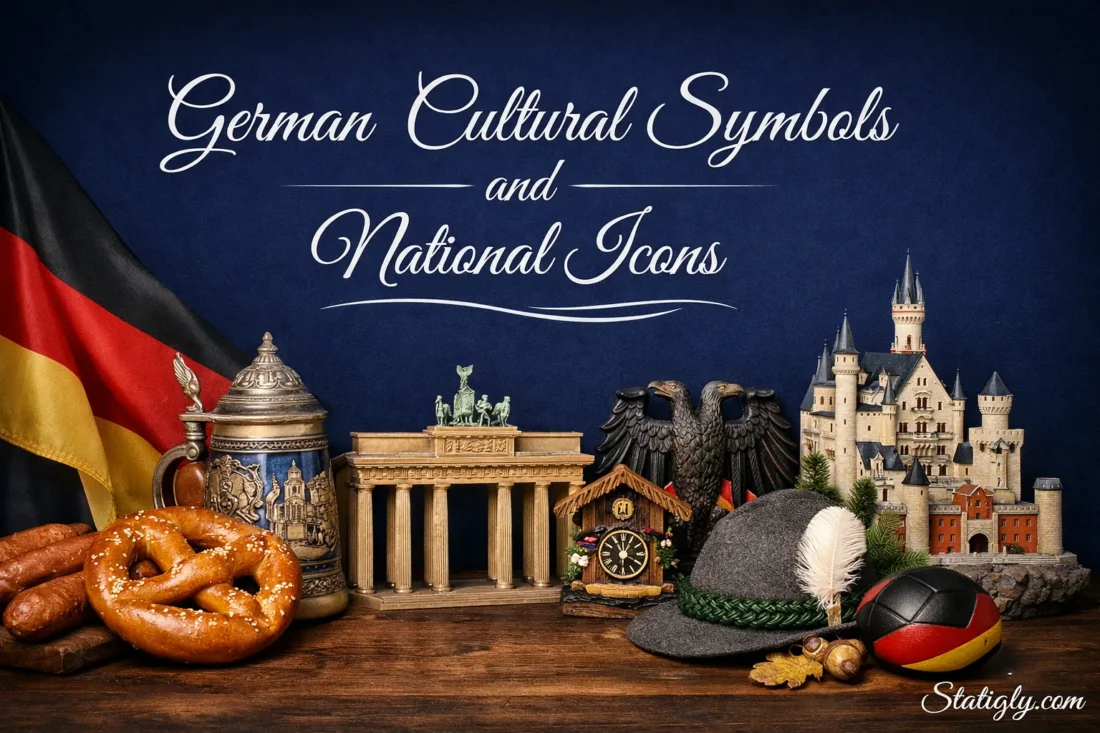
Germany’s cultural symbols are like small keys. Pick one up, and it can open a whole room of stories—craft, music, design, landscapes, and shared rituals. Some icons are official. Others live in daily life: a clock on a wall, a castle silhouette, a winter market glow. Want a clear way to recognize what you’re seeing, and what it quietly stands for? Let’s walk through the symbols Germans know, celebrate, and pass on.
Navigate This Guide
- State Symbols that show up in ceremonies and public spaces
- Landmarks that became national shorthand
- Nature motifs you’ll spot in art and design
- Everyday objects that carry cultural meaning
- Arts and ideas that shaped global culture
- Seasonal traditions that bring people together
- Using symbols with care and respect
| Symbol Or Icon | Where You’ll Notice It | What It Commonly Signals |
|---|---|---|
| Black-Red-Gold flag | Public buildings, sports events, civic celebrations | Shared identity and modern national unity |
| Federal Eagle (Bundesadler) | Official documents, institutions, seals | State authority and continuity of the republic |
| National Anthem (third stanza of “Deutschlandlied”) | Formal ceremonies, major sporting moments | Core civic values expressed in a compact text |
| Brandenburg Gate | Berlin imagery, postcards, cultural references | Berlin as a symbol of German history and renewal |
| Cologne Cathedral | Rhine travel routes, architecture discussions | Gothic craft, perseverance, and sacred artistry |
| Neuschwanstein Castle | Fairy-tale imagery, Bavarian iconography | Romantic imagination and castle aesthetics |
| Bauhaus Design | Architecture, furniture, typography, modern branding | Function-first design and clean geometry |
| Black Forest Cuckoo Clock | Craft shops, home décor, folk art collections | Regional woodworking tradition and playful timekeeping |
| Brothers Grimm Tales | Children’s literature, theater, illustration | Storytelling heritage and moral imagination |
| Christmas Markets | City squares in winter, seasonal crafts and foods | Community warmth, artisan gifts, winter ritual |
State Symbols That Set The Tone
Some symbols are designed to be instantly readable. They appear in public spaces and official moments, so they need to communicate immediately. Think of them as a clean logo for civic life: simple shapes, strong meaning, wide recognition.
The Flag: Black, Red, and Gold
The black-red-gold tricolor is Germany’s national flag. You’ll see it on public buildings, during celebrations, and at big cultural or sporting events. The design is straightforward, which is part of the point: no clutter, no puzzle to solve.
- How to spot it: three horizontal stripes—black on top, red in the middle, gold at the bottom.
- Where it shows up most: civic holidays, national teams, official sites.
- Why it matters: it’s a shared visual shorthand that can unite people who differ in region, dialect, and local tradition.
The Federal Eagle: A Bold Emblem With Deep Roots
The Bundesadler—Germany’s federal eagle—appears on seals, institutions, and formal documents. It’s a symbol with a long European tradition, used here as a state emblem in modern form. Ever noticed how a single animal shape can feel “official” even before you read a word? That’s exactly its job.
Look For These Details
- Strong silhouette: meant to be readable even when small.
- Formal context: used where trust and authenticity matter.
- Design restraint: clear lines over decorative overload.
The Anthem: When A Few Lines Carry A Room
Germany’s national anthem uses the third stanza of the “Deutschlandlied.” It’s typically heard in ceremonial settings and major public events. An anthem isn’t everyday music—it’s more like a shared script, saved for moments when a crowd wants to feel like one voice.
If you’re attending an event where it is played, the simplest rule is also the best one: be present, be respectful, and follow the tone of the setting.
Landmarks That Became National Icons
Germany has famous places in every region, yet a few landmarks have become national shorthand. They show up in books, posters, films, and design because they’re visually distinctive—almost like a signature you recognize from across the page.
Brandenburg Gate
In Berlin, the Brandenburg Gate is more than architecture—it’s a visual anchor. Its balanced columns and classical shape make it easy to remember. Why does it feel so “symbolic”? Because it looks like a threshold: a place you pass through, a place where history pauses.
- Best understood as: a city-and-country emblem
- What it suggests: continuity, public life, open spaces
Cologne Cathedral
Cologne Cathedral is a masterpiece of Gothic scale and meticulous craft. The towers pull your eyes upward—like a stone version of a soaring melody. Even if you don’t know the details, the building communicates one thing clearly: patient work, over generations.
- Best understood as: a craft-and-faith landmark
- What it suggests: artistry, dedication, shared heritage
Neuschwanstein Castle
Neuschwanstein is often linked with fairy-tale imagery. It’s not “typical” everyday Germany, and that’s why it works as an icon: it shows the country’s romantic side, where architecture becomes a daydream in stone.
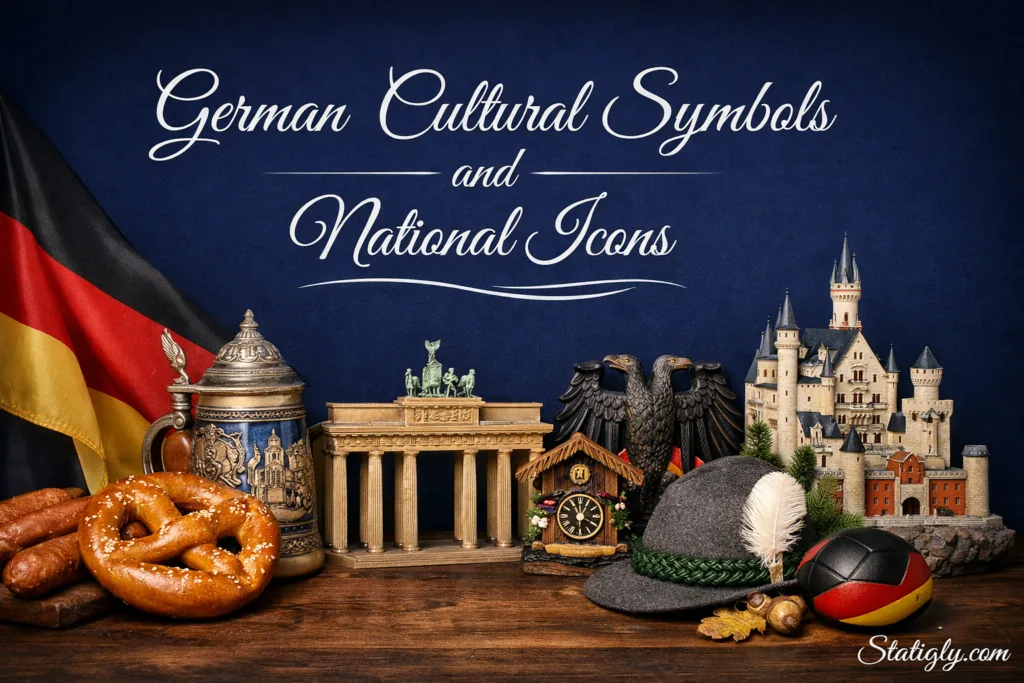
- Best understood as: a romantic imagination symbol
- What it suggests: legends, landscapes, visual drama
Notice the pattern? Each landmark is visually “clean.” Strong outline. Memorable proportions. Icons win by being easy to recall.
Nature Motifs You’ll See Again and Again
Germany’s natural landscapes shape its symbolism in quiet ways. Mountains, forests, rivers, and leaves show up in art, logos, patterns, and seasonal décor. It’s not about “one official nature icon.” It’s about repeated motifs that feel familiar.
Oak Leaves: A Classic Motif Of Strength
Oak leaves are a long-standing European motif, and in Germany you’ll spot them in decorative arts and formal design. They can suggest steadiness, endurance, and rootedness—like a promise that what’s built will last.
The Rhine and The Forest: Geography As Cultural Memory
The Rhine is more than a river in cultural imagination. It’s a recurring reference point in music, poetry, and regional identity. And then there’s the forest, especially the Black Forest in the southwest, which has become a symbol of dense greenery, craft villages, and folk traditions. Ask yourself: why do forests feel so powerful in stories? Because they hold both mystery and home at the same time.
- Common visual cues: fir trees, woodland silhouettes, carved wood patterns
- Where you’ll see them: regional crafts, holiday décor, souvenirs, illustrated books
Everyday Objects That Tell A Cultural Story
Some national icons live in plain sight. You can hold them, use them, display them. These objects turn culture into something touchable.
Cuckoo Clocks: The Black Forest On Your Wall
The cuckoo clock is strongly associated with the Black Forest region. It’s a blend of woodworking, mechanical skill, and playful performance. The little bird popping out feels like a tiny stage show—short, precise, and oddly charming.
How To Recognize Craft Quality
Look for clean carving, crisp joinery, and a case that feels solid rather than lightweight. If the decoration is detailed without looking messy, that’s usually a good sign. Many workshops also share the region and method of making in the product description.
Nutcrackers and Wooden Figures: Folk Art With Character
German folk carving is known for expressive wooden figures, especially in winter traditions. Nutcrackers, miners, and small village characters often appear as decorative pieces. They’re a reminder that craftsmanship can be serious skill while still feeling fun.
Porcelain: Precision You Can See
Germany has a long tradition of fine porcelain and ceramics, especially in parts of Saxony and Bavaria. What makes it iconic? The mix of delicate form and technical control—thin edges, smooth glaze, and decoration that looks intentional rather than loud. It’s the same cultural preference you’ll notice in other areas: careful execution.
Arts and Ideas That Became National Touchstones
When people say “German culture,” they often mean a few big pillars: music, literature, and design. These aren’t museum-only topics. They influence what people listen to, how cities look, and how products are built.
Classical Music: From Bach To Beethoven
Germany’s place in classical music is hard to miss. Names like Johann Sebastian Bach and Ludwig van Beethoven are global reference points. Their work is studied, performed, and reinterpreted everywhere. If you’re new to it, start small. One piece. One movement. Let it land. Music doesn’t need a lecture to work.
- Why it became iconic: strong structures, emotional range, deep craft
- Where you’ll encounter it today: concerts, films, education, cultural events
Literature and Storytelling: Goethe and The Brothers Grimm
Johann Wolfgang von Goethe represents a major literary tradition, while the Brothers Grimm became central to folk storytelling. The Grimm tales are famous worldwide, often reshaped into softer versions for children, yet their original power remains: they are compact stories that move like arrows—straight to the point.
Bauhaus: When Design Became A Cultural Symbol
Bauhaus is one of Germany’s most recognizable cultural exports in modern design. The idea is simple: form and function should cooperate. Clean lines. Honest materials. No fake decoration. It’s a design language that still shapes architecture, furniture, and visual identity today. Ever held a well-made object and thought, “This just makes sense”? That’s the Bauhaus spirit showing up.
A Simple Way To “Read” Bauhaus
- Look for geometry: circles, squares, grids.
- Check the structure: does every part have a job?
- Notice the calm: the design feels quiet, not noisy.
Seasonal Traditions That Bring People Together
Not every cultural icon is a “thing.” Sometimes the icon is a shared rhythm—a season, a ritual, a repeating event that makes a city feel like itself.
Christmas Markets: Light, Craft, and Winter Comfort
Germany is widely known for Christmas markets in wintertime. They often fill central squares with wooden stalls, handmade goods, warm lights, and seasonal foods. The feeling is part of the symbol: a public space turning into a temporary living room.
- What stands out: artisan ornaments, carved figures, regional sweets, choirs and street music
- What the tradition signals: community, craftsmanship, a slower winter pace
Carnival Season: Colorful Public Joy
In parts of western Germany, especially around the Rhine region, carnival season brings costumes, parades, and playful performances. It’s a reminder that German cultural life isn’t only about precision and structure. It also makes room for humor and spectacle.
How To Use Cultural Symbols Respectfully
Symbols work because people agree to treat them as meaningful. That agreement deserves care. If you’re writing, designing, teaching, traveling, or building content about Germany, these habits keep your work accurate and respectful without turning it stiff.
- Name the region when it matters: lederhosen and dirndls are strongly tied to Bavaria and Alpine traditions, not every German region.
- Separate “official” from “popular”: the flag and federal eagle are state symbols; cuckoo clocks and nutcrackers are cultural icons.
- Avoid forcing one meaning: a landmark can represent many feelings—history, pride, beauty, or simply a place people love.
- Prefer specific examples: say “Black Forest woodworking” instead of a vague “German craft.”
- Keep the tone warm: cultural symbols are shared, not locked behind glass.
A Quick Self-Check Before You Publish
- Did I avoid turning regional traditions into “one-size-fits-all”?
- Did I use clear, simple wording instead of dramatic claims?
- Did I keep the focus on curiosity and shared appreciation?