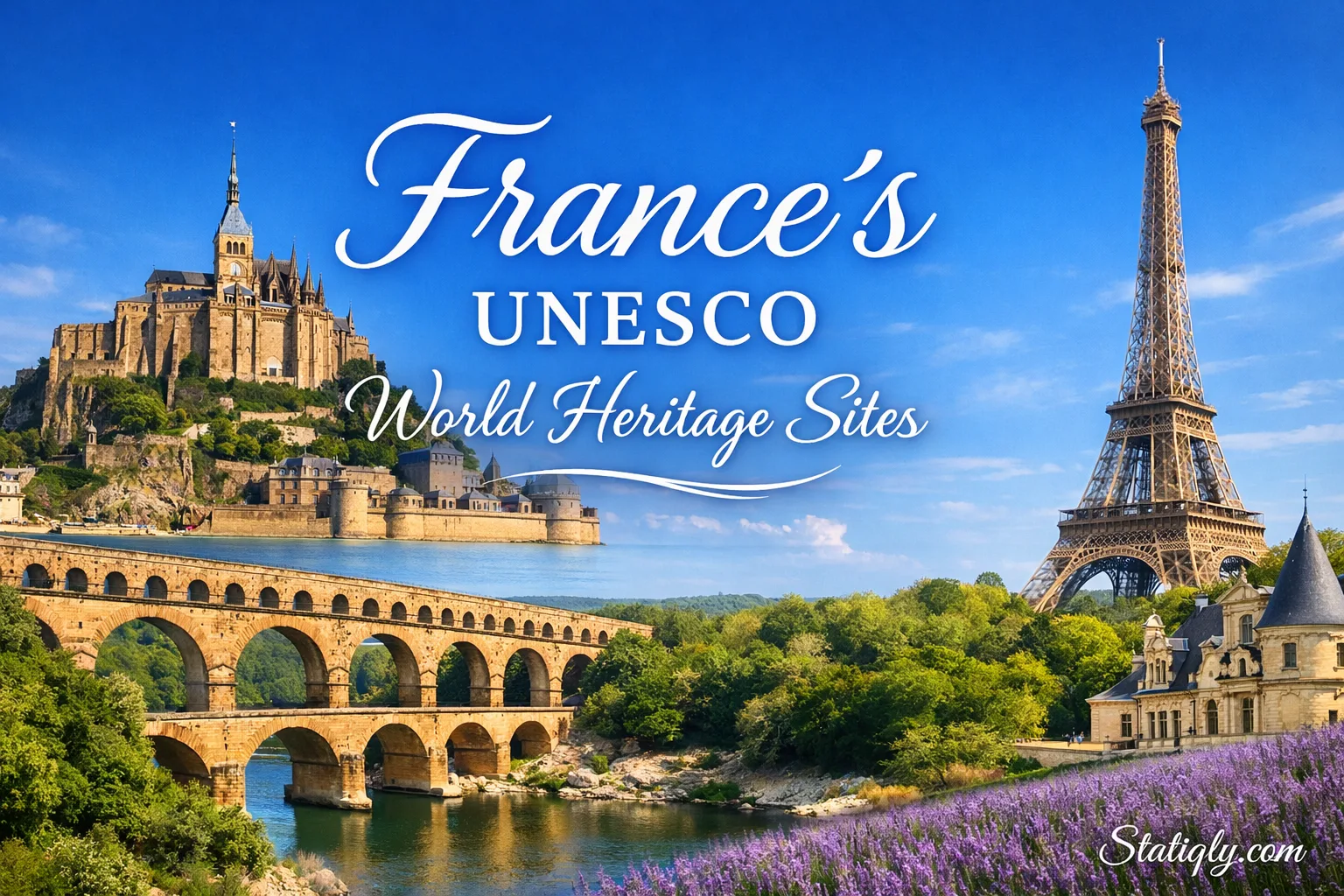
France’s World Heritage list ranges from Gothic cathedrals and prehistoric rock art to historic cities, volcanic landscapes, coral ecosystems, and remote islands. Because France’s listed properties extend across metropolitan France and overseas territories, the country’s UNESCO record covers cultural monuments, working landscapes, geological sites, and protected natural areas.
France On The UNESCO Map
56 World Heritage properties
47 Cultural sites
7 Natural sites
2 Mixed sites
7 Transnational listings
The list includes cathedrals, historic cities, vineyard landscapes, caves, volcanic scenery, coral ecosystems, and overseas island landscapes. France added two cultural properties in 2026: Beaches of the D-Day Landings, Normandy, 1944, a serial property covering six components along about 80 km of the Normandy coast, and Royal Capetian Fortresses of Languedoc, which brings together Carcassonne and seven additional fortified sites.
How UNESCO World Heritage Status Works
“World Heritage” is not a popularity contest. A place is listed because it has Outstanding Universal Value—something so meaningful that it matters to people everywhere. The site also needs clear protection, active care, and a plan that keeps its character intact over time.
- Value: it tells an exceptional story—of art, architecture, landscapes, science, or human creativity.
- Integrity: the key features are still there, not just fragments.
- Care: management and conservation are more than good intentions—they’re ongoing work.
France’s World Heritage Sites By Theme
With dozens of listed properties spread across the country and overseas territories, grouping sites by theme can make route planning easier. Architecture, historic cities, royal landscapes, natural areas, and archaeological sites each offer a different way to organize a trip.
Cathedrals And Sacred Architecture
- Chartres Cathedral
- Amiens Cathedral
- Bourges Cathedral
- Reims Cathedral (with Saint-Rémi and the Palace of Tau)
Binoculars can be useful inside large cathedrals, where sculpture, stained glass, vaulting, and upper architectural details are difficult to see clearly from floor level.
Royal Palaces And Courtly Landscapes
- Palace and Park of Versailles
- Palace and Park of Fontainebleau
- The Loire Valley between Sully-sur-Loire and Chalonnes (home to many famous châteaux)
These properties combine architecture, landscape design, royal residences, and the political history of the French court across different periods.
Historic Cities And Urban Heritage
- Paris, Banks of the Seine
- Strasbourg, Grande-Île and Neustadt
- Historic Site of Lyon
- Bordeaux, Port of the Moon
- Le Havre, the City Rebuilt by Auguste Perret
These are living cities rather than isolated monuments, so their UNESCO value is best understood alongside streets, public spaces, neighborhoods, and the urban fabric around the listed areas.
Nature Landscapes And Geology
- Gulf of Porto: Calanche of Piana, Gulf of Girolata, Scandola Reserve
- Chaîne des Puys – Limagne fault tectonic arena
- Pitons, cirques and remparts of Reunion Island
- French Austral Lands and Seas
These natural properties highlight volcanic processes, coastal geology, biodiversity, marine ecosystems, and remote protected landscapes.
Ways To Plan A First Trip Without Overloading Your Schedule
France’s list is long, so trying to combine too many distant properties in one itinerary can create unnecessary travel time. Pick a region, use nearby sites as day trips, and leave enough time for the larger properties.
Paris And Easy Day Trips
- Paris, Banks of the Seine for iconic cityscapes
- Palace and Park of Versailles for grand interiors and gardens
- Palace and Park of Fontainebleau for a quieter royal-site visit
- Provins, Town of Medieval Fairs for a medieval day out
South For Roman, Medieval, And Papal Heritage
- Pont du Gard (Roman Aqueduct)
- Roman Theatre and its Surroundings and the “Triumphal Arch” of Orange
- Arles, Roman and Romanesque Monuments
- Historic Centre of Avignon: Papal Palace, Episcopal Ensemble and Avignon Bridge
- The Maison Carrée of Nîmes
- Royal Capetian Fortresses of Languedoc for Carcassonne and seven fortified sites linked to the Capetian defensive system
Loire, Burgundy, And Wine Landscapes
- The Loire Valley between Sully-sur-Loire and Chalonnes
- The Climats, terroirs of Burgundy
- Champagne Hillsides, Houses and Cellars
- Vézelay, Church and Hill for its hilltop church and historic landscape
Coasts And Maritime Sites
- Mont-Saint-Michel and its Bay for its tidal bay and medieval architecture
- Cordouan Lighthouse for sea views and engineering
- Beaches of the D-Day Landings, Normandy, 1944 for six components along about 80 km of coastline associated with the Allied landings of 6 June 1944
- Canal du Midi for slow travel by water
Practical Tips For A Smooth Visit
- Check entry rules before you go—many landmarks use timed tickets.
- Arrive early for popular spots, then enjoy quieter afternoons elsewhere.
- Stay on marked paths in natural areas; it protects fragile habitats.
- Pack light: water, layers, and comfortable shoes are more useful than formal footwear.
- Book accommodation early for peak-season hot spots.
- Try local guides for complex sites—stories land better when you hear them on location.
France’s UNESCO World Heritage Sites List
The table below includes all 56 World Heritage properties listed for France, with year, type, and whether the listing is transnational.
| Year | Site Name | Type | Transnational |
|---|---|---|---|
| 1979 | Chartres Cathedral | Cultural | No |
| 1979 | Mont-Saint-Michel and its Bay | Cultural | No |
| 1979 | Palace and Park of Versailles | Cultural | No |
| 1979 | Prehistoric Sites and Decorated Caves of the Vézère Valley | Cultural | No |
| 1979 | Vézelay, Church and Hill | Cultural | No |
| 1981 | Amiens Cathedral | Cultural | No |
| 1981 | Arles, Roman and Romanesque Monuments | Cultural | No |
| 1981 | Cistercian Abbey of Fontenay | Cultural | No |
| 1981 | Palace and Park of Fontainebleau | Cultural | No |
| 1981 | Roman Theatre and its Surroundings and the “Triumphal Arch” of Orange | Cultural | No |
| 1982 | From the Great Saltworks of Salins-les-Bains to the Royal Saltworks of Arc-et-Senans, the Production of Open-pan Salt | Cultural | No |
| 1983 | Abbey Church of Saint-Savin sur Gartempe | Cultural | No |
| 1983 | Gulf of Porto: Calanche of Piana, Gulf of Girolata, Scandola Reserve | Natural | No |
| 1983 | Place Stanislas, Place de la Carrière and Place d’Alliance in Nancy | Cultural | No |
| 1985 | Pont du Gard (Roman Aqueduct) | Cultural | No |
| 1988 | Strasbourg, Grande-Île and Neustadt | Cultural | No |
| 1991 | Cathedral of Notre-Dame, Former Abbey of Saint-Rémi and Palace of Tau, Reims | Cultural | No |
| 1991 | Paris, Banks of the Seine | Cultural | No |
| 1992 | Bourges Cathedral | Cultural | No |
| 1995 | Historic Centre of Avignon: Papal Palace, Episcopal Ensemble and Avignon Bridge | Cultural | No |
| 1996 | Canal du Midi | Cultural | No |
| 1997 | Historic Fortified City of Carcassonne | Cultural | No |
| 1997 | Pyrénées – Mont Perdu | Mixed | Yes |
| 1998 | Historic Site of Lyon | Cultural | No |
| 1998 | Routes of Santiago de Compostela in France | Cultural | No |
| 1999 | Belfries of Belgium and France | Cultural | Yes |
| 1999 | Jurisdiction of Saint-Emilion | Cultural | No |
| 2000 | The Loire Valley between Sully-sur-Loire and Chalonnes | Cultural | No |
| 2001 | Provins, Town of Medieval Fairs | Cultural | No |
| 2005 | Le Havre, the City Rebuilt by Auguste Perret | Cultural | No |
| 2007 | Ancient and Primeval Beech Forests of the Carpathians and Other Regions of Europe | Natural | Yes |
| 2007 | Bordeaux, Port of the Moon | Cultural | No |
| 2008 | Fortifications of Vauban | Cultural | No |
| 2008 | Lagoons of New Caledonia: Reef Diversity and Associated Ecosystems | Natural | No |
| 2010 | Episcopal City of Albi | Cultural | No |
| 2010 | Pitons, cirques and remparts of Reunion Island | Natural | No |
| 2011 | Prehistoric Pile Dwellings around the Alps | Cultural | Yes |
| 2011 | The Causses and the Cévennes, Mediterranean agro-pastoral Cultural Landscape | Cultural | No |
| 2012 | Nord-Pas de Calais Mining Basin | Cultural | No |
| 2014 | Decorated Cave of Pont d’Arc, known as Grotte Chauvet-Pont d’Arc, Ardèche | Cultural | No |
| 2015 | Champagne Hillsides, Houses and Cellars | Cultural | No |
| 2015 | The Climats, terroirs of Burgundy | Cultural | No |
| 2016 | The Architectural Work of Le Corbusier, an Outstanding Contribution to the Modern Movement | Cultural | Yes |
| 2017 | Taputapuātea | Cultural | No |
| 2018 | Chaîne des Puys – Limagne fault tectonic arena | Natural | No |
| 2019 | French Austral Lands and Seas | Natural | No |
| 2021 | Cordouan Lighthouse | Cultural | No |
| 2021 | Nice, Winter Resort Town of the Riviera | Cultural | No |
| 2021 | The Great Spa Towns of Europe | Cultural | Yes |
| 2023 | Funerary and memory sites of the First World War (Western Front) | Cultural | Yes |
| 2023 | The Maison Carrée of Nîmes | Cultural | No |
| 2023 | Volcanoes and Forests of Mount Pelée and the Pitons of Northern Martinique | Natural | No |
| 2024 | Te Henua Enata – The Marquesas Islands | Mixed | No |
| 2025 | Megaliths of Carnac and of the shores of Morbihan | Cultural | No |
| 2026 | Beaches of the D-Day Landings, Normandy, 1944 | Cultural | No |
| 2026 | Royal Capetian Fortresses of Languedoc | Cultural | No |
Tip: If you want more variety in one itinerary, combine one natural property with one or two cultural properties in the same region where distances make that practical.