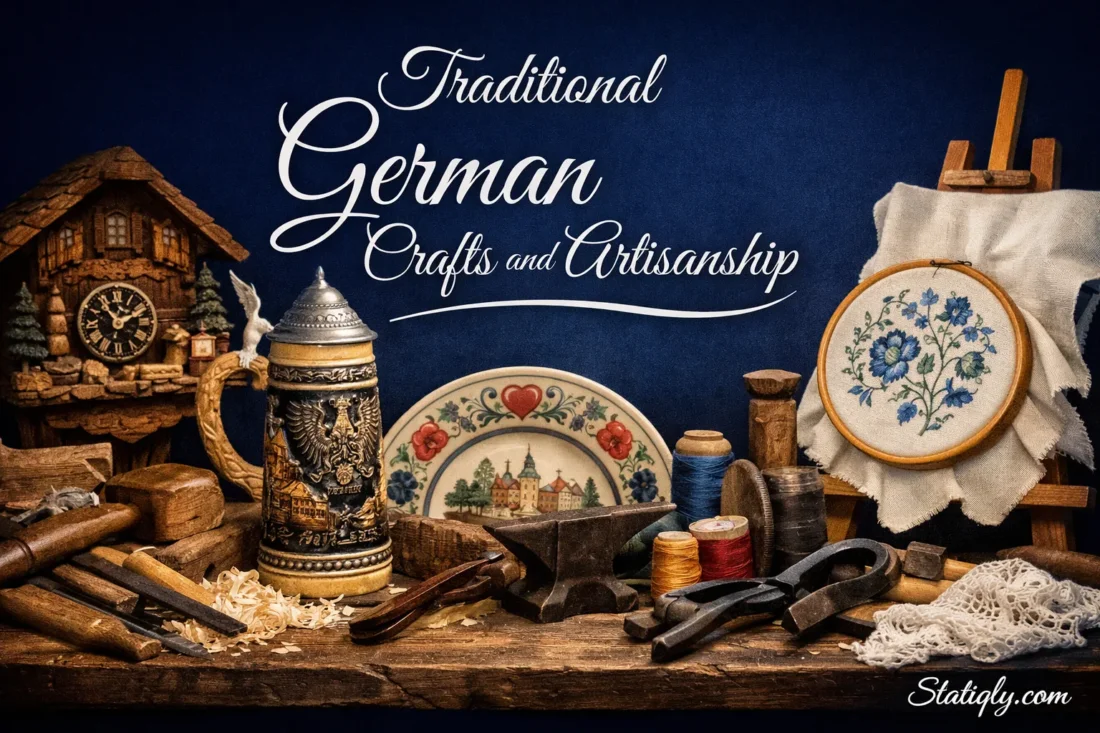
German craftsmanship has a certain quiet confidence. You see it in a porcelain cup that feels almost weightless, in a wooden figure with a friendly face, in a violin that seems to hold a note a little longer. These traditions are not frozen in the past. They’re lived in workshops, taught through careful hands, and carried forward by makers who still care about the small details.
If you love objects that last, you’re in the right place. This guide walks you through traditional German crafts—where they come from, what makes them special, and how to recognize true artisan work without needing a magnifying glass.
What This Guide Helps You Do
- Spot the hallmarks of handmade quality in classic German craft categories
- Learn which regions are closely linked with each tradition, without getting lost in trivia
- Choose pieces you’ll enjoy for years—gifts, keepsakes, and everyday objects
A Handy Snapshot Of Signature Crafts
Germany has hundreds of local craft stories, yet a few traditions show up again and again because they shaped how people worldwide picture “German artisan work.” Here’s a clear starting point.
| Craft | Known For | What To Look For | Why It Stands Out |
|---|---|---|---|
| Meissen Porcelain | Meissen (Saxony) | Crisp forms, fine painting, maker’s marks | European hard-paste porcelain tradition with long-running workshop culture |
| Black Forest Clockmaking | Black Forest (Baden-Württemberg) | Mechanical movements, clean joinery, careful carving | Woodworking and precision mechanics in one object |
| Erzgebirge Woodcraft | Ore Mountains (Saxony) | Hand-turned parts, balanced proportions, smooth finish | Warm folk art with a strong maker-to-maker lineage |
| Mittenwald Violin Making | Mittenwald (Bavaria) | Well-cut scrolls, tidy purfling, elegant varnish | Alpine tonewood tradition with generations of luthiers |
| Lauscha Glassblowing | Lauscha (Thuringia) | Lightness, fine seams, hand-silvered shine | Delicate lampworked glass and iconic ornament-making |
| Plauen Lace | Plauen (Vogtland, Saxony) | Even stitch density, clean edges, rich patterns | Textile artistry that scales from fashion to home details |
| Westerwald Stoneware | Westerwald (Rhineland-Palatinate) | Salt-glazed surface, cobalt decoration, sturdy forms | Everyday pottery that feels built for real life |
| Oberammergau Wood Carving | Oberammergau (Bavaria) | Crisp tool marks, flowing lines, expressive faces | Village-level mastery where carving is part of local identity |
Why Traditional German Craftsmanship Feels So “Solid”
Some craft traditions impress you with sparkle. German craft often impresses you with reliability. Not boring reliability—more like a well-built door that closes with a gentle, satisfying click.
Materials Matter
Makers tend to respect the “personality” of materials—wood grain, clay body, glass thickness, metal hardness. When a craft tradition is old, it usually means the local material supply taught people what works.
Skills Are Passed Hand-To-Hand
Many workshops teach through repetition and tiny corrections. The result is subtle: curves look calmer, seams sit flatter, and patterns feel “right” without shouting.
Function Isn’t An Afterthought
A clock should keep time. A mug should feel good in your hand. A violin should sing. When function leads, beauty follows in a more natural way.
Craft Spotlights And What Makes Each One Special
Meissen Porcelain
Meissen is often mentioned first for a reason. The factory began production in 1710, and it helped define what European porcelain could be: crisp, bright, and remarkably refined. Porcelain painting here isn’t “just decoration.” It’s a craft of brush control, color layering, and steady patience—like miniature art that also happens to be functional.
When You’re Choosing A Piece
- Look for clean edges on handles and rims; they should feel intentional, not rough.
- Hand-painted details often show gentle variation when you view them up close.
- High-quality porcelain rings with a clear tone when lightly tapped with a fingernail (don’t do this in a shop unless invited).
Black Forest Clockmaking
Clockmaking in the Black Forest has roots that go back centuries, and by the 1700s, the region became closely linked with the cuckoo clock’s rise in popularity. What’s charming is the mix of disciplines: woodworking for the case, carving for character, and mechanical engineering for the movement. It’s a bit like a small theater where every actor must hit their cue.
Look For
- Mechanical operation if you want a classic build
- Even carving lines and tidy joints
- A movement that sounds steady and confident, not strained
Easy Care
- Keep it away from damp walls
- Dust gently with a soft brush
- If it needs servicing, choose a clock specialist rather than guessing
Erzgebirge Woodcraft
The Ore Mountains (Erzgebirge) are famous for wooden folk art that feels warm and welcoming—nutcrackers, candle arches, turned ornaments, small figures with friendly faces. The best pieces have a calm symmetry and a finish that feels smooth without looking “plastic.” You can sense the maker’s rhythm in the curves.
A Simple “Hands Test”
Pick up the piece (if allowed). Does it feel balanced? Do edges feel softly finished? High-quality carving usually feels comfortable in the hand, not sharp or awkward.
Mittenwald Violin Making
Mittenwald is one of Germany’s best-known names in violin making. The tradition is strongly associated with the Klotz family and workshop culture reaching back to the 17th century. If you’ve never looked closely at a violin, here’s a fun thought: it’s woodworking at the level of poetry. A millimeter matters. Grain direction matters. Even the varnish behaves like a living skin.
If You’re Buying A Violin
- Ask who set it up (bridge, strings, soundpost). Setup changes everything.
- Look for tidy workmanship inside and out; clean work usually signals care.
- Play it in a quiet room. Does it respond easily, or do you have to “fight” it?
Care Tip
String instruments like stable humidity. A case humidifier (used correctly) and a gentle wipe after playing can keep a violin looking and sounding its best.
Lauscha Glassblowing And The Ornament Tradition
Lauscha, in Thuringia, is widely known for lampworked glass and the tradition of delicate ornaments. Glassblowers here developed iconic hollow forms in the mid-1800s, and the craft is recognized in Germany’s nationwide register of intangible cultural heritage (listed in 2021). The magic is in the lightness: good glasswork feels airy, not clunky, with a shine that looks deep rather than harsh.
Small Signs Of Skilled Glasswork
- Walls that look even in thickness
- Neat seams and clean attachment points
- Paint that sits smoothly, with intentional detail rather than heavy buildup
Plauen Lace And Embroidery
Plauen became especially famous for lace and embroidery that took off globally in the late 1800s. Textile craft can look effortless when it’s done well, like handwriting that flows. The secret is consistency: even tension, crisp edges, and patterns that stay clear from a distance and up close.
- For clothing: choose lace that feels soft against skin and keeps its shape when held up.
- For home textiles: look for stable borders and clean finishing that won’t fray quickly.
- For gifts: smaller lace accents can feel surprisingly luxurious without being overly delicate.
Westerwald Stoneware
Westerwald stoneware is known for a salt-glazed surface and the classic contrast of grey clay with cobalt-blue decoration. It’s practical pottery with character—often sturdy, comfortable to use, and made for everyday routines. If porcelain is a whisper, stoneware is a warm, friendly voice at the table.
How To Choose The Right Piece
- Pick it up. Good stoneware feels solid but not awkwardly heavy.
- Check the rim and handle for comfort. You’ll notice this every day.
- Look at the glaze in light. A well-made surface looks even and intentional.
Oberammergau Wood Carving
Oberammergau is often called a wood carving village, and its carving tradition is documented back into the early 1500s. Carving here can feel expressive and human: folds of fabric, gentle faces, and clean lines that show confident tool control. If you’ve ever wondered why some carvings feel “alive,” this is the reason—good carvers shape light and shadow, not just wood.
How To Shop For Artisan Pieces With Confidence
Ever bought something that looked charming at first, then felt a bit “flat” at home? It happens. A few simple checks can steer you toward pieces that keep their charm over time.
A Simple Checklist That Works Across Crafts
- Ask one clear question: “Who made this?” A seller who knows the workshop story can usually answer without hesitation.
- Look for small variation: handmade work often shows tiny differences that feel natural, not messy.
- Check finishing: edges, seams, and touchpoints (handles, rims, corners) should feel comfortable.
- Prefer timeless design: classic forms age well and fit more spaces.
- Choose what you’ll use: the best craft pieces earn their place through daily enjoyment.
Easy Care Habits That Protect Craftwork
You don’t need complicated routines. A few gentle habits go a long way, especially for wood, glass, and ceramics.
- Dust softly: use a clean, dry microfiber cloth or a soft brush for carved details.
- Avoid sudden temperature swings: especially for glass and fine ceramics.
- Keep wood comfortable: steady indoor conditions help prevent drying or stress over time.
- Use mild cleaning: gentle soap and warm water for most stoneware; avoid harsh abrasives.
Ways To Experience Crafts Beyond Shopping
If you want a deeper connection, try learning how things are made. Even a short visit to a museum or a live workshop demo can change how you see an object. Suddenly the “simple” curve of a handle looks like a small achievement. Isn’t that the fun of craft—realizing how much skill hides inside everyday beauty?
Watch Making In Action
- Clockmaking exhibits can help you understand why mechanical timepieces feel so satisfying.
- Look for displays that show movements, tools, and the step-by-step build.
See Ceramics Up Close
- Porcelain museums and show workshops reveal painting techniques that photos rarely capture.
- Once you see the brushwork up close, you’ll spot quality faster.
Explore Glass And Wood Traditions
- Glass museums often show both historical objects and modern artisan work.
- Woodcarving areas can feel like living studios, not just “heritage.”
A Mini Glossary For Craft Browsing
- Porcelain (Hard-Paste): high-fired ceramic made with kaolin; typically bright, dense, and refined.
- Salt Glaze: a kiln process that creates a slightly pebbled, durable surface on stoneware.
- Luthier: a maker of string instruments such as violins.
- Lampworking: shaping glass in a flame; common for delicate ornaments and detailed glass forms.
- Workshop Tradition: a culture of making where skills are taught through practice and shared methods.