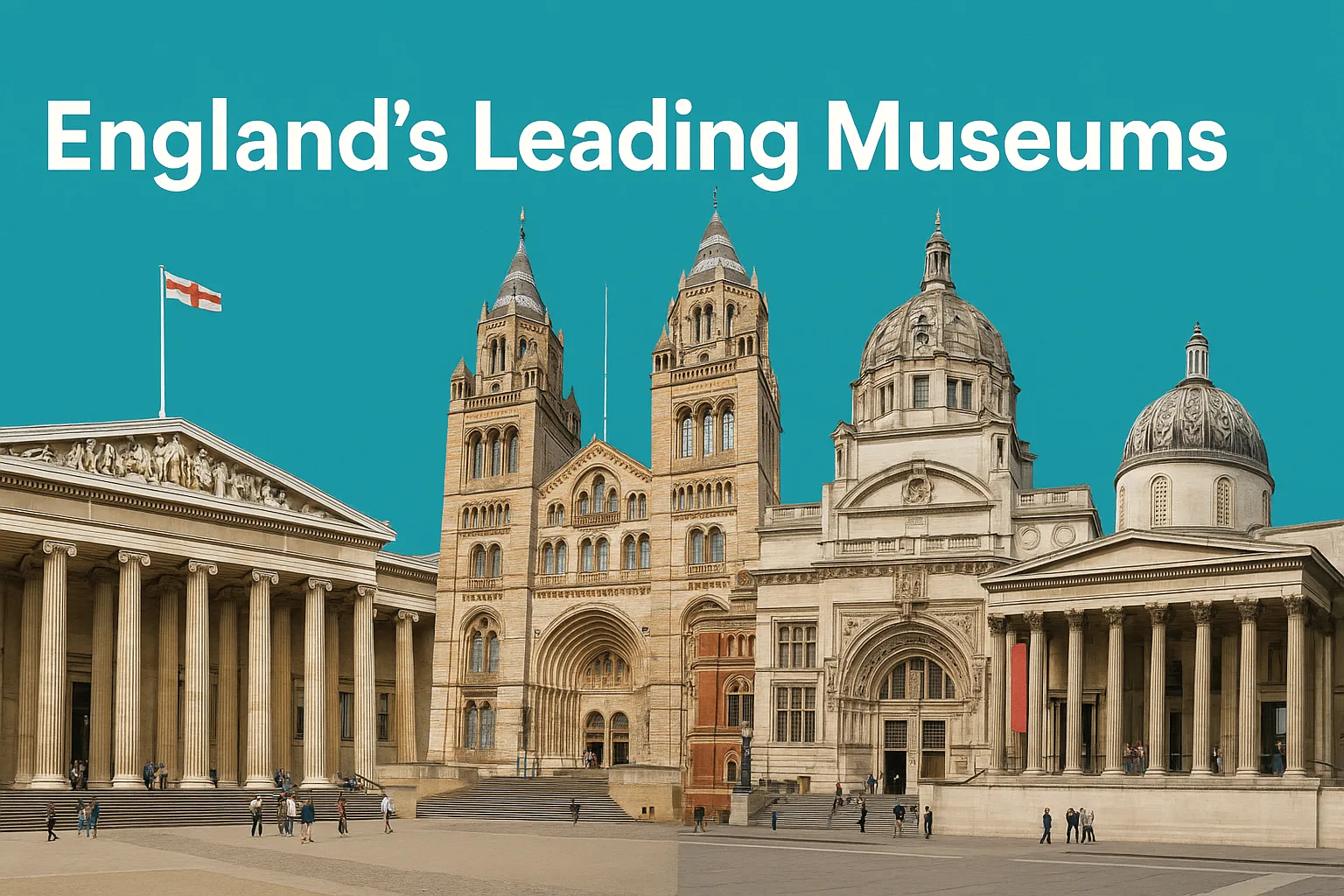
England’s Leading Museums
A practical guide to leading museums in England – from major London collections to museums in Oxford and York.
England’s major museums cover archaeology, painting, fashion, design, natural history, science, transport and contemporary culture. Many national collections offer free general admission, making it possible to build a museum visit around a particular subject rather than trying to cover an entire institution in one day.
London holds the largest concentration, including the British Museum, National Gallery, Tate Modern, the V&A, Natural History Museum and Science Museum. The city’s museum landscape expanded again on 18 April 2026, when V&A East Museum opened in Queen Elizabeth Olympic Park. Another major addition is approaching: London Museum’s new Smithfield home is scheduled to open its free permanent galleries on 28 November 2026. Outside London, Oxford’s Ashmolean Museum and York’s National Railway Museum provide two very different reasons to add a museum stop to a wider England itinerary.
What England’s Major Museums Cover
- Free access to major collections – many national museums in London and elsewhere in England offer free general admission, while temporary exhibitions may require tickets.
- Wide subject range – collections cover painting, archaeology, fashion, decorative arts, natural history, science, engineering, transport and contemporary design.
- Family facilities – interactive galleries, activity areas and cafés are available at many of the larger institutions.
- Different museum settings – collections occupy buildings ranging from Victorian museum complexes and former industrial sites to newly built cultural spaces.
Comparison: England’s Leading Museums
| Museum | Main Focus | Where | Admission* | Best For |
|---|---|---|---|---|
| British Museum | World cultures & archaeology | Bloomsbury, London | Free (charge for special exhibitions) | History and archaeology |
| National Gallery | European painting, 13th–20th c. | Trafalgar Square, London | Free | European painting |
| Tate Modern | Modern & contemporary art | South Bank, London | Free collection, ticketed shows | Modern art and industrial architecture |
| V&A Museum | Design, fashion & decorative arts | South Kensington, London | Free collection | Design, fashion and photography |
| V&A East Museum | Art, design, fashion, architecture & contemporary culture | Queen Elizabeth Olympic Park, London | Free permanent galleries | Contemporary culture and design |
| London Museum Smithfield | London history & culture | Smithfield, London | Free permanent galleries from 28 Nov 2026 | London history and the new Smithfield museum |
| Natural History Museum | Life on Earth, fossils & geology | South Kensington, London | Free (timed entry may apply) | Families, fossils and Earth science |
| Science Museum | Science, technology & space | South Kensington, London | Free galleries; some experiences ticketed | Science, engineering and families |
| Ashmolean Museum | Art & archaeology, global | Oxford | Free | Art, archaeology and Oxford day trips |
| National Railway Museum | Historic & modern trains | York | Free | Railways, transport and engineering |
Must-See Museums in London
British Museum – Archaeology and World Cultures
The British Museum holds one of the world’s largest museum collections, with around eight million objects covering human cultures over roughly two million years. Galleries range from ancient Egypt and Mesopotamia to collections from Asia, Europe, Africa, the Americas and the Pacific.
- Look for: the Great Court, Egyptian collections, ancient sculpture, manuscripts and galleries devoted to different regions and periods.
- Admission: general admission is free; some temporary exhibitions require paid tickets.
- Time needed: 2–4 hours is reasonable for a selective first visit.
National Gallery – European Painting on Trafalgar Square
The National Gallery overlooks Trafalgar Square and displays more than 1,000 paintings at any one time. Its collection covers European painting from the late medieval and Renaissance periods through later schools including Impressionism.
- Highlights: works by Van Gogh, Turner, Monet, Caravaggio and other major European painters.
- Admission: free to the main collection; certain temporary exhibitions are ticketed.
- Planning: choosing several rooms or artists in advance makes a shorter visit easier.
Tate Modern – Modern and Contemporary Art
Housed in a former riverside power station, Tate Modern is one of England’s main museums for modern and contemporary art. Its galleries contain painting, sculpture, photography, film, installations and other media, while the former Turbine Hall remains one of the building’s defining spaces.
- Why go: modern and contemporary collections inside a converted industrial building on the Thames.
- Admission: free to the collection displays; major temporary exhibitions are normally ticketed.
- Good for: modern art, installations and architecture.
V&A – Design, Fashion and Decorative Arts
The Victoria and Albert Museum (V&A) in South Kensington holds a permanent collection of around 2.8 million objects connected with art, design and performance. Its collections include fashion, textiles, jewellery, ceramics, sculpture, photography, furniture and architectural material.
- Highlights: the Cast Courts, fashion collections, Islamic art, sculpture and changing design exhibitions.
- Admission: free general entry; some temporary exhibitions require tickets.
- Tip: the museum is large, so choosing several collections before visiting can save time.
V&A East Museum – Opened in April 2026
V&A East Museum opened on 18 April 2026 at East Bank in Queen Elizabeth Olympic Park. It gives the V&A a second major museum location in east London, separate from the main South Kensington museum.
At the center of the museum are two free permanent Why We Make galleries containing more than 500 objects from the V&A collections. Displays cross art, architecture, design, performance and fashion, using objects from different periods and cultures to examine why people make things and how creative work relates to contemporary life.
- Opened: 18 April 2026.
- Location: Queen Elizabeth Olympic Park, east London.
- Permanent galleries: two free Why We Make galleries.
- Collection on display: more than 500 objects across art, design, architecture, fashion and performance.
London Museum Smithfield – Opening 28 November 2026
London Museum is preparing to open its new Smithfield home in the historic General Market. The museum’s free permanent galleries are scheduled to open on 28 November 2026, so the Smithfield site should be treated as an upcoming museum opening rather than a museum that is already open.
The project will open in stages. The General Market comes first with the permanent galleries, while the adjoining Poultry Market is planned to open in 2028. That later phase is expected to contain temporary exhibition spaces, learning facilities and collection storage.
- General Market opening: scheduled for 28 November 2026.
- Admission: free permanent galleries.
- Location: Smithfield, City of London.
- Poultry Market: planned to open in 2028.
Natural History Museum – Dinosaurs, Oceans and Deep Time
The Natural History Museum occupies a Victorian building in South Kensington. A blue whale skeleton named Hope hangs in Hintze Hall, while surrounding galleries cover fossils, minerals, evolution, oceans, biodiversity and the geological history of Earth.
- Highlights: dinosaur galleries, volcano and earthquake displays, meteorites and gemstones.
- Admission: free general entry; timed booking may be recommended during busy periods.
- Best for: families, fossils, animals and Earth science.
Science Museum – Technology, Engineering and Space
Next to the Natural History Museum, the Science Museum covers science, engineering, medicine, computing, transport and space exploration. Its displays include historic locomotives, early engines and the Apollo 10 Command Module.
- Wonderlab: an interactive gallery with more than 50 exhibits and live demonstrations; separate admission applies.
- Admission: free to the main museum galleries; some experiences and screenings require tickets.
- Tip: allow breaks when visiting with children, especially if combining several interactive areas.
Beyond London: Standout Museums Across England
Ashmolean Museum, Oxford
The Ashmolean Museum is the University of Oxford’s museum of art and archaeology and opened in 1683. Its free galleries range from Egyptian material and classical archaeology to European painting, Asian art, coins, decorative arts and later works.
For a day trip: the museum is in central Oxford and can be combined with the historic university area, nearby colleges and a walk through the city center.
National Railway Museum, York
In York, the National Railway Museum covers more than 300 years of railway history. Its collections include locomotives such as Mallard, railway carriages and examples of later train technology, including a Japanese bullet train.
Good for families: the large halls make it easier to view full-size locomotives and railway equipment without the denser layout found in many traditional museums.
Planning Your Museum Day: Simple Itineraries
One Day in London – Central Museums
- Morning: British Museum – choose one or two sections rather than trying to cover every gallery.
- Lunch: Bloomsbury or the museum café.
- Afternoon: National Gallery at Trafalgar Square.
- Evening: Covent Garden, Soho or a walk toward the Thames.
Two Days – Art, Science and Natural History
- Day 1: Tate Modern in the morning, followed by the South Bank and nearby riverside areas.
- Day 2: Natural History Museum and Science Museum in South Kensington, with breaks between the two.
Three Days – London Plus a Day Trip
- Day 1: British Museum + National Gallery.
- Day 2: V&A South Kensington + Natural History Museum or Science Museum.
- Day 3: train to Oxford for the Ashmolean or York for the National Railway Museum.
Choosing the Right Museum For You
If you’re travelling with children
- Natural History Museum: dinosaurs, the blue whale skeleton and Earth science galleries.
- Science Museum: interactive science, space exploration and Wonderlab.
- National Railway Museum: full-size trains, transport history and large exhibition halls.
If you love art & design
- National Gallery: European painting from the medieval period to the early twentieth century.
- Tate Modern: modern and contemporary art in a former power station.
- V&A South Kensington: fashion, textiles, jewellery, photography, furniture and decorative arts.
- V&A East Museum: contemporary global culture through the two permanent Why We Make galleries and more than 500 displayed objects.
- Ashmolean: archaeology and art collections in central Oxford.
If you’re short on time
Choose one major museum for each half-day and decide which galleries matter most before arriving. Larger museums such as the British Museum, V&A, Natural History Museum and Science Museum contain far more material than most visitors can cover comfortably in one visit.
Practical Tips for Visiting England’s Museums
- Check opening times in advance: schedules, late openings and temporary closures can change during the year.
- Book timed entry when required or recommended: advance booking can be useful during weekends, school holidays and major exhibitions.
- Travel light: bag checks are common and some museums restrict large luggage.
- Use gallery maps: large collections are easier to navigate when you identify several rooms or subjects before starting.
- Take breaks: cafés, seating areas and nearby public spaces make long museum days easier to manage.
- Check the exact V&A location: V&A South Kensington and V&A East Museum are in different parts of London, so they should not be treated as adjacent attractions when planning travel time.
- Do not plan London Museum Smithfield as an open museum before 28 November 2026: the General Market permanent galleries are scheduled to begin welcoming visitors on that date, with the Poultry Market phase planned for 2028.
England’s museum choices now include both long-established national collections and newer institutions such as V&A East Museum. London Museum Smithfield is the next major opening on the calendar, with its General Market galleries scheduled for 28 November 2026. For most visits, choosing museums by subject and location is more practical than trying to cover the largest number in a single day.