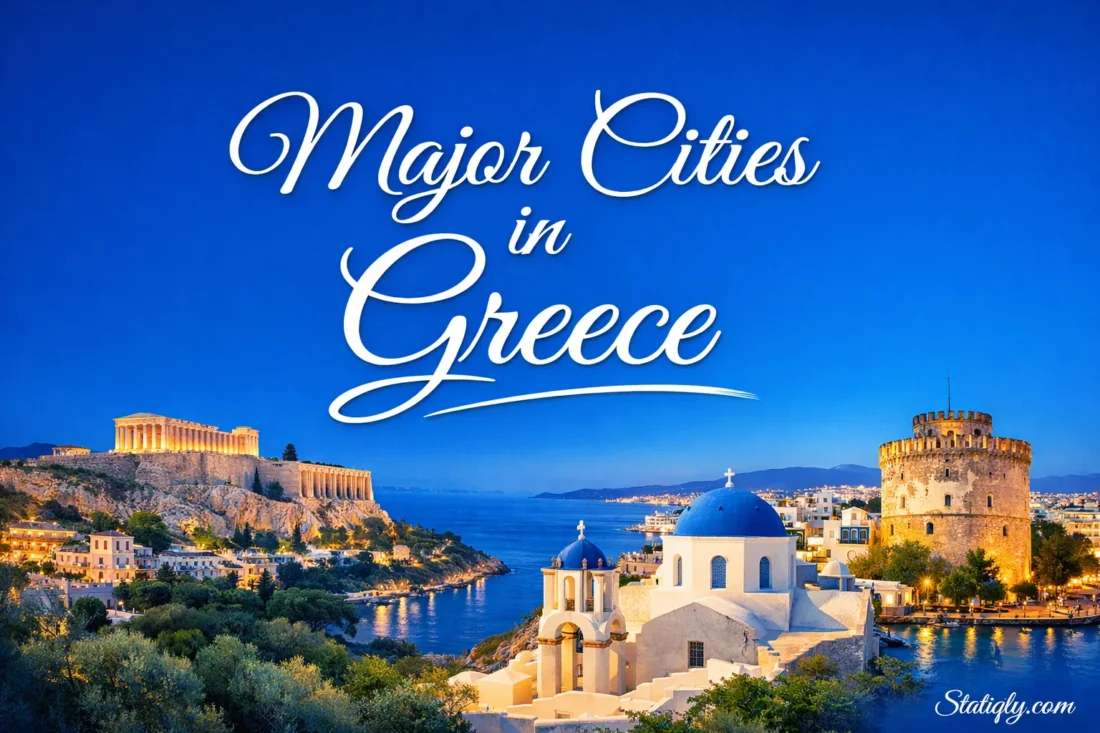
Greece does not spread its urban life evenly. A handful of cities carry most of the country’s cultural pull, port traffic, regional identity, university life, and everyday movement. Athens is the clear giant. Thessaloniki anchors the north. Heraklion gives Crete its urban center. Patras opens the west. Once you see that pattern, the map feels far easier to read.
Largest Greek Cities by Municipality Population
| City | 2021 Resident Population | Why It Matters | What Stands Out |
|---|---|---|---|
| Athens | 643,452 | National capital and biggest urban center | Ancient landmarks, museums, business districts, dense neighborhood life |
| Thessaloniki | 319,045 | Main city of northern Greece | Waterfront, student energy, Byzantine heritage, strong food culture |
| Patras | 215,922 | Leading city of western Greece | Major port role, university presence, broad seafront setting |
| Heraklion | 179,302 | Largest city in Crete | Knossos access, old harbor, island-scale commercial life |
| Piraeus | 168,151 | Main port tied to Athens | Ferry links, working harbor, maritime identity |
| Larissa | 164,095 | Center of Thessaly | Plain-country crossroads, agriculture, lively local rhythm |
| Volos | 139,670 | Primary port of Thessaly | Sea-and-mountain setting, Pelion access, walkable waterfront |
| Rhodes | 125,113 | Major island city in the southeast | Medieval old town, island gateway feel, strong visitor appeal |
| Ioannina | 113,978 | Main city of Epirus | Lake setting, castle quarter, academic and local craft life |
These figures refer to municipality population, not every suburb around each city. That matters most with Athens and Thessaloniki, whose wider urban reach stretches well beyond the municipal line.
How Greece’s Urban Map Works
A simple way to read Greece is this: the biggest cities are not just places with more people. They are also the places where roads meet, ports move people, universities shape daily life, and each region finds its public face. Rare is the Greek city that matters only to its own streets. Most of the well-known ones do two jobs at once. They serve local life, and they also pull in visitors, students, trade, or island traffic.
That is why a city like Piraeus matters even though many travelers treat it as part of Athens, and why a place like Rhodes feels larger than its municipal count suggests. In Greece, coastal position, regional role, and historic weight often matter just as much as size.
Athens
Athens is the city that sets the pace for the whole country. It is the largest urban center, the capital, the busiest cultural stop, and for many people the first point of contact with Greece. Yet Athens is not only about famous ruins. It is a working city, fast in some parts, calm in others, full of neighborhoods that change mood from one hill to the next. One street can feel polished and formal. The next can feel local, relaxed, almost village-like.
People come for the Acropolis, of course, but they stay engaged because Athens keeps shifting shape. Plaka, Monastiraki, Koukaki, Pangrati, Exarchia, Kolonaki, and the coast all show a different side of the same city. For readers trying to understand Greece through one place, Athens is where the country’s ancient memory and present-day routine sit closest together.
Thessaloniki
If Athens feels layered and sprawling, Thessaloniki feels more direct. It is the biggest city in northern Greece and one of the country’s most character-filled urban centers. The waterfront gives it air. The university presence gives it motion. Its churches, monuments, and old quarters give it depth. And then there is the food. Thessaloniki has a reputation for living well without trying too hard.
This is also one of Greece’s strongest heritage cities. Early Christian and Byzantine landmarks are woven right into the street plan, not fenced off from daily life. So the city never feels frozen. It feels used. That is part of its charm.
Patras
Patras often gets less attention than it deserves. That is a mistake. It is one of the country’s largest cities, the leading center of western Greece, and a place with real movement behind it. The port matters. The university matters. The city’s broad layout, with the sea on one side and higher ground behind it, gives it a different feel from the tighter urban form of Athens or Thessaloniki.
Patras works well for readers who want to see a Greek city that is active without feeling overloaded. It has the scale of a major center, but it still reads clearly. You can sense its regional job almost at once. It links people, goods, students, and travel routes. Quietly, but firmly, it holds a large part of western Greece together.
Heraklion
Heraklion is the largest city in Crete, and that alone gives it weight. Still, size is only part of the story. It is also the city that many visitors use to understand the island beyond beaches and resort names. Here, urban life in Crete becomes visible: the working port, the museum culture, the old walls, the daily markets, the modern streets, the link to Knossos. Island and city meet here in a very natural way.
Some Greek cities impress through polish. Heraklion impresses through texture. Venetian traces, later layers, and modern Cretan energy sit side by side. Not tidy in every corner. Memorable, though, very much so.
Piraeus
Piraeus deserves to be treated as more than Athens’s port. Yes, it serves the capital and sits close to it. But it is also a city in its own right, with a strong maritime identity and a rhythm shaped by ferries, ships, and the sea. For many travelers, Piraeus is the moment Greece turns outward toward the islands.
That makes it one of the country’s most practical urban places. It may not lead with monumental fame the way Athens does, yet its role is huge. Without Piraeus, the flow between mainland and island Greece would feel very different.
Larissa
Larissa sits in Thessaly and feels grounded in the plain around it. This is a city tied to farming, movement, and everyday regional life. It does not rely on postcard fame, and that is part of why it matters. Larissa shows another side of Greece: less about island imagery, more about a lived-in urban center that supports a broad agricultural region.
It also has deeper roots than many people expect, with an ancient theater and long city history woven into a place that still feels current. Useful, active, local. Those words fit Larissa well.
Volos
Volos has one of the most appealing settings in Greece. The city stands at the head of the Pagasetic Gulf and below Mount Pelion, so sea and mountain stay in view at the same time. That gives Volos a lighter feel than many inland regional centers. You sense openness in it.
Its port role is no small detail either. Volos serves Thessaly, supports trade, and acts as a natural urban base for nearby coastal and mountain areas. For readers who want a Greek city that feels functional yet easy to enjoy on foot, Volos makes a strong case.
Ioannina
Ioannina is one of the most distinctive cities in mainland Greece. Set around Lake Pamvotida, it has a softer outline than many large urban places. Water shapes the mood. So does the old castle quarter. Add a strong student presence and a long craft tradition, and the city starts to feel unlike anywhere else in the country.
Ioannina is the natural center of Epirus, but it never feels flat or generic. It has atmosphere. Walkable in many parts, reflective in mood, and easy to remember, it gives northwestern Greece a very clear urban heart.
Rhodes
Rhodes is not only a famous island name. It is also one of Greece’s notable cities, with a municipal population that places it among the country’s larger urban centers. What makes it stand apart is the way city life and heritage sit inside the same frame. The medieval town is one of the best-known historic urban areas in Greece, and it gives Rhodes a city identity far stronger than the word “resort” can ever explain.
Rhodes also shows why island cities matter so much in Greece. They are not side notes. They are regional anchors. In the southeast, Rhodes does that job with ease.
Which Greek City Fits Different Travel Styles
- For first-time visitors: Athens, because it gives the broadest picture of the country in one place.
- For food, waterfront walks, and urban character: Thessaloniki.
- For western Greece and a strong regional feel: Patras.
- For understanding Crete beyond resort towns: Heraklion.
- For island departures and maritime energy: Piraeus.
- For a less tourist-heavy mainland city: Larissa.
- For sea, mountain, and a balanced pace: Volos.
- For lakeside atmosphere and local depth: Ioannina.
- For medieval streets and island-city life: Rhodes.
Common Questions About Major Cities in Greece
Which Is the Largest City in Greece?
Athens is the largest city in Greece and the country’s main urban center by a wide margin.
What Is the Second Largest City in Greece?
Thessaloniki holds that place and serves as the leading city of northern Greece.
Is Piraeus Separate From Athens?
Yes. Piraeus is a separate municipality, even though most people experience it as part of the wider Athens urban area.
Which Greek Cities Matter Most Outside Athens?
Thessaloniki, Patras, Heraklion, Larissa, Volos, Ioannina, and Rhodes all stand out for their regional role, city identity, and wider pull.