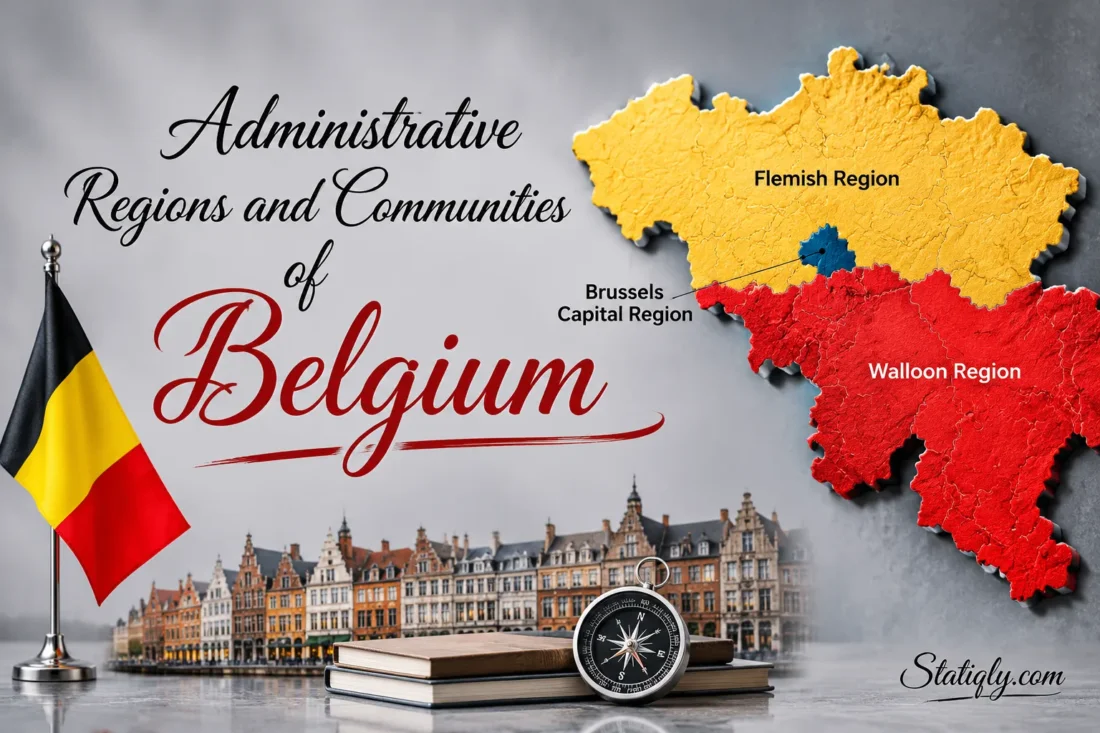
Belgium uses more than one administrative map at the same time. A resident of Eupen, for example, lives in the Walloon Region and Liège Province, while the German-speaking Community handles many language- and person-related matters there. Brussels adds another layer: it is its own Region, has no province, forms a bilingual language area, and hosts both Flemish and French Community institutions. The names overlap, but the layers do different jobs.
The clearest distinction is simple: Regions are mainly territorial, while Communities are mainly connected with language and people. Belgium has three of each, yet neither group sits neatly below the other. Add four language areas, ten provinces, 43 administrative arrondissements and 565 municipalities, and the structure starts to make sense only when each layer is kept separate.
How Belgium’s Administrative Layers Fit Together
| Layer | Number | What It Describes |
|---|---|---|
| Regions | 3 | Territorial responsibilities such as housing, environment, transport and spatial planning |
| Communities | 3 | Language- and person-related matters such as education, culture and parts of health and social assistance |
| Language Areas | 4 | Legally defined linguistic territories |
| Provinces | 10 | Intermediate territorial authorities in Flanders and Wallonia |
| Administrative Arrondissements | 43 | A territorial level used between provinces and municipalities in the administrative classification |
| Municipalities | 565 | The basic local administrative units |
One detail prevents a lot of confusion: Community does not mean a smaller Region. The Flemish, French and German-speaking Communities form a separate layer from the Flemish, Walloon and Brussels-Capital Regions. The two sets overlap geographically, especially in Brussels and eastern Belgium.
Regions and Communities Are Two Different Systems
| Regions | Communities | |
|---|---|---|
| Main Basis | Territory | Language and person-related matters |
| Names | Flemish Region, Walloon Region, Brussels-Capital Region | Flemish Community, French Community, German-speaking Community |
| Typical Responsibilities | Housing, environment, agriculture, spatial planning, regional transport, employment | Education, culture, language use, parts of health care and assistance to individuals |
| Brussels | Forms a Region of its own | Flemish and French Community responsibilities operate there |
This is why a simple Region → Community → Province chain would be wrong. Provinces and municipalities belong to the territorial side of the picture. Communities follow a different logic.
The Three Regions of Belgium
Belgium’s three Regions divide the country territorially. Each has responsibilities tied to its area, including fields such as housing, environment, public works, agriculture, employment, energy and most regional transport.
Flemish Region
The Flemish Region, often called Flanders in geographic use, covers northern Belgium. It contains five provinces and 285 municipalities. Its population was 6,898,350 on 1 January 2026.
Flanders has an unusual institutional arrangement: the Flemish Region and Flemish Community use one Parliament and one Government for their respective responsibilities. Their reach is still not identical. The Flemish Region does not include Brussels, while the Flemish Community can exercise Community responsibilities in Brussels.
Walloon Region
The Walloon Region, commonly called Wallonia, covers southern Belgium. It has five provinces and 261 municipalities, with a population of 3,713,450 on 1 January 2026.
Wallonia contains both the French-language area and the German-language area. That second point matters. The nine municipalities of the German-speaking Community lie territorially inside the Walloon Region, in Liège Province.
Brussels-Capital Region
The Brussels-Capital Region is a separate Region of 19 municipalities. It had 1,255,834 residents on 1 January 2026. Unlike Flanders and Wallonia, Brussels-Capital does not belong to a province.
Its language area is officially bilingual in French and Dutch. Both the Flemish and French Communities operate through institutions in Brussels. Also worth separating: the City of Brussels is only one of the Region’s 19 municipalities. It is not another name for the entire Brussels-Capital Region.
| Region | Population on 1 January 2026 | Municipalities | Provinces |
|---|---|---|---|
| Flemish Region | 6,898,350 | 285 | 5 |
| Walloon Region | 3,713,450 | 261 | 5 |
| Brussels-Capital Region | 1,255,834 | 19 | None |
| Belgium | 11,867,634 | 565 | 10 |
Population is shown by Region rather than by Community because the Community layer does not divide Brussels into three mutually exclusive population territories.
The Three Communities of Belgium
Communities are built around Belgium’s language structure and responsibilities connected with people. They handle fields such as education, culture, use of languages, and parts of health care and social assistance. Their geography therefore does not match the three Regions one-for-one.
Flemish Community
The Flemish Community exercises its responsibilities in the Flemish provinces and in Brussels. This is the main reason the terms Flemish Region and Flemish Community should not be treated as synonyms.
Territorially, Brussels is outside the Flemish Region. For Community matters, Dutch-language institutions in Brussels can fall within the Flemish Community’s sphere of responsibility.
French Community
The French Community exercises its responsibilities in the Walloon provinces except the German-speaking municipalities, and in Brussels. Its institutions also use the name Wallonia-Brussels Federation, a name visitors may encounter on education and public-service websites.
Wallonia and the French Community are therefore not the same territory. Wallonia includes the German-speaking area; the French Community does not exercise its Community powers in those nine German-speaking municipalities.
German-Speaking Community
The German-speaking Community covers nine municipalities in eastern Belgium. All nine lie in Liège Province and within the Walloon Region:
- Amel
- Büllingen
- Burg-Reuland
- Bütgenbach
- Eupen
- Kelmis
- Lontzen
- Raeren
- Sankt Vith
It is a Community, not a fourth Region. Eupen makes the distinction easy to see: it is in the Walloon Region territorially, while German-speaking Community institutions handle many Community matters there.
Belgium’s Four Language Areas
Belgium also has four legally defined language areas. Every municipality belongs to one of them. These areas should not be confused with the three Communities.
| Language Area | Territorial Position |
|---|---|
| Dutch-Language Area | The Flemish Region |
| French-Language Area | Most of the Walloon Region, outside the German-language area |
| German-Language Area | Nine municipalities in eastern Belgium |
| Bilingual Brussels-Capital Area | The 19 municipalities of the Brussels-Capital Region; French and Dutch have official status |
A language area is a legal geographic classification, not a count of what language every resident speaks at home. Belgium also has municipalities with language facilities for speakers of another national language. Those facilities do not transfer a municipality into a different language area.
Ten Provinces, but None in Brussels
The provincial layer is much easier to read once Brussels is separated from Flanders and Wallonia. Belgium has ten provinces: five in the Flemish Region and five in the Walloon Region.
| Region | Provinces |
|---|---|
| Flemish Region | Antwerp, East Flanders, Flemish Brabant, Limburg, West Flanders |
| Walloon Region | Hainaut, Liège, Luxembourg, Namur, Walloon Brabant |
| Brussels-Capital Region | No province |
Brussels-Capital goes directly from the regional layer to its own local and administrative divisions without belonging to an eleventh province. That is why adding “Brussels Province” to a Belgian province list creates an error.
Where Arrondissements and Municipalities Fit
For territorial classification, Belgium uses 43 administrative arrondissements and 565 municipalities. Municipalities are the basic local units and sit closest to everyday local administration.
In Flanders and Wallonia, the familiar territorial sequence is broadly Region → Province → Administrative Arrondissement → Municipality. Brussels-Capital does not have the provincial step. Communities run alongside this territorial sequence rather than forming another rung inside it.
Why Older Sources May Show 581 Municipalities
The number 581 was valid through 31 December 2024. Belgium’s statistical geography uses 565 municipalities from 1 January 2025 after a group of municipal mergers took effect around the turn of the year. Older maps, datasets and articles can therefore show 581 without referring to the current municipal count.
The change did not alter the number of Regions or provinces. It changed the number and boundaries of municipalities in the affected areas.
Brussels Is Where the Layers Overlap Most Clearly
| Administrative Layer | Brussels-Capital |
|---|---|
| Region | Brussels-Capital Region |
| Language Area | Bilingual French-Dutch area |
| Province | None |
| Municipalities | 19 |
| Community Layer | Flemish and French Community responsibilities operate in Brussels |
| Brussels Community Commissions | COCOF, VGC and COCOM |
Three Community Commissions help organize Community responsibilities inside Brussels. The French Community Commission (COCOF) deals with French Community matters, the Flemish Community Commission (VGC) deals with Flemish Community matters, and the Common Community Commission (COCOM) handles Community matters that are not exclusive to one of those two.
This arrangement also explains why Brussels residents should not be pictured as being divided into fixed Flemish and French territorial zones. The Region is bilingual, and Community activity is organized through institutions rather than a second municipal map.
Three Places That Make the Structure Easy to See
| Place | Region | Community Layer | Language Area | Province |
|---|---|---|---|---|
| Antwerp | Flemish Region | Flemish Community | Dutch-language area | Antwerp |
| Eupen | Walloon Region | German-speaking Community | German-language area | Liège |
| City of Brussels | Brussels-Capital Region | Flemish and French Community responsibilities operate | Bilingual Brussels-Capital area | None |
Antwerp shows a case where the territorial and Community labels line up closely. Eupen shows why Wallonia cannot simply be equated with the French Community. The City of Brussels shows the strongest overlap: one municipality inside a bilingual Region where two Communities are active.
Which Level Handles Which Matters?
The difference between Regions and Communities becomes more practical when the subject changes from maps to everyday public services.
| Subject | Main Administrative Level |
|---|---|
| Education | Community |
| Culture and libraries | Community |
| Use of languages in Community fields | Community, subject to specific language rules |
| Parts of health care and assistance to individuals | Community |
| Housing | Region |
| Environment and nature conservation | Region |
| Spatial planning | Region |
| Regional transport | Region (Belgian Railways is excluded from the regional transport competence) |
| Agriculture | Region |
| Local municipal matters | Municipality, within the powers assigned to local authorities |
Not every real-life service fits into a single label, and some responsibilities have exceptions or shared arrangements. Still, the territorial-versus-person distinction is a reliable way to understand why a housing question and an education question may lead to different Belgian authorities.
Administrative Mix-Ups Worth Avoiding
- Flemish Region is not the same as Flemish Community. The Region excludes Brussels; the Community can exercise its responsibilities there.
- Wallonia is not the same as the French Community. The German-language area lies inside Wallonia but outside the French Community’s territorial reach for Community powers.
- Brussels-Capital Region is not the City of Brussels. The Region has 19 municipalities; the City of Brussels is one of them.
- The German-speaking Community is not Belgium’s fourth Region. Its nine municipalities are territorially inside the Walloon Region.
- A language area is not another name for a Community. Language areas divide territory; Communities organize a separate set of responsibilities.
- Belgium no longer has 581 municipalities. The current administrative classification contains 565.
Questions About Belgium’s Regions and Communities
How Many Regions Does Belgium Have?
Belgium has three Regions: the Flemish Region, the Walloon Region and the Brussels-Capital Region.
How Many Communities Does Belgium Have?
There are three Communities: the Flemish Community, the French Community and the German-speaking Community.
Why Are There Four Language Areas but Only Three Communities?
The language areas divide Belgian territory into Dutch-language, French-language, German-language and bilingual Brussels-Capital areas. Communities are a different administrative layer. Brussels forms its own bilingual language area while both Flemish and French Community institutions operate there.
Is Brussels Part of the Flemish Region?
No. Brussels-Capital is a separate Region. The Flemish Community does exercise Community responsibilities in Brussels, which is why the two ideas are sometimes confused.
Is the German-Speaking Community in Wallonia?
Territorially, yes. Its nine municipalities are in Liège Province within the Walloon Region. For Community matters, they form the German-speaking Community and the German-language area.
Does Brussels Belong to a Province?
No. The Brussels-Capital Region has no province. Its 19 municipalities sit within the Region without a provincial layer.
How Many Municipalities Are There in Belgium?
Belgium has 565 municipalities under the administrative classification in force since 2025. Sources based on the previous classification may still show 581.