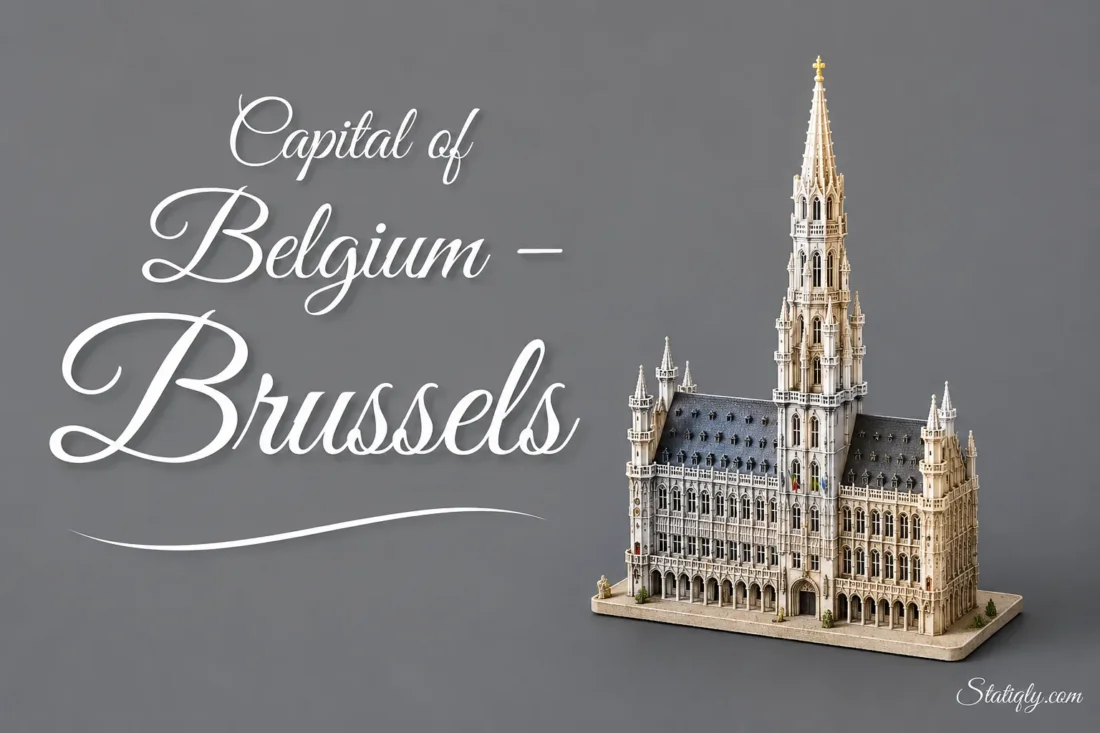
Brussels is the capital of Belgium, but that simple answer hides an unusual geographic detail: “Brussels” does not always describe the same area. The historic City of Brussels is only one municipality inside the much larger Brussels-Capital Region, which contains 19 municipalities. Understanding that distinction makes the city’s population, languages, boundaries and European role much easier to understand.
Brussels in Context
Brussels serves as Belgium’s national capital while also forming one of the country’s three regions. It is officially bilingual at regional level and hosts several major European institutions.
| Detail | Brussels |
|---|---|
| Country | Belgium |
| Capital Status | Capital of Belgium since 1831 |
| Administrative Region | Brussels-Capital Region |
| Municipalities in the Region | 19 |
| Official Regional Languages | French and Dutch |
| Brussels-Capital Region Population | 1,255,795 residents (1 January 2025) |
| City of Brussels Population | 198,314 residents (1 January 2025) |
| Regional Area | 162.4 km² |
| Regional Population Density | 7,732 residents per km² |
| Currency | Euro (€) |
What Does “Brussels” Actually Mean?
A population figure for Brussels might be below 200,000 in one source and above 1.2 million in another. Neither number is necessarily wrong. They can describe two different administrative areas.
The City of Brussels
The City of Brussels is one of the 19 municipalities that make up the Brussels-Capital Region. It contains the historic centre, including the Grand-Place, as well as areas such as Laeken, Haren and Neder-Over-Heembeek.
Official figures for 1 January 2025 recorded 198,314 residents in this municipality. Its territory covers about 33.1 km².
The Brussels-Capital Region
The Brussels-Capital Region is much larger in population and contains all 19 Brussels municipalities. It covers 162.4 km² and had 1,255,795 residents on 1 January 2025.
This is usually the more useful boundary when discussing Brussels as a large urban capital. A person can live in Ixelles, Anderlecht or Schaerbeek and still live inside the Brussels-Capital Region without living in the municipality called the City of Brussels.
The Wider Brussels Urban Area
The built-up city extends beyond the official regional boundary as well. Commuting, housing and daily movement connect Brussels with surrounding communities outside the Brussels-Capital Region. Figures for a “greater Brussels” or metropolitan area therefore measure something different again.
City, region and wider urban area are three different geographic ideas. That distinction explains much of the apparent disagreement between Brussels statistics.
Why Brussels Is the Capital of Belgium
Brussels became the capital of independent Belgium in 1831. Its role as the national capital is therefore much older than the Brussels-Capital Region itself.
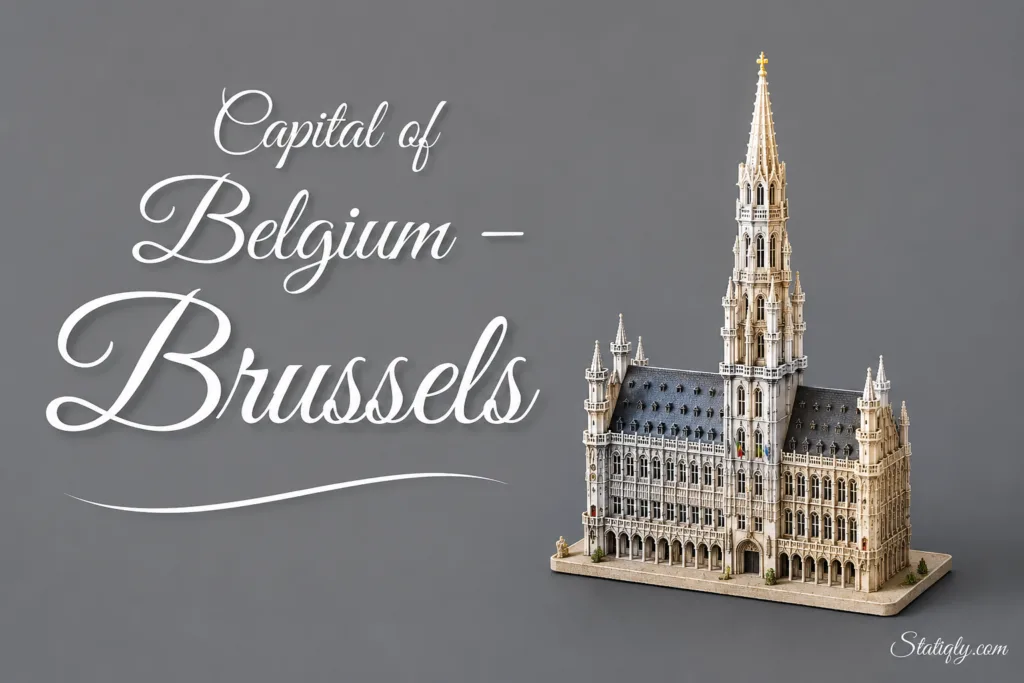
Belgium’s main federal institutions are concentrated in Brussels, and the city also has a close association with the country’s monarchy. The Royal Palace, the Palace of the Nation and other national institutions place the functions of the Belgian capital within a relatively compact part of the city.
The administrative map changed much later. The Brussels-Capital Region was created in 1989 as Belgium developed its present regional structure. So Brussels had already been the national capital for more than a century before the current region existed.
Brussels Has Its Own Place Within Belgium
Belgium has three regions: the Flemish Region, the Walloon Region and the Brussels-Capital Region. This matters because a common geographic misunderstanding places Brussels inside either Flanders or Wallonia.
The Brussels-Capital Region is a separate region. It is surrounded by the Flemish Region, but it does not form part of that region. Nor is it part of the Walloon Region.
- Flemish Region: covers the northern part of Belgium.
- Walloon Region: covers the southern part of Belgium.
- Brussels-Capital Region: a separate region centred on the national capital.
This small regional footprint gives Brussels an unusual position: a national capital that is also its own region within a federal country.
The 19 Municipalities That Make Up Brussels
The Brussels-Capital Region is not governed geographically as one single municipality. Instead, it contains 19 municipalities, each with its own local territory.
- Anderlecht
- Auderghem
- Berchem-Sainte-Agathe
- City of Brussels
- Etterbeek
- Evere
- Forest
- Ganshoren
- Ixelles
- Jette
- Koekelberg
- Molenbeek-Saint-Jean
- Saint-Gilles
- Saint-Josse-ten-Noode
- Schaerbeek
- Uccle
- Watermael-Boitsfort
- Woluwe-Saint-Lambert
- Woluwe-Saint-Pierre
The City of Brussels is therefore only one part of Brussels in the regional sense. Several municipalities also have familiar Dutch and French name forms. Ixelles, for example, is known as Elsene in Dutch, while Schaerbeek appears as Schaarbeek.
Why Brussels Population Numbers Vary So Much
Population figures are one of the easiest ways to see why administrative boundaries matter.
| Area | Population | Area | Density |
|---|---|---|---|
| City of Brussels | 198,314 | 33.1 km² | 5,994/km² |
| Brussels-Capital Region | 1,255,795 | 162.4 km² | 7,732/km² |
A statement such as “Brussels has about 200,000 residents” normally refers to the City of Brussels municipality. A figure above 1.2 million normally refers to the Brussels-Capital Region.
That is a large difference for one name. The boundary being measured matters more than the name printed beside the number.
What Languages Are Official in Brussels?
Belgium has three official languages: Dutch, French and German. Brussels has a more specific language arrangement.
The Brussels-Capital Region is officially bilingual in French and Dutch. Both languages appear throughout public administration and many forms of official communication. This is also why visitors may notice two versions of place names on signs.
| Area | Official Language Status |
|---|---|
| Belgium | Dutch, French and German |
| Brussels-Capital Region | French and Dutch |
Daily language use is much broader than those two official languages. Brussels has residents from more than 180 nationalities, and around 100 languages are spoken across the region. Its formal bilingual status and its highly international population exist side by side.
Is Brussels the Capital of the European Union?
Brussels is often casually called the capital of the European Union, but that phrase needs a little precision. The EU does not operate around one formally designated capital in the same way that Belgium has Brussels as its national capital.
Instead, Brussels, Luxembourg City and Strasbourg are the three official seats of the European institutions. Brussels hosts much of the day-to-day work of several central EU institutions.
- The European Commission works mainly in Brussels, with activities also based in Luxembourg.
- The European Council is based in Brussels.
- The Council of the European Union works in Brussels and Luxembourg.
- The European Parliament works in Brussels, Strasbourg and Luxembourg; its official seat is in Strasbourg.
So calling Brussels Europe’s institutional centre describes its role more accurately than treating it as the EU’s sole official capital.
Why Brussels Has Such an International Role
Belgian institutions are only one layer of Brussels. European bodies add another, while numerous international organisations and diplomatic missions add a third.
NATO Headquarters is also located in Brussels and has been based in the city since 1967. Together with the European institutions, this concentration of international organisations gives Brussels a role that reaches well beyond Belgium’s borders.
That international presence also helps explain why Brussels feels different from a capital defined only by national institutions. French and Dutch remain the region’s official languages, yet multilingual offices, organisations and communities are part of ordinary city life.
Places That Explain Brussels as a Capital
Several places make the different identities of Brussels visible without turning the city into a simple list of landmarks.
Grand-Place
Grand-Place sits within the historic centre of the City of Brussels. The square, with its Town Hall and surrounding historic buildings, represents the older civic city that existed long before today’s regional and European institutions.
The Royal Quarter
The area around the Royal Palace and Brussels Park reflects the city’s national-capital role. Nearby institutions make this part of Brussels closely associated with the Belgian state.
The European Quarter
The European Quarter presents a very different Brussels. Buildings used by the European Commission, European Council, Council of the European Union and European Parliament cluster in and around this part of the city.
Historic Brussels and institutional Brussels sit only a short distance apart, yet they tell very different parts of the same city’s story.
The Atomium
The Atomium belongs to another layer of Brussels identity. Built for the 1958 World’s Fair, it became one of the city’s most recognisable structures and a reminder of the mid-20th-century period when Brussels was strengthening its international presence.
Brussels Through a Few Defining Dates
- 1831: Brussels becomes the capital of independent Belgium.
- 1957: Brussels develops its role as a centre for the European Economic Community.
- 1958: The Atomium opens for the World’s Fair.
- 1967: NATO establishes its headquarters in Brussels.
- 1989: The Brussels-Capital Region is created within federal Belgium.
- 2005: The population of the Brussels-Capital Region passes one million.
- 2025: The regional population passes 1.25 million.
Brussels by the Numbers
| Measure | Figure | What It Describes |
|---|---|---|
| 198,314 | Residents | City of Brussels municipality |
| 1,255,795 | Residents | Entire Brussels-Capital Region |
| 19 | Municipalities | Local municipalities within the region |
| 162.4 km² | Area | Brussels-Capital Region |
| 7,732/km² | Population density | Regional average |
| 2 | Official regional languages | French and Dutch |
The most useful number depends on the question. For the municipality containing the historic centre, use the City of Brussels figure. For Brussels as the full capital region, use the regional figure.
Common Brussels Mix-Ups
Brussels and the City of Brussels Are Not Always the Same Thing
“Brussels” often means the entire Brussels-Capital Region. City of Brussels is the name of only one of its 19 municipalities.
Brussels Is Not Part of Flanders or Wallonia
The Brussels-Capital Region is one of Belgium’s three regions. It is geographically surrounded by the Flemish Region but remains administratively separate.
Belgium and Brussels Do Not Have the Same Official Language List
Belgium has three official languages: Dutch, French and German. The Brussels-Capital Region is officially bilingual in French and Dutch.
Brussels Is Not the EU’s Sole Official Capital
Brussels hosts several central European institutions, but the EU’s institutional seats are shared among Brussels, Luxembourg City and Strasbourg.
Questions About Brussels as Belgium’s Capital
What Is the Capital of Belgium?
Brussels is the capital of Belgium. It has served as the capital since 1831.
Is Brussels a City or a Region?
Both terms can be correct depending on the boundary being discussed. The City of Brussels is a municipality, while the Brussels-Capital Region contains 19 municipalities, including the City of Brussels.
How Many People Live in Brussels?
Official figures for 1 January 2025 recorded 198,314 residents in the City of Brussels municipality and 1,255,795 residents across the Brussels-Capital Region. The correct figure depends on which boundary is being measured.
How Many Municipalities Are in Brussels?
The Brussels-Capital Region contains 19 municipalities.
Is Brussels in Flanders?
No. The Brussels-Capital Region is a separate region of Belgium. It is surrounded by the Flemish Region but is not part of it.
What Are the Official Languages of Brussels?
The Brussels-Capital Region has two official languages: French and Dutch. Belgium as a whole has three official languages: Dutch, French and German.
Is Brussels the Official Capital of the European Union?
Brussels is a major centre for EU institutions, but it is not a formally designated sole capital of the European Union. European institutional seats are shared among Brussels, Luxembourg City and Strasbourg.
When Did Brussels Become Belgium’s Capital?
Brussels became the capital of independent Belgium in 1831. The Brussels-Capital Region came much later, in 1989.