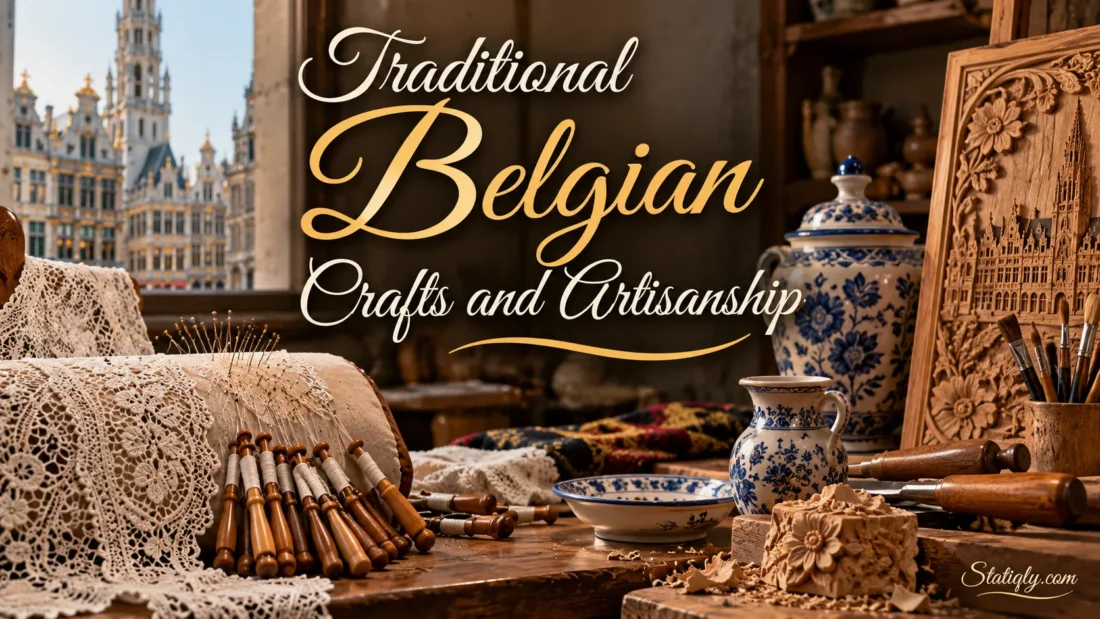
Belgium’s traditional craftsmanship is closely tied to place. Bruges became known for lace, Tournai and Oudenaarde for tapestry, Raeren for stoneware, the Liège area for crystal, and Antwerp for diamonds, jewellery and precious-metal work. These traditions developed in workshops where skill passed from maker to maker, often through years of practice. Some remain active crafts, while others survive mainly through specialist workshops, museums, teaching centres and contemporary makers who adapt old techniques to new forms.
There is no single style that defines Belgian artisanship. A delicate piece of bobbin lace has little in common with a heavy stoneware vessel or a precisely cut gemstone. What connects them is careful handwork, technical knowledge and a strong regional identity.
Belgian Craft Traditions By Region
| Craft | Places Closely Associated With It | Main Materials Or Techniques | Traditional Character |
|---|---|---|---|
| Lace making | Bruges, Brussels, Binche and other historic lace centres | Linen or other fine threads, bobbins, needles, pins and patterns | Openwork textiles formed through highly controlled thread work |
| Tapestry weaving | Tournai, Brussels and Oudenaarde | Loom weaving, coloured yarns and detailed designs | Large decorative textiles combining image-making with weaving |
| Wood carving and retables | Brussels, Antwerp and Mechelen | Carved wood, assembled figures and decorative finishing | Highly detailed sculptural workshop production |
| Stoneware and ceramics | Raeren and other ceramic centres | Clay, wheel forming, moulded decoration and firing | Durable vessels ranging from practical wares to decorated pieces |
| Crystal work | Seraing and the Liège area | Glassblowing, cutting, engraving and polishing | Clear or coloured crystal shaped and finished by specialist artisans |
| Diamond and jewellery work | Antwerp | Gem cutting, polishing, setting, goldsmithing and jewellery making | Precision work that depends on control, proportion and finishing |
Lace Making: Precision Built From Thread
Belgian lace is not one single technique or pattern. Different lace traditions developed in different places, and their names often reflect those geographic origins. Historically, makers worked with both bobbin lace and needle lace, producing openwork textiles without first needing a complete woven fabric underneath.
Bobbin lace begins with threads wound onto small bobbins. The maker crosses and twists those threads around pins placed in a prepared pattern. What looks like a soft textile is therefore created through a surprisingly ordered process. Move one thread incorrectly and the pattern changes. Skilled lace making depends on rhythm, memory and extremely fine hand control.
Bruges And Bobbin Lace
Bruges became especially associated with bobbin lace. Lace making was already established in Flanders during the early modern period, and Bruges developed a long connection with the craft. For many households, lace was once more than decorative work. It could also provide income from work carried out at home.
The tools remain simple: a lace pillow, a pattern, pins, thread and bobbins. The difficulty lies in how they are used. Dozens of threads may be active at once, yet an experienced maker keeps their order without turning the process into a tangle.
Bruges has not treated lace only as something belonging behind museum glass. Lace making is still taught through the city’s Lace Centre, where demonstrations and courses keep practical knowledge connected to living hands.
Brussels, Binche And Other Lace Traditions
Brussels also built an international reputation for fine lace. Surviving examples show how lace could be used for collars, cuffs, dress details, accessories and larger decorative textiles. Techniques, materials and patterns varied, which is why historic lace is often identified not simply as “Belgian lace” but by a more precise regional or technical name.
Binche became associated with finely worked bobbin lace as well. Historic examples survive in major textile collections, showing how a local method could travel far beyond the place where its name originated.
This regional variety matters. Two handmade lace pieces from Belgium can look quite different while both representing authentic craft traditions.
Tapestry Weaving In Tournai, Brussels And Oudenaarde
Belgian tapestry traditions developed on a much larger physical scale than lace. Instead of building a small openwork textile from fine threads, tapestry weavers used looms to construct images in woven form. Figures, plants, architectural details, borders and repeating ornament could all become part of the textile itself.
Tournai became internationally known for tapestry production between the 15th and 18th centuries. Its workshops produced works that later entered museum collections far beyond Belgium. The local connection did not disappear with the old workshops: tapestry and textile art continue to be preserved, restored, studied and reinterpreted in Tournai today.
Brussels was another major centre. Historic Brussels tapestries demonstrate the amount of planning involved in large woven works. A tapestry was not simply a picture copied in thread. Weaving required the maker to translate a design into the physical logic of a loom, controlling colour and form line by line.
Oudenaarde also built much of its reputation around tapestry production, particularly during the 16th century. Collections preserved there still connect the city with the craft that once formed an important part of its working life.
What Makes Tapestry Different From Embroidery?
The distinction is useful. In embroidery, decoration is stitched onto an existing textile. In tapestry weaving, the image is formed as the textile itself is woven. The structure and the picture develop together.
- Warp threads provide the underlying structure on the loom.
- Weft threads travel across the warp and create the visible design.
- Different coloured yarns allow the weaver to form shapes, shading and details.
- Large works may demand long periods of controlled, repetitive handwork.
That slow construction explains why historic tapestries reward close viewing. Step nearer and the image stops behaving like a painting. The woven structure becomes visible.
Carved Retables And Fine Woodworking
Woodworking deserves a place beside Belgium’s better-known textile traditions. During the 15th and 16th centuries, workshops in Brussels, Antwerp and Mechelen became respected centres for carved wooden retables.
A retable is a large decorated structure traditionally placed behind or above an altar. Many historic examples resemble miniature architectural stages filled with carved figures and scenes. Producing one required more than basic woodworking. Artisans had to understand proportion, carving depth, facial expression, drapery, repeated ornament and the behaviour of wood at a very small scale.
Some workshops divided the labour between different specialists. Carvers shaped the figures and architectural elements, while other craftspeople could handle assembly, surface preparation or decorative finishing. The completed object therefore reflected coordinated workshop skill rather than a single simple technique.
Historic retables preserved in Belgian collections also show an important feature of older craft culture: the boundary between an artist and an artisan was often less clear than it appears today. A highly trained woodcarver could be both.
Raeren Stoneware And Ceramic Skill
In eastern Belgium, Raeren developed one of the country’s best-documented historic pottery traditions. Archaeological finds show a long history of stoneware production, including practical household vessels as well as richly decorated Renaissance and Baroque pieces.
Stoneware differs from ordinary low-fired earthenware because it is fired to a point where the clay body becomes dense and hard. This made Raeren vessels useful as durable household objects, but potters did not stop at function.
Decoration became increasingly elaborate during the 16th century. Potters could press ornaments into damp clay with stamps, cut patterns directly into the surface or apply moulded medallions and decorative bands. Some vessels carried detailed image sequences around their bodies. The pot itself became a surface for visual storytelling.
Raeren pottery should be described carefully as a historic craft tradition rather than as an uninterrupted modern industry. Traditional local production eventually ended in the 19th century. Its techniques and objects are now preserved through archaeological study, museum collections and renewed interest in ceramics. The Pottery Museum in Raeren also collects contemporary ceramic work, allowing old stoneware to be viewed beside later approaches to clay.
Crystal Making At Val Saint Lambert
Belgian crystal craftsmanship has a particularly strong association with Val Saint Lambert near Liège. The crystal works began in 1826, and specialist production continues there today.
Crystal making combines several skills that are easy to underestimate when looking only at the finished object. A piece may pass through blowing, shaping, cutting, engraving and polishing before it reaches its final form. Each stage changes how light moves through the material.
- Blowing gives molten glass an initial hollow form.
- Shaping controls proportion while the material remains workable.
- Cutting creates facets and geometric decoration.
- Engraving adds finer surface detail.
- Polishing restores clarity and sharpens the finished appearance.
Val Saint Lambert became particularly associated with cut crystal and coloured work. Its history also shows how Belgian artisanship can sit between craft, design and manufacturing. A workshop may use established methods while designers alter form, pattern and proportion for a new generation.
Antwerp Diamond Cutting, Goldsmithing And Jewellery
Antwerp’s connection with diamonds reaches back centuries. The city was already an important diamond-trading centre in the 15th century, while a specialised diamond-cutting industry developed during the early 16th century. Jewellery workshops later brought gem work together with goldsmithing, setting and decorative metalwork.
Diamond craftsmanship is built around precision. A cutter cannot treat a rough stone as a blank object with unlimited possibilities. Its shape, internal structure and proportions influence the decisions that follow. Cutting and polishing aim to produce controlled facets that interact cleanly with light.
Jewellery making adds another layer. A polished stone may need a setting designed around its dimensions, while metal components must be shaped, joined and finished with accuracy. Even a small ring can therefore combine several specialised skills.
Antwerp still links this older technical knowledge with contemporary jewellery design. Traditional hand skills have not prevented experimentation. They give designers more ways to turn an idea into a finished object.
Why Belgian Craft Traditions Are So Regional
Belgium’s compact size can make its regional craft variety surprising. Yet traditional craft rarely develops according to modern national boundaries alone. It grows where materials, trade, specialist knowledge, workshops and customers meet.
Once a town becomes known for a craft, skills can begin to cluster there. Experienced makers train others. Suppliers understand what workshops need. Buyers know where to look. Patterns and techniques circulate among families and workshops. Over time, the place name itself may become connected with the finished object.
That is why names such as Bruges lace, Brussels lace, Tournai tapestry, Oudenaarde tapestry and Raeren stoneware carry geographic meaning as well as artistic meaning.
How Traditional Craft Skills Are Passed On
Traditional craftsmanship survives only when technique can move from one person to another. Written instructions help, but many skills are difficult to learn from text alone. How tight should a thread feel? How much pressure should a cutting tool receive? When has a surface been polished enough? Much of this knowledge becomes clear through repeated practice.
Historically, training often took place in workshops, families, guild environments or specialist schools. Today the route can include museums, heritage centres, professional ateliers, demonstrations, classes and art education.
Bruges offers a clear example. Its lace tradition is presented historically, yet learners can also encounter the technique as something to practise. Tournai follows another path through textile conservation, restoration and contemporary textile art. In Raeren, historic stoneware is studied alongside later ceramic work. Different crafts need different forms of continuity.
Traditional Technique And Contemporary Design
A traditional craft does not have to reproduce the same object forever. Technique can remain recognisable while form changes.
A lace maker may use coloured threads instead of the pale linen associated with historic pieces. A textile artist may apply weaving skills to an abstract composition rather than a historical scene. A crystal designer can create a modern silhouette and still rely on experienced cutters and polishers. A jeweller may combine established metalworking methods with a distinctly contemporary shape.
This ability to adapt is one reason craft knowledge can stay useful. The old skill is not preserved by freezing it. It survives when someone still knows how to use it.
How To Recognize Artisan-Made Work
“Belgian style” and “made by a Belgian artisan” do not mean exactly the same thing. Visitors looking for genuine craft work can learn more by asking simple questions about the object rather than judging it only by appearance.
- Ask where the piece was made. A maker or specialist shop should usually be able to explain its origin.
- Ask about the technique. Terms such as bobbin lace, hand engraving, wheel-thrown ceramics or hand polishing describe a process, not just a look.
- Look for the maker. Contemporary craft pieces may carry a signature, workshop mark, label or other form of attribution.
- Expect small variations. Hand processes often produce slight differences between individually made pieces.
- Learn what is handmade. Some objects combine handwork with tools or machine-assisted stages. That does not automatically remove the artisan element; what matters is understanding which parts were shaped or finished by skilled hands.
Places Where Belgian Craft Heritage Can Be Experienced
Several Belgian cities make it possible to see craftsmanship in context rather than as an isolated souvenir.
- Bruges: lace collections, lace demonstrations, teaching and historic decorative arts connect the city with its long textile tradition.
- Brussels: museum collections preserve Brussels lace, tapestries, carved retables and other decorative arts.
- Tournai: tapestry heritage remains visible through historic collections, textile art and specialist restoration work.
- Oudenaarde: historic tapestries recall the industry that helped shape the city during its period of major production.
- Raeren: archaeological material and museum collections document the development of the town’s distinctive stoneware.
- Seraing: Val Saint Lambert maintains the connection between Belgian crystal and specialist glassworking skills.
- Antwerp: diamonds, jewellery and precious-metal work remain closely tied to the city’s identity as a centre of specialist craftsmanship.
Small Details That Reveal The Maker’s Skill
The most rewarding way to look at traditional craft is often to ignore the whole object for a moment and examine one small area.
In lace, follow a single thread through the pattern. In tapestry, look at the change from one colour to another. On Raeren stoneware, examine how decoration sits on the curved clay surface. On cut crystal, watch how repeated facets catch light. In carved wood, study a hand, fold of fabric or tiny architectural detail. With jewellery, look closely at the meeting point between stone and setting.
Those details show what traditional artisanship really preserves: not simply old objects, but the ability to control material with trained hands. Belgium’s best-known craft traditions differ in scale, material and technique, yet each depends on the same basic relationship between knowledge and practice. A pattern can be stored in an archive. A finished piece can sit in a museum. The craft itself exists when someone can still make it.