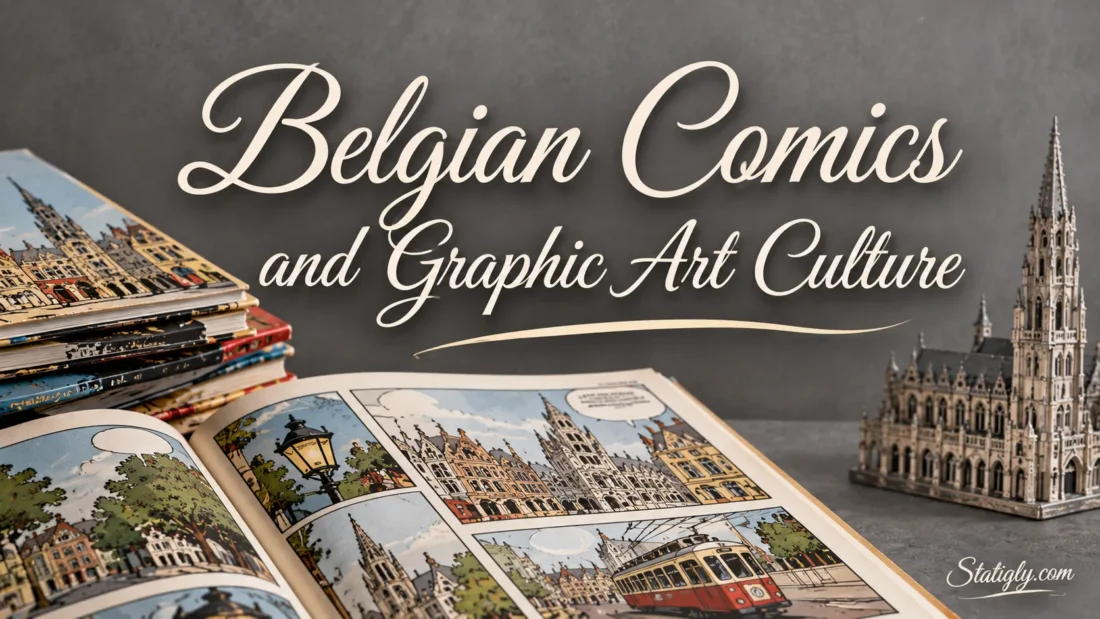
Belgium has an unusually close relationship with comics. Illustrated stories are not treated only as children’s entertainment or bookstore products. They appear in museums, specialist shops, exhibitions, public murals and everyday visual culture. Belgian creators also helped shape some of Europe’s most recognizable approaches to sequential art, from the precise clarity associated with Hergé to the lively movement of artists connected with Spirou.
The French term bande dessinée, often shortened to BD, is widely used for European comics. In Dutch-speaking Belgium, strip and stripverhaal are familiar terms. This multilingual setting matters. French-speaking and Dutch-speaking creators developed strong publishing traditions of their own, while artists, magazines and publishers also influenced one another across language lines.
That mixture produced something broader than a list of famous characters. Belgian comics became a form of graphic culture: drawing, page design, lettering, color, humor and visual storytelling working together.
Belgian Comics in Cultural Context
| Tradition or Element | Associated Examples | Visual or Cultural Character |
|---|---|---|
| Brussels School and ligne claire | Hergé, Edgar P. Jacobs | Clean outlines, readable compositions and carefully organized scenes |
| Spirou and the Marcinelle tradition | Jijé, André Franquin, Morris, Peyo | Energetic movement, expressive figures and flexible drawing |
| Flemish popular comics | Willy Vandersteen, Jef Nys and other Dutch-language creators | Serialized adventures, humor and strong connections with newspaper and family reading |
| Album culture | Hardback and softcover European comic albums | Long-form visual stories designed as complete books |
| Urban comic art | Brussels Comic Strip Trail | Comic characters and scenes adapted to large public murals |
| Museum culture | Comic Art Museum in Brussels | Original artwork, creative processes, publishing history and changing comic styles |
Why Belgium Developed Such a Strong Comics Tradition
Belgian comics grew through a combination of talented artists, active publishers and serialized magazines. For much of the twentieth century, weekly publications gave readers a regular supply of illustrated stories. They also gave artists room to develop characters over many episodes.
Two magazines became especially influential: Tintin and Spirou. They did more than publish stories. Each gathered groups of writers and artists whose work helped define recognizable approaches to drawing and storytelling.
Albums added another layer. A story could first reach readers in installments and later return as a bound book. That helped establish the familiar Franco-Belgian comic album as an object worth keeping on a shelf rather than something read once and discarded.
Hergé and the Clear-Line Tradition
Hergé, the pen name of Georges Remi, introduced Tintin in Brussels in 1929. His approach became closely associated with ligne claire, or “clear line,” a term used for a clean and highly readable drawing style.
The idea is easy to recognize on the page. Objects usually have firm outlines. Characters remain readable against their surroundings. Architectural details, vehicles and interiors may contain plenty of information, yet the panel rarely feels visually confused. Every element has a clear job.
- Consistent outlines help separate people and objects.
- Controlled compositions make complex scenes easy to follow.
- Readable backgrounds provide location and atmosphere without overwhelming the action.
- Clear facial and body gestures communicate emotion without requiring elaborate rendering.
- Careful sequencing moves the eye naturally from one panel to the next.
Edgar P. Jacobs, creator of Blake and Mortimer, also became closely linked with this visual tradition. His pages often place carefully constructed figures inside detailed architectural or technical environments. The result can feel almost staged, as though each panel were a small set designed for the reader’s eye.
The Spirou Tradition and Drawing With Motion
Another influential Belgian current developed around Spirou and artists connected with Jijé. Comic historians often associate this circle with the Marcinelle School, named after the area of Charleroi connected with Spirou’s publisher.
Where clear-line drawing often feels controlled and architectural, the Spirou tradition can feel elastic. Bodies bend. Faces stretch. Vehicles lean into turns. Clothing, hair and limbs help carry movement across a panel. Even a character standing still may look ready to spring into action.
Jijé played an important role in this creative environment. Rather than asking younger artists to reproduce one fixed style, he encouraged individual development. André Franquin, Morris and Will were among the artists closely associated with this circle.
Franquin and Expressive Cartooning
André Franquin became known for drawing that could communicate speed, emotion and physical comedy with remarkable ease. His lines often appear alive rather than rigid. Small details in posture can make a character look nervous, impatient, exhausted or delighted before a speech balloon is even read.
That is one of the pleasures of Belgian comic art: the drawing frequently carries part of the narrative by itself. Words and images cooperate rather than simply repeating one another.
Morris and the Silhouette of Lucky Luke
Morris, the creator of Lucky Luke, developed another instantly readable approach. Characters often have memorable silhouettes, exaggerated proportions and strong poses. A reader can recognize many figures from their outline alone.
This emphasis on silhouette is useful in comics because a panel may be small. The artist cannot depend on tiny facial details every time. Shape has to speak quickly.
Peyo and the Smurfs
Peyo, the professional name of Pierre Culliford, created one of Belgium’s best-known groups of comic characters. The Smurfs first appeared in 1958 in a Johan and Peewit story published in Spirou.
Visually, the characters show how much information can be carried by very simple shapes. Their basic body design is consistent, while clothing, expression, posture and small identifying details distinguish one personality from another.
Simple does not mean empty. In skilled cartooning, removing unnecessary detail can make an image faster to read. Peyo’s character design is a clear example.
Flemish Comics and Dutch-Language Storytelling
Belgian comic culture cannot be understood only through French-language publishing. Dutch-speaking Belgium developed its own popular series, artists and reading habits.
Willy Vandersteen became one of the central figures in Flemish comics. His Suske en Wiske, known in English under names including Spike and Suzy, grew from a tradition closely connected with newspaper serialization and stories designed to appeal to more than one age group.
Vandersteen’s work combines adventure, humor, imaginative inventions and familiar group dynamics. The continuing presence of his characters in Antwerp’s cultural landscape shows how closely some comic creations can become attached to a place.
Other Dutch-language series developed similarly devoted readerships. Flemish comic culture has long valued recurring characters, humorous dialogue and stories that can move freely between ordinary settings and imaginative adventures.
Why Belgian Comic Pages Feel So Readable
A comic page asks the reader to perform several tasks almost instantly: identify characters, understand the setting, follow dialogue, notice movement and determine which panel comes next. Belgian artists became particularly skilled at guiding that process.
Panels Control Time
A panel is more than a box around a drawing. Its size, position and contents affect rhythm. Several small panels can make a sequence feel quick. A larger panel can slow the reader and create room for a detailed setting or visual reveal.
Speech Balloons Become Part of the Composition
Good lettering placement guides the eye. Balloons generally need enough space to remain readable without covering the most useful parts of the drawing. Their order also has to feel natural. Belgian album pages offer many examples of artists planning image and text as one composition rather than treating dialogue as an afterthought.
Backgrounds Tell the Reader Where They Are
A street sign, building facade, desk, railway platform or line of rooftops can establish place in seconds. Detailed backgrounds are especially effective when the artist chooses details that support the story. Too little information leaves a scene floating; too much can bury the characters. Balance matters.
The Comic Album as a Designed Object
Belgian comic culture also places attention on the physical book. The European album format gives drawings more room than many smaller periodical formats. Covers become display pieces. Page layouts can breathe. Color gains space.
Many readers build collections by series, arranging albums in publication order. Matching spines and recurring cover identities make the books feel connected even before they are opened.
This physical tradition helps explain why original comic pages are also appreciated as graphic artworks. Remove the speech balloons and printing process for a moment and a page still reveals composition, brushwork, pencil construction, corrections and the artist’s control of empty space.
From Printed Pages to Gallery Walls
Belgian graphic culture does not stop with printed albums. Original comic drawings and finished pages appear in museums, exhibitions and specialist galleries. Viewers can examine details that may disappear in reproduction: pencil marks beneath ink, changes in line pressure, hand lettering and the scale of the original sheet.
A printed panel may look effortless. The original art often tells a different story. Beneath a clean image sits a series of choices about proportion, pacing and emphasis.
Brussels as an Open-Air Comic Gallery
Few cities make their comics connection as visible as Brussels. Since 1991, comic murals have appeared on walls around the capital as part of what is now known as the Comic Strip Trail.
The network now includes more than 80 murals. Characters associated with Belgian and wider European comics appear across the historic centre and neighborhoods such as the Marolles, Sainte-Catherine, Laeken and Haren.
The scale changes the experience. An image originally designed for a page may cover several floors of a building. Windows, corners and rooflines can become part of the composition. The city itself acts almost like a giant panel border.
- The historic centre combines comic murals with some of Brussels’ best-known streets and landmarks.
- The Marolles route includes numerous murals within a relatively compact area.
- The Sainte-Catherine and canal area mixes comic imagery with a different urban setting.
- Murals also appear outside the central tourist streets, spreading the comic trail across the wider Brussels region.
The Comic Art Museum and Victor Horta
One of the clearest meetings between Belgian comics and graphic design can be found at the Comic Art Museum in Brussels. The museum occupies the former Waucquez department store, an Art Nouveau building designed by Belgian architect Victor Horta and inaugurated in 1906.
The building became the home of the comics museum in 1989. That pairing is unusually fitting. Visitors can study drawn lines and page composition while standing inside an architectural space famous for its own use of line, structure and light.
The museum presents Belgian comics as an artistic process rather than merely a collection of characters. Exhibitions explore creators, original drawings, storytelling methods, historical publishing and newer work. Its permanent displays also place Belgian comics within the wider development of sequential art.
Comics as Part of Everyday Belgian Visual Identity
The presence of comic imagery outside books says a great deal about its place in Belgian culture. Characters appear in public art, exhibitions, cultural events and design projects. Belgium has even used familiar comic characters in the visual design of its national passport, presenting comics as a recognizable expression of Belgian creative culture.
This visibility also explains why the expression “Ninth Art” feels natural in Belgium. Comics sit comfortably beside architecture, illustration, painting and design as subjects for museums and cultural institutions.
What Makes Belgian Comic Art Distinct
There is no single Belgian drawing style. In fact, the differences are part of the appeal. Hergé’s controlled clarity, Franquin’s energetic movement, Peyo’s efficient character design and Vandersteen’s popular storytelling do not look identical.
They do share several habits that appear again and again across Belgian comics:
- Readability: the reader should quickly understand who is acting and where.
- Strong silhouettes: recurring characters are easy to recognize.
- Visual timing: expressions, pauses and movement contribute to humor and drama.
- Detailed settings: backgrounds often help establish place and atmosphere.
- Serial storytelling: characters can support many adventures while remaining familiar.
- Careful book design: covers, page layouts and album formats form part of the reading experience.
Experiencing Belgian Comics Beyond the Famous Characters
Tintin, the Smurfs, Lucky Luke and Suske en Wiske are useful starting points, but Belgian graphic culture is much larger. Museum exhibitions and specialist bookshops reveal detective stories, humorous strips, fantasy, autobiographical work, graphic novels, experimental drawing and contemporary illustration.
Looking at original pages can be especially revealing. Notice where the artist leaves empty space. Watch how characters enter and leave a panel. Compare a calm conversation with a fast chase. Look at how a background becomes simpler when attention needs to stay on a face. These small decisions are the grammar of comic art.
In Belgium, that visual grammar has been practiced for generations. It survives not because every artist follows the same rules, but because drawing and storytelling continue to be treated as crafts worth studying, displaying, collecting and passing on.