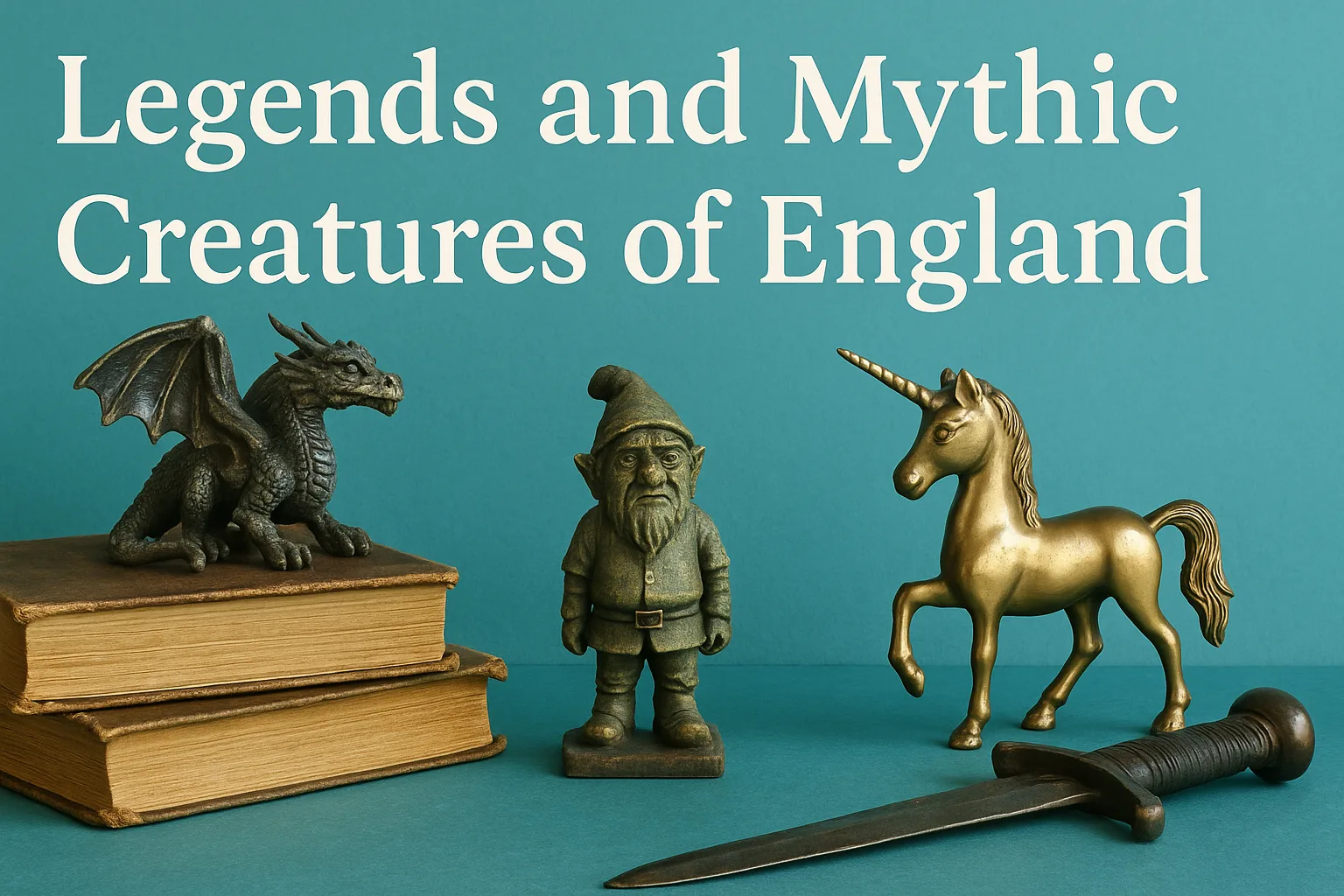
Walk across England’s hills, forests and coasts and you quickly notice something: the land is full of stories. A crooked oak becomes the home of a tree spirit, a ruined castle hides a dragon, a quiet lane at dusk belongs to a glowing-eyed black dog. English legends aren’t just old tales in dusty books; they cling to place-names, pub signs, village fairs and even bus routes. This guide walks you through the most beloved legends and mythic creatures of England, and shows how you can meet them in a way that feels real, thoughtful and fun.
“Every path has its story, every stone its secret.”
Traditional English saying, repeated in many villages
A Landscape Woven with Legends
English myths grow straight out of the land. Misty moors, chalk downs, deep green woods and soft, marshy fens have all shaped the creatures that “live” there in story. Over centuries, farmers, sailors, shepherds, miners and travelers passed tales from one fire to the next. They changed with each telling, like clouds shifting over the hills, but some patterns remain strong:
- Every region has its own guardian creatures and local heroes.
- Danger and wonder sit side by side: a creature might protect you one night and trick you the next.
- Legends often explain why a hill, a pool or a lonely stone looks the way it does.
- Modern life hasn’t killed the stories; it has quietly wrapped around them.
Old Roots
- Stories carried by oral tradition.
- Blending of folklore, faith and seasonal customs.
- Legends tied to specific stones, trees, rivers and crossroads.
Modern Life
- Pub names like “Dragon’s Head” or “Green Man”.
- Local festivals, story walks and themed trails.
- Myths appearing in films, games and novels.
Legendary Figures: Heroes, Tricksters and Green Faces
Before we meet the creatures, it helps to know a few of the great legendary figures of England. They shape the mood of many local tales, and you’ll see their names again and again while traveling.
King Arthur and the Echo of a Mythic Court
Though Arthur belongs to the wider story of Britain, some of his strongest echoes lie in western and southern England. Clifftop Tintagel Castle in Cornwall, the mysterious Tor of Glastonbury in Somerset, and stone circles scattered across the countryside all whisper of a once-mighty king and his shining knights. The tales mix chivalry, magic swords, prophetic wizards and quests with very real landscapes.
- What Arthur shows you: ideas of honor, loyalty, the search for a better world.
- Where you feel it: ruined castles, hilltop earthworks, quiet chapels.
- How to explore: follow “Arthurian” walking trails, visit local museums, join a guided story walk if you find one.
Robin Hood and the Green Shadows of the Forest
Travel to Sherwood Forest in Nottinghamshire and it’s hard not to picture a figure in green stepping between the oaks. Robin Hood is the classic English outlaw, stealing from the rich to help the poor, living free among roots and leaves. While the historical truth is tangled, the legend feels simple and direct: courage, clever tricks, deep loyalty to friends.
- What Robin shows you: a love of fairness, laughter in danger, the forest as a home.
- Where you feel it: Sherwood Forest, old hunting parks, greenwood valleys.
- How to explore: visit Sherwood’s major oaks, look for Robin Hood festivals, archery displays and story-telling events.
The Green Man: A Face in the Leaves
Step into an English church or a traditional pub and look up. You may notice a carved face, leaves flowing from hair, mouth and eyes. This is the Green Man, a powerful symbol of nature’s endless renewal. His meaning shifts from place to place, but he often represents spring, growth and the wild life hidden behind everyday walls.
Quick tip: when you visit an old church, turn it into a gentle treasure hunt. Can you spot a Green Man, strange animals, or little faces hidden among the stone leaves?
Mythic Creatures of England: From Dragons to Dancing Lights
Now to the creatures themselves. English folklore is rich with dragons, black dogs, faeries, giants, water spirits and shapeshifters. Each carries a message from the landscape, like a postcard written in symbols instead of ink.
Dragons and Serpents of Hill and Well
English dragons are rarely just monsters. Many are guardians of hills, caves or sacred springs. The famous Lambton Worm of County Durham, for example, coils its long body around a hill, while other dragon tales explain strange ridges or old earthworks. Quite often, a knight or local hero must face the beast, not only in battle but in a test of character.
- Common traits: huge size, a love of treasure, a link to particular hills or lakes.
- Symbolic meaning: wild forces of nature, greed, fear – but also strength and protection when treated with respect.
- Where to look: places called “Dragon’s Hill”, dragon carvings in churches, village signs, and folklore boards on walking trails.
Black Dogs and Silent Road Guardians
Few English creatures feel as mysterious as the black dog of the lanes. Under names like Black Shuck in East Anglia or the Barghest in the north, this huge shadowy hound pads along lonely roads and church paths. Eyes often glow red or green, and chains may clink softly, though the dog leaves no pawprints.
Spotlight: Black Shuck (East Anglia)
In parts of Norfolk and Suffolk people tell of Black Shuck, a giant dog that runs along the coast and through graveyards on stormy nights. For some, he is a warning to stay safe; for others, a silent companion on rough journeys. This small leged still survives in pub names, coast path stories and local art.
- Common traits: large, dark, often silent; appears suddenly and vanishes just as fast.
- Symbolic meaning: respect for the night, the boundary between worlds, the seriousness of travel.
- Where to look: coastal paths, old causeways, churchyard folklore panels, pub signs depicting a dark hound.
Faeries, Hobgoblins and Helpful (or Mischievous) Spirits
Not all English creatures are huge. Many are the size of a child or smaller, living inside hearths, hedgerows and hollow hills. Names like brownies, pixies, boggarts and hobs appear in different regions. These beings may help with chores at night or hide your tools if they feel ignored.
- Common traits: love of neat offerings (like cream or bread), dislike of loud boasting, quick to vanish.
- Symbolic meaning: the value of small kindnesses, respect for home spaces, the idea that every household has a spirit.
- Where to look: local folktale collections, village story sessions, trails with “pixie” or “fairy” in their name.
Giants and the Builders of the Land
Stand by a chalk cliff or a huge stone and you may hear that a giant dropped it there. English giants often explain bold shapes in the landscape. They hurl rocks at each other, carve valleys with their footsteps, or lie asleep under hills. While they can be fierce in story, they also feel oddly clumsy and human.
- Common traits: massive size, great strength, sometimes a simple or stubborn nature.
- Symbolic meaning: awe at natural forces, the sense that the earth itself has a body.
- Where to look: hills with giant-shaped earthworks, standing stones, coastal cliffs with legends attached.
Water Spirits, Merfolk and Dancing Lights
Where there is water in England, there is story. Deep pools hold water spirits and merfolk who sing, warn, or tempt. Marshes glow with will-o’-the-wisp, those tiny wandering lights that lead travelers off the safe path or, in kinder tales, show them the way home.
- Common traits: love of music, beauty and silence; dislike of carelessness around water.
- Symbolic meaning: respect for rivers, ponds and coastlines; the mystery of places that look calm but hold depth.
- Where to look: lakes with legends on information boards, stories told on boat tours, reed-fringed pools along walking paths.
England by Region: Where Legends Live on the Map
To really enjoy English myths, it helps to match story to place. Below is a simple overview of key regions and their signature legends. Use it as a starting point when you plan routes or day trips.
| Legend / Creature | Region | Iconic Location | Key Theme | How You Can Experience It |
|---|---|---|---|---|
| Lambton Worm (Dragon) | North East England | River Wear & hills near Durham | Responsibility, facing past actions | Walk local trails, read story boards, visit Durham’s historic streets |
| Black Shuck (Black Dog) | East Anglia | Norfolk & Suffolk coastal paths | Respect for night journeys and the sea | Coast walks, pub stories, local ghost tours with a friendly focus |
| Robin Hood | Midlands | Sherwood Forest, Nottinghamshire | Fairness, courage, friendship | Forest trails, visitor centres, themed events and archery shows |
| King Arthur | South West & West Country | Tintagel, Glastonbury and nearby moors | Hope, leadership, spiritual quest | Castle ruins, hill walks, small museums, storytelling evenings |
| Giants of the Coast | Cornwall & coastal England | Cliffs, coves, strange rock formations | Awe of nature’s scale | Coastal hikes, guided geology walks with folklore notes |
| Will-o’-the-wisp | Fens & marshlands | Eastern marshes and wetlands | Finding your path, inner guidance | Boardwalk trails, dusk walks with local guides |
Use this table like a mythic map. Pick a region, note its main figure, and then ask yourself: how can I meet this story gently on my trip?
Exploring English Legends on the Ground
It’s one thing to read about a dragon; it’s quite another to stand on a windy hill that locals still call “Dragon’s Mound”. To experience English myths in a living way, focus on simple but thoughtful habits while you travel.
- Follow themed trails: many areas offer walking routes named after legends, with signs explaining the stories.
- Visit small local museums: they often keep the richest folklore, handwritten notes and old sketches.
- Listen to guides and locals: ask, “Is there a local legend about this place?” and let them talk.
- Pause at “ordinary” spots: a lone tree, a spring, a crossroads can all have quiet tales.
- Travel at different times of day: early morning mist or soft twilight can make stories easier to feel.
Practical “Myth Traveler” Tips
- Carry a small notebook and jot down any story fragments you hear.
- Take photos of carvings, pub signs and information boards to explore later.
- Respect churchyards, ancient stones and private land; myths thrive where people feel safe and respected.
- Check local tourism websites for folklore walks, festivals and family events.
Myths for Families and Curious Beginners
You don’t need deep background knowledge to enjoy English legends. Start small and keep it playful. Think of myths as a conversation starter with the landscape rather than a test you must pass.
- With children: turn walks into gentle quests: “Can we find where the giant might have sat?” or “Which tree could be home to a brownie?”
- On a short city break: visit one old church, one small museum and one green space; look for legendary names and symbols in each.
- On a longer road trip: pick a theme – dragons, black dogs, or water spirits – and plan a route linking places tied to that theme.
- If you like books or games: read or play a modern retelling set in England, then visit the kind of places it describes.
Bringing English Legends Home with You
The journey doesn’t end when your flight leaves. English myths travel well. They slip into home life in small, friendly ways, keeping that sense of wonder and connection alive.
Simple Ideas
- Name a plant on your balcony after a local spirit you learned about.
- Keep a small stone from a walk (where allowed) and write its story in a journal.
- Cook a meal from a region you visited and retell the legend that belongs there as you eat.
Deeper Exploration
- Read different versions of the same legend and notice what changes.
- Sketch or paint your favourite mythic creature as you imagine it.
- Start a small reading group that explores legends linked to real places.
Let the English Landscape Tell Its Stories
In the end, legends and mythic creatures of England are less about escaping reality and more about looking at it with clearer eyes. A dragon wrapped around a hill reminds you that the earth is powerful. A black dog on a stormy path becomes a quiet symbol of caution and care. A Green Man in a church roof gently says that nature and daily life are never far apart.
Next time you cross an English field or step into a stone-walled lane, ask yourself a simple question: “If this place could speak as a story, what would it say?” The answer might arrive as a dragon, a dog, a glimmering light or a face in the leaves. Listen closely, walk kindly, and the legends will walk beside you.