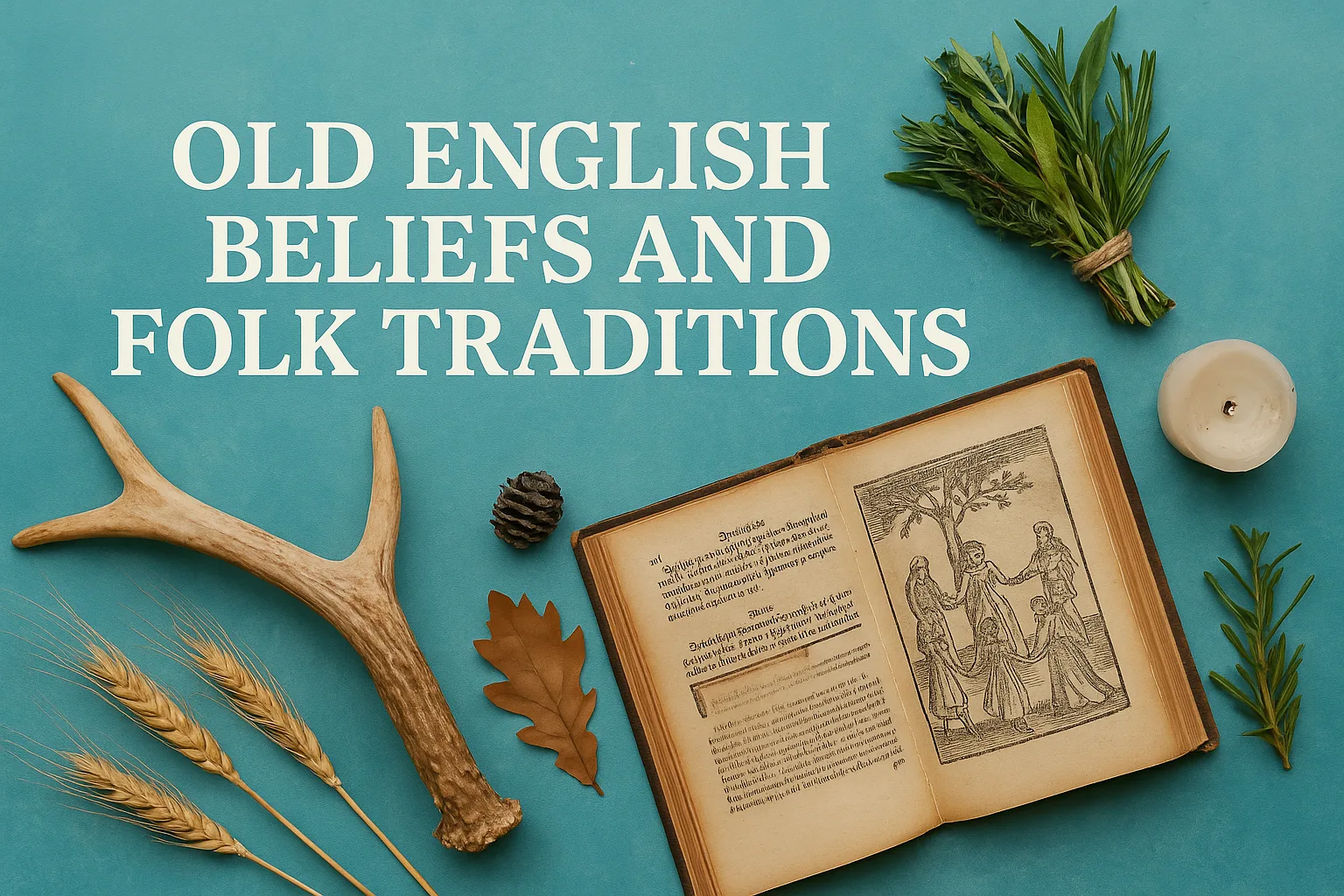
When we talk about Old English beliefs and folk traditions, we are stepping into a world where fields, forests, firelight and family all carried deep meaning. For the people who spoke Old English, life was woven together with stories about fate, unseen spirits, seasonal customs and quiet little rituals that made the world feel safer and more friendly.
Old English Belief: A World That Felt Alive
Early medieval communities in England did not separate “religion” from “daily life” the way many people do today. Their beliefs grew out of the land they farmed, the halls they gathered in, and the stories they heard from elders. They inherited ideas from older Germanic cultures and reshaped them in the English landscape of woods, moors and river valleys.
A key idea was wyrd, often translated as fate or personal destiny. It did not mean a fixed script written long ago. Instead, people saw life as a web of causes and choices, constantly unfolding.
Quick picture in your mind: imagine a woven cloak. Every thread is a choice, an accident, a meeting on a muddy road. Old English people felt that wyrd was the pattern slowly appearing in that cloth.
The Thread of Fate: Understanding Wyrd
In Old English thought, wyrd was powerful but not cold or distant. People believed:
- Past actions helped shape what might come.
- Courage, loyalty and generosity still mattered, even if the final outcome was uncertain.
- Great poems and stories often showed heroes wrestling with their destiny, yet acting bravely anyway.
This meant everyday life was full of quiet questions: “Is this a sign?” “Is this my chance?” People did not only look at fate in big battles or dramatic events; they also felt wyrd close by in travel, trade, health, friendship and family choices.
Short takeaway: for Old English speakers, fate was not a locked door. It was more like a path twisting through the woods, where each step still counted.
Gods, Spirits and a Talking Landscape
Old English communities lived in a polytheistic world view with a rich group of powers and beings. Many people honoured deities now known from later sources as Woden, Thunor and Tiw, alongside other divine figures. At the same time, the land itself seemed full of presence: hills, springs, trees and mists might shelter unseen neighbours.
- Woden – linked with wisdom, knowledge, and powerful insight.
- Thunor – associated with thunder and storms, a strong protector against harmful forces.
- Tiw – connected with honor, oaths and fair dealing.
- Elves (ælfe) – mysterious beings thought to affect health, luck and the natural world.
- Water beings and strange creatures – spirits linked to bogs, rivers, misty lakes and deep pools.
To Old English eyes, the countryside was never just “empty nature”. A long barrow, a dark pool, a twisted old tree – these might all whisper of stories, ancestors and otherworldly guests. Even today, when you walk in rural England on a misty evening, some corners of the land still feel like that, a little thick with old presence.
Helpful, Harmful… or Simply Nearby?
Many beings in Old English folk belief were not completely “good” or “bad”. Instead, they were powerful neighbours. If people showed respect, kept promises, and avoided certain risky places or times, they hoped for protection and support. Careless behaviour, on the other hand, might invite illness, bad luck or strange troubles.
This attitude encouraged politeness toward the unseen world: greeting certain spots, avoiding loud boasting in lonely places, or leaving small offerings of food or drink at special times of year.
Folk Magic, Charms and Everyday Protection
One of the most fascinating windows into Old English belief comes from metrical charms – healing and protective verses written in Old English. These short texts mix spoken formulas, instructions for herbs or salves, and symbolic actions. They show how people tried to keep themselves, their families and their animals safe.
Typical Shape of a Charm
- Address the problem – a pain, a fever, a fear, even an “attack” from unseen forces.
- Name the cause – sometimes a spirit, sometimes an elf, sometimes a general “harm”.
- Speak a strong command – ordering the problem to leave.
- Use a physical action – mixing herbs, making a drink, drawing a sign.
- Seal the effect – with final words of blessing and confidence.
Modern Echoes You May Recognise
- Whispering a hopeful phrase before a big exam.
- Carrying a lucky charm or special stone.
- Using herbal teas to “support” sleep or digestion.
- Hanging a symbol near the door “for good luck”.
These habits feel natural because they grow from the same human wish: to shape uncertainty just a little.
Tip for today’s traveller in England: when you visit a museum and see short Old English texts about healing or protection, you are looking at the everyday magic of real people – not just distant legend.
Seasons, Festivals and the Rhythm of the Year
Old English folk traditions followed the agricultural year. Important moments in farming and in the light–dark cycle often carried special customs: extra food, songs, blessings, bonfires or gatherings in the hall.
Midwinter: Fires, Feasts and New Beginnings
At midwinter, when nights were longest, people needed warmth and hope. Many communities marked this time with:
- Bright fires to push back the darkness.
- Shared feasts to strengthen bonds within the household and neighbourhood.
- Stories of ancestors and heroes that reminded everyone of courage and generosity.
- Little signs of renewal – evergreens, special breads, or small gifts.
If you join a winter festival or market in England today, with lights, song and warm drinks, you are seeing a modern shape built over very old human needs.
Spring and Summer: Water, Blossoms and Fields
As days grew longer, attention moved to growth and good weather. Old customs often involved:
- Trees and blossoms – decorating living branches, walking out into green places.
- Wells and springs – treating certain waters as special, refreshing and lucky.
- Fields and boundaries – walking the edges of land, marking and blessing them for a good harvest.
Even today, some English villages keep traditions like well dressing, village fairs and summer processions. While details changed over centuries, the heart of these customs – caring for land and community – would feel familiar to an Old English farmer.
Omens, Dreams and Everyday Decisions
Old English people did not have instant forecasts or phones, but they had sharp eyes and long memory. They paid attention to patterns in nature and in human behaviour. Certain events felt like signs, especially when they arrived suddenly or at important moments.
- Birds appearing at the right (or wrong) time.
- Unusual animal behaviour near a house or path.
- Sudden changes in weather during a journey.
- Striking dreams before travel, trade or important meetings.
People also listened to chance words – phrases overheard when they were about to choose a path or make a bargain. It was as if the world spoke back in small, sideways ways, and wise people learned to listen without becoming afraid of every little thing.
From Old English Folk Traditions to Modern Life
Many Old English beliefs faded, blended or changed shape over time, yet some traces are still easy to notice if you know where to look.
- Day names – in modern English, Tuesday, Wednesday and Thursday echo Tiw, Woden and Thunor.
- Fairy and elf stories – later British tales of fairies, elf-shot and enchanted rings of mushrooms may carry distant memories of older beliefs in elves and nature spirits.
- Herbal remedies – using plants for comfort and healing remains common, even if modern explanations are more scientific.
- Household rituals – many families still have “good luck” habits when moving house, travelling or starting something new.
All of these are like faint footprints on a well-used path. The modern world has walked over them many times, yet the original steps are still just visible if you look closely.
Core Concepts of Old English Belief
| Concept | Old English Term | Main Idea | Modern Echo |
|---|---|---|---|
| Fate / Destiny | Wyrd | Life as a woven pattern shaped by past actions and present courage. | Talking about “everything happening for a reason”, yet still choosing bravely. |
| Elves & spirits | Ælfe | Unseen neighbours affecting health, luck and the landscape. | Fairy stories, tales of “energy” in certain places. |
| Protective speech | Metrical charms | Spoken verses plus herbs or gestures to drive away harm. | Mantras, affirmations, saying “fingers crossed” or similar phrases. |
| Seasonal customs | Feasts & gatherings | Marking turning points of the year with fire, food and blessing. | Winter markets, village fairs, seasonal festivals. |
| Reading signs | Omens & dreams | Watching nature and chance events for hints about choices. | “I had a feeling”, noticing “little signs” before decisions. |
How You Can Experience These Traditions Today in England
If you travel in England and want to feel the quieter layer of Old English belief beneath modern life, you can look and listen in simple, practical ways.
- Visit local museums – look for displays on early medieval England, Old English language, charms and runic inscriptions.
- Notice place-names – names with “-hurst”, “-den”, “-ley” or “-wood” often hint at woodland, valleys or clearings that once felt very alive to people.
- Walk old paths – country footpaths, church ways or ridge routes may follow much older tracks linking farms, ritual spots and gathering places.
- Join seasonal events – village fairs, midsummer celebrations or winter lights festivals keep the rhythm of the year turning.
- Listen for folk stories – guided walks, local storytellers and small bookshops can reveal tales that still carry traces of Old English folklor.
Traveler’s note: when you stand on a hill at sunset in rural England, try this small exercise. Stay quiet for a moment. Notice the sounds, the wind, the shape of the land. Then imagine how it might feel if every ridge and tree were part of a story about fate, spirits and home. That is the feeling Old English beliefs once wrapped around daily life.
Bringing Old English Wisdom Into Your Own Life
Old English beliefs and folk traditions grew from real needs: to face uncertainty, to care for land, to protect loved ones and to find meaning in the flow of days. You do not need to share those exact beliefs to learn from them.
- Value your choices – like wyrd, your life is shaped by both chance and courage.
- Pay attention to place – treat your surroundings as meaningful, not just as background.
- Keep gentle rituals – small repeated actions can calm the mind and strengthen community.
- Share stories – telling and listening to stories, as in the old halls, helps people feel less alone.
Seen this way, Old English beliefs and folk traditions are not only about distant centuries. They are about the basic human wish to feel at home in the world – a wish that still quietly shapes how many of us live, travel and dream today.