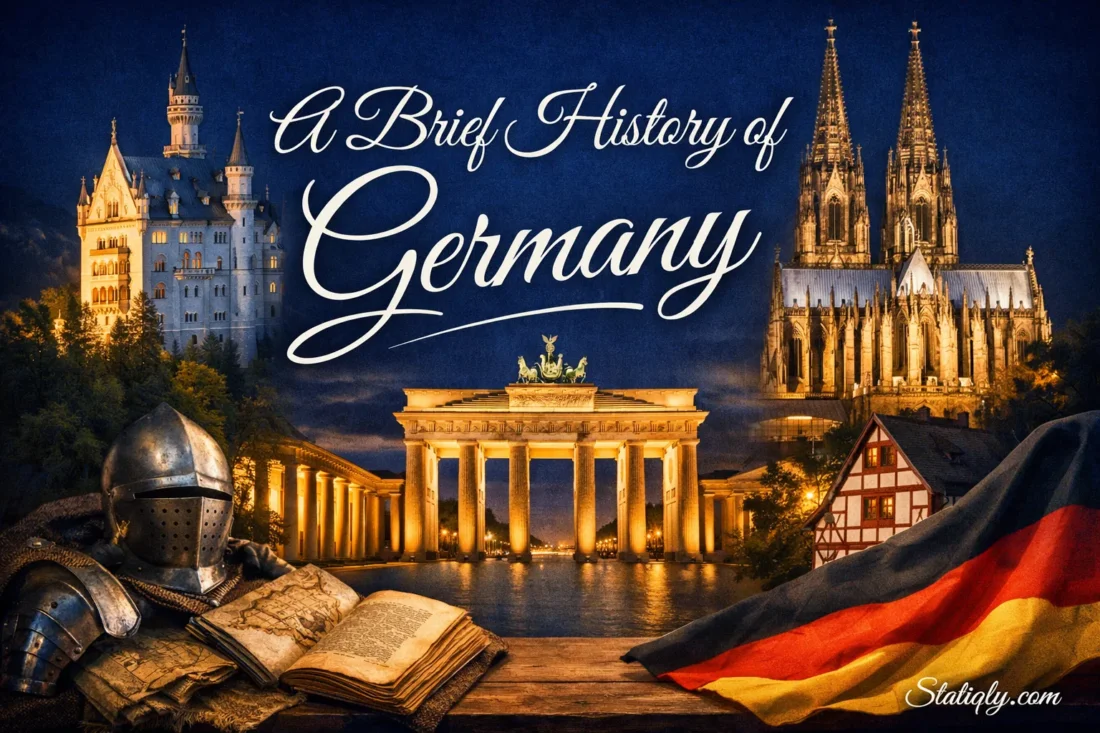
Germany’s history can feel like a long walk through changing landscapes: river valleys, market squares, and workshops where ideas turn into real things. What makes it so compelling? The story is not one straight line. It’s more like a braided river—many streams flowing side by side, sometimes meeting, sometimes splitting again.
This brief guide follows those streams from early communities to a modern country known for craft, learning, and innovation. You will see how towns grew, how books traveled, how music filled halls, and how design reshaped daily life.
| Timeframe | What Was Taking Shape | What You Still Notice Today |
|---|---|---|
| Before 962 | Early communities, Roman-era influences in the west and south, the rise of towns and monasteries | Old trade routes, cathedral towns, regional identities |
| 962–1500 | A shared cultural world across many territories; city charters, guild life, universities | Historic city centers, town halls, crafts and local traditions |
| 1450s–1600s | Printing spreads ideas; religious debate reshapes education and everyday reading | Libraries, book culture, university cities |
| 1700s–1800s | Enlightenment thinking, classical music, industrial workshops and railways | Museums, concert halls, industrial heritage sites |
| 1900s | Modern design and architecture; new approaches to social life and education | Modernist buildings, influential schools of art and design |
| 1949–Today | Modernist buildings, influential schools of art and design | |
| 1949–Today | Democratic constitutional system (Basic Law, May 1949); reunification (October 3, 1990); research-driven economy | Federal states, strong apprenticeships, world-class engineering and science |
Landscapes That Guide the Story
Germany sits at a meeting point of European regions, and geography quietly directs the plot. The Rhine carried trade and stories. The Danube linked communities across long distances. Forests, hills, and plains shaped where people settled and how they traveled.
Over centuries, villages clustered into towns, and towns learned to organize themselves. Markets needed rules. Crafts needed standards. That is where guilds and city charters mattered—not as abstract concepts, but as everyday tools that made life smoother.
Why So Many Regions Feel Distinct
Germany was never a single “one-size-fits-all” space in the way many people imagine. Dialects, building styles, and food traditions formed around rivers, mountains, and trade corridors. Think of it like a mosaic: one picture, many pieces—each with its own color.
Medieval Towns, Trade, and Shared Culture
From the Middle Ages onward, German-speaking lands built dense networks of towns. Many places became known for a signature craft—metalwork, textiles, glass, or printing. Town halls and churches rose as landmarks, but the real engine was daily cooperation: training apprentices, setting quality rules, and connecting buyers with makers.
In the north, the Hanseatic League helped cities trade across the Baltic and North Sea. The details varied city by city, yet the wider effect was clear: reliable routes, shared business habits, and a growing sense that learning and commerce could travel together.
- City charters encouraged local self-organization and practical law
- Guilds protected standards and built strong training cultures
- Trade leagues connected cities and spread urban know-how
A Patchwork of Territories, One Cultural Conversation
In 962, Otto I was crowned emperor, and the Holy Roman Empire emerged as a long-standing political structure across Central Europe. It did not function as a single modern nation-state. Instead, many territories—duchies, bishoprics, free cities—shared a broad cultural space where law, faith, and scholarship could circulate.
Universities strengthened that shared conversation. Heidelberg (founded in 1386) is a classic example of how learning became an anchor for whole regions. Students and teachers moved from town to town, carrying methods, books, and ideas.
Small Details That Tell Big Stories
Look for the “quiet” clues: a town seal on an old document, a guild sign above a doorway, a university crest carved into stone. These are not just decorations. They are footprints of how communities learned to cooperate.
Printing, Reading, and the Reformation Era
Few inventions changed German lands as quickly as printing with movable type in the mid-1400s, closely tied to Johannes Gutenberg of Mainz. Suddenly, texts could travel faster than messengers. Literacy gained momentum, and cities with printers became idea hubs.
In 1517, Martin Luther’s Ninety-five Theses are traditionally dated to October 31. Whether you focus on the exact moment or the wider movement, the key point is simple: public debate, education, and reading habits expanded. People wanted to understand texts for themselves, and schools and universities responded.
- More books meant more shared references across regions
- More readers meant stronger schools and broader learning
- More debate meant fresh energy in writing, music, and public discussion
From Enlightenment Salons To Industrial Workshops
By the 1700s, German-speaking Europe was producing influential work in philosophy, music, and science. The Enlightenment encouraged curiosity and careful thinking. Composers, poets, and scholars shaped a cultural legacy that still draws visitors to concert halls and museums today.
In the 1800s, industrialization accelerated. Railways shortened distances. New factories and laboratories turned craft knowledge into modern engineering. In 1871, many German states united into the German Empire, and the idea of “Germany” took shape as a more clearly defined national structure—without erasing regional character.
Music and Public Life
Opera houses, orchestras, and civic choirs grew into cultural institutions. Music became a shared language across social classes—formal in some places, proudly local in others.
Science and Engineering
Universities and laboratories helped Germany become a leader in chemistry, physics, and applied engineering. The habit of combining theory with practical testing became a lasting strength.
Work, Training, and Skills
Apprenticeships and technical schools strengthened a skills-first mindset. It’s a tradition that still shapes how many people learn trades and professions today.
Modern Design, New Cities, Fresh Ideas
The 1900s brought major changes in how Germans built, studied, and lived. One of the clearest examples is the Bauhaus, founded in 1919 in Weimar. Its approach was bold but simple: make design useful, make it elegant, and let form follow function.
You can still feel that influence in clean typography, modern furniture, and buildings that prefer light and space over heavy decoration. It’s history you can almost touch—like a well-made chair that feels right the moment you sit down.
A Civic Structure That Shaped the Present
In May 1949, the Basic Law (Germany’s constitutional foundation) was adopted. Over time it helped structure public life around clear institutions and individual rights. Later, on October 3, 1990, Germany reunified—an important date that many Germans mark as a national holiday.
A Simple Way To Read Germany’s Timeline
- If a place feels medieval, look for guild houses, market squares, and cathedral quarters
- If a place feels industrial, look for rail hubs, old factories, and technical museums
- If a place feels modernist, look for Bauhaus-era design and clean architectural lines
How To Experience German History Without Getting Lost
If you want the history of Germany to feel real, focus on places where different eras sit close together. Ask yourself one question as you explore: What stayed the same, even as everything changed?
- Old towns for medieval planning, stone gates, and market-day traditions
- University cities for libraries, lecture halls, and long-running academic culture
- Workshops and craft districts for the apprenticeship mindset in action
- Design-focused museums for Bauhaus and modern German aesthetics
- Industrial heritage sites for the shift from handcraft to modern production
Germany rewards slow attention. A street name, a city crest, a font on an old sign—these tiny details can open a whole chapter. And once you notice them, you start seeing the country’s past everywhere, woven into ordinary life.