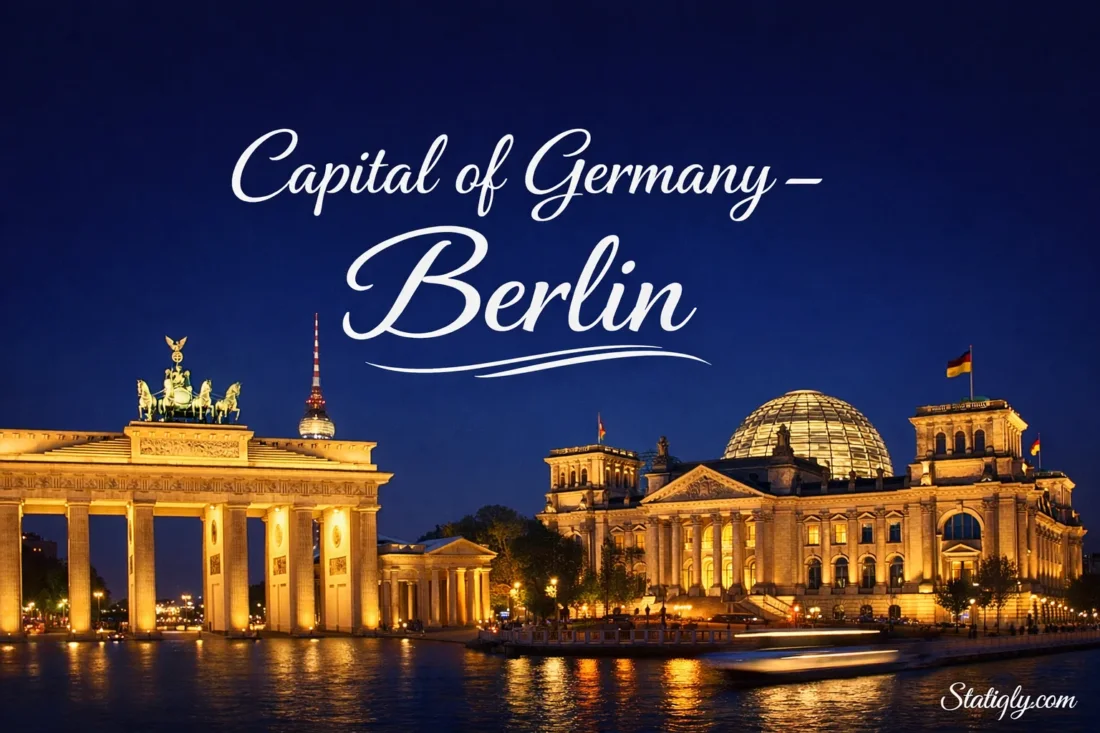
The capital of Germany is Berlin, a large city in northeastern Germany known for its museums, public spaces, waterways, distinctive neighborhoods, and extensive transport network. Berlin is both a city and one of Germany’s federal states. With about 3.7 million residents, it is also Germany’s largest city by population. Its role as the German capital places it at the center of national life, while everyday Berlin often feels much more local, shaped by individual neighborhoods, parks, streets, cafés, galleries, and waterways.
| Berlin Fact | Detail |
|---|---|
| Country | Germany |
| Capital City | Berlin |
| Population | About 3.7 million |
| Area | About 891 square kilometers |
| Administrative Divisions | 12 boroughs |
| Official Language | German |
| Currency | Euro (€) |
| Main Rivers | Spree, Havel, and Dahme |
| Time Zone | Central European Time, with summer daylight saving time |
Berlin as the Capital of Germany
Berlin is Germany’s national capital and one of the country’s best-known urban centers. It covers roughly 891 square kilometers, giving the city enough room for dense central neighborhoods as well as forests, lakes, rivers, residential districts, and quieter areas farther from the center.
This scale can surprise first-time visitors. Berlin does not revolve around a single compact downtown area in the way some capitals do. Instead, activity is spread across several districts and neighborhood centers. Alexanderplatz, Potsdamer Platz, Charlottenburg, Kreuzberg, Friedrichshain, Prenzlauer Berg, and other areas can each feel like a separate piece of the city.
Berlin is also a city-state. In practical geographic terms, this means Berlin is both a municipality and one of Germany’s 16 federal states. The surrounding German state is Brandenburg.
Where Berlin Is Located in Germany
Berlin lies in northeastern Germany. Its position is noticeably farther east than several other major German cities, including Hamburg, Cologne, Frankfurt, and Munich.
The landscape is relatively flat, and water plays a visible role in the shape of the city. The Spree River passes through central Berlin, while the Havel and Dahme form other important parts of the local water system. Lakes and canals add even more water to the cityscape.
Water covers roughly 6.6 percent of Berlin’s total area. More than 600 bridges cross the city’s rivers, canals, and other waterways. So although Berlin is usually pictured through streets and buildings, water is never very far away.
Berlin’s Size and Population
Berlin had approximately 3.7 million residents at the end of 2025. The population is spread across an area of about 891 square kilometers.
The numbers tell only part of the story. Some parts of central Berlin have tightly packed apartment buildings, busy shopping streets, rail stations, and public squares. Travel toward the outer districts and the scenery can change quickly. Houses, woodland, lakes, gardens, and lower-density neighborhoods become far more common.
That contrast is one of Berlin’s defining physical traits: a major European capital can suddenly feel surprisingly green and open.
The 12 Boroughs of Berlin
Berlin is divided into 12 boroughs. Each covers several neighborhoods and localities rather than representing one uniform urban environment.
- Mitte
- Friedrichshain-Kreuzberg
- Pankow
- Charlottenburg-Wilmersdorf
- Spandau
- Steglitz-Zehlendorf
- Tempelhof-Schöneberg
- Neukölln
- Treptow-Köpenick
- Marzahn-Hellersdorf
- Lichtenberg
- Reinickendorf
For everyday orientation, Berliners also use neighborhood and locality names. The German word Kiez is often used for a small neighborhood with its own local character. A person may identify closely with a particular Kiez even while living inside a much larger borough.
Mitte contains many central sights and institutions, while boroughs such as Treptow-Köpenick extend into areas with extensive woodland and water. Charlottenburg-Wilmersdorf mixes major shopping streets with residential areas and green space. Pankow stretches from inner-city neighborhoods toward the northern edge of Berlin. Different in scale and atmosphere, each one.
Brandenburg Gate and Central Berlin
The Brandenburg Gate is one of the most recognizable landmarks in Berlin. It stands beside Pariser Platz and provides an easy geographic reference point for exploring the central part of the city.
Nearby streets connect visitors with several other well-known parts of central Berlin. Unter den Linden, a broad historic boulevard, extends eastward through the city center. Tiergarten, Berlin’s large central park, lies to the west.
Another major urban center is Alexanderplatz, recognizable partly because of the nearby Berlin TV Tower. The square is an important meeting point and transport hub, with rail, underground, tram, and bus connections bringing together routes from different parts of the city.
Museum Island and Berlin’s Cultural Side
Berlin has a large concentration of museums, galleries, performance venues, and cultural institutions. One of its best-known museum areas is Museum Island in the historic center.
Museum Island sits on the Spree and is recognized as a UNESCO World Heritage Site. Its historic ensemble includes five major museum buildings. Collections on the island cover archaeology, sculpture, art, and material from different periods and regions.
Culture in Berlin is not limited to this museum district. Smaller galleries, theaters, concert spaces, libraries, independent exhibition venues, and creative spaces are spread throughout the city. That distribution mirrors Berlin itself: many things worth seeing are not gathered in one central zone.
A Capital Filled With Parks, Forests, and Water
Berlin’s urban image includes plenty of concrete, railways, apartment blocks, and broad streets, yet green areas occupy a large part of the city. Parks and wooded areas appear across both central and outer Berlin.
Tiergarten is the best-known large park near the center. Farther out, substantial forest areas can be found around Grunewald, Köpenick, Spandau, Reinickendorf, and other districts.
Berlin also has numerous lakes. Müggelsee, in Treptow-Köpenick, is the largest lake in the city and covers about 7.4 square kilometers. Other waterways form natural breaks between neighborhoods and give many areas a calmer feel than their position inside a large capital might suggest.
Getting Around Berlin
Berlin has an interconnected public transport system built around several types of service. Travelers can move between different parts of the city using:
- U-Bahn underground and urban rail services
- S-Bahn city and suburban trains
- Trams, particularly common in eastern areas of Berlin
- Buses serving routes throughout the city
- Ferries on selected waterways
- Regional and long-distance railway services
The U-Bahn alone has nine lines and about 175 stations. S-Bahn services reach both central districts and suburban areas. The systems connect at many stations, making transfers between rail, underground, tram, and bus routes part of normal city travel.
Berlin’s size still matters. Two places that appear to be in the same city can be many kilometers apart, so checking the district and transport connection is often more useful than simply looking for “central Berlin.”
What Language Is Spoken in Berlin?
German is the official language used in Berlin. It appears on public information, official documents, signs, transport information, and everyday services.
As a large international city, Berlin is also home to people who speak many other languages. English is commonly encountered in parts of the tourism, hospitality, university, and international business sectors, but German remains the main language of the city.
What Currency Does Berlin Use?
Berlin uses the euro (€), the national currency of Germany. Prices for transport, accommodation, food, museum admission, shopping, and other services are therefore listed in euros.
Berlin’s Time Zone
Berlin follows Central European Time (CET) during the standard-time period. During the warmer part of the year, Germany uses Central European Summer Time (CEST) under daylight saving time.
This places Berlin in the same general time zone as many other major Central European cities.
Why Berlin Feels Different Across the City
Berlin is less like one continuous center and more like a collection of connected urban areas. A short train journey can take someone from dense shopping streets to quiet residential blocks, then onward to forest paths or lakeside neighborhoods.
Architecture changes too. Broad avenues, modern developments, older apartment neighborhoods, detached homes, public squares, industrial conversions, and contemporary buildings all appear within the city limits.
This decentralized pattern explains why two travelers can visit Berlin and come away with very different impressions. One may spend most of the time around museums and central landmarks. Another may remember parks, neighborhood cafés, waterways, local markets, or long rides across the city.
Frequently Asked Questions About Berlin
What Is the Capital of Germany?
Berlin is the capital of Germany. It is located in the northeastern part of the country and is surrounded by the German state of Brandenburg.
How Many People Live in Berlin?
Berlin had about 3.7 million residents at the end of 2025, making it Germany’s largest city by population.
How Large Is Berlin?
Berlin covers approximately 891 square kilometers. Its large municipal area includes dense urban neighborhoods, parks, forests, rivers, canals, and lakes.
How Many Boroughs Does Berlin Have?
Berlin has 12 boroughs. Each borough contains several smaller neighborhoods or localities, giving different parts of Berlin their own recognizable character.
Which River Runs Through Berlin?
The Spree River runs through central Berlin. The Havel and Dahme are also major rivers within the city, while numerous canals and lakes form part of Berlin’s extensive network of waterways.
What Is Berlin Best Known For?
Berlin is widely known for landmarks such as the Brandenburg Gate, cultural areas such as Museum Island, its large public transport network, extensive parks, waterways, museums, and neighborhood-based city life.
Is Berlin Both a City and a State?
Yes. Berlin is a city and one of Germany’s 16 federal states. This city-state status is one of the geographic and administrative features that distinguishes Berlin from many other German cities.