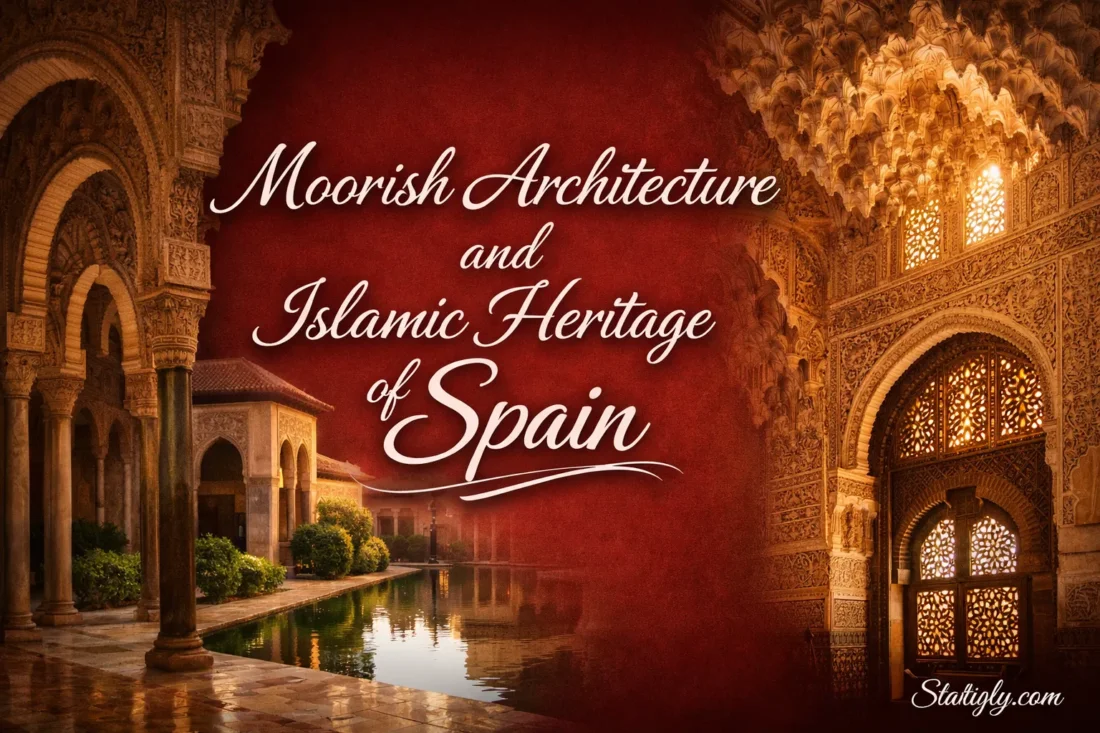
Spain’s Islamic heritage is written in stone, tile, wood, and water. Walk into a courtyard and you feel it at once: cool shade, a soft trickle of fountains, geometry that seems to go on forever. This is often called Moorish architecture, shaped over centuries in al-Andalus and carried forward through Mudéjar craft. Want to recognize it quickly, understand what you’re seeing, and plan a smart route? You’re in the right place.
What You’ll Notice First
- Horseshoe and multi-lobed arches that frame doorways like elegant gateways.
- Courtyards with water—reflecting pools, channels, and fountains that calm the space.
- Layered decoration: carved plaster, glazed tiles, and wood ceilings that reward slow looking.
Landmarks That Bring Islamic Heritage To Life
| Place | City / Area | Approximate Era | What To Look For | UNESCO Recognition |
|---|---|---|---|---|
| Alhambra and Generalife | Granada | 13th–14th centuries | Courtyards, calligraphy bands, muqarnas, gardens and water channels | Yes |
| Great Mosque–Cathedral | Córdoba | Late 8th–10th centuries (major phases) | Forest of columns, double-tier arches, rhythm and repetition | Yes |
| Medina Azahara | Near Córdoba | Mid-10th century | Palace-city layout, ceremonial halls, terraces, carved stone details | Yes |
| Real Alcázar | Seville | 14th century highlights (with older roots) | Mudéjar patios, tilework, delicate stucco, garden rooms | Yes (as part of a larger group) |
| Giralda | Seville | Late 12th century | Minaret form, geometric surface patterns, soaring proportions | Yes (as part of a larger group) |
| Aljafería | Zaragoza | 11th century origins; later Mudéjar features | Arches, courtyards, and Mudéjar craftsmanship within the palace | Yes (Mudéjar Architecture of Aragón) |
Signature Elements You Can Spot In Minutes
Shapes and Structure
- Horseshoe arches that curve inward, often framed by an alfiz (a rectangular outline).
- Multi-lobed and interlaced arches that feel like architectural lacework.
- Hypostyle halls (many columns) that create a “walking-through-a-grove” feeling.
- Courtyard planning: rooms arranged around a central patio for light and airflow.
- Towers that began as minarets and later inspired bell-tower silhouettes.
Surface and Detail
- Carved plaster (stucco) with flowing arabesques and precise geometry.
- Calligraphy bands used as decoration—beautiful even when you can’t read it.
- Glazed tilework that catches light and protects walls at the same time.
- Muqarnas ceilings that look like honeycombs or folded stars.
- Light control: screens, small openings, and layered spaces that keep interiors comfortable.
A Quick “Look-Again” Trick
Stand still for ten seconds. Then look again—this time for repetition. Moorish design loves patterns that return like a chorus: arches echo arches, tiles mirror tiles, and lines lead your eyes toward water or light. It’s like reading a poem where the rhyme is visual.
Water and Gardens: The Quiet Engine Of Moorish Design
Why does water show up so often? Because it works on multiple levels at once. It cools the air, softens sound, and turns courtyards into calm, reflective worlds. In places like Granada’s palatial gardens, narrow channels and long pools guide your movement—almost like a gentle arrow pointing you from one space to the next.
- Reflecting pools double the beauty of arches and façades.
- Fountains create a steady, relaxing rhythm without overpowering conversation.
- Garden geometry makes nature feel ordered—paths, hedges, and water lines in balance.
Mudéjar: Where Islamic Craft and Spanish Tradition Meet
Mudéjar is one of Spain’s most fascinating bridges. It’s a style where Islamic decorative language—brick patterns, glazed tiles, carved wood, stucco—appears in buildings commissioned in later centuries. The result feels seamless: a Spanish palace or church tower that still speaks with Andalusi rhythm.
Easy Mudéjar Clues
- Brick as decoration, not just structure.
- Glazed tile panels used like colorful punctuation on walls.
- Wood ceilings with star-like patterns.
- Arches with framed edges that feel both crisp and ornate.
Where It Shines
- Seville: palace courtyards and tiled rooms that feel made for slow wandering.
- Zaragoza and Aragón: brick-and-tile mastery across multiple monuments.
- Teruel: towers and roofs that make brickwork feel almost weightless.
A Simple Route For First-Time Explorers
Not sure where to start? Pick a route that matches your time and energy. Think of these places as chapters in the same book—each city adds a new texture, a new pattern, a new kind of light.
2 Days: Córdoba + Seville
- Córdoba: focus on arches, columns, and spatial rhythm.
- Seville: focus on courtyards, tiles, and garden layouts.
- Best For: seeing two “core styles” without rushing.
3 Days: Granada + Córdoba
- Granada: palatial detail, muqarnas, and water-focused gardens.
- Córdoba: monumental scale and masterful engineering.
- Best For: the richest “wow” moments in a short trip.
Bonus: Zaragoza + Teruel
- Zaragoza: palace craftsmanship and brick artistry.
- Teruel: towers, roofs, and tilework that feel uniquely local.
- Best For: Mudéjar lovers who want something different from Andalucía.
Practical Tips For A Smooth Day Out
- Reserve ahead for the most popular sites—timed entry is common, and demand can be high.
- Arrive with a simple goal: one detail to focus on (arches, tiles, ceilings, or water). You’ll notice more.
- Bring comfortable shoes. These historic complexes reward wandering—often on stone floors.
- Choose softer hours when you can. The play of light and shadow is part of the architecture.
- In sacred or quiet spaces, keep voices low and pauses longer. Respect makes the visit better for everyone.
- If you like context, a short guided tour can be perfect—think of it as a map for your eyes.
A Mini Glossary That Keeps Things Clear
- Al-Andalus: the historical name for Muslim-ruled parts of the Iberian Peninsula, a major center of art and learning.
- Mudéjar: architecture and decoration shaped by Islamic craft traditions in later Spanish buildings.
- Horseshoe Arch: an arch that curves inward; a signature form in Iberian Islamic architecture.
- Alfiz: a rectangular frame outlining an arch, adding crisp emphasis.
- Muqarnas: “honeycomb” vaulting used in ceilings and domes for a starry, sculpted effect.
- Sebka: repeating lattice-like surface pattern, often seen on towers and façades.