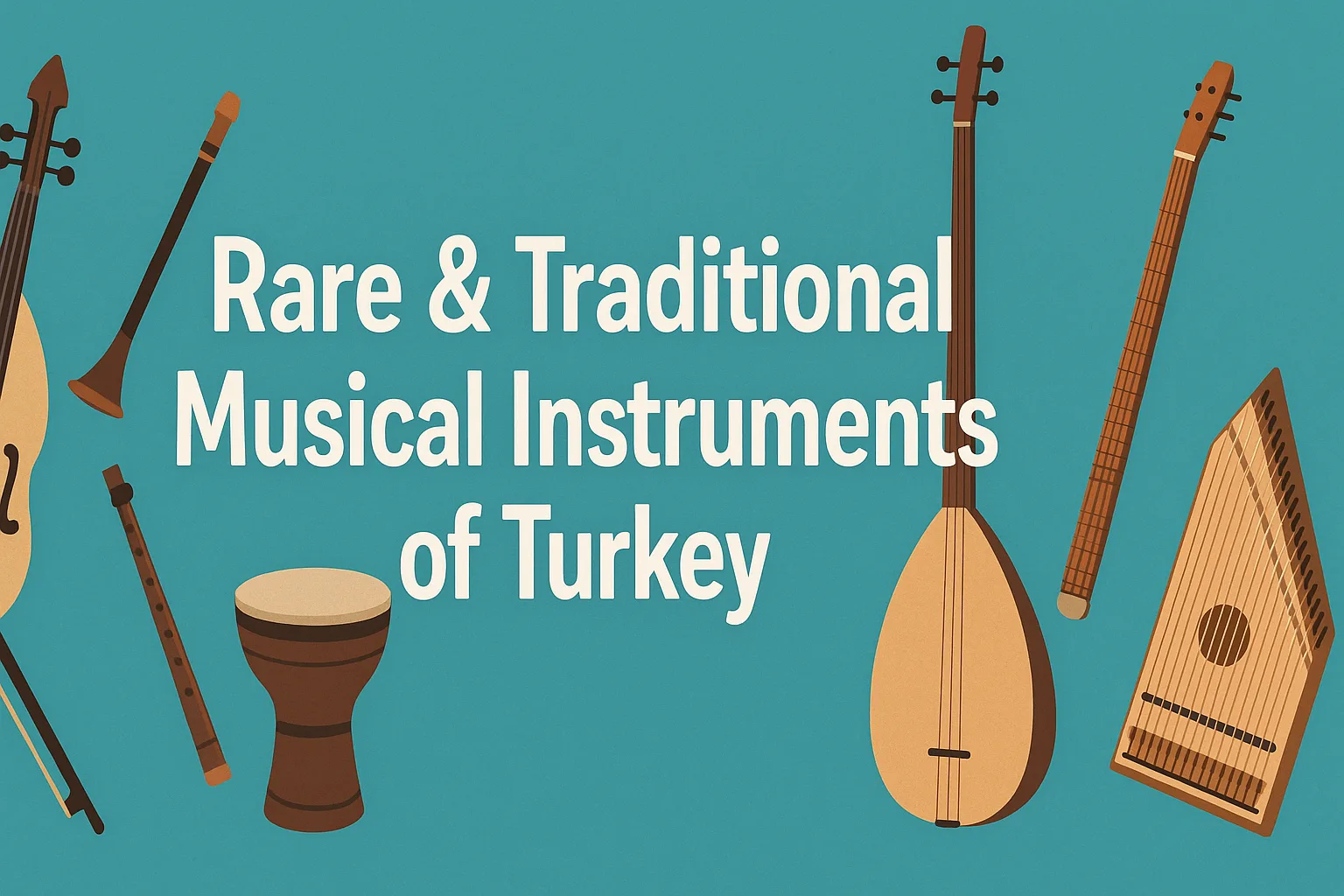
Echoes of Anatolia: A Journey Through Turkey’s Rare & Traditional Instruments
Have you ever heard a melody that feels like it’s pulling at a string inside your chest? That is the magic of Turkish music.
Turkey isn’t just a bridge between East and West geographically; it is a massive bridge of sound. From the misty mountains of the Black Sea to the sunny coasts of the Aegean, every region has a voice. And that voice is carried by instruments that have been crafted by hand and played with heart for centuries.
If you visit Turkey, you won’t just see history; you will hear it. Let’s dive into the wood, string, and skin that make these incredible sounds.
The Baglama (Saz): The Voice of the People
If Turkey had a national soul, it would look like a Baglama. You might hear people call it the Saz. It’s everywhere. It’s in the tea houses, on the radio, and in the hands of grandfathers sitting on village porches.
Think of the Saz as the guitar’s wiser, older cousin. It has a long neck and a deep, pear-shaped body. But here is the secret: it doesn’t just play notes. It plays the spaces between the notes. These are called microtones. To a Western ear, it might sound slightly “off” at first, but once you get it, standard music feels almost empty without it.
The Saz doesn’t just make music; it tells the stories of love, loss, and the dusty roads of Anatolia.
The Ney: Breath of the Spirit
Imagine a sound that is pure wind, yet sings. That is the Ney. It is a simple reed flute, one of the oldest instruments in existence.
Playing the Ney is incredibly difficult. You don’t blow into it; you blow across it. It requires patience. In the philosophy of Rumi (Sufism), the Ney represents the human soul crying to return to its source (God), just as the reed was cut from the reed bed and longs to return to the marsh.
- It is the primary instrument of the Whirling Dervishes.
- The sound is breathy, haunting, and incredibly calming.
- It looks simple—just a piece of cane—but mastering it takes a lifetime.
The Kemençe
Now, let’s speed things up! Head north to the Black Sea region, and you meet the Kemençe. It’s a small, bottle-shaped fiddle played vertically.
The music here is fast. Really fast. It mimics the choppy, energetic waves of the Black Sea and the quick temper of the people living there. When the Kemençe starts, nobody can stand still. It’s pure adrenaline in wooden form.
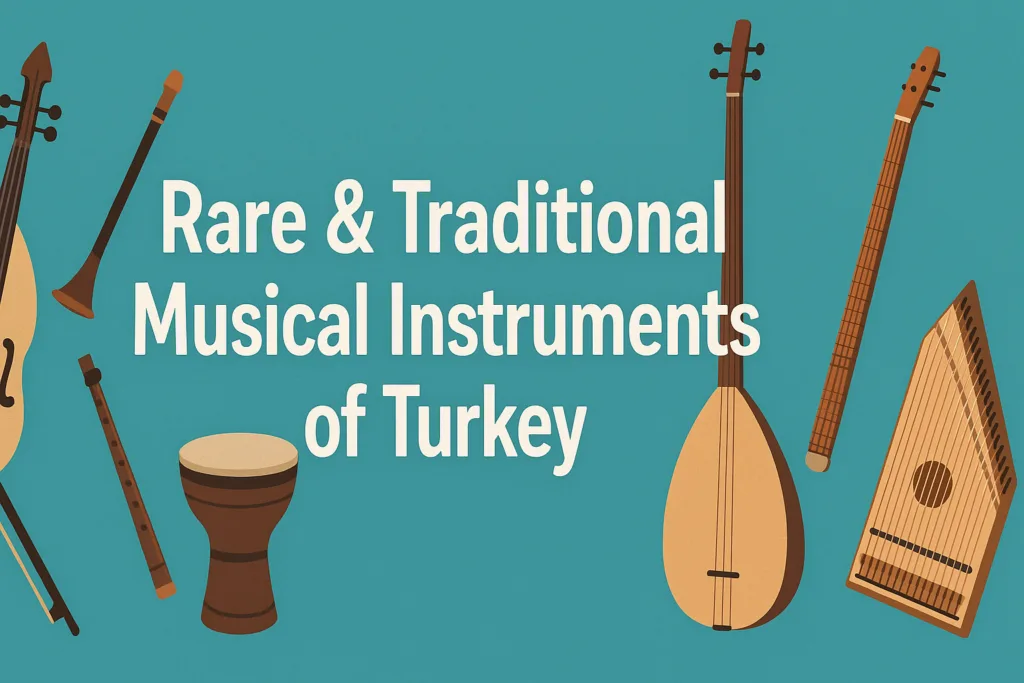
The Kanun
If the Saz is the guitar, the Kanun is the piano of the East. It is a trapezoid-shaped zither with 70+ strings.
The player wears metal picks on their index fingers and plucks the strings with incredible speed. It sounds like a waterfall of notes. What makes it special are the tiny levers (mandals) on the side. The musician flips them up and down while playing to change the pitch by tiny fractions. It creates a hypnotic rhtyhm that mesmerizes the listener.
Quick Guide: What Am I Hearing?
| Instrument | Family | Best Describes The Sound | Where You’ll Hear It |
|---|---|---|---|
| Saz (Baglama) | String | Deep, metallic, storytelling | Everywhere (Folk Music) |
| Ney | Wind | Breathy, spiritual, sad | Religious ceremonies, Classical |
| Zurna | Wind | Loud, piercing, celebratory | Village weddings |
| Kemençe | Bowed String | Fast, energetic, sharp | Black Sea folk dances |
| Kanun | String (Zither) | Sparkling, complex, royal | Classical Ottoman Music |
Did You Know?
There is an instrument called the Tulum. It is basically a Turkish bagpipe made from goat skin! While most people associate bagpipes with Scotland, the Tulum has been echoing through the mountains of Northeast Turkey for centuries. It produces a continuous, droning sound that is impossible to ignore.
Why Does This Matter?
Music in Turkey isn’t just entertainment. It is how people communicate feelings they can’t put into words. When you hear the Zurna (a loud woodwind) paired with a big drum, you know a wedding is happening three streets away. When you hear the Ney, you know it is time for reflection.
The next time you listen to a track, try to pick out these unique sounds. Are those strings snapping quickly? That’s the Kanun. Is there a deep, vibrating strum? That’s the Saz.
These instruments are the heartbeat of a culture that loves to express itself. They are rare treasures in a world of digital sounds.