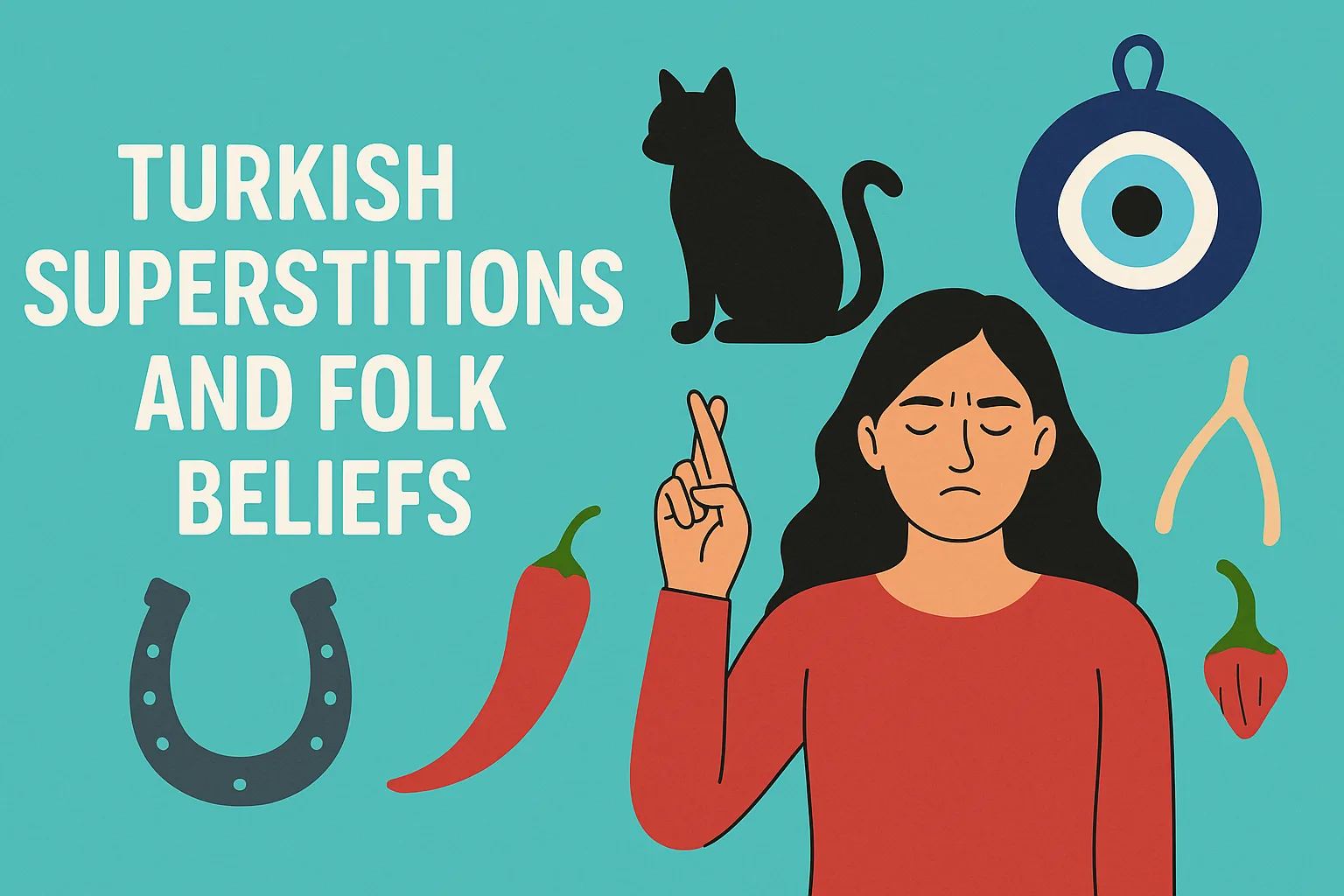
Walking Under Ladders? In Türkiye, It’s Much More Interesting
Ever wondered why your Turkish friend poured a glass of water behind your car as you drove away? Or why that blue eye is staring at you from every shop window?
Traveling across the rich landscapes of Anatolia, you quickly realize something profoundly beautiful: culture isn’t just history; it is a living, breathing habit. When I first stepped onto the cobblestones of Istanbul, I thought I knew about superstitions. I was wrong. Turkish folk beliefs are not just about fear or luck. They are a complex language of social kindness and ancient memory.
Unlike the western “step on a crack, break your mother’s back” style of rhymes, superstitions here—often called batıl inançlar—are deeply woven into hospitality. They are like invisible threads connecting people. Let’s dive into this mystical world without getting tangled in the details.
The Blue Gaze: The Nazar Boncuğu
You have seen it. That unmistakable blue glass bead with an eye in the center. It is everywhere. From the rearview mirrors of taxis to the collars of newborn babies. This is the Nazar Boncuğu (Evil Eye bead).
Here is the logic: Envy has power. If someone looks at your success, your beauty, or your new car with too much jealousy (even unintentionally), it causes bad energy. This little blue amulet acts like a shield. It absorbs the negative energy so you don’t have to. If the glass cracks, it means it worked! It took the hit for you. Simply replace it and carry on.
“Maşallah” (Mashallah) is the verbal shield. You will hear this spoken constantly when admiring a child or a beautiful home. It effectively means, “Let no bad energy touch this.”
Flow Like Water, Go and Come Back
This is one of my absolute favorites because it is so poetic. Picture this: You are leaving for a long trip. Your bags are packed. As you step out the door and get into the vehicle, a family member throws a jug of water behind you.
Why? To make a mess?
No. The sentiment is: “Su gibi git, su gibi gel.” (Go like water, come back like water). Water flows smoothly, finds its way easily, and returns to its source. It is a wish for a journey without obstacles. It’s a heartwarming way to say safe travels.
The Funny Rules of Daily Life
Daily life in Türkiye has a rhythm of small “do’s and don’ts” that keep the cosmic balance in check. Some are practical; others are pure folk magic.
| The Situation | The Meaning / Belief |
|---|---|
| Itchy Right Palm | Money is coming! You might receive a payment soon. |
| Itchy Left Palm | Money is leaving. Unexpected expense is on the way. |
| Slipper Upside Down | Bad luck for the house. Turn it over immediately! |
| Giving a Knife/Scissors | Never hand them directly to someone. It causes a fight. Put them on the table first. |
| Whistling at Night | Don’t do it. It is belived to call evil spirits into the home. |
Knocking on Wood: Tahtaya Vur!
This one is universal, but the Turks do it with extra flair. If you talk about a calamity, an illness, or a bad event that you want to avoid, you don’t just say “God forbid.”
- You gently pull your earlobe (to wake up your awareness).
- You make a kissing sound.
- You knock on wood three times.
It sounds complex, but it happens in a split second. Tuk-tuk-tuk. Safe.
Coffee Grounds: The Muddy Future
After sipping a strong, delicious Turkish coffee, the ritual isn’t over. You place the saucer over the cup, flip it upside down, and let it cool. The shapes left by the grounds (called telve) tell a story.
Is that a bird? News is coming. Is it a fish? Fortune or luck. A long road? Travel. While many people claim not to believe it fully, almost everyone enjoys the session. It is less about predicting the future and more about therapy between friends.
Why Does This Matter?
These beliefs are the glue of the community. They show that people care about each other’s safety, wealth, and future. Whether you are walking in Izmir or hiking in the Black Sea region, respecting these little quirks helps you blend in.
So, the next time someone hands you a pair of scissors and places them on the table rather than in your hand, don’t be offended. Smile. They just want to stay friends with you!