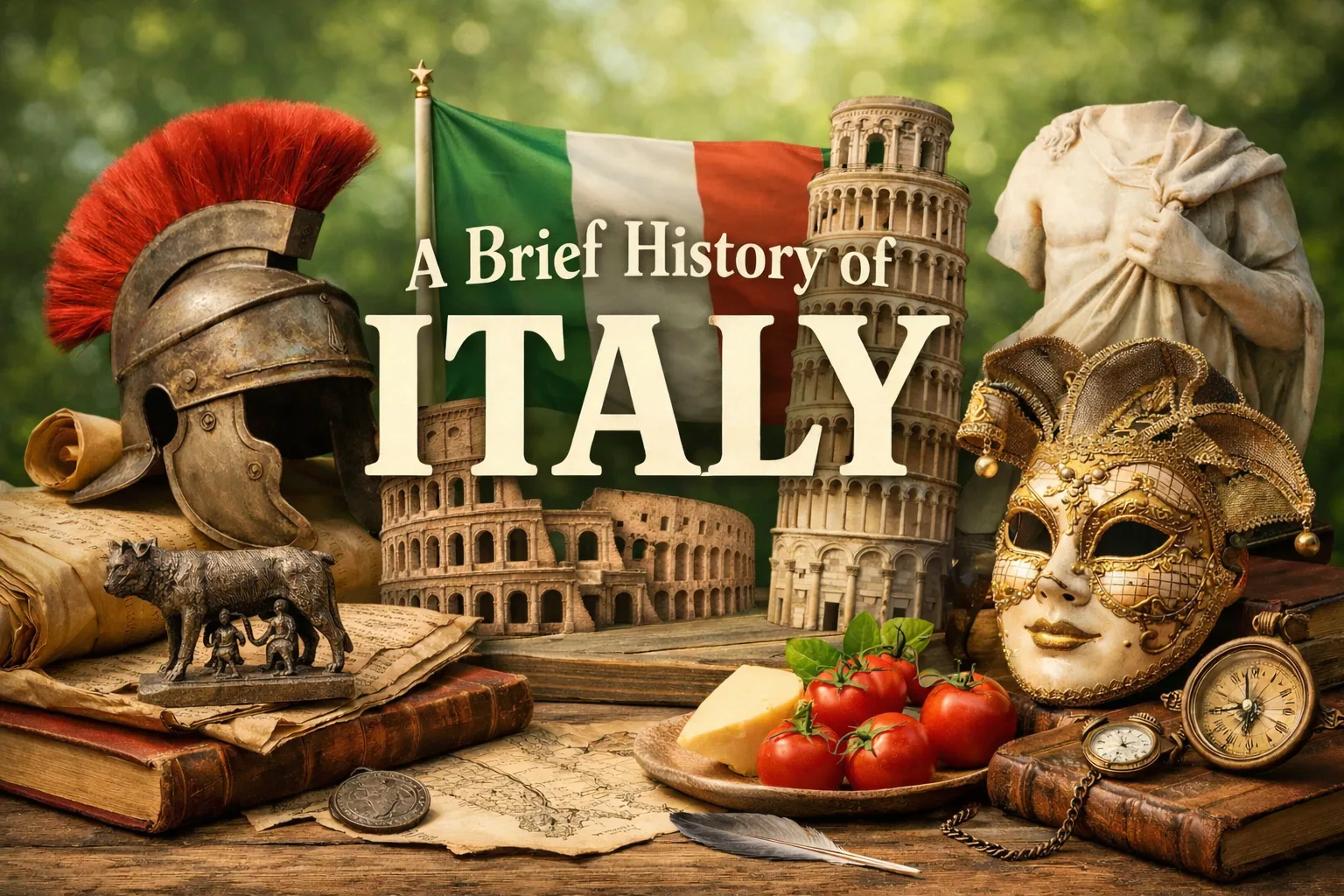
Italy’s past feels less like a straight line and more like a layered city: step into a lively piazza, then notice older stones under your feet, then spot a Renaissance arch tucked behind a café sign. Ever wondered why one country can feel like many worlds at once? Italy’s geography, regional identities, and centuries of craft have stacked up like a well-loved cookbook—pages worn, margins full of notes, flavors still bold.
Italy In One Breath
A peninsula where stone, story, and style keep handing the microphone to each other.
What This Brief History Focuses On
This overview follows Italy’s culture-first timeline: languages and learning, cities and craftsmanship, art and architecture, food and everyday rituals. You’ll see names you recognize, plus quieter threads that explain why Italy feels so richly textured.
Quick Threads To Watch
- Sea as a highway for ideas
- Cities as creative engines
- Workshops turning skill into beauty
- Regions keeping distinct flavors alive
Before Rome: Many Italies On One Peninsula
Long before “Italy” sounded like one word, the peninsula hosted a busy mosaic of communities. In central areas, the Etruscans shaped art, ritual, and urban life, leaving behind striking tomb paintings and metalwork. In the south, Greek-speaking settlements helped spread alphabetic writing, theater, and new ways of building and decorating public spaces. Add mountain cultures, coastal traders, and inland farmers, and you get a place where variety was normal.
Here’s the big takeaway: Italy’s early history is about exchange. People learned from neighbors, borrowed ideas, and adapted them. That habit—taking something good and making it local—never really left.
Italy’s secret superpower is remixing: familiar ingredients, new recipe.
The Roman Era: Roads, Words, And Everyday Engineering
The Roman world turned Italy into a workshop of infrastructure. Think paved roads that stitched towns together, aqueducts that made fresh water dependable, and public buildings designed for crowds—baths, forums, amphitheaters. Even if you’re not chasing ruins, you can still feel this mindset in how Italian cities value plazas, walkability, and shared public life.
Language That Traveled
Latin became a powerful bridge across regions. Over centuries, everyday speech shifted, softened, and split into the Romance languages. Modern Italian later grew from these living dialects, shaped by writers, merchants, and scholars who wanted words that could carry ideas clearly.
Design That Still Works
Roman builders loved practical beauty: arches, domes, and concrete that let spaces feel open and strong. That balance—utility plus elegance—shows up again and again in Italian architecture, furniture, and even product design.
Medieval Italy: Monasteries, Markets, And City Life
After the later Roman period, Italy’s story becomes more local and city-centered. Monasteries and schools helped preserve learning by copying texts and teaching reading and music. Meanwhile, ports and market towns grew lively through commerce, crafts, and seasonal fairs. If you’ve ever enjoyed an Italian town’s weekly market—stalls of cheese, olives, textiles—you’re tasting a rhythm that is centuries old.
Italy’s cities also became early homes for universities and specialized trades. Bologna is often cited among Europe’s oldest universities, and many towns built reputations around signature skills: weaving, glassmaking, leatherwork, stone carving. Skills moved from master to apprentice like a family recipe—guarded, refined, proudly local.
Travel Tip: Read A City Like A Map
- Look for the cathedral and the main square—community heartbeats.
- Notice street names tied to crafts (often linked to old guild quarters).
- Step into one small church and one small museum; details add up fast.
The Renaissance: Art, Ideas, and Workshops
The Renaissance wasn’t just “famous paintings.” It was a whole way of thinking that treated curiosity like fuel. City workshops blended art with anatomy, geometry with perspective, and craftsmanship with bold imagination. Painters studied light like scientists. Architects used mathematics to make harmony visible. Writers searched for clean, expressive language—words that could carry meaning without wobbling.
Florence often takes center stage, but the Renaissance had many stages: Venice with its trade-driven cosmopolitanism, Rome with grand building projects, and countless smaller cities that nurtured local talent. The result is still all around you: frescoes, palaces, sculpted doorways, and the feeling that beauty belongs in public, not only behind velvet ropes.
Think of the Renaissance as a spark that jumped from studio to studio—each place lighting it in a slightly different color.
From Baroque Splendor To Modern Taste
In the centuries after the Renaissance, Italy kept refining how it expresses emotion and elegance. Baroque churches turned interiors into immersive experiences—curves, light, marble, and music-like movement in stone. Opera flourished, carrying stories through voice and stagecraft. Scientific inquiry also left a deep mark; Italy’s thinkers helped expand how Europeans described nature, motion, and the sky with sharper tools of observation.
As time moved on, Italy’s regions continued to build their own identities—through food traditions, local festivals, dialects, architecture, and family businesses. That’s why traveling in Italy can feel like flipping through many mini-histories: a coastal fishing town, a mountain village, an industrial city, a vineyard valley—each with its own tempo.
A Timeline Of Italy’s Cultural Layers
If you want a quick mental map, use this simplified timeline. It’s not about every event; it’s about what people were making, building, and passing on.
| Era | What Was Taking Shape | What You Can Still See Today |
|---|---|---|
| Before Rome | Regional cultures, early cities, artistic styles, alphabetic writing influences | Tomb art, ancient street grids, museum collections, place names |
| Roman Era | Connected roads, public architecture, shared urban habits, Latin language foundations | Amphitheaters, aqueduct traces, bridges, long straight roads, Latin roots in words |
| Medieval Centuries | Craft guilds, marketplaces, universities, manuscript culture | Historic centers, cathedrals, market squares, artisan districts |
| Renaissance | Art and innovation powered by workshops, patrons, and curiosity | Fresco cycles, palaces, sculpture, city museums, harmonious architecture |
| Baroque To 1800s | Expressive architecture, opera, refined regional cuisines, evolving literature | Grand church interiors, theaters, culinary traditions, landscaped piazzas |
| 1900s To Today | Design, fashion, cinema, industrial craftsmanship, global culinary influence | Iconic brands, film heritage, contemporary art, modern museums, living food culture |
Italy’s Modern Identity: Craft Meets Daily Joy
Modern Italy is where heritage and innovation shake hands. You’ll find tiny family-run workshops beside sleek design studios. You’ll see ancient stones throught the window of a fast espresso bar. And you’ll notice a cultural habit that feels almost universal across the peninsula: doing ordinary things with care—setting a table, tailoring a jacket, shaping a pastry, polishing a doorway.
Small Things That Tell Big History
- The piazza as a social living room
- The market as a weekly ritual
- The workshop as a school of patience
- The regional kitchen as local memory
If You’re Visiting, Notice This
- How materials change by region (stone, brick, marble, volcanic rock)
- How churches double as art galleries
- How local dishes match climate and landscape
- How dialects color everyday speech
A Simple Way To “Read” Italy In One Day
Want history without homework? Try this gentle itinerary anywhere in Italy. It turns the past into a walk you can actually feel.
- Start at the main square and watch how people use space.
- Visit one church (art, architecture, local devotion—quietly informative).
- Find a market or food shop (regional identity on display).
- Step into a museum room (even 20 minutes can reframe what you saw outside).
- End with a slow meal and notice how tradition survives in small choices.
Italy’s History In One Thought
Italy keeps proving that the past doesn’t have to feel distant. Here, it’s a living texture—in the streets, in the language, in the way people shape beauty into daily life.