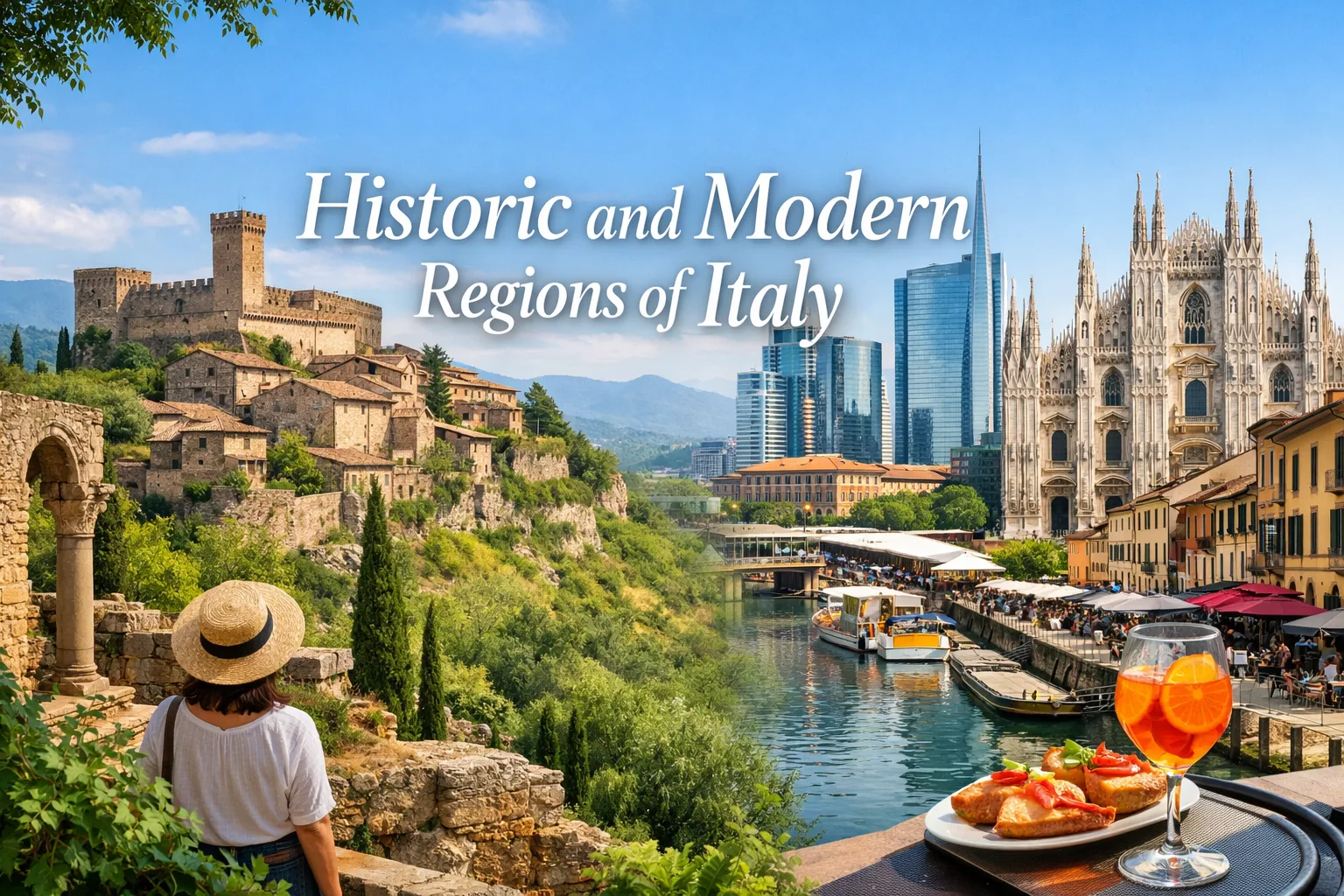
Italy can feel like a living mosaic: one peninsula, thousands of local details. Cross a hill, and the accents shift. Turn a corner, and the food changes. Ever wondered why a single country can serve up snow-capped peaks, calm lakes, rolling vineyards, and sunlit islands—sometimes in the same week? The secret sits in Italy’s historic regions and its modern administrative regions, layered like pages in a well-loved travel notebook.
Historic and Modern Regions In One Minute
- Historic regions are cultural-geographic “labels” shaped by centuries of life: landscapes, dialects, art traditions, food habits, and local identity.
- Modern regions are today’s official administrative units: 20 regions (Regioni), each with a capital and regional government.
- Many names overlap. Tuscany is both a modern region and a historic idea that reaches far beyond paperwork.
- Italy also has macro-areas people use casually—like North, Center, South, and the Islands—handy for planning routes and expectations.
Why Regions Matter For Travel, Food, And Culture
Think of Italy’s regions as chapters in the same book. If you know the chapter, you can guess the mood: alpine air and lakefront promenades, museum-rich cities and hill towns, coastal walks and island sunsets. Regions also help you choose a base, pace your itinerary, and avoid cramming too much into too few days.
For First Timers
- Pick 1–2 regions per week.
- Mix one big city with one slower town.
- Use regions to group day trips logically.
For Food Lovers
- Regional cooking is deeply local—ask for specialità.
- Seasonal ingredients shape menus more than trends.
- Try the same dish name in two regions; it may feel like a new recipe.
For Landscape Hunters
- Mountains dominate the North; coasts and islands shine in the South.
- Central Italy balances hills, art cities, and countryside drives.
- Even short distances can mean a big change in weather.
A Gentle Timeline: How Historic Regions Became Modern Ones
Italy’s regional story didn’t start with modern borders. It grew, slowly, from geography and daily life. Picture a river as a natural “sentence break,” a mountain ridge as a sturdy bookmark, and a port city as a busy crossroads where ideas arrive early.
- Ancient roots: people grouped places by coastlines, valleys, and trade routes—practical, not abstract.
- City and countryside layers: medieval and Renaissance Italy formed strong local identities around cities, plains, and hill towns.
- Today’s 20 regions: the modern regional system organizes services, transport planning, and local administration.
A modern region is a map you can file. A historic region is a feeling you can taste.
Italy’s Four Big Cultural Zones
If the 20 regions are the detailed map, these four zones are the quick compass. They’re not strict borders—more like weather patterns you can sense as you move.
Northern Italy
Alps, lakes, long aperitivo evenings, sleek city energy, and plenty of green valleys. Great for scenic rail rides and short hops between towns.
- Lake views and mountain air
- Elegant cities and design culture
- Vineyards and slow lunches
Central Italy
Art cities, hill towns, and countryside roads that feel like they were made for sunset. It’s the classic postcard zone—without needing to chase it.
- Museums, piazzas, and craft traditions
- Rolling landscapes and olive groves
- Walkable towns with big character
Southern Italy
Warm hospitality, dramatic coastlines, and food that leans bright and sunny. Many visitors fall for the rhythm here—unhurried, conversational, human.
- Seaside promenades and ancient streets
- Bold flavors and local markets
- Small towns with big views
The Islands
Sicily and Sardinia feel like two distinct worlds, each with its own pace, coast, and interior landscapes. Island light is different—sharper, kinder, almost cinematic.
- Beaches, hikes, and village life
- Seafood and regional sweets
- That unforgettable Mediteranean glow
The 20 Modern Regions Of Italy Overview
Below is a practical snapshot of the administrative regions of Italy. Use it like a menu: pick the flavors you want, then build your route around them.
| Region | Capital | Signature Feel | A Local Bite |
|---|---|---|---|
| Abruzzo | L’Aquila | Mountains to coast, nature-forward | Arrosticini |
| Aosta Valley | Aosta | Alpine villages and high peaks | Fontina dishes |
| Apulia | Bari | White towns, long coastlines | Orecchiette |
| Basilicata | Potenza | Quiet hill towns, rugged beauty | Peperoni cruschi |
| Calabria | Catanzaro | Seas on two sides, big views | Nduja (spicy spread) |
| Campania | Naples | Iconic cities and coastal drama | Pizza Napoletana |
| Emilia-Romagna | Bologna | Food capital energy, porticoes | Tagliatelle al ragù |
| Friuli Venezia Giulia | Trieste | Borderland flavors, elegant cafés | Frico |
| Lazio | Rome | Ancient streets and countryside escapes | Carbonara |
| Liguria | Genoa | Cliffside villages, sea breezes | Pesto Genovese |
| Lombardy | Milan | Lakes, fashion, fast connections | Risotto alla Milanese |
| Marche | Ancona | Adriatic coast and gentle hills | Olive all’ascolana |
| Molise | Campobasso | Small towns, calm countryside | Cavatelli |
| Piedmont | Turin | Wine country and alpine edges | Agnolotti |
| Sardinia | Cagliari | Wild coasts, strong island identity | Pane carasau |
| Sicily | Palermo | Layered history, vibrant street life | Arancini |
| Trentino-Alto Adige/Südtirol | Trento | Mountain valleys, bilingual charm | Canederli |
| Tuscany | Florence | Art cities and vineyard hills | Ribollita |
| Umbria | Perugia | Green heart, medieval hill towns | Black truffle dishes |
| Veneto | Venice | Canals, mountains, and prosecco hills | Polenta e schie (varies by area) |
Note: Italy has five autonomous regions with special administrative arrangements: Aosta Valley, Trentino-Alto Adige/Südtirol, Friuli Venezia Giulia, Sicily, and Sardinia. For visitors, this mainly shows up as strong local language and cultural character.
Historic Regions You’ll Hear All The Time
Some “regions” live in everyday speech more than in official documents. They’re useful because they describe shared vibes: architecture, farm products, local pride, even the way people set the table.
- The Italian Riviera (mostly Liguria): pastel villages, coastal walks, sea-facing cafés.
- The Dolomites (mostly Trentino-Alto Adige and Veneto): dramatic peaks and storybook valleys.
- The Po Valley (across multiple northern regions): flatlands, rivers, fertile fields, and classic comfort cooking.
- Val d’Orcia (Tuscany): rolling hills and cypress-lined roads—yes, it’s that dreamy.
- Amalfi Coast (Campania): cliffs, lemon groves, and sea views that steal your attention mid-sentence.
Quick Tip: Match Your Trip To A Region’s Shape
Long, narrow regions often reward a linear route (north-to-south or coast-to-inland). Chunkier regions suit a hub-and-day-trip plan. It’s like choosing shoes: the fit matters more than the brand.
How To Choose A Region Without Overthinking It
Start with one simple question: What do you want to feel? Calm? Inspired? Outdoorsy? Beachy? Italy can deliver all of that—just in different corners.
- If you want iconic art cities plus countryside: try Tuscany or Umbria.
- If you want lakes and mountains: try Lombardy, Piedmont, or Trentino-Alto Adige/Südtirol.
- If you want coastal beauty with easy day trips: try Liguria or Campania.
- If you want island energy: choose Sicily for variety, Sardinia for beaches and wide-open nature.
Mini FAQ For Curious Travelers
Are Historic Regions On Maps?
Sometimes. You’ll see them in guidebooks, local storytelling, and cultural references. They’re less about lines and more about shared habits.
Do Modern Regions Change Often?
Not really. The 20-region administrative structure is stable, so it’s safe to learn the names and use them for planning.
Which Region Has The “Most” To Do?
That’s the fun part: each region is packed in its own way. Choose by your mood and time, not by trying to “win” Italy.
A Friendly Way To Remember Italy’s Regions
If you forget everything else, keep this image: Italy is a patchwork quilt. The stitching is geography—mountains, rivers, seas. The patterns are history—cities, crafts, recipes, traditions. The result is warm, varied, and surprisingly easy to enjoy once you stop trying to see it all at once.