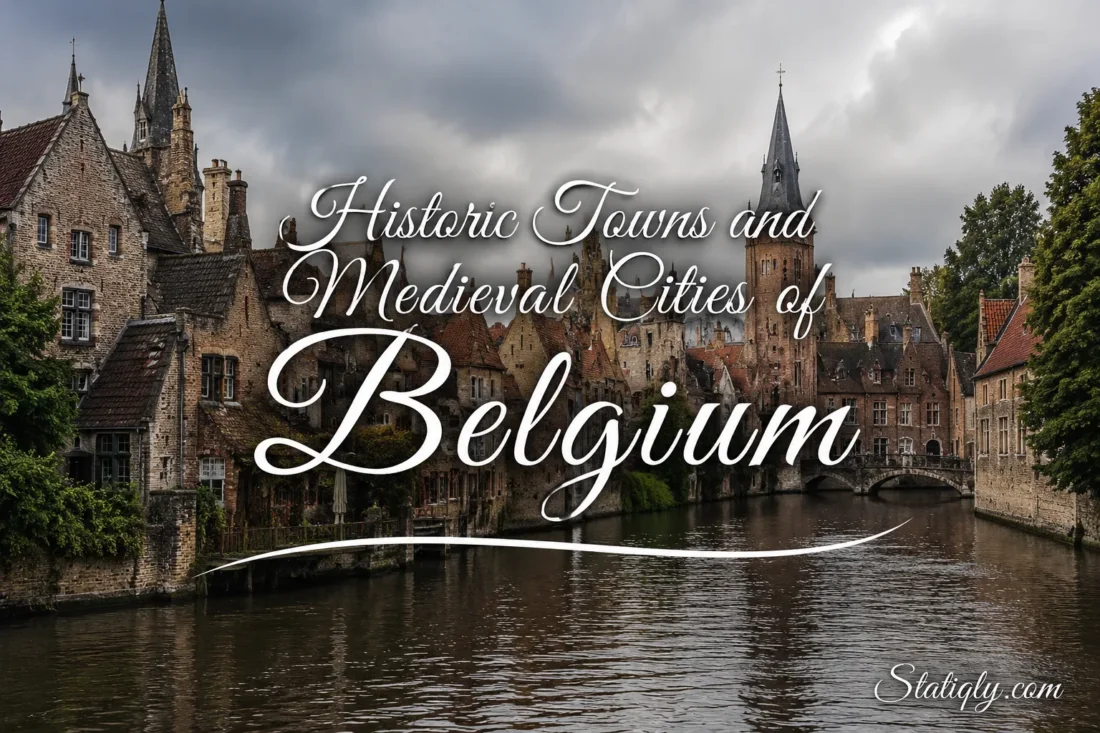
Belgium’s medieval past survives not only in isolated monuments but in the shape of entire streets, squares, waterways and historic districts. Bruges and Ghent preserve the scale of wealthy medieval trading cities, while places such as Damme and Durbuy offer a much smaller urban setting where old street patterns are easy to read on foot. Leuven, Mechelen, Tournai and Dinant add their own character through Gothic civic buildings, early university heritage, monumental churches and river landscapes.
No Belgian city is frozen in a single century. Medieval houses stand beside later façades, old commercial halls have acquired new uses, and some landmarks have been restored or rebuilt over time. What makes these places valuable is the continuity of their historic urban fabric: streets still converge on old market squares, towers continue to define skylines, and former trade routes remain visible in canals, quays and riverfronts.
| Historic Place | Medieval Character | Defining Features | Best Known For |
|---|---|---|---|
| Bruges | Large preserved medieval commercial city | Canals, Markt, Burg, Gothic civic buildings | Exceptionally coherent historic centre |
| Ghent | Dense medieval trading city | Gravensteen, old quays, towers, merchant architecture | Monumental medieval cityscape |
| Leuven | Late-medieval civic and university city | Grote Markt, Gothic Town Hall, St. Peter’s Church, University Hall | University and civic heritage |
| Mechelen | Compact late-medieval urban centre | Grote Markt, St. Rumbold’s Tower, historic houses and courtyards | Burgundian-era architecture |
| Tournai | Ancient city with major medieval layers | Notre-Dame Cathedral, Belfry, historic streets | Romanesque and Gothic architecture |
| Damme | Small medieval port town | Market square, old town hall, church, former harbour landscape | Connection with medieval Bruges |
| Dinant | Historic Meuse town with medieval foundations | Collegiate church, riverfront, older fortress site | Dramatic river-and-cliff setting |
| Durbuy | Tiny historic Ardennes town | Cobbled lanes, stone houses, old street pattern, rampart remains | Compact historic centre |
Bruges: Belgium’s Most Complete Medieval Cityscape
Bruges is the clearest place to see how a prosperous medieval city could function as a connected whole. Its historic centre retains an old network of streets, squares and canals rather than presenting medieval architecture as a collection of separate monuments. The entire historic centre has been recognised as a UNESCO World Heritage Site since 2000.
Water shaped the city from an early stage. The River Reie and its connections toward the North Sea helped Bruges develop into a trading centre, while a settlement grew around the area now known as Burg Square. From the 11th century onward, the cloth trade helped drive urban growth. By the late 13th and 14th centuries, merchants from several parts of Europe were active in the city.
Markt, Burg and the Medieval Commercial Core
The relationship between Markt and Burg explains much of Bruges’ historic structure. Markt developed as a commercial focus, while Burg formed an older administrative and ceremonial centre. They sit only a short walk apart, yet each has a distinct architectural identity.
The Belfry and former market halls dominate Markt. Nearby streets lead toward canals lined with brick façades, former commercial buildings and houses with tall gables. This close arrangement of trade, civic administration, religion and housing is one reason Bruges feels like a city rather than an open-air collection of historic landmarks.
A City That Preserved Its Medieval Street Pattern
Bruges did not preserve every building exactly as it appeared in the Middle Ages. Façades changed, structures were restored, and later architecture became part of the streetscape. Yet the underlying urban pattern survived remarkably well. Canals still curve through dense blocks, narrow streets still approach old market areas from several directions, and major towers remain visual reference points.
That distinction matters. A medieval city is more than a row of old houses. In Bruges, the city plan itself is part of the historical experience.
Ghent: A Medieval Metropolis on the Lys and Scheldt
If Bruges feels unusually cohesive, Ghent shows the scale and energy of a large medieval urban centre. The settlement developed around the meeting of the Lys and Scheldt rivers, and from roughly the year 1000 to the middle of the 16th century it ranked among Europe’s major cities.
Ghent’s medieval heritage is concentrated within a living city rather than separated from modern neighbourhoods. Stone towers rise above busy streets. Historic quays remain gathering places. A medieval fortress stands within walking distance of former commercial districts. The contrasts are sharp, but the old city remains easy to recognise.
Gravensteen and the City’s Medieval Scale
The Gravensteen, or Castle of the Counts, gives Ghent something rare among major Belgian cities: a large medieval fortress embedded directly within the historic centre. Its present appearance reflects several periods of construction and restoration, but its walls, towers and defensive form still convey the importance of the site during the Middle Ages.
From the castle, the medieval city unfolds in several directions. Old streets lead toward the Graslei and Korenlei, where goods were once unloaded beside the Lys. Tall historic façades facing the water recall the commercial functions that made the riverfront one of Ghent’s busiest areas.
The Three-Tower Skyline
Another defining feature is the sequence of towers associated with St. Nicholas’ Church, the Belfry and St. Bavo’s Cathedral. Seen together, they create one of Belgium’s most recognisable historic skylines.
Ghent works especially well for visitors interested in urban scale. Medieval heritage here is not confined to one picturesque square. It stretches across quays, churches, former market areas, narrow lanes and civic spaces.
Leuven: Gothic Civic Architecture and a Medieval University City
Leuven presents a different side of medieval Belgium. Trade and religious life shaped the city, but its identity also became closely tied to learning after the university was founded in 1425. Medieval commercial buildings, academic institutions and late-Gothic architecture still overlap in the centre.
The Grote Markt and Gothic Town Hall
Leuven’s Grote Markt is dominated by two buildings that developed during the 15th century: St. Peter’s Church and the Town Hall. The Town Hall, begun around the middle of that century, became one of Belgium’s best-known examples of late-Gothic civic architecture.
Its exterior is exceptionally elaborate, yet the square is more interesting when viewed as an urban space. Church, civic administration and commercial streets meet within a compact area, showing how different parts of medieval city life occupied the same centre.
The Town Hall interior is currently unavailable to visitors while renovation work continues, with reopening planned for 2029. Its exterior remains a defining part of the Grote Markt.
From Cloth Hall to University Hall
The University Hall reveals how existing commercial infrastructure could be adapted as medieval cities changed. The building originally served the cloth trade. After the university was established, part of it was made available for teaching. The connection between commerce and education is still readable in the building’s long history.
Leuven therefore feels different from Bruges or Ghent. Its medieval heritage does not revolve mainly around canals or a fortress. Late-Gothic architecture and centuries of university life give the centre its character.
Mechelen: A Compact City of Towers, Squares and Historic Houses
Mechelen reached one of its most influential cultural periods during the late 15th and early 16th centuries. Artists, scholars and administrators were drawn to the city, and traces of that prosperity remain in its churches, civic buildings and former urban residences.
Grote Markt and St. Rumbold’s Tower
The historic centre is relatively compact. Grote Markt provides the natural starting point, with the immense tower of St. Rumbold’s Cathedral visible from many surrounding streets. Historic façades around the square illustrate several architectural periods, giving the centre a layered appearance rather than a single uniform style.
Mechelen is particularly rewarding for its smaller details. Courtyards, former city residences and narrow streets often sit only a few minutes from the main square. The result is a historic city that can be understood without covering large distances.
For travellers who find Bruges or Ghent too extensive for a short visit, Mechelen offers a dense concentration of late-medieval and early modern urban heritage in a smaller area.
Tournai: Romanesque and Gothic Architecture in One Historic Centre
Tournai is one of Belgium’s oldest cities, and its medieval importance is especially visible around the Cathedral of Notre-Dame and the surrounding historic centre. Unlike cities dominated by Flemish brick Gothic, Tournai displays another architectural tradition, shaped heavily by stone and by its position near several cultural regions of medieval northwestern Europe.
Notre-Dame Cathedral
The UNESCO-listed Cathedral of Notre-Dame was begun in the first half of the 12th century. Its enormous Romanesque nave and distinctive group of five towers make it unlike any other major church in Belgium. The choir, reconstructed in the 13th century, belongs to the Gothic period.
This makes the cathedral especially useful for understanding the transition between Romanesque and Gothic architecture. Instead of seeing the two styles in separate monuments, visitors can observe them within a single complex.
A Medieval Skyline Built Around Civic and Religious Towers
Tournai’s historic skyline is not defined by the cathedral alone. Its belfry stands nearby, forming a second vertical landmark within the old centre. Streets and squares around these monuments preserve the spatial relationship between religious, commercial and civic areas that characterised many medieval towns in the region.
Damme: The Small Port That Served Medieval Bruges
Damme is much smaller than Belgium’s famous historic cities, yet its story is directly connected with the rise of Bruges. A major coastal change in the 12th century created the Zwin waterway, improving access toward Bruges. A settlement developed beside a dam, and Damme received city rights in 1180.
The town became a transshipment port. Larger vessels could bring cargo toward Damme, where goods could be transferred for movement farther inland. This gave the small settlement an economic role far greater than its physical size might suggest today.
Reading the Former Port in Today’s Town
Damme no longer has the crowded harbour environment that shaped its medieval prosperity. The Zwin gradually lost its effectiveness as a navigable route, while the landscape and waterways continued to change. What remains is a quiet historic centre containing the market square, old civic architecture and the Church of Our Lady.
The contrast with nearby Bruges is useful. Bruges shows what a medieval commercial centre could become at metropolitan scale; Damme shows the smaller port infrastructure that helped support that larger trading network.
Dinant: A Historic Town Shaped by the Meuse Valley
Few Belgian towns are as closely tied to their physical setting as Dinant. The historic centre occupies a narrow strip beside the Meuse, squeezed between the river and steep limestone slopes. Buildings therefore developed in a very different pattern from the broad market-centred cities of Flanders.
The Collegiate Church Beside the Meuse
The Collegiate Church of Notre-Dame, built in local limestone, is the main medieval architectural landmark at river level. Its Gothic fabric and later additions reflect a long construction history. The unusual bulbous roof above the tower belongs to a later period, so the building should not be read as an entirely medieval structure.
A Fortress Site Above the Town
A fortified position has occupied the heights above Dinant for centuries. An 11th-century castle once stood on the site, although the citadel visible today belongs largely to much later phases of fortification. This distinction is worth remembering: the setting has medieval roots, but the present fortress should not be mistaken for an intact medieval castle.
Dinant’s strongest historical feature is therefore the relationship between river, church, cliff and fortified high ground. Geography dictated the town’s form.
Durbuy: Medieval-Scale Streets in the Ardennes
Durbuy provides another contrast. Its historic heart is tiny, winding through a bend of the River Ourthe beneath wooded slopes. Cobbled pedestrian lanes, stone buildings and surviving traces of older ramparts create an intimate urban pattern rarely found in Belgium’s larger historic cities.
The old centre covers only a small area, so changes in direction, building materials and street width become easy to notice. Rue Daufresne de la Chevalerie, regarded locally as the oldest street in Durbuy, is paved with rounded stones traditionally associated with the nearby Ourthe.
About the “Smallest City” Nickname
Durbuy is frequently promoted as the “smallest city in the world.” The phrase should be understood as a historic tourism nickname, not as a modern worldwide population ranking. Its appeal comes from the unusual combination of an old city status and an exceptionally compact historic centre.
For anyone interested in the human scale of an old town, Durbuy is particularly revealing. A visitor can cross much of the historic core in a short time, yet individual lanes reward closer attention.
What Makes Belgium’s Medieval Cities Look Different From One Another?
Belgium is small, but its historic towns are not architectural copies of one another. Geography, trade and local building materials produced noticeable differences.
- Bruges is shaped by canals, former commercial spaces and a remarkably coherent historic street network.
- Ghent feels larger and denser, with major medieval monuments embedded in an active city centre.
- Leuven is marked by late-Gothic civic architecture and centuries of university use.
- Mechelen combines a monumental tower with a compact pattern of squares, residences and historic streets.
- Tournai stands apart for monumental stone architecture and the meeting of Romanesque and Gothic forms.
- Damme preserves the scale of a small medieval port connected historically with Bruges.
- Dinant owes much of its shape to the narrow space between the Meuse and the cliffs.
- Durbuy offers a tightly packed Ardennes townscape of winding lanes and stone buildings.
How to Recognise Medieval Urban Fabric
A building does not need to survive unchanged from the 13th or 14th century for a historic district to retain a medieval character. In many Belgian towns, the more revealing clues are found in the relationships between buildings and streets.
- Market squares: central spaces where commerce, civic buildings and major churches developed close together.
- Narrow irregular streets: routes that grew gradually rather than according to a modern geometric plan.
- River and canal quays: surviving evidence of the transport networks that supported cities such as Bruges and Ghent.
- Civic towers: vertical landmarks that made municipal institutions visible across the urban landscape.
- Former commercial halls: large buildings associated with cloth, storage, markets and other urban trades.
- Dense plots: narrow building frontages and deep properties created by the limited space inside historic urban areas.
- Old routes preserved beneath later architecture: even where façades have changed, the street itself may follow a much older line.
This is why walking a historic Belgian centre can reveal more than studying one monument in isolation. Turn away from the main square and the old city often becomes easier to understand: a narrow lane follows a canal, a street widens where a small market once formed, or a tower appears precisely at the end of a historic route.
Choosing a Belgian Historic Town by Its Character
Travellers interested mainly in a preserved medieval cityscape will find Bruges the strongest starting point. Ghent is better suited to those who want medieval architecture on a larger urban scale, including a fortress, waterfronts and major churches within the same centre.
For Gothic civic architecture, Leuven deserves particular attention. Mechelen offers a compact alternative with a powerful historic skyline and shorter walking distances. Tournai is the better choice for anyone interested in the relationship between Romanesque and Gothic architecture.
The smaller towns tell different stories. Damme makes sense as a companion to Bruges because the two were historically connected through trade and waterways. Dinant is defined by the geography of the Meuse Valley, while Durbuy offers the close proportions, stone lanes and irregular layout of a tiny Ardennes historic centre.
Together, these places show why Belgium’s medieval heritage cannot be reduced to castles or Gothic façades. The streets themselves carry much of the history. Market squares still anchor old centres, waterways explain the location of commercial districts, and towers continue to mark places that have served as urban focal points for centuries.