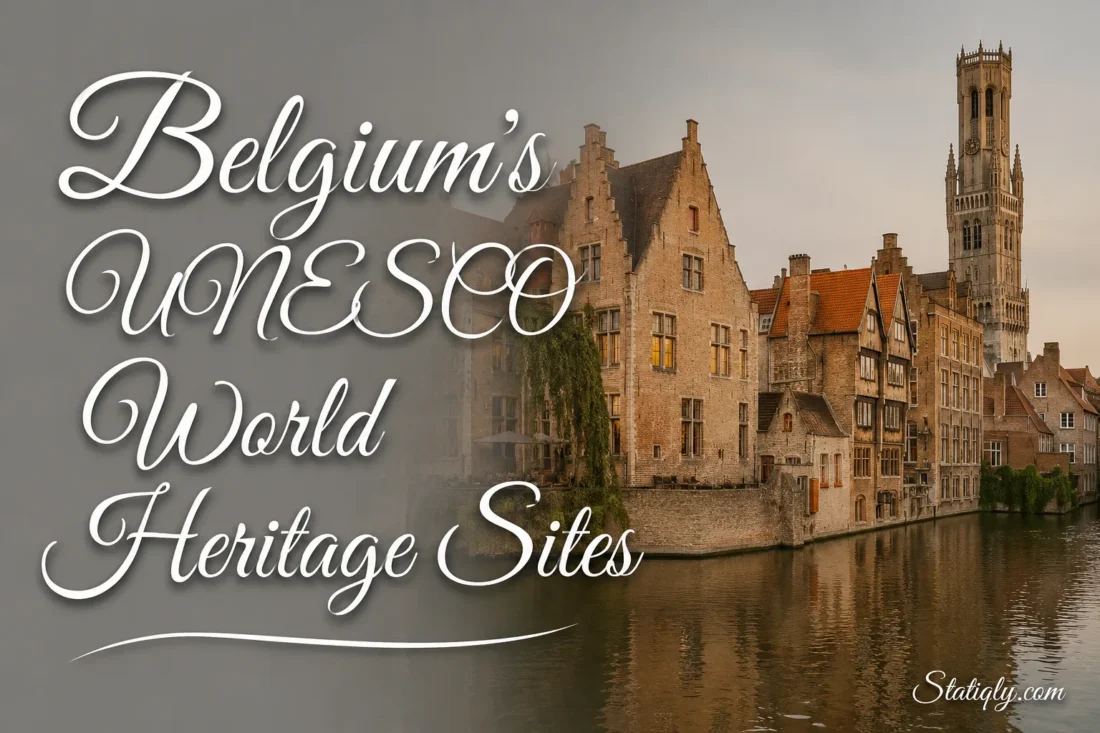
Belgium has 16 properties on the UNESCO World Heritage List: 15 cultural properties and one natural property. The number does not equal 16 individual places, because several entries are serial properties made up of many separate locations. The Flemish Béguinages alone contain 13 component sites, while the Belfries of Belgium and France include 33 belfries on the Belgian side. Belgium’s list therefore reaches far beyond a handful of monuments, linking medieval town centers, Art Nouveau houses, printing heritage, early mining, canal engineering, archaeological remains, planned landscapes and protected beech forest.
Another feature stands out: six of Belgium’s World Heritage properties are transnational, shared with one or more other countries. That makes the Belgian list a useful way to see how architecture, technology, urban life and natural processes crossed modern borders long before UNESCO began protecting them.
Belgium’s UNESCO World Heritage Sites
| World Heritage Property | Inscription | Type | Belgian Focus |
|---|---|---|---|
| Flemish Béguinages | 1998 | Cultural | 13 béguinages in Flanders |
| La Grand-Place, Brussels | 1998 | Cultural | Historic central square in Brussels |
| The Four Lifts on the Canal du Centre and Their Environs, La Louvière and Le Roeulx (Hainaut) | 1998 | Cultural | Four hydraulic boat lifts in Hainaut |
| Belfries of Belgium and France | 1999; extended 2005 | Cultural, transnational | 33 Belgian belfries |
| Historic Centre of Brugge | 2000 | Cultural | Historic urban core of Bruges |
| Major Town Houses of the Architect Victor Horta | 2000 | Cultural | Four Art Nouveau houses in Brussels |
| Neolithic Flint Mines at Spiennes (Mons) | 2000 | Cultural | Prehistoric mining landscape near Mons |
| Notre-Dame Cathedral in Tournai | 2000 | Cultural | Romanesque and Gothic cathedral |
| Plantin-Moretus House-Workshops-Museum Complex | 2005 | Cultural | Historic printing complex in Antwerp |
| Ancient and Primeval Beech Forests of the Carpathians and Other Regions of Europe | 2007; Belgium joined in 2017 | Natural, transnational | Five components in the Sonian Forest |
| Stoclet House | 2009 | Cultural | Vienna Secession house in Brussels |
| Major Mining Sites of Wallonia | 2012 | Cultural | Four preserved mining sites |
| The Architectural Work of Le Corbusier, an Outstanding Contribution to the Modern Movement | 2016 | Cultural, transnational | Maison Guiette in Antwerp |
| Colonies of Benevolence | 2021 | Cultural, transnational | Wortel colony landscape |
| The Great Spa Towns of Europe | 2021 | Cultural, transnational | Spa in Liège Province |
| Funerary and Memory Sites of the First World War (Western Front) | 2023 | Cultural, transnational | Belgian memorial and funerary landscapes |
How Belgium’s UNESCO List Is Structured
A UNESCO property can be a single building, an entire historic center or a serial property made up of separate components that share the same heritage value. Belgium has all three forms. La Grand-Place is a compact urban ensemble, Bruges covers a broad historic center, and the Flemish Béguinages form a network of 13 separate places.
Transnational properties add another layer. In these cases, one UNESCO inscription protects related places in several countries. Belgium participates in the Belfries of Belgium and France, the European beech forests, Le Corbusier’s architectural series, the Colonies of Benevolence, the Great Spa Towns of Europe and the funerary and memory sites of the Western Front.
Medieval Cities, Squares and Community Heritage
Flemish Béguinages
The Flemish Béguinages preserve a distinctive form of community planning that developed around the Beguine tradition in north-western Europe. Beguines were women who followed a religious life while remaining outside a conventional monastic order. From the 13th century onward, their communities took shape as enclosed quarters with houses, churches or chapels, service buildings, streets, courtyards and gardens.
UNESCO’s Belgian property contains 13 béguinages in Flanders. They vary in size and layout, so the value of the listing is not tied to one fixed architectural formula. Some feel like small villages inside a town; others fit more tightly into an urban street pattern. What connects them is the relationship between private dwellings, shared spaces and a calm, clearly defined community environment.
La Grand-Place, Brussels
At the center of Brussels, La Grand-Place gathers public buildings and former guild houses around a cobbled rectangular square. Much of the ensemble visible today dates from the late 17th century. Rather than being valued as one isolated façade, the square is protected as a coherent urban composition in which architecture, ornament and the public space work together.
The Town Hall provides the dominant vertical accent, while the surrounding buildings create a dense sequence of sculpted façades and varied rooflines. The experience is unusually concentrated: a visitor can stand in one place and read several layers of Brussels’ civic and commercial history at once.
Belfries of Belgium and France
Belfries became defining elements of many towns in present-day Belgium and northern France. The UNESCO series contains 56 belfries in total, including 33 in Belgium: 26 in Flanders and seven in Wallonia. The first 32 Belgian belfries were inscribed in 1999; the property was extended in 2005 with the belfry of Gembloux and 23 French examples.
These towers served practical and civic roles. Bells could regulate daily life, charters and valuables could be kept there, and some towers provided lookout space. Architecturally, the series ranges across centuries and styles. Their repeated presence beside market squares, halls and town centers also helps explain why the belfry became such a recognizable feature of the Belgian urban landscape.
Historic Centre of Brugge
The Historic Centre of Brugge covers 410 hectares and preserves the layout and building fabric of a major medieval commercial city. Brick Gothic architecture is one of its clearest visual signatures, but Bruges is more than a collection of Gothic monuments. Canals, streets, market spaces, religious buildings and civic structures still form a readable historic city.
Bruges also holds an important place in European painting. The city became a center of patronage and artistic production associated with the Flemish Primitives, including artists such as Jan van Eyck and Hans Memling. That connection between urban prosperity, architecture and painting is part of the reason UNESCO treats the center as a whole rather than as a short list of famous buildings.
Notre-Dame Cathedral in Tournai
Tournai’s Notre-Dame Cathedral brings two major medieval architectural languages into one building. Its large Romanesque nave and transept belong mainly to the first half of the 12th century, while the choir was rebuilt in the 13th century in Gothic form. The transept is crowned by five towers, giving the cathedral one of the most recognizable silhouettes in Belgium.
The contrast matters. Instead of presenting a uniform design from one moment, the cathedral shows architectural change in place: Romanesque mass and rhythm meet the lighter structural ideas of Gothic building.
Art Nouveau and Modern Architecture
Major Town Houses of the Architect Victor Horta
Brussels is closely associated with Art Nouveau, and UNESCO’s Victor Horta property brings together four of the architect’s houses: Hôtel Tassel, Hôtel Solvay, Hôtel van Eetvelde, and Maison & Atelier Horta. Inscribed in 2000, the group shows how Horta rethought the late-19th-century townhouse through open interior planning, flowing circulation, natural light and decoration integrated with structure.
Horta treated architecture and interior design as parts of the same composition. Ironwork, mosaic, glass, wall decoration, furniture and the movement from room to room were planned to reinforce one another. Curved lines are easy to notice, but the more revealing detail is how light penetrates deep into narrow urban plots.
Stoclet House
Stoclet House offers a different route from Art Nouveau toward 20th-century modernism. Austrian architect Josef Hoffmann designed the Brussels residence for Adolphe Stoclet, beginning in 1905; the house and garden were completed in 1911. Its restrained geometry, carefully coordinated interior and works by artists including Gustav Klimt and Koloman Moser reflect the Vienna Secession ideal of a Gesamtkunstwerk, or total work of art.
The building’s clean planes and geometric order anticipate later Art Deco and modern architecture. Its importance comes from the way architecture, interior decoration, furniture, art and garden design were conceived as parts of one coordinated work.
Maison Guiette and the Le Corbusier Series
Belgium contributes one building to The Architectural Work of Le Corbusier, a 17-site series spread across seven countries. The Belgian component is Maison Guiette in Antwerp. Designed in the 1920s, it helped introduce ideas associated with the Modern Movement to Belgium and the Netherlands.
Maison Guiette makes sense when viewed as one piece of an international architectural experiment. Its value lies not in monumental scale but in the way a compact house expresses a new language of form, planning and everyday living.
Printing, Engineering and Industrial Landscapes
Plantin-Moretus House-Workshops-Museum Complex
Antwerp’s Plantin-Moretus House-Workshops-Museum Complex preserves a rare combination of family home, printing business, workshops, archives, library, equipment and art. The printing firm founded by Christophe Plantin remained active at the site, under the Plantin-Moretus family tradition, for centuries. UNESCO describes it as the only surviving printing and publishing complex of its kind from the Renaissance and Baroque periods.
Its rooms make the history of printing tangible. Historic presses, type, books and business records show that printed culture depended on skilled labor, commercial networks and highly organized workshops. The property also contains works connected with Peter Paul Rubens and the Plantin-Moretus family’s cultural circle.
The Four Lifts on the Canal du Centre
Near La Louvière and Le Roeulx, four historic hydraulic boat lifts solve a practical engineering problem: how to move vessels through a large change in elevation over a short canal section while using limited water. The four lifts cover a seven-kilometer stretch of the historic Canal du Centre, with each lift overcoming roughly 15 to 16 meters of level difference.
The canal opened to navigation in 1917, and the lifts remain an unusually complete example of late-19th-century hydraulic engineering. Their machinery, canal setting, bridges and associated buildings allow the industrial landscape to be understood as a functioning system rather than as detached pieces of equipment.
Major Mining Sites of Wallonia
The Major Mining Sites of Wallonia bring together Grand-Hornu, Bois-du-Luc, Bois du Cazier and Blegny-Mine. These four places preserve different parts of Belgium’s coal-mining heritage, including industrial structures, underground or surface workings, worker housing and planned settlements.
The sites are spread across a broad east-west band of Wallonia, so the UNESCO property is best understood as a landscape of industrial development rather than a single museum complex. Grand-Hornu is especially noted for its planned architecture, while Bois-du-Luc preserves an extensive settlement closely tied to the mine.
Prehistoric Mining and Living Natural Heritage
Neolithic Flint Mines at Spiennes
Near Mons, the Neolithic Flint Mines at Spiennes cover more than 100 hectares and form one of Europe’s earliest and largest concentrations of prehistoric mines. Neolithic communities extracted flint through a range of techniques, including underground shafts and galleries, then worked the material into tools.
The site changes the usual picture of Neolithic life. Farming communities were not only cultivating land and building settlements; they could also organize technically demanding extraction on a large scale. Archaeology at Spiennes reveals knowledge of geology, mining methods and stone-working that developed thousands of years before metal mining.
Ancient and Primeval Beech Forests
Belgium’s only natural World Heritage property forms part of the Ancient and Primeval Beech Forests of the Carpathians and Other Regions of Europe. The full transnational series contains 93 component parts across 18 countries. Belgium contributes five components within the Sonian Forest south-east of Brussels.
These forest areas help document the ecological success of European beech after the last Ice Age. Beech expanded from refuge areas across much of the continent, adapting to varied climates, soils and elevations. The Belgian components therefore belong to a much larger ecological story that can only be understood across national boundaries.
- Sonian Forest – Forest Reserve “Joseph Zwaenepoel”
- Sonian Forest – Grippensdelle A
- Sonian Forest – Grippensdelle B
- Sonian Forest – Réserve forestière du Ticton A
- Sonian Forest – Réserve forestière du Ticton B
Planned Landscapes and Shared European Heritage
Colonies of Benevolence
The Colonies of Benevolence are a Belgian-Dutch cultural landscape created from a 19th-century experiment in social reform. The World Heritage property includes three component parts representing four historical colonies. Belgium’s contribution is Wortel, near the Dutch border.
Wortel was organized as an agricultural settlement with a highly ordered landscape. Straight roads, fields, avenues, farms and communal buildings reveal how planners tried to reshape rural land and daily life together. The geometry remains one of the easiest ways to understand the site: the landscape itself is part of the historical evidence.
The Great Spa Towns of Europe
The town of Spa represents Belgium in a transnational series of 11 spa towns across seven European countries. These towns grew around natural mineral springs and developed a recognizable urban pattern of bathing and treatment buildings, drinking halls, promenades, gardens, hotels and social spaces.
Spa’s place in the series is especially fitting because the town’s name became closely associated with the wider idea of a spa resort. UNESCO’s property focuses on the European spa culture that reached its most developed urban form from the 18th century into the early 20th century.
Funerary and Memory Sites of the First World War
Inscribed in 2023, the Funerary and Memory Sites of the First World War (Western Front) form a transnational series of 139 places in Belgium and France. The property centers on remembrance through cemeteries, memorials, landscape design, architecture and carefully planned spaces for reflection.
The Belgian components are distributed across West Flanders and the Walloon provinces of Hainaut, Liège, Namur and Luxembourg. Their designs vary greatly in scale and form, yet the series is connected by the treatment of individual memory, human dignity and reconciliation. It is a heritage landscape intended for reflection rather than a single monument.
What Makes Belgium’s World Heritage List Unusual
- One inscription can contain many places. The 16 official properties represent far more than 16 physical locations.
- Urban heritage is especially strong. Brussels, Bruges, Antwerp, Tournai and many smaller towns contribute buildings or historic ensembles.
- Industrial heritage has a clear presence. Canal lifts, printing workshops and former mining sites show how UNESCO recognition extends beyond palaces and cathedrals.
- Modern architecture sits beside medieval heritage. Horta, Hoffmann and Le Corbusier appear on the same national list as medieval belfries and Romanesque-Gothic architecture.
- Belgium’s natural entry is part of a continent-wide forest series. The Sonian Forest components connect Belgium with protected beech forests across 18 European countries.
World Heritage Sites and the Tentative List Are Different
Belgium also maintains a UNESCO Tentative List, but tentative properties are not yet World Heritage Sites. As of 2026, Belgium has 16 properties on that separate candidate list. They include historic urban areas, architectural works, landscapes and other cultural places that may be considered for nomination in the future.
This distinction prevents a common counting error. A place can be nationally protected, locally celebrated or included on Belgium’s Tentative List without being one of the country’s 16 inscribed World Heritage properties. For the official UNESCO count, only properties already entered on the World Heritage List belong in the total.