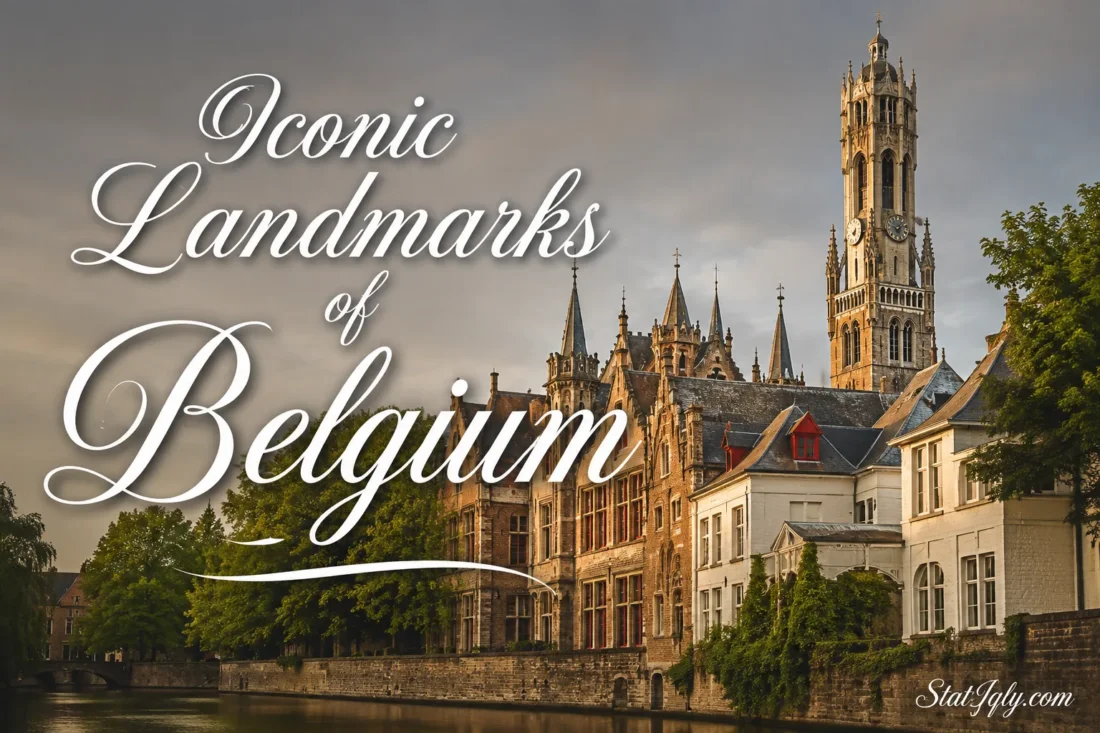
Belgium packs an unusual range of landmarks into a relatively small area. Medieval towers rise above old market squares, elaborate Gothic façades fill historic city centres, and unmistakably modern structures reshape the skylines of Brussels and Liège. Some Belgian landmarks impress through scale; others are surprisingly small. Together, they show how strongly architecture, civic identity and public space shape the character of the country.
Brussels naturally contains several of the best-known examples, including the Grand-Place, Atomium and Manneken Pis. Yet Belgium’s landmark landscape extends far beyond the capital. Bruges has its towering Belfry, Ghent its stone Gravensteen, Antwerp its soaring Cathedral of Our Lady, while Dinant uses a dramatic riverside cliff as the setting for one of Wallonia’s most recognizable views.
Belgium’s Landmark Profile
| Landmark | Location | Main Character | What Makes It Recognizable |
|---|---|---|---|
| Grand-Place | Brussels | Gothic and Baroque civic architecture | Ornate guild houses surrounding a historic square |
| Atomium | Brussels | 20th-century architecture | Nine enormous metallic spheres connected by tubes |
| Manneken Pis | Brussels | Historic fountain sculpture | A tiny bronze figure with an outsized cultural identity |
| Cinquantenaire Arch | Brussels | Monumental civic architecture | Three arches topped by a bronze quadriga |
| Koekelberg Basilica | Brussels | Art Deco architecture | Large copper-green dome visible across the city |
| Belfry of Bruges | Bruges | Medieval civic tower | 83-metre tower overlooking Markt square |
| Gravensteen | Ghent | Medieval stone fortress | Battlements, towers and a central keep in the city centre |
| Cathedral of Our Lady | Antwerp | Gothic cathedral | 123-metre tower dominating Antwerp’s historic skyline |
| Leuven Town Hall | Leuven | Late Gothic civic architecture | Densely decorated façade with slender turrets and statues |
| Citadel of Dinant | Dinant | Hilltop fortification | Stone complex perched high above the Meuse |
| Liège-Guillemins Station | Liège | Contemporary architecture | Sweeping white structural ribs and a vast glass canopy |
Brussels Landmarks That Define the Capital
Grand-Place
Few places express the architectural identity of Brussels as clearly as the Grand-Place. The rectangular cobbled square is enclosed by richly decorated guild houses, Brussels City Hall and the Maison du Roi. Most of the surrounding buildings reflect the rebuilding of the square around the end of the 17th century, while the Gothic City Hall is older.
The visual effect comes from detail rather than sheer size. Gilded ornaments, sculpted façades, steep roofs and elaborate gables line almost every side. Each building has its own design, yet the square reads as a coherent whole. The Grand-Place has been on the UNESCO World Heritage List since 1998.
Look closely at the City Hall. Its tall tower creates the dominant vertical line, while rows of windows, arches and sculpture draw the eye across the façade. Facing it stands the Maison du Roi, known in Dutch as the Broodhuis. The contrast between these major buildings and the narrower guild houses gives the square much of its visual rhythm.
Atomium
The Atomium belongs to a completely different Belgium. Built for the 1958 Brussels World’s Fair, it became one of the country’s most recognizable modern structures. Nine large spheres form the shape of an iron crystal unit cell, connected by twenty tubes that create its unusual geometric silhouette.
The structure rises 102 metres, while each sphere measures 18 metres in diameter. From ground level, those dimensions are difficult to judge because the balanced geometry makes the structure appear almost like a scientific model placed on the lawn. Only as visitors approach does its real scale become obvious.
Its metallic exterior also changes with the weather. Under clear skies, the spheres strongly reflect their surroundings; on cloudy days, they take on a softer silver appearance. That changing surface helps the Atomium remain visually distinctive without relying on elaborate decoration.
Manneken Pis
Belgium’s most famous landmarks are not always large. Manneken Pis proves the point. The small fountain figure stands near the Grand-Place and has been associated with Brussels for centuries.
The City of Brussels commissioned sculptor Jérôme Duquesnoy to create a new bronze figure for the fountain in 1619. The sculpture seen outside today is a copy; the original has been preserved in the Brussels City Museum since 1966.
Part of the figure’s character comes from its remarkable wardrobe tradition. Manneken Pis has accumulated more than 1,000 costumes, with selections displayed separately at the GardeRobe MannekenPis. The contrast is memorable: a physically tiny monument has become one of the largest symbols of Brussels in popular culture.
Cinquantenaire Arch
The broad avenues of Cinquantenaire Park lead directly toward another unmistakable Brussels silhouette: the triple Cinquantenaire Arch. Three monumental arches support a bronze quadriga, creating a strong central axis through the formal park.
The arch reaches about 45 metres high. Its scale works especially well because it is approached across open lawns and long paths rather than through narrow streets. From a distance the composition is simple. Closer up, columns, sculptural groups and architectural details become much clearer.
The upper level also functions as a viewpoint, opening a broad perspective over the park and surrounding parts of Brussels.
Koekelberg Basilica
On another part of the Brussels skyline, the National Basilica of the Sacred Heart at Koekelberg offers a very different form. Its huge copper-green dome and paired towers make it visible from many distant viewpoints around the capital.
The basilica is especially notable for its Art Deco design. Instead of the pointed vertical emphasis associated with Belgium’s Gothic churches, Koekelberg uses broad masses, geometric forms and an enormous central dome. Inside and outside, the scale is immediately apparent.
A panorama beneath the dome provides a high viewpoint over Brussels, linking the building’s architectural presence with the wider cityscape.
Medieval Towers and Civic Architecture in Flanders
Belfry of Bruges
Bruges has canals, stepped-gable houses and several historic church towers, but the Belfry of Bruges remains one of the clearest markers of the city’s skyline. Rising approximately 83 metres above Markt square, it developed in stages between the 13th and 15th centuries.
The Belfry was closely connected with medieval civic life. Important city documents, seals and funds were once kept in its treasury, while the tower’s bells helped communicate across the city. It therefore served as more than an observation point. It represented urban authority and local independence.
Today, visitors who climb the 366 steps pass through different levels of the tower before reaching the upper viewing area. The carillon contains 47 bells, keeping sound as much a part of the landmark’s identity as its familiar octagonal upper stage.
Gravensteen in Ghent
Gravensteen, usually translated as the Castle of the Counts, feels unusual because such a strongly fortified medieval structure stands directly inside the modern centre of Ghent. Streets, squares and city buildings surround its stone walls rather than a wide rural estate.
The site has much older origins, but the form that established its present identity is closely connected with Philip of Alsace and the rebuilding of 1180. The central stone keep rises about 30 metres, surrounded by a wall punctuated with projecting towers and a prominent gatehouse.
From street level, the strongest impression comes from the sequence of rough stone walls, battlements and narrow openings. From the upper sections, the contrast reverses: visitors look from medieval masonry across the dense rooftops of present-day Ghent.
Cathedral of Our Lady in Antwerp
The historic centre of Antwerp is visually anchored by the Cathedral of Our Lady. Its slender northern tower rises to approximately 123 metres, making it one of the easiest structures to recognize from different parts of the city centre.
The building is a major example of Gothic architecture in the Low Countries. Its exterior combines strong vertical lines with highly detailed stonework, while the interior uses tall columns and pointed arches to produce a far more open sense of space than the dense façade suggests.
The cathedral also connects Antwerp’s architectural identity with its artistic heritage. Inside are four works by Peter Paul Rubens, including The Descent from the Cross. Architecture and painting therefore meet within the same landmark rather than existing as separate attractions.
Leuven Town Hall
Leuven Town Hall can almost seem sculpted rather than constructed. Its late Gothic façade fills one side of the Grote Markt with narrow windows, pointed niches, elaborate stonework and rows of statues.
Construction began around the middle of the 15th century and took roughly thirty years. The decorative programme seen today continued to evolve later, and the exterior now contains 235 statues. Slender corner turrets give the roofline an unusually intricate profile.
The building is currently undergoing a long restoration programme. Its interior is closed to visitors until 2029, though the exterior remains a dominant feature of Leuven’s Grote Markt and can still be viewed from the square.
Landmarks Shaped by Wallonia’s Cities and Valleys
Citadel of Dinant
Dinant’s landmark identity depends as much on geography as architecture. The Citadel of Dinant sits on a high rocky outcrop directly above the town and the Meuse River. From the opposite riverbank, the cliff, citadel and buildings below appear almost stacked vertically.
This elevated position creates one of Belgium’s most recognizable urban panoramas. The river provides the foreground, the town occupies a narrow strip beside the water, and the stone citadel forms the upper edge of the scene.
Visitors approaching from the town centre can reach the site by the historic 408-step staircase, which dates to 1577, while road access reaches the upper entrance. From the top, the view follows the Meuse through its steep-sided valley and makes Dinant’s unusual geography much easier to understand.
Liège-Guillemins Station
Not every Belgian landmark belongs to the distant past. Liège-Guillemins railway station has become one of Wallonia’s most recognizable pieces of contemporary architecture since opening in 2009.
Designed by Santiago Calatrava, the station replaces the visual weight of a conventional façade with an enormous open canopy. White structural ribs rise over the railway platforms and support broad areas of glass, creating a building that feels open from several directions.
The structure reaches about 40 metres high and 150 metres wide across its two canopies. Those proportions are important to its character: the station feels horizontal and sweeping rather than tower-like. Daylight passes through the glass roof and changes the appearance of the interior throughout the day.
Why Belgian Landmarks Look So Different From One Another
Belgium has no single architectural formula that defines a national landmark. The contrast between its best-known structures is part of their appeal. A visitor can move from a medieval belfry to an Art Deco dome or a vast steel-and-glass station without leaving the country.
- Civic towers such as the Belfry of Bruges emphasize the historic independence and public identity of towns.
- Gothic buildings such as Antwerp Cathedral and Leuven Town Hall use vertical lines, carved stone and dense architectural detail.
- Historic public spaces such as the Grand-Place rely on the relationship between several buildings rather than a single monument.
- Modern icons such as the Atomium use geometry and structural form instead of traditional ornament.
- Landscape landmarks such as the Citadel of Dinant gain much of their visual impact from cliffs, rivers and elevation.
- Contemporary structures such as Liège-Guillemins show that Belgium’s recognizable architecture is still evolving.
Landmark Details Worth Noticing
The most familiar postcard view is not always the most revealing one. Many Belgian landmarks become more interesting when individual architectural details are examined instead of treating the entire structure as a single object.
- At the Grand-Place, compare the individual guild-house gables rather than viewing the façades as one continuous wall.
- At the Atomium, notice how the reflections on the spheres change according to clouds, sunlight and viewing angle.
- At the Belfry of Bruges, listen for the carillon as well as looking at the tower itself.
- At Gravensteen, look at the contrast between the heavy stone fortress and the surrounding city streets.
- At Antwerp Cathedral, compare the highly vertical exterior tower with the spacious rhythm of the interior columns.
- At Leuven Town Hall, examine the façade in sections; its hundreds of figures and niches are difficult to appreciate from a single viewpoint.
- At the Citadel of Dinant, cross the Meuse before looking back toward the cliff to understand why the entire setting functions as one landmark.
- At Liège-Guillemins, walk beneath the central canopy and then step outside. The building’s curved structure reads very differently from each position.