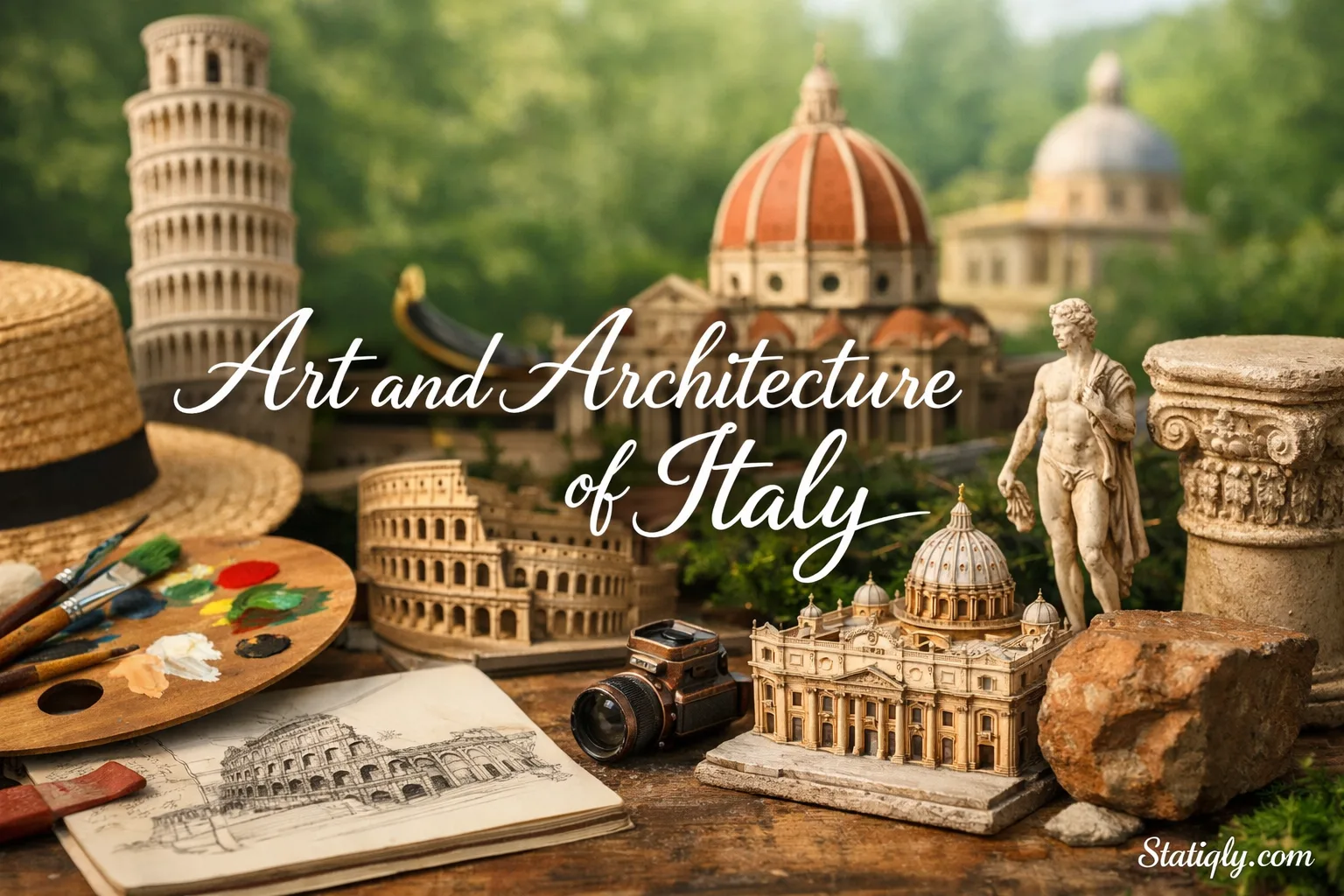
Italy is one of those places where art and architecture don’t sit politely inside museums. They spill into streets, climb bell towers, hide in courtyards, and glow quietly under afternoon light. Ever turned a corner and felt like the city itself was “curated”? In Italy, that feeling is normal—and wonderfully addictive.
How To Read Italian Art And Architecture With Ease
- Start with the bones: arches, columns, domes, and proportions tell you the “logic” of a place.
- Follow the light: Italian builders choreograph sunlight like it’s a material.
- Look for layers: a Roman wall, a medieval bell tower, a Renaissance façade—stacked like a history sandwich.
- Spot the details: cornices, capitals, mosaics, and stone textures reward slow looking.
- Use one simple question: “What was this space made for?” The answer unlocks the design.
A Clear Roadmap of Styles Across Italy
If you like tidy patterns, you’ll love this: Italy’s visual story moves in “chapters,” and each chapter has a recognizable look. The fun part is learning the clues—then spotting them in real life.
| Style & Era | What It Feels Like | Easy Places To Experience It |
|---|---|---|
| Ancient Roman | Bold scale, clean geometry, engineering confidence | Rome, Pompeii, Verona |
| Mosaics & Medieval | Gold shimmer, symbolic imagery, thick stone walls | Ravenna, Venice, Assisi |
| Romanesque | Rounded arches, sturdy rhythm, carved portals | Pisa, Lucca, Modena |
| Gothic | Vertical drama, pointed arches, lace-like stone | Milan, Siena, Orvieto |
| Renaissance | Balance, perspective, human-scale harmony | Florence, Rome, Urbino |
| Baroque | Movement, curves, theatrical light | Rome, Naples, Lecce |
| 19th–21st Century | Iron-and-glass elegance to modern experimentation | Milan, Rome, Turin |
One Super-Useful Tip: Pick A “Style Anchor”
Choose one landmark as your anchor—say the Pantheon for Roman space, or Florence’s Dome for Renaissance ambition. After that, everything else starts to “click” faster.
Ancient Rome: Space And Stone That Still Feels Modern
Roman builders loved big ideas—then made them practical. They treated a city like a machine you could walk through. The Pantheon (rebuilt in the early 2nd century CE) is a masterclass in calm geometry, while the Colosseum (completed in 80 CE) shows how structure can handle crowds with surprising grace.
What To Notice
- Arches that distribute weight smoothly
- Concrete hidden under stone and brick skins
- Coffers (sunken ceiling panels) that lighten massive surfaces
- Interiors designed for flow—entrances, exits, corridors
Where To Go (Simple Picks)
- Rome: Pantheon, Colosseum, Roman Forum
- Verona: Roman Arena with a different city vibe
- Pompeii: streets and homes frozen in time
Mosaics And Medieval Italy: Gold, Stone, And Quiet Wonder
Step into Ravenna and you’ll understand why mosaics feel almost “alive.” Tiny pieces of glass and stone catch light like a low, steady flame. In Venice, St Mark’s Basilica carries that shimmer forward—an atmosphere where walls seem to glow instead of simply stand.
What Makes This Period Easy To Spot
- Thick walls, smaller windows, cozy interiors
- Mosaics that tell stories through symbols and patterns
- Stone surfaces that feel hand-built, not factory-perfect
- A sense of craft everywhere you look
Great Cities For This Mood
- Ravenna: mosaic-rich churches and mausoleums
- Venice: basilicas, palaces, and glittering interiors
- Assisi: fresco cycles and hilltop spaces
The Renaissance: When Perspective Changed The Way We See
Here’s the Renaissance in one line: space starts behaving logically. Buildings look measured. Paintings feel believable. Florence leads the show, especially with Filippo Brunelleschi’s dome on Santa Maria del Fiore (built 1420–1436). It’s architecure that feels like a solved puzzle—bold, clean, and strangely calming.
Renaissance “Clues” You Can Use Today
- Symmetry: left and right feel balanced
- Proportion: parts relate like a well-tuned chord
- Linear perspective: lines guide your eye into depth
- Calm surfaces: less clutter, more clarity
Must-See Places
- Florence: Duomo complex, Palazzo Pitti (begun 1458), bridges and piazzas
- Rome: Renaissance palaces and grand interiors
- Urbino: refined Renaissance urban design
Art Highlights (Keep It Simple)
- Frescoes that read like cinematic scenes
- Portraits where faces feel present, not distant
- Architecture that frames public life—loggias, courtyards, arcades
If you’re visiting major museums, booking ahead can turn a long line into a smooth morning. The Uffizi Galleries are an obvious classic, and the building itself began as a 16th-century architectural project commissioned shortly after 1550.
Baroque Italy: Curves, Motion, And Instant Drama
Baroque design is the moment Italy leans into movement. Lines curve. Spaces surprise you. Light becomes a spotlight. Rome is the easiest place to feel it—walk a few blocks and you’ll find façades that ripple, domes that lift, and interiors that feel staged (in the best way).
What To Look For
- Curved walls and oval plans
- Ceilings that dissolve into painted skies
- Strong contrast—bright highlights against deep shadow
- Details that guide you: columns, niches, sculpted frames
Easy Places To Feel It
- Rome: fountains, churches, theatrical piazzas
- Naples: bold interiors and layered streets
- Lecce: richly carved stonework with a sunny energy
From Iron And Glass To Today: Italy Keeps Reinventing Itself
Italy isn’t “stuck” in the past. It keeps building—and often with a sharp sense of style. In Milan, the Galleria Vittorio Emanuele II (built 1865–1877, opened 1877) shows how iron and glass can feel elegant, not industrial. For contemporary architecture, Rome’s MAXXI opened in 2010 and invites you to walk through space like it’s a flowing line drawing.
Modern Highlights Worth Your Time
- Rome: MAXXI (opened 2010), Auditorium Parco della Musica (delivered 21 December 2002)
- Milan: Bosco Verticale (inaugurated October 2014), sleek design districts
- Turin: museums and boulevards with a refined urban feel
Why This Chapter Matters
It proves a simple point: Italian design isn’t a museum piece. It’s a living language. And once you learn a few “words,” you start hearing it everywhere.
For a big-picture reminder of Italy’s cultural depth, the country holds 61 UNESCO World Heritage Sites (the most in the world, as recorded in mid-2025).
A Practical Way To Plan An Art And Architecture Trip
Want a plan that doesn’t feel like homework? Pick a route that matches your mood. Think of it like choosing music: same country, different rhythm.
Route 1: Rome For Big Ideas
- Morning: Ancient landmarks and open-air ruins
- Midday: Museums or galleries for masterpieces
- Evening: Piazzas, fountains, and golden-hour walks
Route 2: Florence For Renaissance Clarity
- Start with the Duomo area for skyline-defining design
- Choose one major museum, then slow down
- Cross the river for palaces, workshops, and quieter streets
Route 3: Venice For Mosaics And Atmosphere
- Begin early for peaceful squares and soft light
- Go inside one basilica and one palace
- End with a slow waterside wander—no rush, just notice
Mini Glossary For Looking Smarter Instantly
- Fresco: painting on fresh plaster so pigment bonds as it dries
- Loggia: an open-sided gallery, often with arches
- Coffer: a recessed ceiling panel, usually geometric
- Oculus: a circular opening that brings in light (and drama)
- Rustication: rough-cut stone blocks used for texture and strength
Do I Need To Book Tickets In Advance?
For famous museums and landmark interiors, yes—especially in peak seasons. Booking ahead often saves thier whole morning.
How Do I Avoid “Museum Overload”?
Keep a simple rule: one major museum per day, plus street architecture. Your eyes stay fresh, and the city itself becomes part of the visit.
What’s The Easiest Way To Take Better Photos?
Step back, include a doorway or arch as a frame, then wait for the light to settle. Italy rewards patience more than filters.
A Final Thought
Italian art and architecture work best when you let them breathe. Don’t try to “collect” everything. Pick a few masterpieces, then look up at façades, step into courtyards, and notice the everyday beauty in between. That’s where Italy quietly wins your heart.