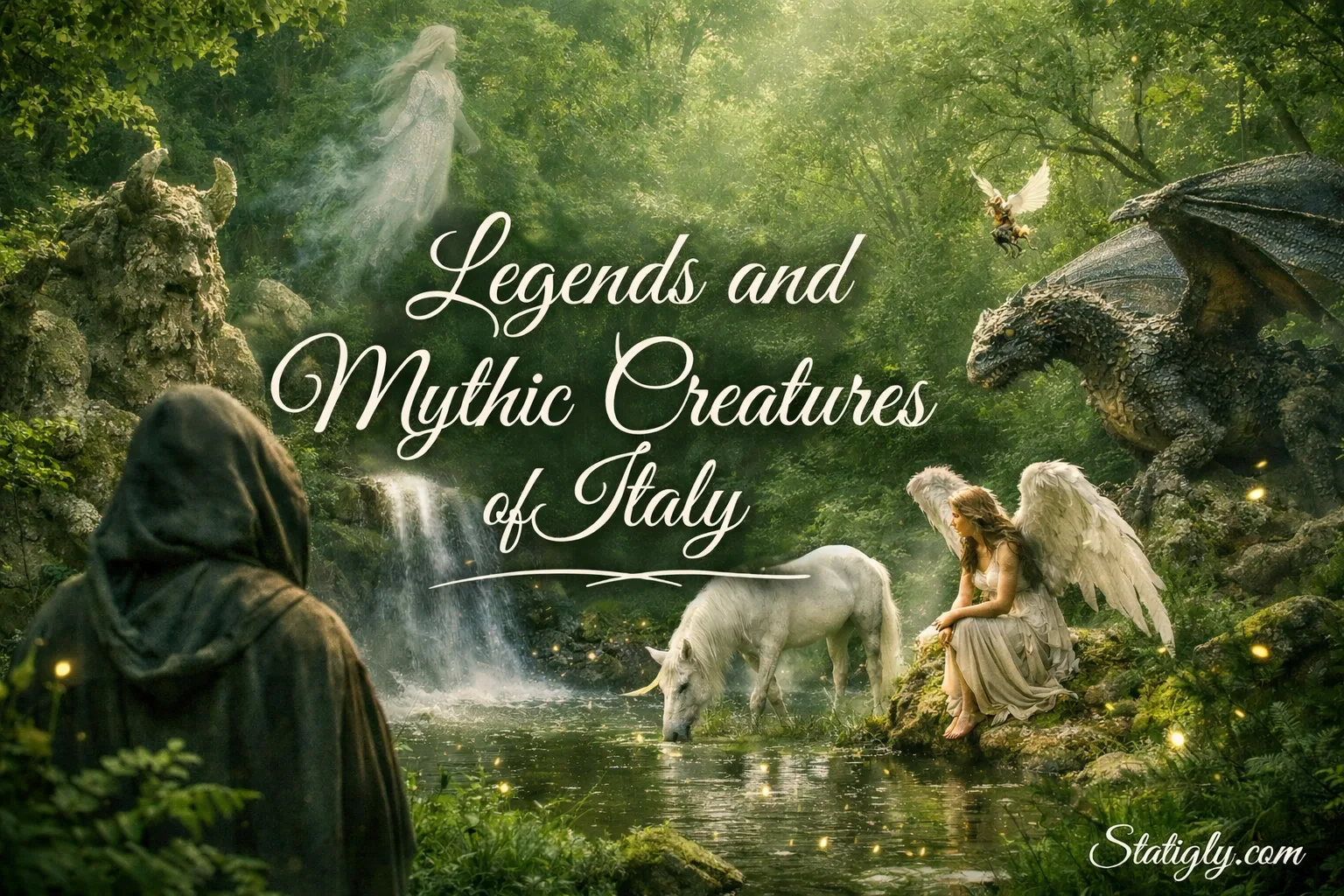
Italy doesn’t just have places to visit. It has stories that cling to doorways, drift across mountain paths, and sparkle on the water at dusk. Ever noticed how one tiny alley can feel like a stage set? That’s Italian folklore at work—quiet, local, and surprisingly practical. These legends and mythic creatures aren’t dusty museum pieces. They’re a second map you can carry in your pocket.
Why Italian Folklore Still Feels Alive
Italy is a mosaic of regions, dialects, and landscapes. So its legends come in many flavors, too. In the north, mountain tales sound like wind in pines. In the south, stories lean toward the sea, warm stone, and candlelit kitchens.
Here’s the fun part: you don’t need to “believe” anything to enjoy it. Think of folklore like local cuisine. You taste it to understand the place. Ask a friendly question, walk the right street, show a little curiosity, and the myth starts to feel… close.
Use This Like A Travel Map
If you want the most from these legends, pair each one with a real-world moment. A festival date. A viewpoint. A museum stop. A simple evening walk. That’s when the stories stop being text and start being experience.
Winter is perfect for gift-bringers and village masks.
- La Befana
- Badalisc
Cities shine with house-spirits and alleyway mischief.
- Il Monaciello
- La Bella ’Mbriana
Water tales belong to coastlines, straits, and mountain lakes.
- Colapesce
- Anguane
Legends And Mythic Creatures To Find Across Italy
Each stop below gives you three things: the story in plain language, where it “lives” on the map, and an easy way to experience it without forcing anything. Bring curiosity. That’s enough.
La Befana And The Sweetest Night In January
Picture an old woman with a broom, a warm smile, and a bag of small surprises. That’s La Befana, Italy’s beloved gift-bringer who visits on Epiphany Eve. The mood is cozy, playful, and very family-friendly.
- Where It Belongs: Across Italy, with especially lively celebrations in some central towns.
- What It Feels Like: A winter tradition that turns streets into a gentle festival.
- Easy Way To Experience It: If you’re in Italy around January 5–6, look for local Epiphany events, markets, or parades.
Small Detail: In many families, the “magic” is less about big gifts and more about tiny treats, jokes, and the feeling that winter has a friendly heartbeat.
Il Monaciello, Naples’ Mischief In A Tiny Hood
Naples is famous for its energy. The legend of Il Monaciello fits right in: a small “little monk” spirit who slips through old buildings, hides things, and sometimes leaves luck behind. Is it spooky? Not really. It’s more like living in a house that likes to tease you.
- Where It Belongs: Naples, especially the historic center and the city’s older stories.
- What It Represents: The idea that a city has a personality—and it can be witty.
- Easy Way To Experience It: Take a guided walk that focuses on Naples’ traditions and hidden corners. Then notice how locals talk about “luck” like it’s a neighbor.
Try This: When you step into a narrow courtyard, pause for ten seconds. Listen. Naples is loud, sure. Yet some corners feel mysterous in the best way.
La Bella ’Mbriana And The Spirit Of A Happy Home
While Il Monaciello jokes around, Naples also keeps a softer story close: La Bella ’Mbriana, a protective house spirit linked with harmony, sunlight, and the feeling that a home is a living thing. The message is simple. Keep your space cared for. Speak kindly inside it.
- Where It Belongs: Naples and its long, intimate home traditions.
- What It Represents: Hospitality, calm, and respect for the place you live.
- Easy Way To Experience It: Visit neighborhoods where daily life is on display—laundry lines, open windows, tiny courtyards. You’ll understand why a “home spirit” makes sense here.
Good To Know: In some retellings, people avoid talking about moving house indoors. It’s a charming way of saying, “This home deserves a little loyalty.”
Colapesce, The Boy Who Became Sea-Strong
In Sicily, the sea isn’t a backdrop. It’s family. The legend of Colapesce tells of a boy named Nicola—so devoted to the water that people said he moved like a fish. In many versions, a king tests his diving skill by tossing objects into the deep. Nicola brings back treasures… then discovers something bigger: Sicily itself is said to rest on pillars beneath the sea. One pillar is weakened, and Colapesce stays below to support it.
- Where It Belongs: Sicily, often linked to the Strait of Messina and coastal storytelling.
- What It Represents: Love for home, responsibility, and the island’s bond with the sea.
- Easy Way To Experience It: Spend an evening near the strait or a working harbor. Watch the water change color as the light drops. The legend suddenly feels logical.
Bonus Sea-Legend: The Fata Morgana is a famous mirage reported in the Strait of Messina, named after the enchantress Morgan le Fay. On certain days, the coastline can look stretched, stacked, or floating—like the sea is playing tricks with a smile.
Badalisc And The Alpine Village That Laughs Together
Up in Lombardy’s Val Camonica, the Badalisc is described as a forest creature with a big head and a wild presence. The best part is how the village handles it: with masks, procession, and humor. It’s folklore as community glue—everyone shows up, everyone shares the moment.
- Where It Belongs: Andrista (Cevo area), Val Camonica, in the southern central Alps.
- What It Represents: A ritual excuse to gather, tease, and reset the mood for the year.
- Easy Way To Experience It: If you’re nearby in early January, check local event listings for the Badalisc celebration and related village festivities.
Travel Tip: In small towns, the best seat is often a respectful distance back. You see more, and you’re not in anyone’s way. Folk traditions breathe better that way.
The Apennine Sibyl And A Mountain With A Secret
The Sibillini Mountains sit between Marche and Umbria like a jagged spine. Their signature legend is the Apennine Sibyl, a powerful figure said to rule an underground realm accessed through a cave near Monte Sibilla. Over centuries, the story inspired writers, travelers, and plenty of wide-eyed hikers.
- Where It Belongs: The Sibillini Mountains area, with Montemonaco often linked to the legend.
- What It Represents: Mountains as mystery—places where nature feels older than your plans.
- Easy Way To Experience It: Visit local museums and viewpoints tied to the Sibyl tradition, then take a well-marked hike suited to your level. Access rules around the cave area can change, so check local guidance before heading up.
Best Moment: Go near sunrise or late afternoon. The light shifts fast in the Apennines, and the landscape can feel like it’s telling its own story.
Anguane, The Water Spirits Of Northern Italy
In parts of Veneto, Trentino, and the Dolomites, people tell stories of Anguane—water-connected beings linked with springs, streams, and mountain lakes. Some tales paint them as helpers. Others make them playful and elusive. Either way, they’re a reminder: in the Alps, water is precious. It deserves respect.
- Where It Belongs: Northern Italy’s alpine and pre-alpine regions, especially areas shaped by rivers and high lakes.
- What It Represents: Nature as caretaker—and as something you don’t control.
- Easy Way To Experience It: Walk a lakeside trail in the Dolomites or nearby valleys, then stop where the water runs clear. Folklore often grows exactly where the landscape asks you to slow down.
Keep It Simple: If you’re visiting a quiet water spot, do what locals do—keep voices low, leave no trace, and treat it like a shared living room.
A Simple Snapshot Of Where These Legends Live
| Legend Or Creature | Region Focus | Best Real-World Pairing | When It Pops |
|---|---|---|---|
| La Befana | Nationwide | Epiphany events, markets, family parades | Early January |
| Il Monaciello | Naples | Historic-center walk, courtyards, old stairways | Any season, best at dusk |
| La Bella ’Mbriana | Naples | Neighborhood strolls, everyday home life scenes | Sunny afternoons |
| Colapesce | Sicily | Harbors, straits viewpoints, evening sea watching | Late afternoon into night |
| Badalisc | Val Camonica (Lombardy) | Village festivities, masked tradition, local food | Early January |
| Apennine Sibyl | Sibillini Mountains | Museums + viewpoint hikes with local guidance | Spring to early autumn |
| Anguane | Dolomites / Veneto / Trentino | Lakeside trails and clear-water springs | Summer and early autumn |
How To Ask About Legends Without Being Awkward
- Start With Place: “Is there a local story about this street or this lake?” works better than naming a creature first.
- Invite, Don’t Test: You’re not checking facts. You’re opening a door.
- Keep It Light: A smile and a short question usually gets a better story than a long interview.
- Say Thanks: Folklore is a gift. Treat it like one.
Italy’s myths don’t demand anything from you. They just offer a different way to look at a street, a mountain ridge, a slice of winter sky. And once you start noticing them, you’ll realize something lovely: the country isn’t only made of places. It’s made of stories that refuse to fade.