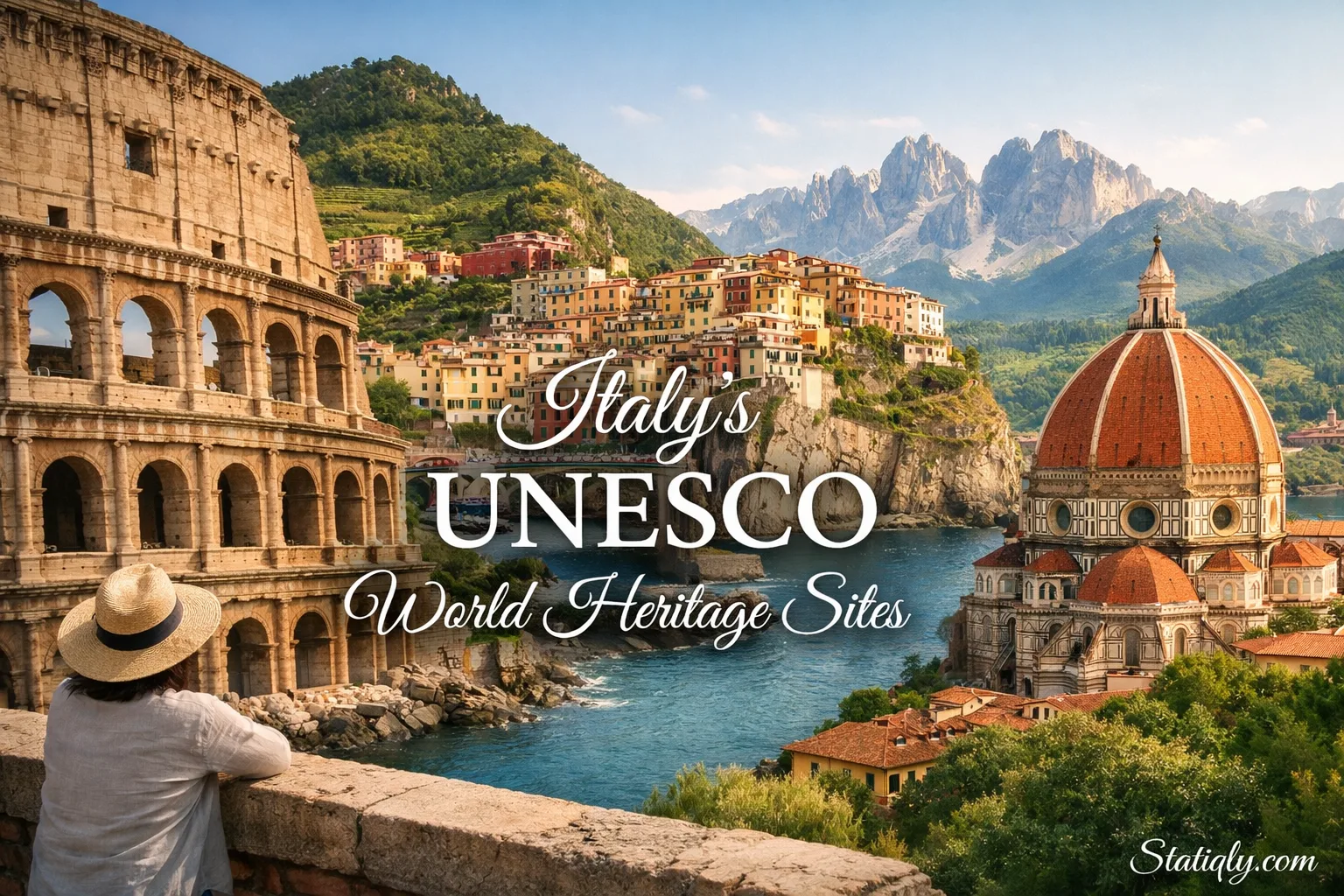
Italy’s UNESCO World Heritage Sites are like a necklace made of many different gems—ancient streets, painted chapels, volcano slopes, and cliffside villages—each one catching the light in its own way. Ever walked into a place and felt time slow down, just a little? That’s the feeling these sites tend to spark, from grand city centers to quiet landscapes where the view does the talking.
A Few Numbers That Set The Scene
- 61 World Heritage properties in Italy
- 55 are Cultural, 6 are Natural
- 7 are shared across borders (transnational)
- 0 are listed as “in danger” right now
UNESCO listings focus on Outstanding Universal Value—the kind of cultural or natural importance that speaks to everyone, not just locals. In Italy, that story is told through cities, archaeology, sacred art, and landscapes that still feel alive.
How Italy’s UNESCO Sites Fit Into Real Travel Plans
Some UNESCO places are one ticket and one doorway. Others are whole neighborhoods, coastlines, or valleys—more like a stage than a single scene. The trick is to match the site to your energy. Want an easy day with minimal logistics? Choose a compact historic center. Craving a slow, outdoorsy experince? Pick a natural site and let the day breathe.
Low-Friction Picks
- Historic Centre Of Florence (walkable, dense, unforgettable)
- Piazza Del Duomo, Pisa (easy stop, iconic silhouette)
- Historic Centre Of San Gimignano (small town, big atmosphere)
Slow-Travel Favorites
- Val d’Orcia (rolling hills that look painted)
- Costiera Amalfitana (coastal views, cliffside lanes)
- Portovenere, Cinque Terre, And The Islands (paths, sea air, colorful villages)
The Six Natural UNESCO Sites In Italy
Italy’s natural sites are fewer in number, yet they hit hard—like a chorus that arrives after a long verse. If you want wide skies, clean horizons, and that “I can finally exhale” feeling, start here.
| UNESCO Natural Site | What It Feels Like | Practical Tip |
|---|---|---|
| Isole Eolie (Aeolian Islands) | Island-hopping with dramatic volcanic shapes | Pick fewer islands and stay longer; ferries reward patience |
| Monte San Giorgio | Quiet trails with a deep-time, geology-first vibe | Bring good shoes; this is a “slow steps, big views” day |
| Ancient And Primeval Beech Forests Of Europe | Forest calm that feels almost storybook | Go early for the softest light and the fewest people |
| The Dolomites | Sharp peaks and sweeping meadows—postcard, but real | Check lift schedules by season; it changes your whole route |
| Mount Etna | Otherworldly lava landscapes and big-sky panoramas | Weather shifts fast; pack one extra layer even in warm months |
| Evaporitic Karst And Caves Of Northern Apennines | Caves, rock forms, and nature’s “hidden rooms” | Book guided access when offered; it usually improves the visit |
Cultural Highlights That Never Feel Like Homework
“Cultural” can sound academic. In Italy, it’s often the opposite. It’s the sound of footsteps on old stone, the way a piazza opens up like a surprise, the quiet inside a chapel when the outside world keeps moving.
- Historic Centre Of Rome — layers on layers, like a city built from stacked postcards
- Venice And Its Lagoon — a place that floats between reality and dream
- Archaeological Areas Of Pompei, Herculaneum And Torre Annunziata — streets that still feel surprisingly familiar
- Historic Centre Of Naples — lively, human, full of everyday beauty
- The Sassi Of Matera — carved spaces that glow at sunset
- Genoa: Le Strade Nuove And The Palazzi Dei Rolli — grand streets with a “look up” kind of charm
Two Newer Names To Put On Your Radar
Via Appia. Regina Viarum (inscribed in 2024) invites you to follow an ancient route where history feels like a long, walkable line.
Funerary Tradition In The Prehistory Of Sardinia – The Domus De Janas (inscribed in 2025) adds a fresh spotlight on Sardinia’s deep past—quiet places, powerful presence.
Simple Itinerary Ideas Built Around UNESCO Sites
Not everyone wants to “collect” sites. Many people just want a trip that flows. Here are a few routes that feel natural, not forced—like following a river instead of drawing straight lines on a map.
- Rome + Tivoli: base yourself in Rome, then add Villa Adriana and Villa d’Este as day trips for a clean “city-to-gardens” contrast.
- Tuscany In Three Moods: start with Florence, slow down in Val d’Orcia, then finish in San Gimignano for small-town atmosphere.
- Sicily’s Big Contrast: pair Mount Etna with the Late Baroque Towns of the Val di Noto for nature + architecture in one trip.
- Northern Craft And Calm: mix Mantua and Sabbioneta with Ravenna for art-rich days that still feel relaxed.
Small Habits That Make Your Visit Better
- Book timed entries when they exist; it keeps your day smooth.
- Start early for famous sites—morning light is a bonus.
- Look up local rules (especially in sacred spaces). It’s a small gesture with big respect.
- Choose one “slow” moment daily: a bench, a view, a short walk. The memory sticks.
- Keep it gentle: stay on paths, avoid touching fragile surfaces, and leave places exactly as you found them.
Full List Of Italy’s UNESCO World Heritage Sites
Open The Complete List (All 61)
Tip: use your browser’s find function to jump to a city or region fast. The Category column marks Cultural vs Natural.
| Year | Property Name | Category |
|---|---|---|
| 1979 | Rock Drawings in Valcamonica | Cultural |
| 1980 | Church and Dominican Convent of Santa Maria delle Grazie with “The Last Supper” by Leonardo da Vinci | Cultural |
| 1980 | Historic Centre of Rome, the Properties of the Holy See in that City Enjoying Extraterritorial Rights and San Paolo Fuori le Mura | Cultural |
| 1982 | Historic Centre of Florence | Cultural |
| 1987 | Piazza del Duomo, Pisa | Cultural |
| 1987 | Venice and its Lagoon | Cultural |
| 1990 | Historic Centre of San Gimignano | Cultural |
| 1993 | The Sassi and the Park of the Rupestrian Churches of Matera | Cultural |
| 1994 | City of Vicenza and the Palladian Villas of the Veneto | Cultural |
| 1995 | Crespi d’Adda | Cultural |
| 1995 | Ferrara, City of the Renaissance, and its Po Delta | Cultural |
| 1995 | Historic Centre of Naples | Cultural |
| 1995 | Historic Centre of Siena | Cultural |
| 1996 | Castel del Monte | Cultural |
| 1996 | Early Christian Monuments of Ravenna | Cultural |
| 1996 | Historic Centre of the City of Pienza | Cultural |
| 1996 | The Trulli of Alberobello | Cultural |
| 1997 | 18th-Century Royal Palace at Caserta with the Park, the Aqueduct of Vanvitelli, and the San Leucio Complex | Cultural |
| 1997 | Archaeological Area of Agrigento | Cultural |
| 1997 | Archaeological Areas of Pompei, Herculaneum and Torre Annunziata | Cultural |
| 1997 | Botanical Garden (Orto Botanico), Padua | Cultural |
| 1997 | Cathedral, Torre Civica and Piazza Grande, Modena | Cultural |
| 1997 | Costiera Amalfitana | Cultural |
| 1997 | Portovenere, Cinque Terre, and the Islands (Palmaria, Tino and Tinetto) | Cultural |
| 1997 | Residences of the Royal House of Savoy | Cultural |
| 1997 | Su Nuraxi di Barumini | Cultural |
| 1997 | Villa Romana del Casale | Cultural |
| 1998 | Archaeological Area and the Patriarchal Basilica of Aquileia | Cultural |
| 1998 | Cilento and Vallo di Diano National Park with the Archeological Sites of Paestum and Velia, and the Certosa di Padula | Cultural |
| 1998 | Historic Centre of Urbino | Cultural |
| 1999 | Villa Adriana (Tivoli) | Cultural |
| 2000 | Assisi, the Basilica of San Francesco and Other Franciscan Sites | Cultural |
| 2000 | City of Verona | Cultural |
| 2000 | Isole Eolie (Aeolian Islands) | Natural |
| 2001 | Villa d’Este, Tivoli | Cultural |
| 2002 | Late Baroque Towns of the Val di Noto (South-Eastern Sicily) | Cultural |
| 2003 | Monte San Giorgio | Natural |
| 2003 | Sacri Monti of Piedmont and Lombardy | Cultural |
| 2004 | Etruscan Necropolises of Cerveteri and Tarquinia | Cultural |
| 2004 | Val d’Orcia | Cultural |
| 2005 | Syracuse and the Rocky Necropolis of Pantalica | Cultural |
| 2006 | Genoa: Le Strade Nuove and the system of the Palazzi dei Rolli | Cultural |
| 2007 | Ancient and Primeval Beech Forests of the Carpathians and Other Regions of Europe | Natural |
| 2008 | Mantua and Sabbioneta | Cultural |
| 2008 | Rhaetian Railway in the Albula / Bernina Landscapes | Cultural |
| 2009 | The Dolomites | Natural |
| 2011 | Longobards in Italy. Places of the Power (568-774 A.D.) | Cultural |
| 2011 | Prehistoric Pile Dwellings around the Alps | Cultural |
| 2013 | Medici Villas and Gardens in Tuscany | Cultural |
| 2013 | Mount Etna | Natural |
| 2014 | Vineyard Landscape of Piedmont: Langhe-Roero and Monferrato | Cultural |
| 2015 | Arab-Norman Palermo and the Cathedral Churches of Cefalú and Monreale | Cultural |
| 2017 | Venetian Works of Defence between the 16th and 17th Centuries: Stato da Terra – Western Stato da Mar | Cultural |
| 2018 | Ivrea, industrial city of the 20th century | Cultural |
| 2019 | Le Colline del Prosecco di Conegliano e Valdobbiadene | Cultural |
| 2021 | Padua’s fourteenth-century fresco cycles | Cultural |
| 2021 | The Great Spa Towns of Europe | Cultural |
| 2021 | The Porticoes of Bologna | Cultural |
| 2023 | Evaporitic Karst and Caves of Northern Apennines | Natural |
| 2024 | Via Appia. Regina Viarum | Cultural |
| 2025 | Funerary Tradition in the Prehistory of Sardinia – The domus de janas | Cultural |
One last thought: you don’t need to see everything. Pick a handful that match your pace, and let Italy do what it does best—turn a simple day into a story you’ll retell.