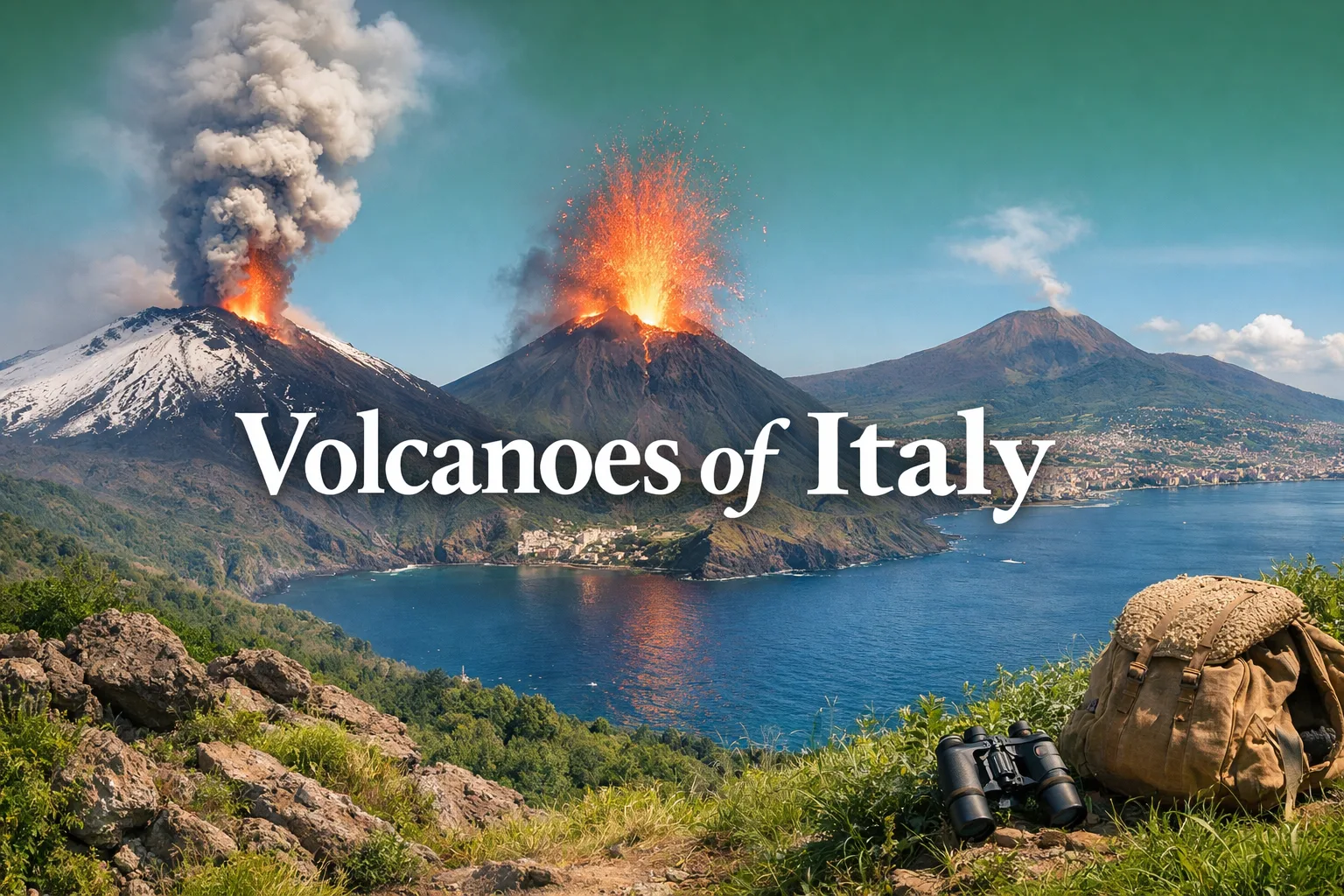
Italy’s volcanic landscapes range from high-elevation craters and broad lava fields to black-sand islands, fumaroles, and geothermal areas. The volcanoes of Italy are concentrated mainly around Campania, Sicily, and the Aeolian Islands, with visitor access shaped by terrain, weather, and current volcanic activity.
Why Italy’s Volcano Landscapes Feel So Unique
Italy sits where large tectonic pieces meet and shift, shaping a chain of volcanic areas from Campania to Sicily and out into the Aeolian Islands. That’s why you can taste mineral-rich wines on volcanic slopes, then—within a short flight or ferry—watch fumaroles curl into the air by the sea.
These volcanic areas are not all alike. Some are known for broad lava fields, others for well-defined crater rims, while places such as Ischia and Campi Flegrei are closely associated with geothermal heat, warm water, and steam vents.
What You’ll Notice Right Away
- Color contrasts: dark lava rock beside bright Mediterranean blues.
- Texture changes: crunchy volcanic gravel, smooth basalt, soft ash.
- Natural warmth: hot ground in pockets, especially near vents and thermal zones.
How To Enjoy It Comfortably
- Choose marked trails and official viewpoints.
- Go early for clearer skies and calmer paths.
- If a guide is recommended, take it—good guides feel like a shortcut to the best moments.
Italy’s Most Famous Volcanoes And What They’re Like To Visit
Mount Etna (Sicily)
Etna is one of Italy’s main volcano destinations, with landscapes that change markedly with elevation. Vineyards and orchards occupy lower slopes, while higher areas are dominated by lava rock, ash, and exposed volcanic terrain.
- Best for: big panoramic views, lava landscapes, cable car + guided options (seasonal).
- Great base: Catania or Taormina for easy access and lots of day-trip choices.
- Small tip: bring a light layer even on warm days—higher elevations can feel surprisingly cool.
Etna Activity Snapshot — August 2026
INGV’s VONA archive recorded repeated changes in Etna’s aviation color code during July and August 2026. From 15–20 August, notices included both RED and ORANGE codes; on 24 August 2026, the aviation color code was YELLOW. These codes are issued for aviation monitoring and should not be read as a permanent public-access or eruption-risk rating.
INGV’s satellite monitoring page, updated on 24 August 2026, described thermal activity in Etna’s summit area over the previous week as moderate. Because volcanic conditions and access rules can change quickly, this is a dated snapshot rather than a standing description of Etna’s current state.
Stromboli (Aeolian Islands)
Stromboli is a volcanic island with a steep cone rising directly from the Tyrrhenian Sea. Many visitors come for coastal viewpoints and evening observation, when permitted, because eruptive activity can sometimes be visible after dark.
- Best for: island atmosphere, coastal viewpoints, guided hikes depending on current access rules.
- Great base: staying on Stromboli itself, or pairing it with Lipari for ferries and variety.
- Small tip: aim for a guided experience if you want higher viewpoints—routes can change over time.
Mount Vesuvius (Near Naples)
Vesuvius offers one of Italy’s most direct crater-rim visits. The established route reaches viewpoints over the crater and the Bay of Naples, making it practical to combine with other stops around Naples and the surrounding archaeological areas.
- Best for: accessible crater views, short half-day planning, pairing with nearby cultural stops.
- Great base: Naples or Sorrento.
- Small tip: book timed entry when required and arrive earlier than you think—popular days fill up fast.
Campi Flegrei (Phlegraean Fields)
Campi Flegrei is a broad volcanic area rather than a single cone. Its landscape includes craters, fumarolic zones, geothermal features, and lakes, with several sites located close to Naples and Pozzuoli.
- Best for: geothermal scenery, short walks, unusual landscapes near Naples.
- Great base: Pozzuoli or Naples.
- Small tip: choose official access points—some areas have restrictions for good reasons.
Vulcano And Lipari (Aeolian Islands)
The Aeolian Islands make it possible to combine volcanic landscapes with short ferry connections. Vulcano is known for its crater area and geothermal features, while Lipari works well as a practical hub with services, viewpoints, and connections to other islands.
Ischia (Thermal Comfort With A Volcanic Heart)
Ischia is widely associated with its thermal culture, including naturally heated waters and established spa areas. It suits visitors who want to experience a volcanic island without making a crater hike the main focus of the day.
Volcano Access And Safety
Access can change with volcanic activity, weather, gas conditions, or local restrictions. Check current official guidance before setting out, stay on marked trails, and use authorized guides where required. If conditions change during a visit, follow closures and turn-around instructions rather than relying on an earlier plan.
- Wear grippy shoes (loose volcanic gravel can slide).
- Bring water and a light snack.
- Pack sun protection—lava terrain reflects light more than you expect.
How To Choose The Right Volcano Experience
The best choice depends mainly on whether you want a big mountain day, an island visit, or a volcanic area close to a major city.
| What You Want | Best Match In Italy | Why It Fits | Easy Planning Note |
|---|---|---|---|
| Big, all-in volcano scenery | Mount Etna | Wide landscapes, multiple routes, varied terrain | Consider a guided upper-slope option if available |
| Island atmosphere + volcanic views | Stromboli / Vulcano | Ferries, viewpoints, and a “volcano holiday” mood | Build buffer time for sea schedules |
| Short, classic crater walk | Mount Vesuvius | Direct path to a famous rim view | Timed entry may apply on popular dates |
| Something unusual near Naples | Campi Flegrei | Geothermal features and crater landscapes | Use official access points and current guidance |
| Volcanic energy with relaxation | Ischia | Thermal culture in a scenic island setting | Great for mixed groups and slower travel |
Two Practical Volcano Itineraries
Sicily Focus: Etna With Bonus Stops
- Base in Catania or Taormina.
- Pick an Etna route that matches your comfort (short walk, mid-slope, guided higher areas when available).
- End with a relaxed meal featuring local produce and regional foods grown on volcanic soils.
Naples Focus: Vesuvius Plus Volcanic Neighbors
- Base in Naples for easy transport links.
- Do Vesuvius early for clearer views.
- Add a half-day in Campi Flegrei for a different kind of volcanic landscape.
What To Pack For A Volcano Day Without Overthinking It
Most standard visitor routes do not require technical equipment, but basic footwear, water, and weather protection make a noticeable difference.
- Sturdy shoes with grip (the single best upgrade).
- Light jacket or wind layer for higher elevations.
- Water + a simple snack.
- Sunglasses + sunscreen.
- Small bag you can keep close while walking.
Volcanic Italy Beyond Craters: Food, Wine, And Views
Volcano travel in Italy isn’t only about the hike. Volcanic soils are often linked with vibrant agriculture, and many regions celebrate that connection through local markets and restaurants. If you enjoy tasting a place as much as seeing it, you’ll love how vineyards on volcanic slopes and orchards near lava fields create a memorable backdrop for a simple meal.
Simple Volcano And Coastal Pairings
- A coastal viewpoint + a calm ferry ride in the Aeolian Islands.
- A morning crater walk + a long lunch near Naples.
- A day on Etna + an evening stroll in a historic town.
Landscape Details To Notice
- Changes in color and texture between fresh-looking lava rock, older weathered flows, and ash-covered ground.
- Differences between steep crater rims, broad lava fields, and coastal volcanic formations.
- Pioneer plants growing in volcanic gravel and other young or nutrient-poor surfaces.
Common Questions About Visiting Italy’s Volcanoes
Do I need a guide? For many easy viewpoints, no. For higher routes (especially on islands or upper slopes), guides can be required or simply smarter because conditions and access rules can change.
Is it okay with kids? Often, yes—choose shorter walks, wider paths, and places with visitor infrastructure. Islands like Ischia can be especially family-friendly.
What’s the best season? Spring and autumn are popular for comfortable walking. Summer works too—just plan earlier in the day and bring extra water.