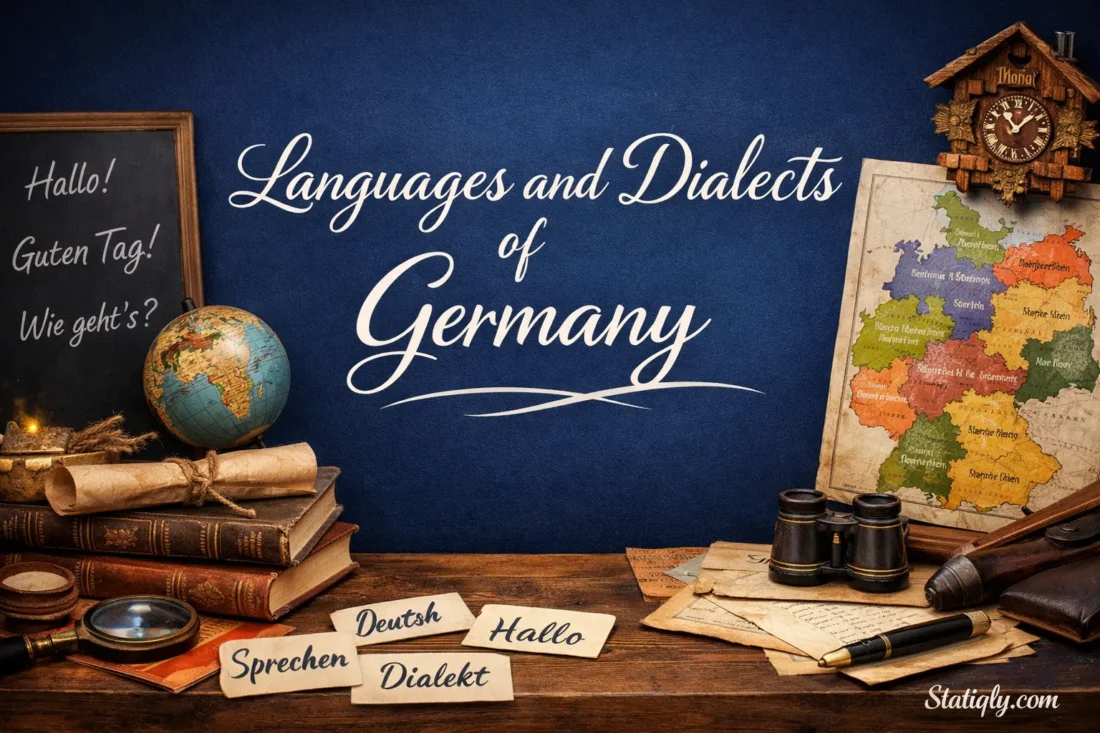
Germany is a country where one language can sound like a dozen—depending on the train stop, the market, or the café you walk into. You might hear crisp Standard German on the news, then catch a warm local rhythm at the bakery counter. Is it still “German” if you barely recognize the words? Yes—and that’s the fun part. Think of dialects as local seasoning: the dish stays familiar, yet every region adds its own flavor.
| Language Variety | Where You’ll Hear It | What To Know |
| Standard German (Hochdeutsch) | Nationwide | The default for school, national media, and formal settings. |
| Regional Dialects | Town-to-town | Everyday speech can shift fast—sometimes within one hour of driving. |
| Low German (Plattdeutsch) | Mainly the North | A distinct regional language tradition alongside Standard German. |
| Danish | Near the Danish border | A traditional minority language with local visibility in its region. |
| Sorbian (Upper & Lower) | Parts of Saxony & Brandenburg | A Slavic language presence with strong community roots. |
| Frisian (North & Saterland) | Northwest coastal areas | Small-area languages with a deep regional heritage. |
| Romani (German Sinti & Roma) | Non-territorial | Traditionally used across regions rather than one specific area. |
| German Sign Language (DGS) | Across Germany | A full language with its own grammar, used in Deaf communities. |
Standard German And Everyday Communication
Standard German is the shared bridge across the country. It’s what you’ll see in nationwide newspapers, hear in most TV broadcasts, and use in formal writing. If you learned German in a classroom, this is the register you practiced.
Where Standard German Shows Up Most
- Public services (forms, official letters, many federal procedures)
- Education (school materials, exams, universities)
- Workplaces (meetings, reports, customer communication)
- National media (news, documentaries, many podcasts)
If someone starts in a dialect and notices you’re new to it, many speakers can shift into a more standard style. A simple, friendly request often does the trick.
Accent Vs. Dialect: A Helpful Distinction
An accent is mostly about pronunciation. A dialect can change pronunciation and vocabulary, grammar, and even sentence melody. So when a local says, “That’s our dialect,” they may mean more than a different way of saying the same words.
Germany’s Dialect Map In Plain English
Germany’s dialect landscape is less like neat boxes on a map and more like a color gradient. Neighboring towns often understand each other easily, while far-apart regions can sound surprisingly different. Ever heard someone say a greeting that didn’t match your textbook? That’s the gradient at work.
North: Low German Influence
In the north, you may encounter Low German traditions and northern speech patterns that feel brisk and direct.
- Plattdeutsch (Low German traditions in many areas)
- Common greeting: “Moin” (often used all day)
- Local accents can sound “flatter” to newcomers—less sing-song, more clipped
Center: The Big Mix
Central Germany is a meeting point of dialect families. You’ll notice plenty of regional signatures—especially in cities with strong local identity.
- Kölsch (Cologne area)
- Hessian (around Frankfurt and beyond)
- Thuringian and Saxon varieties (east-central areas)
- Berlin-Brandenburg speech patterns in and around the capital region
South: Upper German Dialects
In the south, dialects can be especially vivid in sound and vocabulary. Many people keep them for family and community life.
- Bavarian (many parts of Bavaria)
- Swabian (parts of Baden-Württemberg)
- Alemannic varieties (southwest areas)
- You’ll often hear a more melodic intonation than in the north
What Makes Dialects Feel “Hard” Sometimes?
It’s usually one of these:
- Different words for everyday things (bread rolls, greetings, small talk)
- Contracted speech (words run together in fast conversation)
- Local grammar habits (small shifts that add up)
- Pronunciation surprises (sounds you didn’t expect from Standard German)
A Simple Mindset That Helps
Don’t chase every unfamiliar word. Follow the topic, catch the key verbs, and let the rest fill in naturally. Dialects are like music—at first you hear noise, then you find the beat.
Regional And Minority Languages With Special Protection
Beyond dialects, Germany is also home to several traditional minority and regional languages. These are long-established language communities with their own stories, literature, and local presence. You’ll most often notice them through bilingual signage, cultural events, local media, and community education in the regions where they are used.
| Language | Type | Common Regional Presence | A Useful Note |
| Danish | Minority language | Near the Danish border | You may spot bilingual public information in local contexts. |
| Upper Sorbian | Minority language | Parts of Saxony | Often connected to strong local traditions and community life. |
| Lower Sorbian | Minority language | Parts of Brandenburg | You may notice it in local signage and cultural programming. |
| North Frisian | Minority language | North Sea coastal areas | Seen in local place names and community initiatives. |
| Saterland Frisian | Minority language | A small area in Lower Saxony | One of Europe’s notable small-area Germanic languages. |
| Romani (German Sinti & Roma) | Minority language (non-territorial) | Across regions | Not tied to one place, but historically present nationwide. |
| Low German (Plattdeutsch) | Regional language | Mainly the North | Separate from Standard German, with its own long tradition. |
How To Spot These Languages While Traveling
- Bilingual signs for towns, streets, or public buildings
- Local radio segments or community announcements
- Bookstores carrying regional-language titles
- Museums or visitor centers highlighting local linguistic heritage
If you’re curious, asking “Is this also written in a regional language?” is a friendly opener that often leads to a great conversation.
German Sign Language And Accessible Communication
German Sign Language (often shortened to DGS) is a complete language with its own grammar and natural flow. It is used across Germany within Deaf communities and in many interpreted settings. DGS is not “signed German” word-for-word; it’s its own linguistic system.
What Visitors Should Know
- In formal contexts, interpreting can be available depending on the setting and the service provider.
- Many institutions also offer information in simpler language formats or accessible communication options.
- If you need accommodation, asking early is the smoothest path.
A respectful habit: address the person directly, not the interpreter. It keeps the conversation human and natural.
Languages Commonly Heard In Modern Germany
Germany’s cities and university towns sound globally connected. Alongside German varieties, you may hear many international languages in daily life—on public transport, in shopping streets, and around campuses. English is also widely used in tourism and in many international work environments.
- Turkish
- Arabic (many regional varieties)
- Polish
- Russian
- Kurdish (several varieties)
- Romanian
- Italian
- Greek
- Spanish and French
- Ukrainian
Hearing multiple languages in one afternoon is normal—especially in bigger cities. It’s part of the everyday soundscape, like street music you didn’t plan to find.
How To Navigate Dialects Without Stress
You don’t need to “master” a dialect to enjoy Germany. A few practical moves can make conversations smoother—whether you’re visiting for a week or settling in for years.
Friendly Phrases That Work Almost Anywhere
- “Könnten Sie das bitte wiederholen?” (Could you repeat that, please?)
- “Etwas langsamer, bitte.” (A bit slower, please.)
- “Meinen Sie …?” (Do you mean …?)
- “Können wir Hochdeutsch sprechen?” (Can we speak Standard German?)
People usually appreciate the effort. You’re not criticizing their speech—you’re building a bridge.
Listening Tricks That Feel Like Cheating (In A Good Way)
- Anchor words: listen for verbs, time words, and place names first.
- Context clues: what’s happening around you often explains the sentence.
- One question at a time: ask about one word, not the whole paragraph.
- Repeat back the idea: “So you mean the train leaves from platform 4?”
Where Dialects Shine Most
If you want to hear dialects in their natural habitat, look for settings where people relax. Markets, small cafés, local festivals, neighborhood bakeries—places where language feels like a handshake. And if you catch only half of it, that’s still a win. You’re hearing Germany’s cultural texture, not just its dictionary.