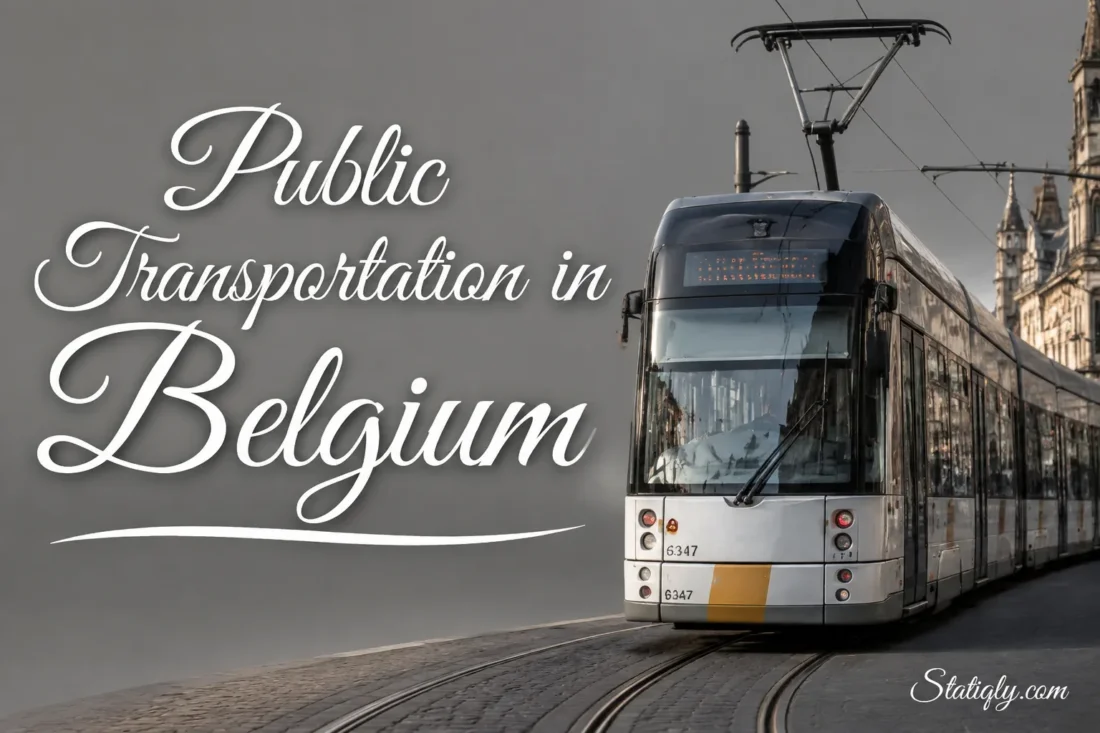
Belgium is compact enough that trains can carry you between many major cities in a relatively short time, but understanding the network takes more than knowing where the nearest station is. The country uses one national rail operator and three main regional public transport operators. Brussels adds another layer because all four can appear within the same journey. Once that division makes sense, travelling between Brussels, Antwerp, Ghent, Bruges, Leuven, Liège, Namur and the Belgian coast becomes much easier to plan.
The most useful rule is simple: think of SNCB/NMBS for travel between cities, then look at the regional operator for the local part of the journey. Brussels is the main exception because trains, metro services, trams and buses overlap more closely there.
Four Operators Shape Public Transportation in Belgium
Belgium does not have one single public transport company covering every train, tram, metro and bus. Instead, responsibility is divided by transport type and region.
| Operator | Main Area | Typical Services | Where Visitors Commonly Meet It |
|---|---|---|---|
| SNCB / NMBS | Across Belgium | National and regional trains | Travel between Belgian cities and towns |
| STIB / MIVB | Brussels-Capital Region | Metro, tram and bus | Getting around Brussels |
| De Lijn | Flanders | Bus and tram | Antwerp, Ghent, Bruges and other Flemish destinations |
| TEC | Wallonia | Bus and regional urban transport | Liège, Namur, Charleroi, Mons and other Walloon destinations |
The double names can look like separate companies at first. They are not. SNCB and NMBS are two language versions of the same Belgian railway operator. SNCB comes from its French name, while NMBS is the Dutch abbreviation.
The same applies to STIB and MIVB in Brussels. STIB is the French abbreviation and MIVB is the Dutch one. You may see either version on signs, maps, ticket information or journey planners.
Trains Carry Most Intercity Journeys
For someone travelling around Belgium rather than staying in a single city, the railway is usually the central part of the trip. SNCB/NMBS connects Brussels with Antwerp, Ghent, Bruges, Leuven, Liège, Namur and many smaller destinations.
This produces a very Belgian travel pattern: train first, local bus or tram second. A journey from Brussels to Ghent, for example, may involve an SNCB/NMBS train to Gent-Sint-Pieters followed by a De Lijn tram. Brussels to Liège may end with a TEC connection after arrival at Liège-Guillemins.
- Brussels to Antwerp: SNCB/NMBS to Antwerpen-Centraal, then walking or De Lijn where needed.
- Brussels to Ghent: SNCB/NMBS to Gent-Sint-Pieters, followed by De Lijn for many city destinations.
- Brussels to Bruges: SNCB/NMBS to Brugge; the historic centre can then be reached on foot or by De Lijn.
- Brussels to Leuven: SNCB/NMBS covers the main journey, with walking or De Lijn for the final section.
- Brussels to Liège: SNCB/NMBS to Liège-Guillemins, then TEC when a local connection is required.
- Brussels to Namur: SNCB/NMBS for the intercity leg, with TEC serving local journeys.
Buy Your Train Ticket Before Boarding
For ordinary domestic SNCB/NMBS journeys, passengers must have a valid ticket before getting on the train. Since July 1, 2026, normal onboard ticket sales have ended. There are limited exceptions on certain international services, but visitors using Belgian domestic trains should treat pre-boarding purchase as the rule.
Tickets can be obtained through SNCB/NMBS digital channels, station ticket machines and ticket offices where available. Buying before reaching the platform also removes one small source of stress when making a tight connection.
Older Belgian Rail Pass Advice Can Be Out Of Date
Belgian rail fares have changed, so older travel articles referring visitors to products such as Standard Multi, Youth Multi or Local Multi deserve caution. Those products were discontinued for new purchases in October 2025.
The current SNCB/NMBS system places more emphasis on passenger age, travel time and Train+. Adults aged 26 to 64 receive a 30% reduction on the standard fare on Saturdays, Sundays and public holidays even without Train+. Train+ is a paid monthly or annual product that adds further reductions, including discounted weekday off-peak travel.
For an occasional visitor making only one or two rail trips, buying Train+ automatically may not make sense. Someone making repeated longer journeys can compare the cost of the subscription with the fares for the journeys actually planned.
Brussels Is Where Belgium’s Networks Overlap
Brussels is different from most Belgian cities because several operators can appear within the same urban area. STIB/MIVB runs the metro, trams and most of the urban buses visitors use, while SNCB/NMBS trains can also function as useful cross-city links. De Lijn and TEC services enter Brussels as well.
That means a bus seen in Brussels is not automatically a STIB/MIVB bus, and a rail journey within the city does not automatically use a normal STIB ticket. The operator and ticket product still matter.
Contactless Payment Makes Simple Brussels Trips Easy
For occasional journeys entirely on the STIB/MIVB network, a contactless bank card or compatible phone or smartwatch can be one of the simplest payment methods.
- A normal contactless STIB/MIVB journey costs €2.40.
- Connections made within 60 minutes of the first validation are included when the same payment method is used correctly.
- Contactless STIB/MIVB spending is capped at €8.50 per day.
- The same card or device should be validated when making a connection.
One detail matters: this is not a Belgium-wide tap-and-ride system. Tapping a bank card on a Brussels metro gate does not create a ticket valid on any Belgian train, bus or tram you happen to use afterward.
Brupass Connects Operators Inside Brussels
Brupass exists for journeys where the operator boundary would otherwise become inconvenient. Within its defined Brussels area, it can cover travel on STIB/MIVB, SNCB/NMBS, De Lijn and TEC.
Brupass XL extends that idea beyond the main Brussels zone into a wider area around the capital. Its coverage reaches more than 50 SNCB/NMBS stations in the wider Brupass XL area as well as additional De Lijn and TEC stops.
| Ticket | Typical Coverage | Single Digital Journey | Useful When |
|---|---|---|---|
| STIB/MIVB Contactless | STIB/MIVB network | €2.40 | You only need Brussels metro, tram or STIB/MIVB bus services |
| Brupass | Brussels zone across participating operators | €2.70 | Your trip combines operators inside Brussels |
| Brupass XL | Brussels plus the defined outer zone | €3.60 | Your journey continues into participating suburban areas |
Brupass is not a national Belgium ticket. A Brupass journey cannot simply be continued to Bruges, Antwerp or Liège because those destinations sit outside its Brussels coverage.
There is another important exception: journeys on STIB/MIVB bus 12 departing from Brussels Airport toward Brussels require the Airport2City fare rather than an ordinary Brupass or Brupass XL journey.
Brussels Station Names Change With The Language
A train screen, map and hotel directions can show different-looking names for exactly the same Brussels station. This is normal in a bilingual city.
| French Name | Dutch Name | Same Station? |
|---|---|---|
| Bruxelles-Midi | Brussel-Zuid | Yes |
| Bruxelles-Central | Brussel-Centraal | Yes |
| Bruxelles-Nord | Brussel-Noord | Yes |
The first pair causes the most confusion. Bruxelles-Midi and Brussel-Zuid are not two stations. Both names refer to Brussels-South.
Central, Midi And Nord Serve Different Parts Of A Brussels Trip
Bruxelles-Central/Brussel-Centraal is the most convenient of the three for many central sights and streets. Bruxelles-Midi/Brussel-Zuid is a major domestic interchange and the main Brussels station for several international rail services. Bruxelles-Nord/Brussel-Noord is another major stop on the north-south rail corridor through the city.
There is no need to use Midi simply because a ticket says “Brussels” somewhere in the journey. If a domestic train also stops at Central and that station is closer to the destination, staying on for the appropriate Brussels stop can save an unnecessary metro connection.
Flanders Uses De Lijn For Local Buses And Trams
After arriving by train in Flanders, De Lijn is the name visitors will encounter most often for local public transportation. Its network includes buses across Flanders and tram services in cities such as Antwerp and Ghent.
A De Lijn single ticket currently costs €3, while the 24-hour day ticket for passengers aged 12 and over costs €9. Contactless bank-card payment is available on buses and trams. When a passenger transfers to another De Lijn vehicle within 60 minutes, the contactless system does not charge another journey when the transfer is made under the applicable conditions.
This makes a Brussels-to-Ghent trip easy to understand once the operators are separated mentally: SNCB/NMBS carries the passenger to Gent-Sint-Pieters; De Lijn handles the local tram or bus afterward. Same trip, two networks.
The Coastal Tram Creates A Different Kind Of Belgian Journey
One of the more unusual pieces of Belgian public transport sits along the North Sea coast. De Lijn’s Coastal Tram, or Kusttram, links De Panne, Oostende and Knokke along a long chain of coastal communities.
The service has 67 stops. During the day, trams commonly run every 10, 15 or 20 minutes depending on the period, with a 30-minute evening interval in the regular published pattern. Rail and stop improvement works have also taken place along parts of the route in 2026, so the live timetable remains useful when planning a coastal day.
The Coast Tram changes how a Belgian seaside trip can be built. Rather than treating every resort as a separate road journey, visitors can arrive on the coast by train and use the tram for the section along the shoreline.
Wallonia Uses TEC And A Simpler Fare System
Local public transportation changes again after crossing into Wallonia. Here, TEC operates the regional bus network and other urban services used in places such as Liège, Namur, Charleroi and Mons.
The TEC fare structure changed on February 1, 2026. The older Next and Horizon zone distinction was removed and replaced by a simpler model built around Classic and Express service levels.
| TEC Fare Type | Single Journey | Day Ticket | Coverage |
|---|---|---|---|
| Classic | €2.80 | €6 | Regular TEC network, excluding Express lines |
| Express | €5.50 | €11 | Includes Express services as well as the wider eligible network |
A Classic single journey is valid for 90 minutes under the current fare conditions. Purchasing an ordinary single ticket onboard costs more than buying the standard fare in advance, so arranging the ticket before boarding can also save a small amount.
For visitors, the disappearance of the old zone logic makes one part of Walloon travel easier to understand. Older pages still describing Next and Horizon products may therefore reflect a fare system that no longer applies.
Brussels Airport And Charleroi Airport Need Different Plans
Brussels Airport (BRU) and Brussels South Charleroi Airport (CRL) are not two terminals of the same airport. Their public transport connections work very differently.
| Feature | Brussels Airport (BRU) | Brussels South Charleroi Airport (CRL) |
|---|---|---|
| Railway station at the terminal | Yes | No |
| Direct SNCB/NMBS trains to central Brussels | Yes | No |
| Main local public transport option discussed here | STIB/MIVB bus 12 | TEC A1 from Charleroi-Central |
| Typical rail-based journey | Train directly from the airport station | TEC A1 to Charleroi-Central, then train |
Brussels Airport Has Its Own Railway Station
The railway station at Brussels Airport-Zaventem sits directly below the terminal. Trains connect the airport with Brussels-North, Brussels-Central and Brussels-South, with the trip to central Brussels taking about 18 minutes. The airport lists six trains per hour serving the three main Brussels stations.
Train journeys to or from Brussels Airport normally include a Brussels Airport Supplement. The 2026 supplement is €6 and is automatically included in most regular tickets issued specifically to or from Brussels Airport-Zaventem.
Bus 12 Has An Unusual Direction-Based Fare Rule
STIB/MIVB bus 12 gives Brussels Airport another useful public transport connection, but its ticket rule is not symmetrical.
- Brussels city to Brussels Airport: normal STIB/MIVB tickets and eligible season tickets can be used on bus 12.
- Brussels Airport to Brussels city: an Airport2City ticket or eligible Airport Line season ticket is required.
The current Airport2City fare is €7.90 with contactless payment or a MOBIB card. A paper Airport2City ticket costs €8.40. After the first validation, Airport2City also allows eligible connections on the STIB/MIVB network within its one-hour validity period.
Charleroi Airport Requires A Bus Connection For Rail Travel
Brussels South Charleroi Airport does not have an SNCB/NMBS station underneath its terminal. A rail-based journey uses TEC line A1 between the airport and Charleroi-Central station, followed by the train.
The current A1 timetable provides a bus every 15 minutes between Charleroi-Central and the airport, seven days a week, between 04:30 and 23:30. The bus journey is around 20 minutes, and the dedicated Airport ticket costs €6.
This difference is worth remembering when comparing flight options: BRU has rail at the terminal; CRL uses a separate bus leg before the train.
One Physical Journey Does Not Always Mean One Ticket
A common misunderstanding comes from treating a connection as one ticket simply because journey planners present it as one route. Belgian operators cooperate in several areas, but their normal tickets do not automatically merge everywhere.
| Journey Pattern | What To Expect |
|---|---|
| STIB/MIVB to STIB/MIVB within the transfer window | A normal eligible Brussels journey can include the connection |
| De Lijn to De Lijn within the contactless transfer period | The transfer can remain part of the same paid journey |
| Brupass journey inside its zone | Participating STIB/MIVB, SNCB/NMBS, De Lijn and TEC services can be combined |
| Standard SNCB/NMBS ticket followed by De Lijn outside an integrated product | Normally requires a separate local transport ticket |
| Standard SNCB/NMBS ticket followed by TEC outside an integrated product | Normally requires a separate local transport ticket |
So a Brussels-to-Bruges train ticket should not be assumed to include the De Lijn bus taken after arriving in Bruges. Likewise, arriving at Liège-Guillemins by train does not automatically make the same SNCB/NMBS ticket valid on an ordinary TEC connection.
MOBIB Is A Card Platform, Not A Nationwide Unlimited Ticket
The MOBIB card can hold tickets and season products from Belgian public transport operators including STIB/MIVB, SNCB/NMBS, De Lijn and TEC. That can make the card look like a universal Belgian transport pass. The distinction is important: MOBIB is the medium carrying the product, not the product itself.
A reloadable MOBIB card currently costs €6 and is valid for five years. Multiple compatible transport products can be stored on it.
A short-stay visitor does not automatically need one. Contactless STIB/MIVB payment, digital Brupass products, De Lijn contactless payment and ordinary SNCB/NMBS tickets can cover many visitor journeys without buying a physical MOBIB card. For regular travel or specific season products, the card becomes more useful.
Match The Ticket To The Geography Of The Trip
Belgian ticket choices make more sense when the destination is considered before the vehicle. Asking “bus or tram?” is often less useful than asking “Brussels, Flanders or Wallonia?”
| Trip | Start With | Possible Second Network |
|---|---|---|
| Brussels city only | STIB/MIVB | None for many journeys |
| Several operators inside Brussels | Brupass | Already covers participating operators inside its zone |
| Brussels and defined outer suburbs | Brupass XL | Already covers participating operators inside its zone |
| Brussels to Antwerp | SNCB/NMBS | De Lijn if needed |
| Brussels to Ghent | SNCB/NMBS | De Lijn if needed |
| Brussels to Bruges | SNCB/NMBS | Walking or De Lijn |
| Brussels to Liège or Namur | SNCB/NMBS | TEC if needed |
| Belgian coast | SNCB/NMBS for reaching the coast | De Lijn Coastal Tram for coastal movement |
| Brussels Airport | SNCB/NMBS or STIB/MIVB bus 12 | Depends on destination |
| Charleroi Airport by rail | TEC A1 + SNCB/NMBS | Two-part airport and rail journey |
Major Belgian Cities Work Differently After The Train
Antwerp
Antwerpen-Centraal places rail passengers close to a busy part of central Antwerp. Many central journeys can continue on foot, while De Lijn trams and buses cover destinations farther from the station.
Ghent
Gent-Sint-Pieters is a major rail station but is not directly inside the oldest central streets. This is where the train-to-tram pattern becomes especially useful: arrive with SNCB/NMBS, then use De Lijn for the local section when walking is not preferred.
Bruges
Brugge station sits within practical walking distance of the historic centre for many visitors. De Lijn buses remain useful for other parts of the city and for journeys where walking is less convenient.
Leuven
Leuven’s station-to-centre relationship is relatively straightforward, so walking works for many central trips. De Lijn becomes more useful for outer districts and destinations beyond the central streets.
Liège And Namur
SNCB/NMBS handles the intercity journey into Wallonia, while TEC takes over many local trips after arrival. Liège-Guillemins in particular is a major railway gateway where the distinction between national rail and local transport is easy to see in practice.
Check The Final Connection On Evening And Rural Trips
Belgium’s main rail corridors make city-to-city travel straightforward during much of the day. The part worth checking more closely is often the last local connection. A train may still run to the destination city after a local bus or tram frequency has already reduced for the evening.
The same applies outside the larger urban areas, where local services can be less frequent than the trains linking the country’s main cities. Checking the whole journey rather than only the rail leg avoids reaching a station with a long wait for the final bus.
Use The Operator That Controls The Part Of The Journey You Need
For national rail times and rail tickets, SNCB/NMBS is the relevant operator. For metro, tram and bus movement in Brussels, use STIB/MIVB information. De Lijn covers the Flemish local network, while TEC covers Wallonia.
The STIB/MIVB journey planner can also display services from the other operators around Brussels, which is helpful where several networks overlap. For a trip crossing several Belgian regions, it is still sensible to check the national rail leg and the final regional leg separately.
Public Transport Mistakes That Are Easy To Avoid
- Treating SNCB and NMBS as different rail companies. They are two names for the same operator.
- Treating STIB and MIVB as different Brussels networks. They are the French and Dutch abbreviations for the same operator.
- Assuming every Brussels bus uses the same operator. De Lijn and TEC also run services into Brussels.
- Expecting one contactless bank-card system across Belgium. Contactless rules differ by operator.
- Using Brupass as though it covers the whole country. Its validity is geographically limited to its defined Brussels area.
- Planning to buy an ordinary domestic SNCB/NMBS ticket onboard. Domestic passengers should obtain a valid ticket before boarding.
- Thinking Bruxelles-Midi and Brussel-Zuid are separate stations. They are two names for Brussels-South.
- Confusing Brussels Airport with Brussels South Charleroi Airport. Only Brussels Airport has its own railway station at the terminal.
- Assuming a train ticket automatically includes the next local bus or tram. Separate tickets are often needed outside integrated products.
- Buying a MOBIB card and assuming transport is included. The card holds tickets; it is not itself an unlimited nationwide fare.
Common Questions About Public Transportation In Belgium
Is Public Transportation Good For Travelling Around Belgium?
Yes. The railway connects the main Belgian cities closely, while regional operators provide local buses, trams and metro services. Trips between Brussels, Antwerp, Ghent, Bruges, Leuven, Liège and Namur are especially natural to build around the train.
Can You Travel Around Belgium Without A Car?
Many city-based trips can be made entirely by public transport. National rail covers the intercity portion, and STIB/MIVB, De Lijn or TEC can handle the local section. Smaller or rural destinations may require more attention to connection times.
Is There One Public Transport Ticket For All Of Belgium?
No single ordinary visitor ticket automatically covers every SNCB/NMBS, STIB/MIVB, De Lijn and TEC journey nationwide. Integrated products such as Brupass work across operators only inside their defined areas.
Can You Pay For Belgian Public Transport With A Bank Card?
Contactless bank-card payment is available on STIB/MIVB services in Brussels and on De Lijn buses and trams, but the rules and fares belong to each operator. SNCB/NMBS domestic rail travel should not be treated as a nationwide tap-on bank-card system; obtain the required rail ticket before boarding.
What Is The Difference Between SNCB And NMBS?
There is no operational difference. SNCB is the French abbreviation and NMBS is the Dutch abbreviation for Belgium’s national railway operator.
What Is The Difference Between STIB And MIVB?
They are also the same operator. STIB is the French abbreviation and MIVB is the Dutch abbreviation for Brussels’ public transport company.
Can You Buy A Belgian Train Ticket On The Train?
Not for ordinary domestic SNCB/NMBS travel. Since July 1, 2026, passengers generally need a valid ticket before boarding. Limited exceptions exist for certain international services.
Does A Belgian Train Ticket Include The Tram Or Bus?
Usually not. A normal SNCB/NMBS ticket covers the rail journey stated on the ticket. Local travel with STIB/MIVB, De Lijn or TEC normally needs its own valid fare unless an integrated or combined product specifically includes both networks.
Does Brussels Airport Have A Train Station?
Yes. Brussels Airport-Zaventem railway station is directly below the airport terminal and has direct trains to Brussels and other Belgian destinations.
Does Charleroi Airport Have A Train Station?
No. Passengers using the railway normally travel between Brussels South Charleroi Airport and Charleroi-Central by TEC A1 bus, then continue by SNCB/NMBS train.
Do Visitors Need A MOBIB Card?
Not always. Short visits can often be handled with contactless payments, digital regional tickets and normal rail tickets. MOBIB becomes more useful when a traveller needs compatible passes or several transport products stored on one reusable card.
Is Bruges Easy To Reach By Public Transport?
Yes. Bruges has direct rail connections from Brussels, and Brugge station is close enough to the historic centre for many visitors to continue on foot. De Lijn buses are available when a local connection is more convenient.