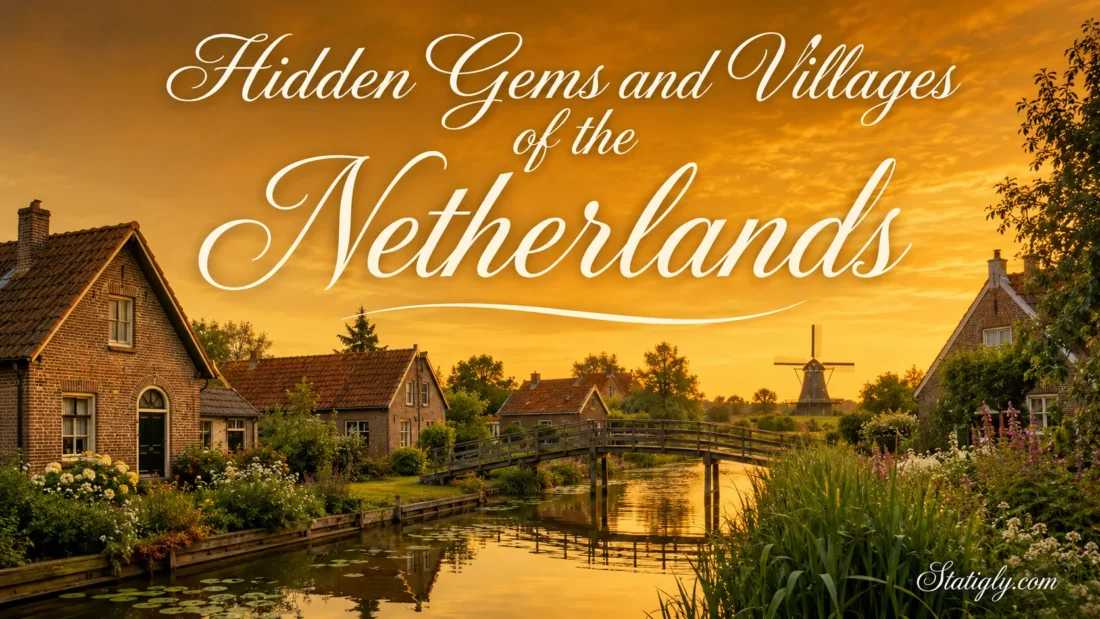
Beyond Amsterdam’s canals and the country’s larger cities, the hidden gems and villages of the Netherlands reveal a quieter side of Dutch life. Wooden houses stand beside narrow waterways, church paths cross raised village mounds, and old lanes lead toward dunes, forests, lakes, or green hills. Some places need only an hour or two. Others deserve a full day on foot or by bicycle.
The places below include traditional villages as well as several small historic towns. Each one offers a clear reason to visit, whether that is canal scenery, regional architecture, coastal nature, local art, or walking routes.
| Place | Province | Known For | Best Match |
|---|---|---|---|
| Broek In Waterland | North Holland | Wooden houses and waterways | Easy trip from Amsterdam |
| De Rijp | North Holland | Restored houses and polder scenery | Architecture and cycling |
| Dwarsgracht | Overijssel | Canals, bridges, and thatched farms | Quiet water landscapes |
| Kalenberg | Overijssel | Reed beds and wetland paths | Nature and small-boat trips |
| Woudsend | Friesland | Lakes, alleys, and windmills | Walking and boating |
| Sloten | Friesland | Canal town and historic mill | A compact half-day visit |
| Hindeloopen | Friesland | Decorative painting and maritime streets | Regional culture |
| Orvelte | Drenthe | Thatched Saxon-style farms | Rural heritage |
| Dwingeloo | Drenthe | Village green and nearby heathland | Walking and stargazing |
| Winsum | Groningen | Waterways, bridges, and windmills | A village with useful services |
| Niehove | Groningen | Raised mound and radial lanes | Traditional village form |
| Groede | Zeeland | Art, old façades, and coastal routes | Culture near the sea |
| Burgh-Haamstede | Zeeland | Dunes, forest, and village streets | Coastal hiking |
| Oirschot | North Brabant | Historic centre and countryside routes | Architecture and cycling |
| Thorn | Limburg | White-painted houses and cobbled lanes | A distinctive townscape |
| Noorbeek and Epen | Limburg | Hills, orchards, and half-timbered houses | Country walks |
A Different Side Of The Dutch Landscape
Dutch villages change with the ground beneath them. Settlements in Waterland sit among ditches and meadows. Friesland’s villages face lakes and open skies. Drenthe is marked by old farms, greens, heath, and woodland, while Groningen’s mound villages rise slightly above the surrounding fields.
Travel south and the scenery shifts again. Zeeland brings dunes and tidal landscapes. North Brabant has broad market squares and brick heritage, while South Limburg offers slopes, sunken lanes, orchards, and timber-framed buildings. Short distances, very different settings.
Water Villages Near Amsterdam
Broek In Waterland
Broek In Waterland lies close to Amsterdam but feels firmly rural. Its muted wooden houses, small bridges, gardens, and waterways create a compact village scene that is easy to explore on foot. The historic centre rewards slow walking because many of its finest details appear around doorways, gables, and waterside paths.
The surrounding Waterland landscape matters just as much as the village. Flat meadows stretch between narrow channels, making the area well suited to cycling. Broek can also be combined with nearby Monnickendam, Zuiderwoude, or Marken.
De Rijp
De Rijp has rows of restored seventeenth-century houses, an ornate former town hall, narrow lanes, and a strong relationship with the surrounding water. It once stood on an island between lakes and wet ground. Reclaimed land later changed the map, yet the village retained much of its historic shape.
Close by is the Eilandspolder, a protected landscape of meadows, waterways, and bird habitat. Walking and cycling routes follow old dikes, while small boats can enter channels that roads never reach. De Rijp works especially well for visitors who want architecture and countryside in the same outing.
Marken
Marken is better known than many places on this list, yet its side lanes still hold intimate village scenes. Once an island, it is now linked to the mainland by a causeway. Green wooden houses, raised residential areas, narrow footpaths, and views across the Markermeer define its character.
Walk beyond the busiest central streets and the settlement opens toward meadows and water. The route to the lighthouse provides a wider view of the former island landscape. Early morning and late afternoon are particularly pleasant for an unhurried walk.
Canal Settlements In Overijssel
Dwarsgracht
For canal scenery on a smaller scale, consider Dwarsgracht. The village sits within the wet landscape of Weerribben-Wieden, close to Giethoorn but with a more residential character. Thatched farms, wooden bridges, side canals, and gardens line the water.
A bicycle or small boat fits the setting better than a rushed road visit. Dwarsgracht also connects naturally with wetland routes through reed fields and open water. Respect private paths and gardens; people live in the houses that visitors come to admire.
Kalenberg
Kalenberg forms a long ribbon beside the Kalenbergergracht canal. Reeds, small bridges, waterside homes, and narrow paths place the village firmly inside the landscape of Weerribben-Wieden National Park.
This is a good base for canoeing, quiet boating, walking, and cycling. The surrounding wetlands contain a patchwork of reed beds, peatland, woodland, and open water. From the village, the transition between settled land and wetland happens almost without a boundary.
Blokzijl
Blokzijl is a small historic town rather than a village. Its harbour basin, merchant houses, narrow streets, and waterside setting make it an easy addition to a route through northwestern Overijssel. It also provides cafés and services that are less common in the smaller canal settlements.
Small Places Among The Frisian Lakes
Woudsend
Woudsend, known as Wâldsein in Frisian, sits between Heegermeer and Slotermeer. Its centre contains narrow alleys, restored buildings, churches, small waterside spaces, and two working windmill landmarks: the wood-sawing mill De Jager and the flour mill ’t Lam.
Although water shapes the village, Woudsend is equally enjoyable on foot. Short lanes produce unexpected views toward canals and gardens. It also makes a practical stop on a cycling route through Southwest Friesland.
Sloten
Sloten, or Sleat in Frisian, is the smallest of Friesland’s eleven historic cities. Its scale feels closer to a village. A central canal, old merchant houses, water gates, trees, and De Kaai flour mill form a remarkably complete townscape within a small area.
A relaxed circuit of the centre does not take long, but the details slow the visit down. Look for traditional façades, waterside gardens, and views along the canal. Slotermeer lies just north of town, allowing Sloten to form part of a longer lake route.
Hindeloopen
Hindeloopen is another of the Frisian eleven cities, though its lanes and harbour feel wonderfully compact. The town developed its own dialect, decorative painting style, and clothing traditions. Hindeloopen painting is recognized by floral patterns and curling ornament applied to furniture and household objects.
The old harbour, small bridges, wooden façades, and narrow streets can be explored comfortably on foot. Museum Hindeloopen provides useful context for the town’s maritime life, decorative arts, and local customs.
Village Greens and Old Farms In Drenthe
Orvelte
Orvelte is a living monument village, not an empty open-air display. People continue to live and work among its thatched farms, brick outbuildings, trees, and old lanes. Several buildings welcome visitors through workshops, exhibitions, or seasonal activities.
The village centre is largely explored on foot. Its Saxon-style farm buildings show how homes, storage areas, and agricultural work once shared closely connected spaces. Orvelte is compact, but allowing extra time makes it easier to notice the construction details and surrounding fields.
Dwingeloo
Dwingeloo grew around a broad village green known as a brink. Traditional buildings, mature trees, shops, and the onion-shaped church spire surround this open centre. The protected village scene remains active rather than museum-like.
Nearby Dwingelderveld National Park adds heathland, woodland, fens, and broad skies. The area is suited to walking and cycling, while its open landscape also supports clear views of the night sky. The Dwingeloo Radio Telescope, operating since 1956 and now a national monument, adds an unexpected scientific feature to the area.
Mound Villages In Groningen
Winsum
Winsum combines the scale of a village with the services of a small town. The Winsumerdiep waterway winds through its centre, crossed by bridges and lined with historic buildings. Two churches and two windmills contribute to its recognizable skyline.
Winsum can be reached by train from Groningen, which makes it one of the easier northern villages to visit without a car. It also serves as a starting point for cycling through fields and raised settlements closer to the Wadden coast.
Niehove
Small but carefully formed, Niehove stands on an artificial dwelling mound. The church occupies the highest central point, while narrow paths and brick houses spread outward around it. This radial layout is best understood by walking a full circle through the village.
Niehove offers few conventional attractions. That is part of its value. The shape of the settlement, the red brick, and the broad agricultural surroundings provide the experience.
Coastal Villages In Zeeland
Groede
Groede is an artists’ village in Zeeland-Flanders. Galleries, workshops, historic façades, and the church square give its centre a cultural focus. Slijkstraat preserves a collection of small premises and traditional workshop settings.
The coast lies nearby, as does the Waterdunen nature area, where walking routes pass tidal scenery and bird habitat. Groede therefore suits travelers who want to pair a village visit with a coastal walk.
Burgh-Haamstede
Burgh-Haamstede developed from the neighboring settlements of Burgh and Haamstede. Today it provides access to two of Zeeland’s most attractive natural areas: the Zeepeduinen dunes and the forest of Westerschouwen.
The appeal lies in contrast. Village streets give way to woodland, open dunes, and long coastal paths. Visitors interested mainly in nature can spend most of the day outside the centre, while shorter walks can combine local architecture with the edge of the dune landscape.
Veere
Veere is officially a historic town, yet its size and waterside calm earn it a place on many village routes. The old market, town hall, marina, Grote Kerk, and Scottish Houses sit within an easily walkable centre beside the Veerse Meer.
Veere becomes livelier during sunny weekends. A morning visit leaves more room for examining the façades and harbour. Cycling routes continue around the lake and through the Walcheren countryside.
Heritage Places In North Brabant
Oirschot
Oirschot has a broad market square, historic civic buildings, churches, brick houses, and many protected monuments. The former town hall, dating from 1513, anchors the centre and now includes the local visitor information point.
Country lanes and marked cycling routes extend beyond the village. Oirschot works well as a cultural stop between Eindhoven, Tilburg, and the rural areas of Brabant, particularly for travelers who prefer an active historic centre rather than a preserved display.
Heusden
Heusden is a small restored town beside the Bergsche Maas. Its geometric earthworks, harbour, windmills, brick streets, galleries, and independent shops fit into a very compact centre. A walk around the outer paths gives the clearest view of the town’s shape and relationship with the river.
The surrounding dikes also support pleasant cycling. South of Heusden, the landscape changes toward the woods and inland dunes of Loonse and Drunense Duinen National Park.
White Houses and Green Hills In Limburg
Thorn
Thorn is known as the White Town because white-painted façades dominate its protected centre. Cobbled lanes curve between historic houses, small courtyards, and the large Abbey Church, whose tower rises above the low rooftops.
The centre can be explored through a short walking circuit. Museum Thorn adds architectural and cultural context, while paths outside town connect with the Maas Valley river landscape. The white walls look especially clear in soft morning light.
Noorbeek
Noorbeek occupies a green valley in South Limburg, not far from Maastricht. Orchards, hedges, slopes, and farm buildings surround its compact centre. The change in elevation feels unusual after traveling through the flatter western and northern provinces.
Walking routes pass fields, woodland edges, small chapels, and neighboring hamlets. The slopes can be steeper than visitors expect from the Netherlands, so route distance tells only part of the story.
Epen
Epen sits among hills and stream valleys near the southern edge of the country. Half-timbered houses, old farms, orchards, and views across the Geul Valley shape the village and its surroundings.
The area is made for walking. Routes can link Epen with nearby hamlets, woodland, and open farmland, while longer paths continue toward Mechelen, Vijlen, and the border landscape. Here, the Netherlands feels less like a water country and more like a gentle upland region.
Choosing Villages By Interest
- For canals and wooden bridges: Dwarsgracht, Kalenberg, and Broek In Waterland
- For windmills and lake scenery: Woudsend, Sloten, and Winsum
- For old farm architecture: Orvelte and the countryside around Dwingeloo
- For coastal walks: Burgh-Haamstede and Groede
- For unusual village layouts: Niehove and Heusden
- For distinctive façades: Thorn, Hindeloopen, and De Rijp
- For hills and orchards: Noorbeek and Epen
- For an easy outing from Amsterdam: Broek In Waterland, Marken, and De Rijp
Planning A Village Route
Travel By Region
Grouping nearby places reduces travel time and creates a more coherent day. Broek In Waterland and Marken fit naturally together. Dwarsgracht, Kalenberg, and Blokzijl belong to the same wetland region. Woudsend, Sloten, and Hindeloopen can form a Southwest Friesland route.
- Waterland day: Broek In Waterland, Zuiderwoude, and Marken
- Wetland day: Dwarsgracht, Kalenberg, and Blokzijl
- Frisian lake day: Woudsend and Sloten
- Drenthe day: Orvelte, Dwingeloo, and Dwingelderveld
- Groningen day: Winsum and Niehove
- Zeeland day: Groede with Waterdunen or Burgh-Haamstede with the dunes
- Limburg day: Thorn or a walking circuit through Noorbeek and Epen
Traveling Without A Car
Several destinations can be reached by train or regional bus, but connections become less frequent in rural areas. Winsum has a railway station. Other villages generally require a bus connection, bicycle ride, or a combination of both.
A bicycle often solves the final part of the journey while also revealing the surrounding landscape. Check the current Dutch public transport planner before departure, especially on Sundays, public holidays, and outside the summer period.
When To Visit
- Spring: Fresh greenery, blossoms, and comfortable cycling weather
- Summer: Long daylight hours, boat trips, and more seasonal businesses
- Autumn: Woodland color in Drenthe, Brabant, and Limburg
- Winter: Quiet streets and clear architectural views, though some attractions keep shorter hours
Weekday mornings usually provide the calmest experience in well-known places such as Marken, Veere, and Thorn. Smaller villages may have limited café and museum hours, so confirm any indoor stop before building a day around it.
Walking With Care
Many historic centres contain cobbles, narrow bridges, uneven paths, or streets shared with bicycles. Canal villages may also have unguarded water edges. Travelers who need step-free routes should check local accessibility information in advance.
These are living communities. Stay on public paths, leave entrances clear, keep noise low near homes, and ask before photographing residents at close range. A little care preserves the peaceful atmosphere that makes these places worth visiting.
Questions Travelers Often Ask
Which Dutch Village Is Closest To Amsterdam?
Broek In Waterland is one of the easiest rural villages to reach from Amsterdam. Its wooden houses and waterways can be combined with nearby Waterland settlements during a half-day or full-day trip.
Where Can Visitors Find Canal Villages Beyond Giethoorn?
Dwarsgracht and Kalenberg offer strong canal and wetland scenery within the same wider region. Broek In Waterland and Woudsend provide different versions of Dutch village life shaped by water.
Which Places Are Best For A Village and Nature Combination?
Choose Dwingeloo for heathland, Burgh-Haamstede for dunes and forest, Groede for tidal coastal nature, De Rijp for polder scenery, or Epen for hills and stream valleys.
Can These Places Be Visited Throughout The Year?
Yes. Streets, landscapes, and public walking routes remain appealing in every season. Museums, boat rentals, visitor centres, and small shops may reduce their hours during colder months, making advance checks useful.
Which Village Offers The Most Unusual Architecture?
Thorn stands out for its white-painted centre. Orvelte is notable for thatched farm buildings, Hindeloopen for decorative art, Broek In Waterland for wooden houses, and Epen for half-timbered architecture.