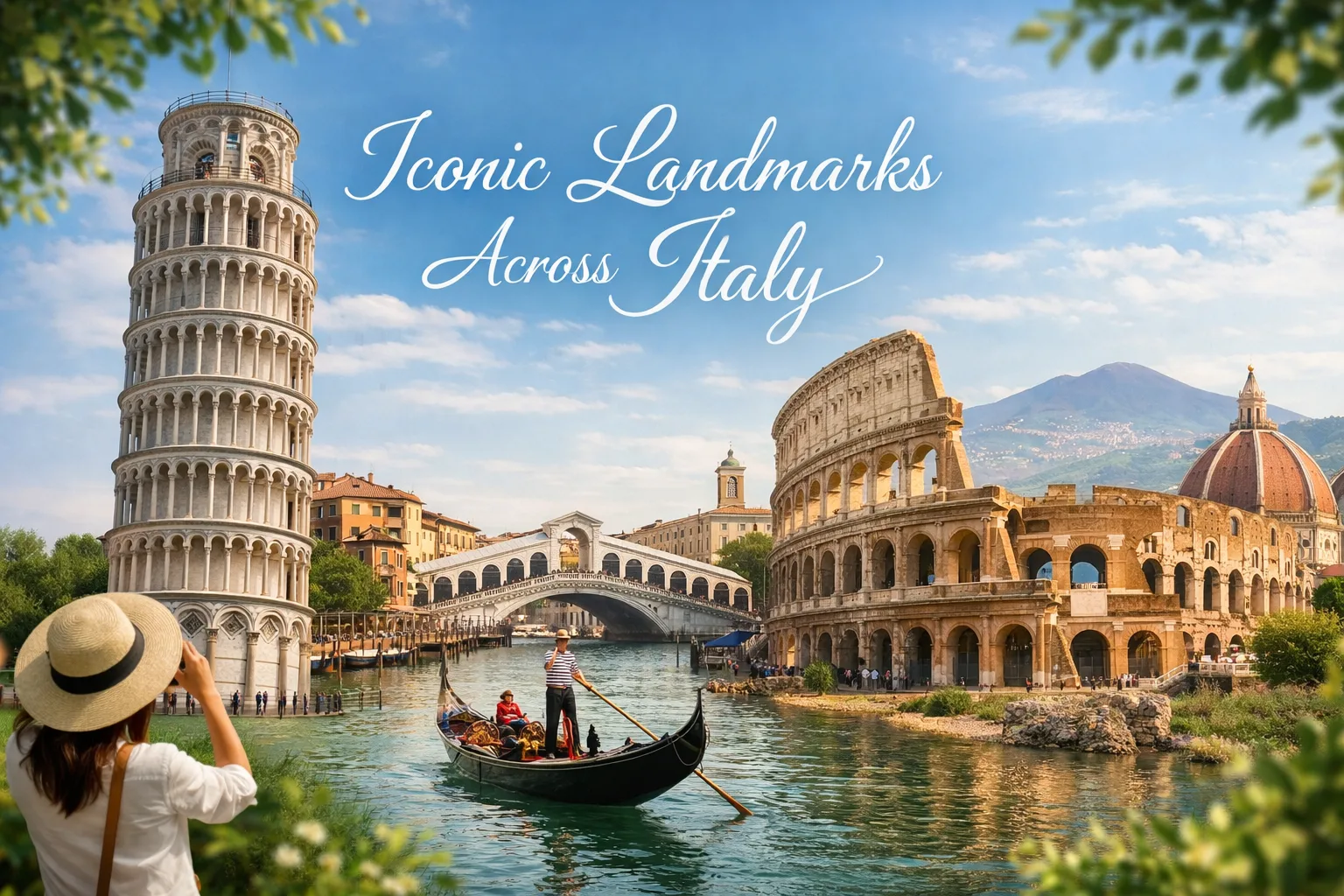
Italy can feel like a museum with open doors—except the “exhibits” are whole streets, cliffs, domes, and sunlit squares. If you want iconic landmarks across Italy without getting overwhelmed, this guide helps you pick the right places, understand what you’re seeing, and enjoy the moments that stay with you.
How To Use This Landmark List
Think of Italy as a long, beautiful ribbon. Start where it’s easiest, then let the highlights pull you forward.
- Pick 6–8 landmarks for a first trip, or 10–12 if you’re moving fast.
- Pair one big-name icon with one slow, scenic stop each day.
- For the smoothest travel flow, go North → Central → Rome → South.
Northern Italy Landmarks That Feel Like A Movie Set
Milan Cathedral (Duomo Di Milano)
Milan’s cathedral looks like lace carved into stone. It’s a Gothic masterpiece whose construction began in 1386, and the detail is so dense you’ll keep finding new shapes—spires, statues, and tiny surprises.
- Best moment: rooftop terraces for a “wow” skyline view.
- Don’t miss: the forest of spires up close—stonework you can almost read like handwriting.
- Time idea: 2–3 hours, longer if you love architecture.
St. Mark’s Basilica In Venice
Step inside and you’ll understand why people call Venice a floating jewel. St. Mark’s is famous for gold mosaics, shimmering surfaces, and a design shaped by centuries of craft. The current basilica began in the 11th century.
- Best moment: morning light when the interior feels warm and glowing.
- Look for: mosaic scenes that read like a visual storybook.
- Pair it with: a slow walk along the Grand Canal.
Cinque Terre Clifftop Villages
Cinque Terre isn’t one monument—it’s five postcard villages perched on the Italian Riviera: Monterosso, Vernazza, Corniglia, Manarola, Riomaggiore. The “landmark” here is the coastline itself.
- Best moment: late afternoon when the sea turns metallic-blue.
- Easy win: take the train between towns, then walk short scenic sections.
- Bring: comfy shoes and a light jacket for teh evening breeze.
Central Italy Icons That Shaped Art And Architecture
Florence Cathedral Dome (Brunelleschi’s Dome)
This dome isn’t just a roof—it’s a moment when imagination became engineering. Built in the 15th century, it remains a symbol of Renaissance Florence and creative courage.
- Best moment: climb for a close look at the brickwork and the city panorama.
- Notice: how the dome dominates the skyline like a calm, perfect planet.
- Time idea: 2–4 hours for the cathedral area and nearby streets.
Ponte Vecchio Over The Arno
Ponte Vecchio is proof that a bridge can be a neighborhood. Shops line its span, and at sunset the river reflects warm tones like a moving painting. Want a simple plan? Walk it once, then step back and see it from a nearby riverside spot.
- Best moment: golden hour for photos that look effortlessly classic.
- Nearby pairing: a stroll toward Piazza della Signoria.
- Good for: travelers who love walkable city magic.
Leaning Tower Of Pisa
Yes, it leans. And that’s exactly why it’s unforgettable. The tower rises about 56 meters (roughly), and the experience is less “one photo” and more “how is this even real?”
- Best moment: arrive early for calmer views of the whole cathedral complex.
- Do this: explore the surrounding monuments, not only the tower.
- Time idea: 2–3 hours for a relaxed visit.
Rome Landmarks That Make Time Feel Stretchy
The Colosseum
The Colosseum is an architectural headline you can walk around. Built in the 1st century, it’s a masterclass in arches, crowd flow, and bold design. Stand close and you’ll see layers of history like rings in a tree trunk.
- Best moment: morning for softer light and a calmer pace.
- Look for: the repeating arches—simple shapes, huge impact.
- Pair it with: a walk to the nearby Roman Forum viewpoints.
The Pantheon And Its Perfect Dome
The Pantheon feels almost impossibly modern for its age. The building you see today was rebuilt under Emperor Hadrian around 118–128 CE. Step inside, look up, and you’ll get it—the oculus turns daylight into theater.
- Best moment: midday when the sunbeam is most dramatic.
- Listen for: the hush—this place naturally invites quiet awe.
- Time idea: 45–90 minutes, plus nearby cafés.
Trevi Fountain Baroque Drama In Stone
Trevi is pure spectacle—water, stone, movement, and that unmistakable Roman sense of style. Completed in 1762, it’s a landmark that works in five minutes… or fifty, if you’re happy just watching the scene.
- Best moment: early morning for breathing room and softer sound.
- Photo tip: stand slightly off-center to capture the fountain’s full width.
- Good to know: local access rules can change, so check official updates close to your visit.
Southern Italy And Island Landmarks With Big Wow Energy
Pompeii Archaeological Park
Pompeii is history you can walk through—streets, courtyards, and everyday spaces preserved after the 79 CE eruption of Mount Vesuvius. It’s a place that makes ancient life feel surprisingly close.
- Best moment: cooler hours for a comfortable, unhurried visit.
- Plan for: a lot of walking on uneven stone paths.
- Time idea: 3–5 hours, depending on your pace.
Amalfi Coast Viewpoints
The Amalfi Coast is a landmark made of light, sea, and cliffs. The best “must-see” here is often a viewpoint—a place where you stop, breathe, and let the coastline unfold like a ribbon of color.
Matera Cave Districts (Sassi)
Matera’s Sassi are ancient cave neighborhoods carved into rock. It’s a landmark that feels like a time portal—quiet lanes, stone stairways, and views that change with every step.
- Best moment: sunset when the stone turns honey-gold.
- Do this: wander slowly and take the long way down, then back up.
- Good for: travelers who love atmosphere.
Castel Del Monte In Puglia
Castel del Monte is famous for its octagonal design and crisp geometry. Built in the 13th century under Frederick II, it feels both medieval and strangely modern—like a castle designed by a mathematician.
- Best moment: bright daylight to see the shape clearly in photos.
- Look for: symmetry everywhere—doorways, angles, and repeating patterns.
- Time idea: 1.5–3 hours with travel time.
Valley Of The Temples In Sicily
In Agrigento, ancient temples stand in open air, framed by big Sicilian sky. It’s one of those places where scale hits you fast—columns, shadows, and long lines that still feel precise after centuries.
- Best moment: late afternoon for dramatic light and softer heat.
- Photo tip: step back and include the landscape, not only the columns.
- Time idea: 2–4 hours.
A Gentle Reminder Before You Go
Opening rules and reservation systems can change at popular landmarks. A quick check of official updates before your visit keeps the day smooth and stress-free.
- Carry water in warm months.
- Wear shoes you trust.
- Build in small breaks—Italy rewards slow moments.
Landmark Planner Table
Not sure how to combine these into a trip that feels easy? Use this table to mix big icons with pleasant pacing.
| Landmark | Region | Ideal Visit Time | Pairs Well With |
|---|---|---|---|
| Milan Cathedral | North | 2–3 hours | Galleria stroll, city rooftop views |
| St. Mark’s Basilica | North | 1.5–3 hours | Grand Canal walk, quiet side streets |
| Cinque Terre | Northwest | Half day–2 days | Short coastal walks, train hops |
| Florence Dome | Central | 2–4 hours | Ponte Vecchio, city viewpoints |
| Leaning Tower Of Pisa | Central | 2–3 hours | Cathedral complex, nearby cafés |
| Colosseum | Rome | 2–4 hours | Forum viewpoints, historic center walk |
| Pompeii | South | 3–5 hours | Naples day trip, coastal scenery |
| Castel Del Monte | South | 1.5–3 hours | Puglia countryside towns, easy road trip day |
A Simple Way To Build Your Italy Route
Ever wondered why some trips feel effortless, while others feel like a race? It’s usually the order. Italy rewards a smooth sequence more than a packed checklist.
- Start North (Milan, Venice, Cinque Terre) for easy train connections.
- Slide Into Central Italy (Florence, Pisa) for art, domes, and walkable cities.
- Give Rome Time—at least two full days for the big icons.
- Finish South (Pompeii, Amalfi Coast, Matera, Puglia, Sicily) for wide skies and slower evenings.
Landmark-Lover Packing Notes
- Shoes: cushioned and reliable for stone streets.
- Day bag: water, sunscreen, a light layer, and a small power bank.
- Mindset: leave space for one unplanned detour per day—those become the best stories.
Common Questions People Ask
Which Landmarks Feel Most “Once In A Lifetime”?
If you want the classic “I can’t believe I’m here” feeling, start with the Colosseum, the Pantheon, Florence’s Dome, and Venice’s St. Mark’s. Add Cinque Terre if you want nature and charm in the same frame.
How Many Landmarks Should I Plan Per Day?
Two is the sweet spot: one major landmark plus one wander-friendly area. That way, you don’t just see Italy—you feel it.
Do I Need Guided Tours Everywhere?
Not everywhere. Tours shine at places with layers of history (like Pompeii or the Colosseum). For scenic landmarks (like the Amalfi Coast), your best “guide” is time and a good viewpoint.
If you’re building a first trip, start with the landmarks that match your travel personality. Do you want grand architecture, coastal beauty, or ancient streets? Pick your favorites, then let the route flow. Italy makes the rest easy.