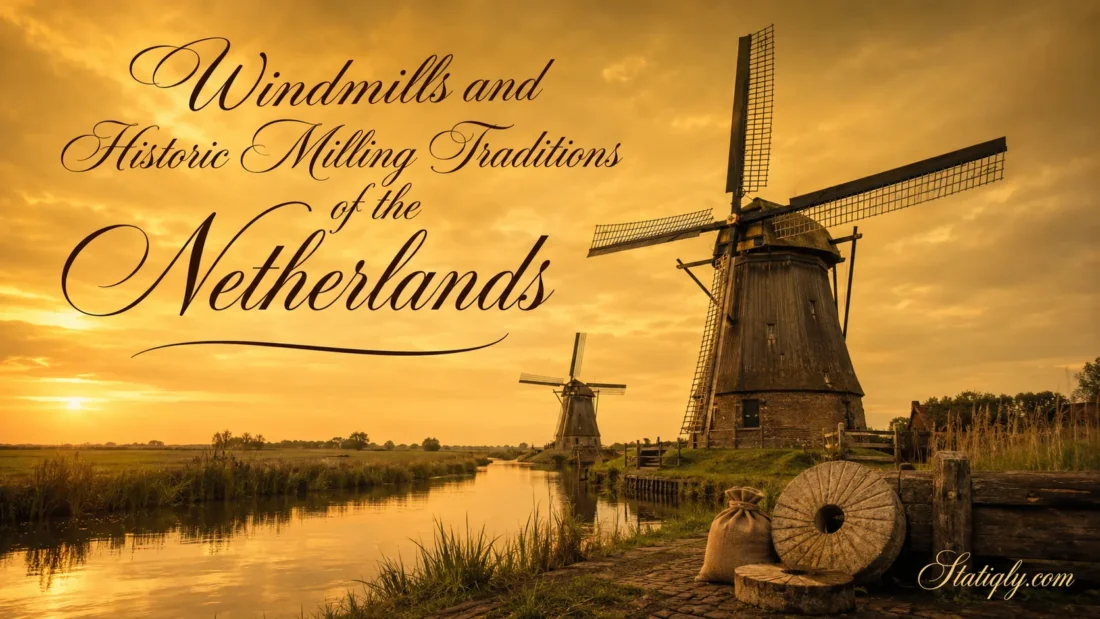
A Dutch windmill is more than a familiar shape on the horizon. It is a working machine built to grind grain, move water, saw timber, press oil, make paper, and process raw materials. Each type reflects a practical need. Together, the surviving mills reveal how Dutch communities used wind, waterways, skilled labor, and careful engineering to shape everyday life.
About 1,100 traditional windmills and 100 watermills remain in the Netherlands. They do not all share the same design or purpose. A small drainage mill in Friesland, for example, works very differently from a tall urban grain mill or a Zaan sawmill.
That variety matters. Dutch milling history is not one story but a collection of local solutions, each adapted to the surrounding land and the work that had to be done.
Wind, Water, and Work
| Mill Function | Main Task | Working Equipment | Common Setting |
|---|---|---|---|
| Drainage mill | Moved excess water out of low-lying land | Scoop wheel or Archimedean screw | Polders, marshes, and canal networks |
| Grain mill | Ground wheat, rye, barley, or buckwheat | Pairs of millstones | Towns, villages, and farming districts |
| Sawmill | Cut logs into planks and smaller timber | Crankshaft and frame saws | Waterfront timber districts |
| Oil mill | Crushed and pressed oil-bearing seeds | Edge stones, heaters, and wedge presses | Industrial milling areas |
| Paper mill | Reduced prepared fibers to pulp | Stampers or beating machinery | Areas with clean water and steady wind |
| Paint or pigment mill | Ground coloring materials into fine powder | Grinding stones | The Zaan region and other craft centers |
| Hulling mill | Removed husks from barley or other grain | Hulling stones and sieves | Grain-producing districts |
Why Windmills Took Root In The Netherlands
The Dutch landscape offered several useful conditions for wind-driven machinery. Much of the country is open and relatively flat, giving sails access to steady coastal winds. Rivers and canals made it easier to transport grain, timber, seeds, and finished products. Low-lying land also created a constant need for controlled drainage.
Wind alone was not enough. Craftspeople had to turn its changing force into dependable movement. Wooden shafts, toothed wheels, stone gears, ropes, brakes, and working tools formed a carefully balanced system. The mill was an adaptable engine, and its final task depended on the machinery connected to it.
A grain mill rotated stones. A sawmill moved blades up and down. A polder mill lifted water. Same wind, different work.
From Medieval Grain Mills To Wind-Driven Industry
Wind-powered grain mills appeared in the Netherlands during the Middle Ages. Early examples often used the post mill design. Its wooden body rested on a large upright post, allowing the miller to turn the entire body toward the wind.
Later builders developed larger mills with fixed bodies and movable caps. These designs created more room for machinery, storage, and several working floors. They could also stand higher, where buildings or trees might otherwise block the wind.
- Middle Ages: Post mills became established for grinding grain.
- Late sixteenth century: Improved gearing and crankshaft systems opened new industrial uses for wind energy.
- 1592: Cornelis Corneliszoon of Uitgeest fitted a windmill with a crankshaft that changed rotary motion into the vertical movement needed for sawing.
- Seventeenth century: Large drainage projects and industrial milling districts expanded.
- 1612: Lake Beemster was drained to create the 7,208-hectare Beemster Polder. About 40 windmills originally served its drainage system.
- 1738 and 1740: Sixteen of the best-known Kinderdijk drainage mills were built in two groups.
- Nineteenth century: Steam machinery began to replace wind in many mills. Diesel and electric equipment followed.
- Twentieth century: Organized restoration, training, and volunteer milling helped keep surviving machines operational.
- 2017: The craft of operating windmills and watermills was added to UNESCO’s Representative List of the Intangible Cultural Heritage of Humanity.
How A Dutch Windmill Turns Wind Into Work
Facing The Wind
Traditional windmills need to face the wind. In a post mill, the miller turns most of the wooden structure. In many later mills, only the cap and sail assembly rotate. This operation is called winding or turning the mill into the wind.
A long tail structure, hand-operated wheel, winch, or chain system helps position the cap. Some later mills use automatic winding equipment, but many historic examples still depend on direct control by the miller.
Preparing The Sails
The four sails are fixed to a central windshaft. On traditional common sails, the miller spreads sailcloth over part of the wooden lattice. More cloth catches more wind. Less cloth slows the mill when the wind grows stronger.
This adjustment resembles changing the amount of canvas on a sailing vessel. The miller must read the conditions, prepare the correct sail area, and keep watching the weather. A passing shower or sudden rise in wind can change the operating plan.
Transferring The Motion
As the sails rotate, they turn the windshaft inside the cap or body. A large brake wheel on that shaft transfers movement to another gear. From there, an upright shaft can carry the rotation down through the mill.
Smaller gears connect the central drive to millstones, pumps, saw frames, or pressing equipment. Gear sizes control speed and turning force. The exact arrangement varies between mill types, yet the principle stays clear: capture rotation, guide it through the machinery, and apply it to a useful task.
Controlling And Stopping The Mill
A brake surrounds part of the large wheel attached to the windshaft. Releasing it allows the sails to move; applying it stops the machinery. The miller also controls individual working parts through gears, lifting devices, ropes, and levers.
Not every usable wind is suitable for every job. Milling grain calls for a controlled speed, while pumping water may allow a different operating range. Experience tells the miller when to start, adjust, or stop.
The Traditional Grain-Milling Process
Grain milling remained one of the most familiar windmill trades. Farmers or grain merchants brought sacks to the mill, where the contents were checked, weighed, and prepared. Hoisting equipment powered by the mill could then raise heavy sacks to an upper floor.
- Cleaning: Dust, chaff, small stones, and unwanted material were removed before grinding.
- Feeding: Grain entered a hopper positioned above the millstones.
- Regulating: A moving shoe delivered grain into the center opening of the upper stone.
- Grinding: The upper runner stone rotated above the fixed bedstone.
- Collecting: Ground meal traveled outward through cut channels and fell into a surrounding casing.
- Sorting: Sieves could separate finer flour from bran and coarser material when the desired product required it.
The patterned grooves cut into a millstone do two jobs. They help break the grain and carry the ground material toward the edge. Those grooves wear down, so millstones need periodic dressing. A trained worker lifts the runner stone, examines its surface, and renews the pattern with specialized tools.
Texture Depends On The Miller
The gap between the stones affects the finished meal. So does the grain flow, stone speed, moisture level, and condition of the grinding surfaces. Too much grain can overload the stones. Too little may lead to uneven grinding.
The miller checks the product by sight and touch, sometimes listening closely to the machinery as well. Small changes matter. Good flour begins with steady control, not simply fast-turning sails.
Drainage Mills And The Making Of Polders
A polder is an area of managed land surrounded by dikes, with its water level controlled separately from the water outside. Once water has been removed, rain and groundwater seepage continue to enter. Drainage is therefore an ongoing process.
Windmills helped raise this water into higher canals or storage basins. From there, it could move toward a river or another outlet when conditions allowed. Where one lift could not overcome the full height difference, several mills worked in stages. Each one raised the water a little farther.
Scoop Wheels And Archimedean Screws
Many older drainage mills used large scoop wheels. Their blades lifted water from a lower channel and released it at a higher level. Later systems often used an Archimedean screw, a rotating spiral set inside a sloping casing.
The small tjasker, once common in parts of Friesland, Drenthe, Groningen, and Overijssel, shows the screw principle in a simple form. Its sail shaft connects almost directly to the water-lifting screw, with little additional gearing.
Kinderdijk-Elshout
The Kinderdijk-Elshout network contains 19 historic drainage mills, along with canals, reservoirs, dikes, sluices, pumping stations, and former water-board buildings. Eight mills are round brick ground-sailers, ten are thatched octagonal smock mills, and one is a hollow post mill.
The sixteen mills of the Nederwaard and Overwaard groups date mainly from 1738 and 1740. They formed part of a wider water-management system rather than operating as isolated machines. Modern pumps now perform most routine drainage, while the historic mills remain operational within the managed landscape.
The Beemster Polder
North of Amsterdam, the Beemster project shows what improved drainage technology could achieve on a larger scale. Lake Beemster was drained in 1612, creating new agricultural land arranged in a geometric pattern of fields, roads, canals, and settlements.
About 40 windmills originally moved water from the former lake basin into a ring canal. Steam pumping stations replaced them in the late nineteenth century, and later equipment used diesel and electricity. The planned landscape remains clearly visible.
The Industrial Windmills Of The Zaan Region
The Zaan region, north of Amsterdam, became one of Europe’s earliest large industrial milling districts. Good waterways brought raw materials to the mills and carried finished goods away. Open land supplied access to wind, while nearby commercial centers created steady demand.
More than 1,200 mills stood in the Zaan region over the course of its history. Around 1700, roughly 600 windmills may have been active at the same time. Their tasks included sawing wood, pressing oil, making paper, hulling grain, grinding spices, and preparing pigments.
Wind-Driven Sawmills
The crankshaft transformed sawmilling. It changed the circular motion of the sails into the repeated upward and downward movement of frame saws. Another part of the mechanism advanced the log after each stroke.
This arrangement allowed several planks to be cut in one working sequence. Sawmills often stood beside water because logs arrived by boat and could be stored wet before cutting. The recognizable paltrok sawmill turned its entire body on a ring of rollers to face the wind.
Oil Mills
Oil mills processed materials such as linseed and rapeseed. Heavy edge stones first crushed the seeds. The prepared material was then warmed and placed in pressing bags or mats. Wind-driven rammers forced wedges into a wooden press, releasing the oil.
The remaining pressed material formed dense cakes that could be used as livestock feed when suitable. This careful use of both the main product and the residue made oil milling closely connected with farming and local trade.
Paper, Pigment, And Spice Mills
Paper mills used repeated mechanical action to prepare fiber pulp. Pigment mills reduced coloring materials to a controlled fineness for paint production. Other mills ground mustard seed, spices, chalk, and similar materials.
A mill could also change purpose. Machinery might be removed, rearranged, or replaced while the wind-driven structure remained. De Zoeker at Zaanse Schans, for instance, began as a drainage mill in 1609 and later served several industrial roles, including oil and pigment processing.
Dutch Windmill Forms And Their Uses
| Mill Form | What Turns Toward The Wind | Typical Use |
|---|---|---|
| Post mill (standerdmolen) | The entire wooden body | Grain milling |
| Hollow post mill (wipmolen) | The upper body and sails | Drainage, sometimes grain milling |
| Smock mill | The cap and sails | Drainage or industrial work |
| Tower mill | The cap and sails | Grain milling and other heavy work |
| Gallery mill (stellingmolen) | The cap and sails | Urban or industrial milling |
| Ground-sailer | The cap and sails | Drainage or grain milling |
| Paltrok mill | Most of the mill body | Timber sawing |
| Tjasker | The sail-and-shaft assembly | Small-scale water lifting |
A gallery mill has a raised wooden platform around its tower. The platform allows the miller to reach the sails and winding controls even when the lower part of the mill stands among buildings. A ground-sailer needs no raised gallery because its sail tips pass close to ground level.
The Miller’s Living Craft
Operating a historic mill requires more than starting and stopping the sails. A miller combines mechanical knowledge with close observation of wind, clouds, moisture, sound, and vibration.
- Turn the mill accurately toward changing wind.
- Select the right amount of sailcloth.
- Control working speed with the brake and machinery.
- Adjust millstones or processing equipment.
- Inspect wooden gears, shafts, ropes, bearings, and fastenings.
- Keep records of maintenance and unusual movement.
- Recognize changing weather before it reaches the mill.
- Pass practical knowledge to trainees.
Traditionally, learners gained these skills beside experienced millers. That method continues through structured instruction and supervised practice. The Guild of Volunteer Millers, founded in 1972, has helped train people who operate and care for mills across the Netherlands.
UNESCO recognized the craft in 2017 because the machinery cannot remain meaningful through carpentry and restoration alone. A working mill also needs trained hands, attentive ears, and knowledge passed from one person to another.
Why The Surrounding Landscape Matters
Preserving the building is only part of mill conservation. A windmill also needs clear access to moving air. Trees, tall structures, and dense development can disturb or block the wind before it reaches the sails.
The Dutch term molenbiotoop describes the mill and the surrounding conditions that allow it to function. For a windmill, this includes open wind access. For a watermill, it includes the waterways that deliver and carry away water.
Regular operation supports preservation as well. Turning the machinery distributes lubricants, exposes developing faults, and keeps operating knowledge in use. A motionless mill may look complete from outside while its working tradition slowly disappears.
Places Where The Milling Traditions Remain Visible
- Kinderdijk-Elshout: Shows how mills, reservoirs, canals, dikes, and pumping stations belong to one drainage system.
- Zaanse Schans: Presents several industrial mill types, including saw, oil, spice, and pigment mills.
- The Beemster Polder: Reveals the planned landscape created after the drainage of Lake Beemster.
- The Dutch Open Air Museum In Arnhem: Contains relocated working structures that illustrate grain milling, drainage, sawing, and other rural crafts.
- Local Town And Village Mills: Many surviving grain mills still turn regularly and may produce flour during demonstrations.
Operating days can depend on staffing, maintenance, and suitable wind. A stationary mill can still reveal its architecture, but a working demonstration shows the full relationship between sails, gears, sound, and finished material.
What To Notice Inside A Working Mill
Begin with the windshaft and follow the motion through the gears. Look for wooden teeth that can be replaced individually, the brake fitted around the main wheel, and the upright shaft carrying movement between floors.
In a grain mill, observe how the hopper feeds the stones and how flour reaches the collection chute. In a drainage mill, identify the point where rotation reaches the scoop wheel or screw. A sawmill adds another change of direction as the crankshaft turns circular movement into repeated saw strokes.
- Notice which part of the mill turns to face the wind.
- Identify the machine’s original working purpose.
- Look at how motion travels from one floor to another.
- Compare large slow gears with smaller fast-turning gears.
- Watch how the miller responds when the wind changes.
- Stay within marked visitor areas and follow the miller’s instructions around moving machinery.
Seen this way, a windmill stops being a decorative silhouette. It becomes what it was built to be: a practical machine, a place of skilled work, and a living record of Dutch milling knowledge.