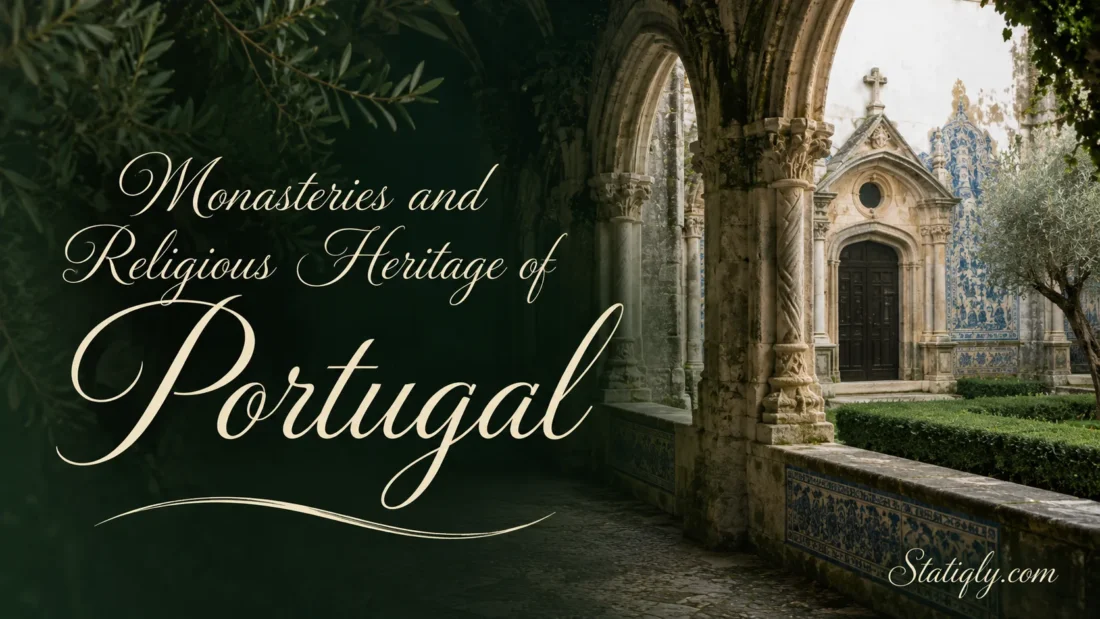
Portugal’s monasteries are not only quiet religious places. They are stone records of art, learning, craft, travel, and daily life. Walk into one cloister and you may notice carved arches, soft light, blue-and-white tiles, old refectories, royal tombs, a library, or a garden shaped for silence. Each place tells a different part of Portugal’s story, yet the mood is often the same: calm, patient, and deeply tied to place.
For travelers, Portuguese religious heritage is easy to enjoy without needing specialist knowledge. The beauty is visible. The spaces speak through scale, rhythm, stone, wood, tile, and light. A monastery in Portugal can feel like a book you read with your feet.
| Site | Location | Main Heritage Character | What To Notice |
|---|---|---|---|
| Jerónimos Monastery | Lisbon | Manueline architecture linked with Belém and Portugal’s maritime era | Stone carving, cloisters, vaulted church, riverfront setting |
| Monastery Of Alcobaça | Alcobaça | Cistercian Gothic monastery founded in the 12th century | Plain scale, clean lines, royal tombs, monastic order |
| Monastery Of Batalha | Batalha | Gothic and Manueline masterpiece connected with royal memory | Royal Cloister, high nave, carved stone, unfinished chapels |
| Convent Of Christ | Tomar | Layered complex with Romanesque, Gothic, Manueline, Renaissance, and Baroque details | Round chapel, cloisters, Manueline window, hilltop setting |
| Royal Building Of Mafra | Mafra | Palace, basilica, convent, library, garden, and park in one large complex | Basilica, long façades, convent spaces, historic library |
| Bom Jesus Do Monte | Braga | Sacred landscape shaped by chapels, stairways, fountains, and gardens | Baroque staircase, hillside views, symbolic route upward |
Why Portugal’s Religious Heritage Feels So Distinct
Portugal’s religious buildings often sit close to rivers, old towns, hills, and trade routes. That matters. A monastery was never only a church with rooms around it. It could shape farming, education, writing, charity, music, building skills, and even the look of a whole town.
Some places feel grand. Others feel almost bare. Alcobaça speaks through proportion and discipline. Jerónimos speaks through ornament. Batalha lifts the eye upward. Tomar feels layered, almost like a walk through several centuries at once.
That variety is the real charm. Portugal does not offer one single style of sacred heritage. It offers many voices, carved into stone.
The Main Styles Visitors Will See
A traveler can enjoy these places much more by knowing a few simple terms. No need for heavy art history. Just enough to look closer.
- Cistercian Gothic: clean, balanced, restrained, and focused on order. Alcobaça is the clearest example.
- Portuguese Gothic: tall spaces, pointed arches, ribbed vaults, and a strong sense of vertical movement.
- Manueline: a Portuguese style rich in carved stone, twisted forms, maritime symbols, plants, ropes, and royal signs.
- Renaissance And Mannerist Details: more measured forms, classical balance, and careful proportion, often visible in later cloisters.
- Baroque: movement, drama, gilded woodwork, ceremonial spaces, stairways, and strong visual rhythm.
- Azulejo Tilework: painted ceramic tiles that decorate churches, cloisters, chapels, and convent walls with color and story.
The styles often mix. In Portugal, a single convent may begin in one period, expand in another, and receive new decoration later. So the building becomes layered. Like a city, only quieter.
Jerónimos Monastery In Lisbon
Jerónimos Monastery is one of Portugal’s most famous religious monuments. It stands in Belém, close to the Tagus River, where Lisbon opens toward the Atlantic. The setting already gives the visitor a clue: this monastery is closely linked with movement, sea routes, memory, and royal patronage.
The building is a fine place to understand Manueline architecture. Look at the stonework. It does not feel plain. It curls, twists, and gathers detail. Columns, arches, and portals carry a sense of movement, as if the stone had learned to breathe.
What Makes Jerónimos Special
- The monastery is part of the Belém cultural area, one of Lisbon’s best-known historic districts.
- The cloister shows highly detailed Manueline carving.
- The church has a wide, elegant interior with tall columns and a calm sense of space.
- The site reflects the close bond between royal patronage, devotion, art, and seafaring memory.
Jerónimos is not the place to rush. The exterior can look busy at first, but the details settle once the eye adjusts. Stand still for a moment. The building rewards patience.
Alcobaça: The Beauty Of Restraint
The Monastery of Alcobaça offers a different mood. It was founded in the 12th century and became one of the great Cistercian monasteries of Europe. Compared with Jerónimos, Alcobaça feels quieter, cleaner, and more severe. That is not a weakness. It is the point.
Cistercian design valued clarity. The architecture avoids needless noise. Wide stone surfaces, long lines, and balanced spaces create a sober kind of beauty. It feels almost musical, but with very few notes.
What To Notice Inside Alcobaça
- The scale: the church is large, yet the decoration stays controlled.
- The light: pale stone and open space create a calm interior.
- The monastic plan: church, cloister, refectory, dormitory, and work areas show how daily life was organized.
- The royal tombs: they add a human and artistic layer to the monastery’s story.
Alcobaça is a good reminder that religious heritage does not always need heavy decoration. Sometimes, the strongest impression comes from discipline. Simple, but not empty.
Batalha: Stonework With A Royal Memory
The Monastery of Batalha is one of Portugal’s most striking Gothic monuments. Its name means “battle,” yet visitors do not need to focus on conflict to understand the place. The monastery is best read as a work of memory, devotion, royal identity, and artistic ambition.
The building rises with confidence. High walls, pointed arches, and carefully carved details give Batalha a strong vertical pull. Then the Manueline details arrive, more decorative and more playful. The mix gives the monastery its character.
The Parts Visitors Often Remember
- The Royal Cloister: detailed, balanced, and full of fine stonework.
- The Founder’s Chapel: an important dynastic space with a strong ceremonial feel.
- The Unfinished Chapels: open to the sky, dramatic without trying too hard.
- The main church: tall, clear, and shaped by Gothic rhythm.
Batalha works well for travelers who enjoy architecture. It also works for people who simply like beautiful places. You do not need to know every style label to feel the skill in the stone.
The Convent Of Christ In Tomar
The Convent of Christ in Tomar is one of the most layered religious sites in Portugal. It grew over centuries, so it does not speak in one style only. Romanesque, Gothic, Manueline, Renaissance, Mannerist, and Baroque elements all appear in the same complex.
That sounds complicated. On the ground, it feels like discovery. You pass through walls, courtyards, cloisters, chapels, and stone passages. Each turn changes the mood.
Why Tomar Feels Different
- The complex stands on a hill above the town.
- The round chapel, often called the Charola, gives the site a rare spatial form.
- The convent includes several cloisters from different periods.
- The famous Manueline window shows how symbolic and decorative Portuguese stonework could become.
Tomar is not only a stop for one building. The town, the hill, the convent, and the surrounding landscape all work together. Seen from below, the complex has presence. Seen from inside, it has layers.
Mafra: Basilica, Convent, Palace, And Library
Mafra is not a small religious site. It is a vast complex that brings together a palace, basilica, convent, historic library, garden, and park. For visitors, this makes Mafra one of the best places to see how royal life, religious life, ceremony, learning, and landscape could meet in one planned setting.
The basilica forms the spiritual center of the building. The convent spaces add rhythm and order. The library adds another kind of silence, the silence of books. Different rooms, different pace.
What To Look For At Mafra
- The basilica façade: formal, balanced, and made to impress from a distance.
- The convent areas: useful for understanding the scale of religious life inside the complex.
- The library: one of the most admired historic library interiors in Portugal.
- The gardens and park: a reminder that heritage can include landscape, not only buildings.
Mafra can feel almost too large at first. Give it time. The best way to read it is not as one room after another, but as a complete cultural machine: prayer, power, study, nature, and ceremony arranged in stone.
Bom Jesus Do Monte And Sacred Landscape
Not all Portuguese religious heritage is a monastery. Bom Jesus do Monte in Braga shows another tradition: the sacred landscape. Here, architecture and hillside work together. Chapels, fountains, steps, gardens, and views shape the visitor’s movement upward.
The famous stairway is more than a practical path. It creates rhythm. Step, pause, turn, look. The route slows the body, which changes the way the place feels.
Braga itself has deep religious heritage, and Bom Jesus adds a strong visual landmark to that identity. For many visitors, it is one of the most memorable sacred sites in northern Portugal because it combines architecture with open air.
Fátima And Living Religious Heritage
Fátima belongs to a different kind of heritage. It is not mainly about medieval stonework or monastic planning. It is about living pilgrimage, prayer, gathering, and personal reflection. Visitors come for many reasons: faith, curiosity, family tradition, quiet, or cultural understanding.
The site is large and open. The mood depends on the hour, the season, and the number of pilgrims present. Some days feel busy. Some moments feel very still.
For a country-focused article on Portugal, Fátima matters because it shows that religious heritage is not frozen in the past. It continues through movement, ritual, memory, and shared space.
Azulejos, Woodcarving, And Sacred Art
Portugal’s religious heritage is also found in details: a tiled wall, a carved altar, a painted ceiling, a sacristy cabinet, a choir stall, a chapel lamp. These details are easy to miss when a visitor only looks for the “main attraction.”
Azulejo tiles are especially useful for reading Portuguese sacred spaces. They can bring brightness to cloisters, cover church walls, or tell stories in blue and white. In some buildings, the tiles soften the stone. In others, they guide the eye around the room.
Gilded woodcarving, often called talha dourada, creates a different effect. It glows. In Baroque churches and chapels, this golden carving can make an interior feel warm, dense, and ceremonial. Too much? Maybe at first glance. Then the pattern appears.
How To Visit Portuguese Monasteries With More Care
A good visit is not only about taking photos or checking off famous names. These places carry religious meaning, public history, and local pride. A slower visit usually gives more back.
- Check opening hours before going. Heritage sites may change hours by season, holiday, or restoration work.
- Dress with basic respect. Many sites still include active worship spaces.
- Look for the cloister. In many monasteries, the cloister is the heart of the building.
- Read the plan of the site. Refectory, chapter house, dormitory, church, and sacristy each had a role.
- Notice sound. Stone churches often change the way footsteps, voices, and silence behave.
- Give yourself enough time. Thirty rushed minutes rarely suits a major monastery.
A Sensible Route For First-Time Visitors
If time is limited, it helps to group sites by region. Portugal is not a huge country, but travel days still need care. A monastery route should feel enjoyable, not like a race.
| Route | Best For | Suggested Focus |
|---|---|---|
| Lisbon And Belém | Short city stay | Jerónimos Monastery, Belém heritage area, nearby museums and riverfront walks |
| Central Monastery Route | Architecture lovers | Alcobaça, Batalha, and Tomar, with time for cloisters and old town walks |
| Mafra And Lisbon Coast | Palace, basilica, and library interest | Royal Building of Mafra, convent spaces, basilica, gardens, and historic interiors |
| Braga And The North | Sacred landscape and church heritage | Bom Jesus do Monte, Braga churches, stairways, gardens, and viewpoints |
| Fátima And Central Portugal | Living pilgrimage culture | Sanctuary spaces, quiet reflection, nearby heritage towns |
The central route is especially strong for monasteries. Alcobaça, Batalha, and Tomar each has a clear personality. Together, they show how much range Portuguese religious architecture can have within a fairly compact area.
What These Places Reveal About Portugal
Portugal’s monasteries reveal a country shaped by coastline, towns, kings, religious orders, stoneworkers, tile painters, teachers, pilgrims, and local communities. The buildings are formal, yes, but they are not cold. They hold traces of hands and habits.
A cloister says something about daily rhythm. A refectory says something about shared meals. A library says something about learning. A chapel says something about hope. Even a worn step says something, if you let it.
For readers planning a trip, the main lesson is simple: do not treat Portuguese monasteries as background scenery. They are among the clearest ways to understand the country’s art, landscape, and memory.
Small Details Worth Noticing
- Doorways: portals often carry some of the richest carving on the building.
- Vaults: look up in churches, cloisters, and chapter houses to see how stone ribs shape the ceiling.
- Water features: fountains and wash areas can show how monastic life balanced prayer and daily routine.
- Tiles: azulejos often explain stories, decorate quiet spaces, or add light to heavy walls.
- Gardens: many religious sites use outdoor space as part of the experience, not as decoration only.
- Empty space: plain walls and open rooms can be just as meaningful as ornament.
Respectful Notes For Visitors
Many Portuguese religious sites welcome travelers, but they still deserve care. Keep voices low in chapels and active worship areas. Follow photo rules. Avoid blocking doors, tombs, altars, or narrow cloister paths. If a service or ceremony is taking place, step back and observe quietly.
These are simple habits. They make the visit better for everyone: locals, pilgrims, guides, families, and travelers seeing Portugal for the first time.
Frequently Asked Questions About Portugal’s Monasteries
Which Monastery In Portugal Is Best For A First Visit?
Jerónimos Monastery is the easiest choice for many first-time visitors because it is in Lisbon and sits within the Belém heritage area. Travelers with more time should also consider Alcobaça, Batalha, and Tomar, especially if they enjoy architecture.
Are Portugal’s Monasteries Only For Religious Travelers?
No. Many visitors come for architecture, history, tilework, gardens, photography, town walks, or quiet cultural travel. These places have religious meaning, but they also form part of Portugal’s public heritage.
What Is Manueline Architecture?
Manueline is a Portuguese architectural style linked with the late 15th and early 16th centuries. It often uses rich stone carving, maritime forms, plants, ropes, crosses, royal symbols, and detailed portals. Jerónimos and parts of Batalha and Tomar show this style well.
Can Alcobaça, Batalha, And Tomar Be Visited On One Route?
Yes. Many travelers group them into a central Portugal heritage route. It is better to avoid rushing all three in a single short day, though. Each site deserves time, and the towns around them add value to the trip.
What Should Visitors Wear In Portuguese Monasteries And Churches?
Simple, respectful clothing is enough in most cases. Since many places include active worship spaces, visitors should avoid overly casual beachwear inside churches, chapels, and sanctuaries.
Why Are Cloisters So Common In Monasteries?
A cloister connected different parts of monastic life: church, chapter house, dormitory, refectory, and work areas. It also created a quiet inner space for walking, reading, and reflection. In Portugal, cloisters are often among the most beautiful parts of a monastery.