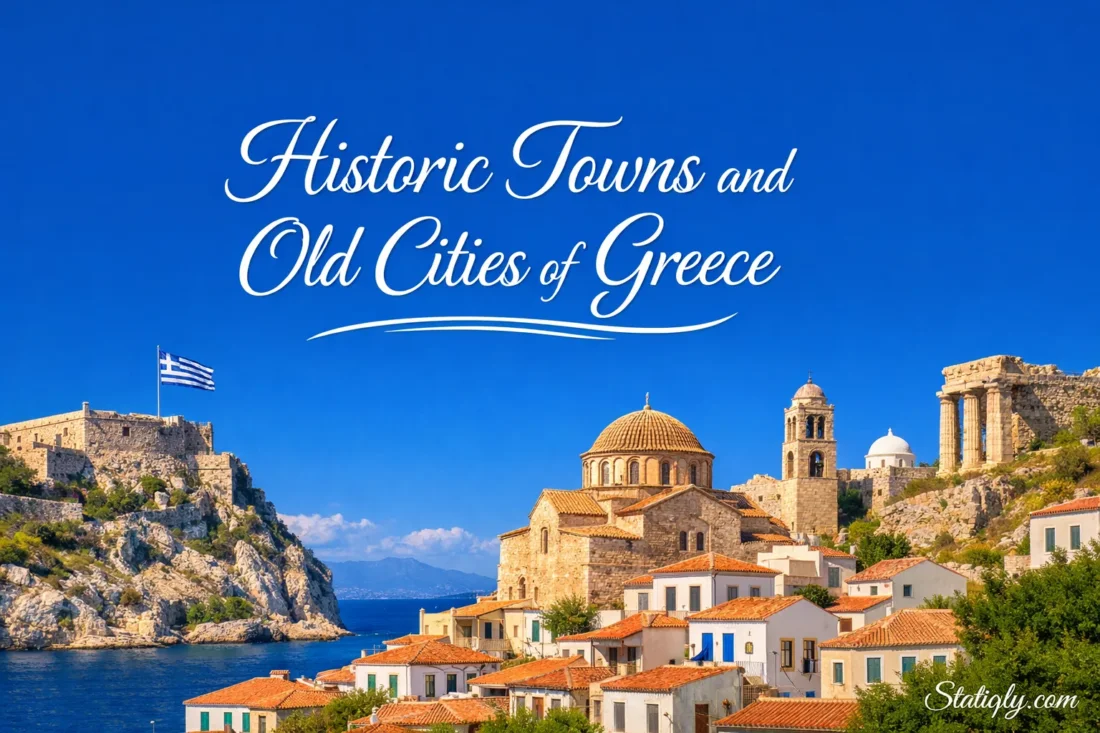
Greece does not keep its past in one place. You find it in old ports, stone lanes, hill towns, city walls, church domes, and quiet squares where daily life still moves at walking pace. That is what makes the historic towns and old cities of Greece so memorable. They are not only famous landmarks. They are living street patterns, old building habits, and local routines that have stayed visible for centuries.
Some Greek towns feel polished and open to the sea. Others feel enclosed, almost secret, as if the stone itself decided where the streets should go. A few remain active city centers. A few read more like preserved urban memories. Taken together, they show why Greece holds so much urban history in such a small space. You do not need a museum label on every corner to feel it. Often, one short walk is enough.
What Makes Historic Towns in Greece So Distinct
An old Greek town rarely depends on a single monument. Its identity usually comes from the full setting: a street plan shaped before cars, houses built close together for shade and shelter, a harbor or fortress tied to the land, and public spaces that still work as meeting points. That is why these places stay readable. Even when the periods change, the bones of the town often stay in place.
Another detail matters too: many of these places carry more than one historical layer at once. Byzantine churches, Venetian facades, later civic buildings, stone houses, arches, and market routes sit side by side. Nothing feels flat. Nothing feels one-note. The town keeps speaking, just in more than one accent.
| Place | Part of Greece | What Gives It Character | What It Feels Like Today |
|---|---|---|---|
| Nafplio | Peloponnese | Old harbor town with layered fortifications and an early modern state role | Elegant, walkable, easy to read |
| Monemvasia | Peloponnese | Walled stone settlement attached to a sea rock | Quiet, enclosed, deeply atmospheric |
| Rhodes Old Town | Dodecanese | Large medieval city inside long walls | Busy, layered, urban in scale |
| Corfu Old Town | Ionian Islands | Forts, narrow lanes, arcades, and mixed European urban forms | Open, civic, lively |
| Thessaloniki | Macedonia | Byzantine monuments woven into a living modern city | Historic without feeling sealed off |
| Chania Old Town | Crete | Harbor district within Venetian walls, with mixed urban layers | Soft, scenic, full of local rhythm |
| Mystras | Peloponnese | Hillside medieval city arranged around a fortress | More preserved than lived-in, but deeply expressive |
Nafplio: The Old Port City That Feels Instantly Human
Nafplio is one of the easiest old cities in Greece to enjoy on foot. The town opens to the sea, then folds inward through streets, balconies, stone fronts, and public squares that still feel made for conversation. It has order, but not stiffness. The old quarter feels settled, lived in, and easy on the eye from the first few minutes.
That is a large part of its charm. Nafplio carries Venetian and later urban layers without losing warmth, and in the 19th century it served as an early capital of the modern Greek state. You feel that civic role in the rhythm of the town. It has grace, yes, but also balance. Harbor, streets, fortifications, homes, and squares sit close together, so the whole place makes sense quickly.
- Why It Stays With People: the old town is compact without feeling cramped.
- What Stands Out: sea views and historic streets stay in the same frame.
- Who It Suits: readers looking for a historic Greek town that feels welcoming from the first walk.
Monemvasia: The Stone Town Hidden by the Rock
Monemvasia does not reveal itself all at once. First comes the rock. Then the walls. Then, almost tucked inside them, the town. Founded by the Byzantines in the sixth century, it still feels shaped by protection, foot travel, and careful use of space. Streets stay narrow. Houses stay close. The setting does half the storytelling before you even reach the gate.
Inside the lower town, the lanes feel intimate and self-contained. Higher up, the upper town adds silence, height, and long sea views. Few places show the link between topography and urban design as clearly as Monemvasia. Here, the land is not a backdrop. It is the plan. That gives the town a rare sense of unity, almost as if stone, wall, and street grew together.
- Main Appeal: a fully legible medieval layout.
- Best Detail To Notice: how every lane seems to follow the rock instead of resisting it.
- Overall Feel: enclosed, calm, and wonderfully direct.
Rhodes Old Town: A Full Medieval City, Not Just an Old Quarter
Rhodes Old Town works on a bigger scale than many historic towns in Greece. It sits within long medieval walls and reads as a complete urban space rather than a small preserved pocket. Streets widen, then tighten. Quiet corners appear after busier routes. The city keeps shifting its mood, and that makes it rewarding to explore slowly.
The medieval plan shaped by the Knights of Saint John is still easy to sense, especially in the way the high town and lower town relate to each other. Yet Rhodes does not feel trapped in one period. Different building traditions remain visible inside the same enclosure, so the old city feels layered rather than staged. Large, inhabited, and still urban at heart, it shows how an old city can remain active without losing form.
- Why It Matters: the scale is rare for a Greek old city.
- What To Notice: the shift between grand routes and smaller residential lanes.
- Strong Point: it still feels like a real town, not an outdoor set.
Corfu Old Town: A Greek City With a Broad Urban Face
Corfu Old Town has a different rhythm from the fortress towns of the Aegean and the Peloponnese. Its roots reach back to the eighth century BC, and later centuries added Venetian, French, British, and Greek layers that still shape the town’s outward form. The result feels urban in a wide, public way. There are lanes, of course, but also arcades, open spaces, civic facades, and a sense of air moving through the streets.
This is where Corfu stands apart. It does not depend only on intimacy. It also offers breadth. Palaces, forts, austere public buildings, and everyday homes sit together without breaking the town’s flow. Old Corfu feels both local and outward-looking, both Greek and distinctly Ionian. In a country full of stone hill towns and enclosed lanes, that lighter urban character makes it memorable.
- Main Mood: open, civic, and highly walkable.
- What Gives It Depth: several administrations left visible but well-blended marks.
- Best For: readers drawn to old cities with squares, facades, and a more public street life.
Thessaloniki: An Old City Spread Through a Living Metropolis
Thessaloniki does not present its past as one tidy historic quarter. It scatters it through the living city. Walls, churches, monuments, upper neighborhoods, and major routes all hold pieces of the older urban fabric. That makes the experience different. You are not stepping out of the present to find the past. You are walking through both at once.
The city’s Byzantine identity still carries real weight here. UNESCO-listed monuments, including stretches of the city walls and major churches, show how strongly that period still shapes Thessaloniki’s face. For readers asking which Greek old city feels most alive in daily terms, this one deserves special attention. Cafes, apartments, markets, and traffic keep moving around monuments that are not pushed to the edge. They stay in the middle of life, where they belong.
- What Makes It Different: history appears as part of an active city, not a sealed district.
- What To Watch For: how monumental architecture and ordinary streets meet.
- Overall Character: layered, energetic, and deeply continuous.
Chania Old Town: A Harbor City With Many Urban Voices
Chania brings the harbor into the story of old Greek cities. Its Old Town sits within Venetian walls and turns around one of Crete’s most familiar waterfront scenes. The port, the lanes behind it, and the compact quarters nearby all work together. Nothing feels detached. Sea, street, and stone remain closely tied.
What makes Chania so appealing is the way different periods remain visible without pulling the town apart. Venetian elegance, Ottoman-era details, and everyday Cretan life sit side by side. One street can feel formal, the next domestic, the next almost village-like. Softly it changes. That makes Chania one of the most readable old cities of Greece for visitors who enjoy atmosphere but still want a strong urban structure beneath it.
- Main Appeal: a historic port with warmth and local rhythm.
- Best Detail To Notice: the shift from waterfront openness to sheltered inner lanes.
- Why It Works: several periods stay visible without visual clutter.
Mystras: The Hillside City That Shows How Medieval Greece Was Built
Mystras is not a living town in the same way as Nafplio, Corfu, or Chania. Even so, it belongs in any serious look at historic towns in Greece. Built on a slope near Sparta and arranged around a fortress, the city rises like an amphitheater. Its layout makes immediate sense: height for outlook, religious buildings as anchors, houses adapted to the terrain, and routes that follow the hillside rather than cut across it.
Today Mystras reads more like a preserved urban memory than a daily-use settlement. That is exactly why it matters. It helps explain the logic behind many old Greek towns: upper and lower zones, protected movement, and an urban form shaped by land, not by straight-line planning. Quietly it teaches. Very clearly too.
- Why It Belongs Here: it reveals the structure of a late medieval Greek city with unusual clarity.
- What To Notice: the way churches, homes, and routes settle into the slope.
- Overall Feel: reflective, stony, and deeply rooted in place.
How To Read an Old Greek City as You Walk
Readers often focus on famous buildings first. Fair enough. Still, the real story usually appears in smaller details. Look for the shape of the streets, the relation between high and low ground, and the way public life still gathers in certain corners. In Greece, old cities often make sense through movement. Walk slowly and the plan reveals itself.
- Notice the street width. Narrow lanes usually tell you more than the grand road does.
- Watch how the town meets the land. On a hill, by a harbor, around a rock, behind walls—this changes everything.
- Look for reused forms. Arches, thresholds, stairways, stonework, and courtyards often outlast the original owners.
- Pay attention to public space. A square, a market street, or a church forecourt often explains how the town lived.
- Read the town by layers, not by labels. One period rarely erased the next. More often, it settled beside it.
Which Historic Town in Greece Fits Different Interests
- For Seafront Elegance: Nafplio.
- For A Stone-Walled Medieval Feel: Monemvasia.
- For A Large Enclosed Old City: Rhodes Old Town.
- For Arcades, Squares, and a Broad Urban Texture: Corfu Old Town.
- For Byzantine Continuity Inside Modern Daily Life: Thessaloniki.
- For Harbor Atmosphere in Crete: Chania Old Town.
- For A Quiet Lesson in Medieval Urban Form: Mystras.
No two of these places tell the same story in the same tone. That is the pleasure of them. Historic towns and old cities of Greece are not memorable only because they are old. They stay in the mind because each one solves urban life in a different way—through stone, slope, sea, walls, courtyards, and streets still made for people first.