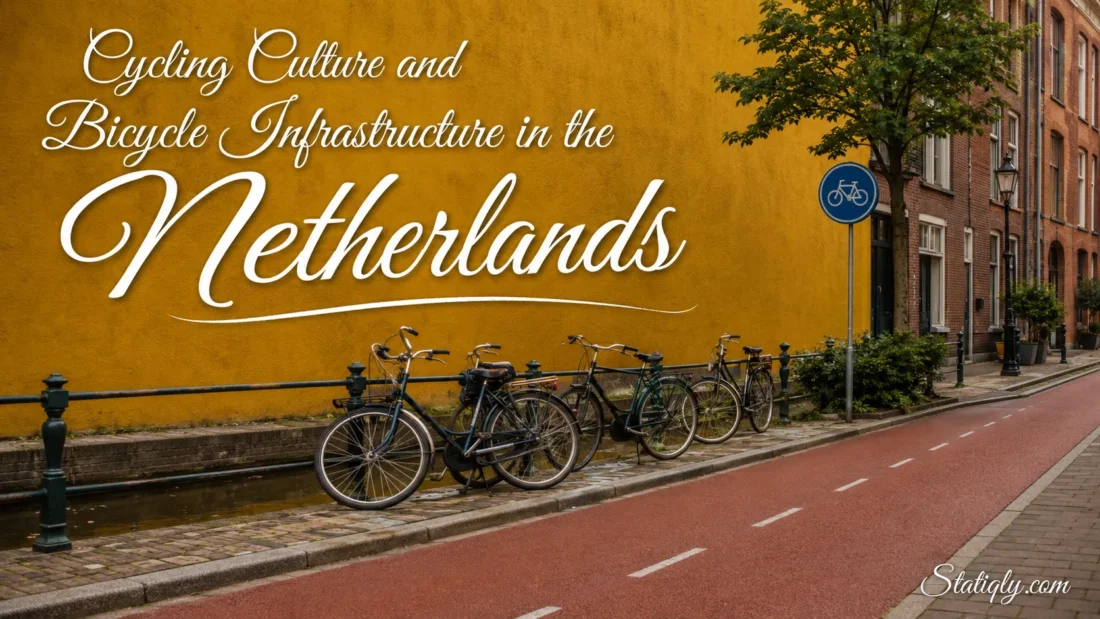
In the Netherlands, the bicycle works as everyday transport. People ride to school, offices, shops, parks, railway stations, and social visits. This habit rests on more than flat land. Connected routes, clear road design, practical parking, and close links with public transport make cycling useful for ordinary journeys.
Dutch cycling culture can look effortless from the outside. Yet every smooth trip depends on many small details: a path that does not end without warning, a traffic light placed where riders can see it, enough room to wait at a junction, and somewhere suitable to leave a bicycle at the destination.
Cycling In Numbers
National figures show how deeply the bicycle sits within daily mobility. The data years differ because travel surveys and network measurements follow separate publication schedules.
| Measure | Recorded Figure | Data Year |
|---|---|---|
| Share of all trips made by bicycle | 27% | 2023 |
| Average bicycle trips per resident aged 6 or older | 266 trips per year | 2023 |
| Average annual cycling distance per resident aged 6 or older | 1,065 kilometres | 2023 |
| Bicycle trips shorter than 3.7 kilometres | 70% | 2023 |
| Total mapped cycling network | 153,783.7 kilometres | 2025 |
| Cycle paths beside roads | 10,490.9 kilometres | 2025 |
| Standalone cycle paths | 12,726.7 kilometres | 2025 |
| Designated bicycle streets | 504.6 kilometres | 2025 |
The total mapped network includes several types of route, including ordinary roads where cycling is permitted. It should not be read as the length of physically separated cycle paths. That distinction matters when comparing Dutch figures with statistics from other countries.
Why Cycling Feels Ordinary
The bicycle is rarely reserved for exercise or weekend recreation. It is a practical vehicle used across age groups and trip purposes. Riders often wear their normal clothes and carry bags in panniers, baskets, or front racks. The journey fits into the day without becoming an event of its own.
Distance helps explain this pattern. Many homes, schools, shops, workplaces, and stations sit within a manageable cycling range. Compact neighbourhoods create several possible destinations within a short ride. A bicycle can therefore handle an entire local journey rather than serving only as a recreational extra.
Convenience builds the habit. Once cycling becomes dependable, people can choose it without studying the route before every trip. Familiar signs, repeated street layouts, and connected paths reduce uncertainty.
Learning Through Daily Life
Many Dutch children meet the bicycle early through family outings, short neighbourhood trips, and journeys to school. They gradually learn balance, signalling, route awareness, and how to move among other riders. Where distance and family circumstances allow, cycling becomes part of the school routine.
Adults reinforce the same culture. Parents may use cargo bicycles for children or shopping, commuters ride to stations, and older residents often continue cycling for nearby errands. Electric assistance has also made longer routes and headwinds easier for many riders.
How Dutch Bicycle Infrastructure Works
A Dutch cycling route may pass through several street types during one journey. It can begin on a calm residential road, join a separated path, cross a junction with bicycle signals, and finish on a bicycle street. Continuity between these parts matters as much as the design of any single section.
Separated Cycle Paths
Separated paths place space between bicycle traffic and faster motor traffic. The separation may take the form of a kerb, verge, row of trees, parking strip, or raised level. Many paths use red pavement, although colour alone does not determine the applicable rule. Signs, markings, and the street layout still guide users.
Some paths carry bicycles in one direction. Others are two-way routes. Direction arrows and centre lines help riders read the arrangement, particularly near crossings and junctions.
Bicycle Lanes
Painted lanes appear where bicycles share the wider road corridor. Their design varies by location. Some use solid markings, while others use broken lines or advisory space. Riders should follow local signs rather than assuming that every red strip works in the same way.
Bicycle Streets
A fietsstraat, or bicycle street, gives the street a clear cycling character while still allowing certain motor vehicles. Red surfacing, bicycle symbols, restrained vehicle speeds, and the position of the riding area make its purpose easy to recognise.
These streets often connect neighbourhood routes where a fully separated path would not suit the surrounding layout. They also show that Dutch bicycle planning does not rely on one design everywhere.
Junctions and Crossings
Junctions receive close attention because several movements meet there. Common features include bicycle traffic lights, coloured crossing surfaces, waiting areas, direction markings, and traffic islands. Some signals detect an approaching bicycle and adjust the light sequence.
Roundabouts and crossings do not all follow one priority arrangement. Local signs and road markings settle the order. Clear sight lines help each road user understand where others are likely to move.
Regional Cycling Routes
Cycling infrastructure extends beyond city centres. Regional routes link residential areas with employment districts, schools, transport hubs, and neighbouring towns. These routes often aim for direct travel with fewer interruptions, smooth surfaces, and enough width for passing.
Electric bicycles have expanded the practical range of these connections. A journey between nearby municipalities can now suit riders who might have considered the distance too demanding on a conventional bicycle.
The Bicycle and Train Connection
One of the most useful features of Dutch mobility is the link between bicycles and rail travel. A rider can cycle from home to a station, park there, take a train, and continue by bicycle or public transport at the other end.
Large stations may have staffed or self-service bicycle storage, multi-level parking, repair services, and clear walking routes toward the platforms. Smaller stations usually offer simpler racks or covered spaces. The scale changes, but the purpose remains the same: make the first and final part of a rail journey manageable.
Public Transport Bicycles
The national OV-fiets rental system provides bicycles at hundreds of locations. It is designed mainly for the final section of a public transport journey. Availability can be checked digitally, and the standard bicycle can be collected using an eligible personal travel card and rental arrangement.
This system removes the need to carry a personal bicycle on the train. It also gives visitors and occasional riders a practical choice for short trips from a station.
Bicycles Built For Everyday Tasks
The upright city bicycle remains a familiar sight. Its riding position offers a broad view of the street, while mudguards, chain protection, lights, and a rear rack support daily use. Speed is only one concern. Comfort and utility matter too.
- City bicycles suit commuting, shopping, and short local journeys.
- Electric bicycles assist with longer distances, wind, and heavier loads.
- Cargo bicycles carry groceries, children, parcels, or work equipment.
- Folding bicycles can help travellers combine cycling with public transport.
- Touring bicycles serve longer leisure routes and multi-day trips.
Many everyday bicycles place function before delicate components. A covered chain, built-in lights, steady stand, and practical carrying space can save time during repeated short trips.
The Rhythm Of A Dutch Cycle Path
A busy path has its own flow. Riders usually keep right, pass on the left, and signal before turning. Faster cyclists look for a suitable passing moment rather than forcing through a narrow gap. A bell offers a brief warning when needed.
Predictable movement keeps the path comfortable. Sudden stops, unclear turns, or standing in the riding line interrupt that rhythm. Near stations and city centres, watching the surrounding flow for a moment can make the local pattern much easier to understand.
Useful Path Etiquette
- Ride on the correct side and follow directional arrows.
- Keep right when the path has room for riders to pass.
- Use a clear hand signal before turning.
- Check behind before changing position.
- Move away from the riding line before stopping.
- Follow bicycle traffic lights, signs, and surface markings.
- Use lights when visibility is low.
- Walk beside the bicycle in pedestrian-only areas.
How Cycling Changes Between Dutch Cities
The national cycling culture has strong shared features, but each city feels different. Street age, water crossings, population density, and railway connections shape the local experience.
| Place | Typical Cycling Character |
|---|---|
| Amsterdam | Busy flows, canal crossings, narrow historic streets, and many short urban trips |
| Utrecht | Strong bicycle-and-train connections, busy radial routes, and extensive station parking |
| Groningen | Compact distances, active student travel, and direct routes across the urban area |
| Rotterdam | Broader streets, bridge crossings, modern road layouts, and longer urban distances |
| The Hague | Urban routes connected with parks, coastal paths, dunes, and nearby communities |
| Eindhoven | City and regional links serving residential areas, campuses, and employment districts |
Smaller towns and villages add another side to Dutch cycling. Local streets may be quieter, while paths beside canals, fields, and dikes connect communities. Wayfinding signs often direct riders toward town centres, stations, and regional destinations.
Cycling Through Dutch Weather
Rain and wind form part of daily cycling decisions. Riders often check a weather app, carry a light rain layer, or adjust the route according to wind direction. Covered bicycle components and full mudguards help keep an ordinary journey practical.
Route maintenance supports year-round use. Drainage, surface repair, vegetation control, lighting, and winter treatment all affect whether a path remains dependable. A well-placed route loses much of its value when its surface becomes difficult to use.
What Visitors Should Notice
The greatest adjustment for many visitors is not balancing the bicycle. It is reading the movement around them. Dutch riders often know their route and maintain a steady pace. A visitor who rides predictably will fit into that flow more easily.
- Choose a comfortable bicycle. Adjust the saddle so starting and stopping feel controlled.
- Study the first few turns. Navigation is easier when the phone can remain stored during the ride.
- Look for bicycle signs. The most direct cycling route may differ from the driving route.
- Check both directions. Some paths carry two-way bicycle traffic beside a one-way road.
- Cross tram tracks carefully. Approach the rails at a clear angle rather than riding closely along them.
- Park only in suitable spaces. Busy centres and stations may use marked racks, designated zones, or managed facilities.
- Allow the path to clear before stopping. Move onto a pavement or waiting area where cycling is permitted to end.
Why The Network Supports Daily Use
No single path explains Dutch cycling culture. The experience comes from several practical elements working together across an entire journey.
- Routes connect useful destinations. Schools, shops, homes, offices, and stations can often be reached without a long detour.
- Street layouts feel familiar. Repeated markings and design patterns help riders understand new locations.
- Parking completes the trip. Bicycle racks and station facilities support arrival as well as movement.
- Public transport extends the range. Trains and rental bicycles make mixed journeys realistic.
- Different bicycles serve different needs. City bikes, electric models, and cargo bikes support varied ages and trip purposes.
- Maintenance protects continuity. Smooth surfaces, drainage, lighting, and seasonal care keep routes usable.
The result is a transport culture shaped by repetition. People cycle because routes usually take them where they need to go, and each completed trip makes the next one feel familiar.
Questions About Cycling In The Netherlands
Is Every Dutch Road Equipped With A Separate Cycle Path?
No. Separate paths commonly appear beside faster or busier roads. Calm residential streets, bicycle streets, and some rural roads use shared space. The selected design depends on speed, traffic volume, available space, and the role of the route.
Why Are Many Dutch Cycle Paths Red?
Red surfacing makes cycling space easier to identify. It can highlight a path, lane, crossing, or bicycle street. Riders must still read the signs and markings because colour does not create the same priority arrangement at every location.
Can Visitors Rent Bicycles Easily?
Rental shops operate in many cities and visitor areas. Public transport bicycles serve eligible users at hundreds of locations, mainly for journeys from stations. Rental terms, identification requirements, return rules, and bicycle types vary by provider.
Are Electric Bicycles Common?
Yes. Electric bicycles support commuting, regional trips, leisure rides, and journeys with heavier loads. Their wider range has made them useful beyond compact city centres.
Is Cycling Limited To Major Cities?
No. Towns, villages, rural districts, and regional corridors also have cycling routes. The density and design change from place to place, yet the bicycle remains useful well beyond Amsterdam, Utrecht, and other large urban centres.
What Makes A Dutch Cycling Route Easy To Use?
A useful route stays understandable from departure to arrival. Direct connections, readable junctions, suitable surfaces, clear signs, comfortable width, and practical parking all contribute. The whole journey matters.