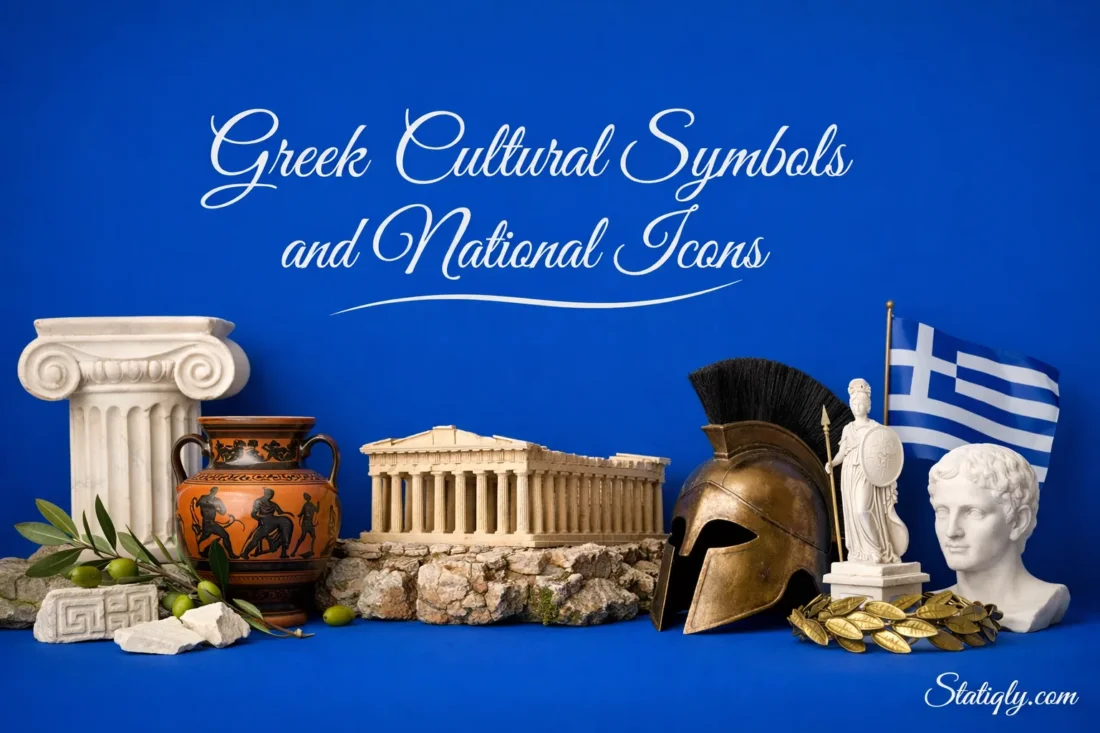
Greek cultural symbols do not sit in one narrow box. Some are official state symbols. Some live in music, design, dress, food, and city memory. Put them together and a clear picture forms: blue and white, the cross, the owl of Athena, the olive tree, the Parthenon, the meander pattern, the Evzones, and living traditions such as rebetiko, Byzantine chant, and the shared table of the Mediterranean diet. That mix is what makes Greek national icons feel so immediate. You see them on buildings and uniforms, hear them in song, and notice them in everyday rituals almost without trying.
| Symbol Or Icon | Type | What It Commonly Signals |
|---|---|---|
| Greek Flag | Official national symbol | State identity, public ceremony, shared national image |
| National Emblem | Official national symbol | The white cross on blue, framed by laurel branches |
| “Hymn To Freedom” | Official national anthem | Formal occasions and collective memory |
| Owl Of Athena | Cultural symbol | Wisdom, Athens, learning |
| Olive Tree | Cultural symbol | Continuity, daily life, food culture |
| Parthenon And Acropolis | National icon | A visual shorthand for Greek heritage |
| Meander Pattern | Design motif | Greek visual identity in art and decoration |
| Evzones And Fustanella | Ceremonial icon | Public ritual, formal presence, recognizable dress |
| Rebetiko And Byzantine Chant | Living sound traditions | Voice, memory, and cultural continuity |
| Mediterranean Table | Living cultural practice | Hospitality, seasonality, and eating together |
Official Symbols Seen In Public Life
The most formal symbols of Greece are easy to name and easy to recognize. The national flag has nine horizontal stripes, five blue and four white, with a white cross inside a blue canton. It is simple, clean, and memorable. You do not need an explanation the first time you see it. It already feels settled in the eye.
The national emblem repeats the same visual language. It shows a blue shield with a white cross, framed by two laurel branches. That repetition matters. Nations often build recognition by repeating a few forms again and again, and Greece does this with unusual clarity. Blue. White. Cross. Laurel. The image stays stable even when the setting changes.
The national anthem, “Hymn To Freedom”, was written by Dionysios Solomos and set to music by Nicholas Mantzaros. It became the national anthem in 1864. In official use, the first two stanzas are the ones most often heard. This gives Greece a symbol that is verbal as well as visual: not just a flag to raise, but words to remember and a melody to share.
Why Blue And White Matter So Much
Some national palettes feel decorative. Greece does not work like that. Blue and white function almost like a visual signature. They appear in the flag, the emblem, and many public-facing images of the country. They also fit what many people already associate with Greece: bright light, sea, sky, whitewashed surfaces, and open space. The match between official symbols and lived visual memory is unusually tight. That is one reason these colors travel so well.
There is another reason they stay with people. They are easy to repeat without losing force. On a document, on a public building, on a ceremony, on a harbor scene, the same two colors still feel right. Few countries have that kind of visual economy. Greece does.
The Owl And The Olive Tree
If the flag shows the state, the owl and the olive tree show something deeper in cultural memory. Both are tied to Athena, and both are closely linked with Athens. Britannica notes that the owl became famous as the symbol of the city of Athens, while the olive tree was also sacred to Athena. Those links still shape how Greek identity is pictured today.
The owl of Athena works because it carries a plain, strong idea: wisdom. It does not need much decoration around it. A small bird becomes a lasting emblem. Strange, maybe, but true. It is one of those cases where a compact image does more than a long explanation ever could.
The olive tree moves in a different way. It belongs to myth, but also to the table, the landscape, and daily routines. It is one of the rare cultural symbols that crosses every level of life. You can meet it in story, in agriculture, in food, in family habits, and in the broader Mediterranean way of eating together. That range gives the olive tree unusual staying power. It is not only remembered. It is used.
Why These Two Symbols Last
- The owl points to Athens, thought, and learned culture.
- The olive tree joins memory with ordinary life.
- Both symbols are old, yet they still feel natural in present-day Greece.
- Neither one needs a complicated explanation to be understood.
The Meander Pattern In Greek Visual Identity
The meander, often called the Greek key pattern, is one of the clearest Greek design markers. Britannica notes that the motif appears in Greek decorative vocabulary and became especially visible in pottery and geometric ornament. It is made from a continuous line that turns at right angles and repeats. Simple shape. Long life.
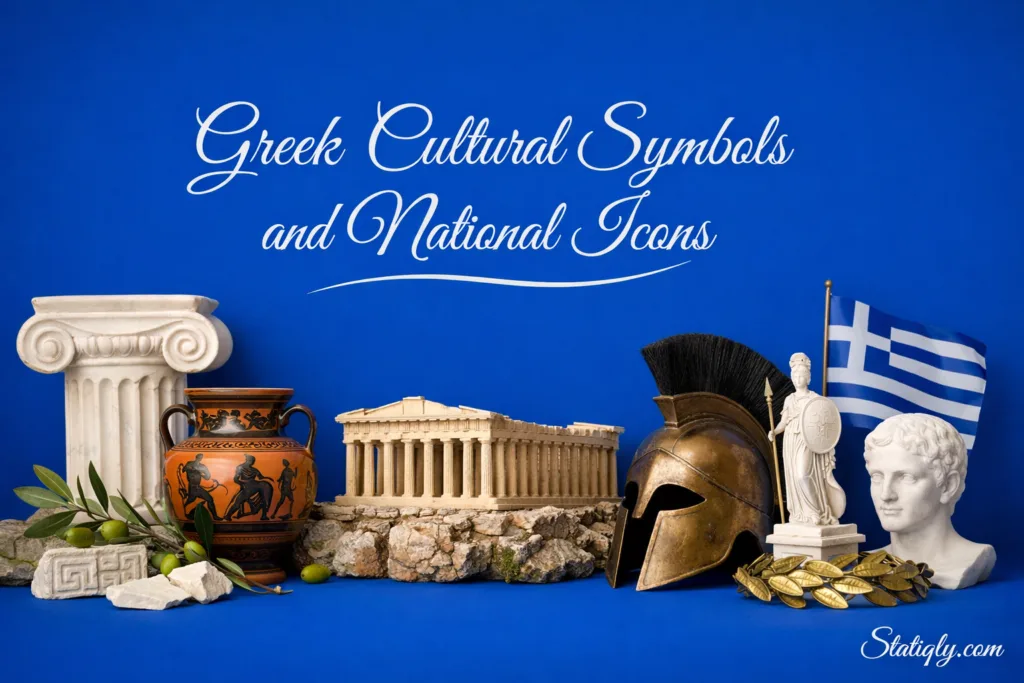
Why has it lasted? Because it travels well. It can sit on a vase, a border, a floor, a textile, a book cover, or a modern souvenir without losing its Greek character. Many symbols need their original setting. The meander does not. It carries its identity with it.
That is part of its charm. The pattern feels ordered, rhythmic, and unmistakable. Not loud. Not complicated. Yet instantly Greek to many viewers. In visual culture, that kind of recognition is rare.
The Parthenon And The Acropolis As National Icons
No list of Greek national icons feels complete without the Parthenon and the Acropolis of Athens. The Parthenon was built in the mid-5th century BCE and dedicated to Athena Parthenos. UNESCO describes the Acropolis and its monuments as universal symbols of the classical spirit and civilization. That phrase matters because it explains why the site carries more than local meaning. It belongs to Athens, yes, but it also stands as one of the clearest public images of Greece as a whole.
The Parthenon does something few buildings can do. It works at once as architecture, memory, and national shorthand. Show its outline and most people know the country. That kind of recognition is powerful. A monument becomes a sentence.
The Acropolis also ties together several Greek symbols in one place: Athena, the owl, the olive tree, marble architecture, and the visual language of the city itself. So even when people speak only about the Parthenon, they are often responding to a larger symbolic landscape around it.
Evzones, The Fustanella, And Ceremonial Presence
The Evzones, the ceremonial guards of the Presidential Guard, are among the most recognizable living icons in Greece. Their role is public and formal, yet their impact is cultural as much as ceremonial. You see them and you are not looking only at a military unit. You are looking at an image that has been carefully preserved and made visible in civic space.
Their dress is central to that image, especially the fustanella, the white pleated garment that has become one of the best-known elements of Greek ceremonial clothing. The uniform is precise, handmade, and highly recognizable from a distance. It turns public ritual into something visual, almost sculptural. Stillness does a lot of the work here.
This is why the Evzones matter beyond the ceremony itself. They keep a national image in motion without changing it too much. In a fast world, that kind of continuity stands out.
Music And Voice As Cultural Symbols
Greek national icons are not only things you can see. Some are heard. Rebetiko, inscribed by UNESCO in 2017, is described as a musical and cultural expression directly linked to song and dance. Today it is part of social occasions and shared musical memory. It carries a lived, urban sound that many people inside and outside Greece instantly connect with Greek culture.
Byzantine chant, added by UNESCO in 2019, represents another side of the Greek soundscape. It is a vocal art with a very long history and a distinct musical system. Its presence reminds us that national identity is not built from one style only. Greece holds both the intimate voice of the song table and the formal, sustained line of chant. Different sounds. One cultural field.
Then there is the polyphonic song of Epirus, kept visible through the Polyphonic Caravan, which UNESCO placed on its Register of Good Safeguarding Practices in 2020. Group singing, shared roles, memory passed from voice to voice: this is a national icon in a less obvious form. You cannot hang it on a wall, yet it carries identity just as strongly.
What These Sound Traditions Share
- They are living practices, not museum pieces.
- They depend on participation, listening, and repetition.
- They connect formal heritage with ordinary social life.
- They show that Greek identity is heard as much as it is seen.
The Mediterranean Table As A National Image
Food enters this topic in a meaningful way. UNESCO describes the Mediterranean diet not just as food, but as a set of skills, knowledge, rituals, symbols, and traditions. It places special weight on eating together, hospitality, seasonal habits, and the passing of knowledge across generations. That makes the shared table a cultural symbol, not merely a menu.
In the Greek setting, this matters a great deal. The olive tree, bread, vegetables, herbs, seafood, family meals, market rhythms, and festive gatherings all meet here. The result is a national image with warmth and texture. Not staged. Lived.
For readers trying to understand Greek symbols, this is worth keeping in mind: some icons stand on monuments or uniforms, while others appear in the ordinary act of gathering around food. Both belong to the same story.
How These Symbols Work Together
Greek cultural symbols become more meaningful when seen side by side. The flag and emblem give official form. The owl and olive tree add memory and myth. The Parthenon gives a monumental face to the country. The meander turns identity into pattern. The Evzones make ceremony visible. Rebetiko, Byzantine chant, and polyphonic song turn memory into sound. The Mediterranean table brings the whole idea back into daily life.
That is why Greek national icons feel coherent rather than scattered. They do not all come from one era or one setting, yet they speak to one another. A monument answers a melody. A bird answers a city. A tree answers a meal. Piece by piece, the image holds.
Where People Commonly Encounter Them Today
- Public buildings and ceremonies: the flag, emblem, anthem, and the Evzones.
- Athens and its visual identity: the owl of Athena, the Acropolis, and the Parthenon.
- Art and design: the meander pattern in objects, borders, and decorative work.
- Music and gatherings: rebetiko, chant, and regional vocal traditions.
- Food culture: olive-based cooking, shared meals, and seasonal market habits.
Seen this way, Greek cultural symbols are not isolated tokens. They are part of a living system of images, sounds, places, and habits. Some belong to the state. Some belong to the street, the home, the table, or the song. Together, they form one of the clearest national symbol sets in Europe: easy to recognize, easy to remember, and still active in everyday life.