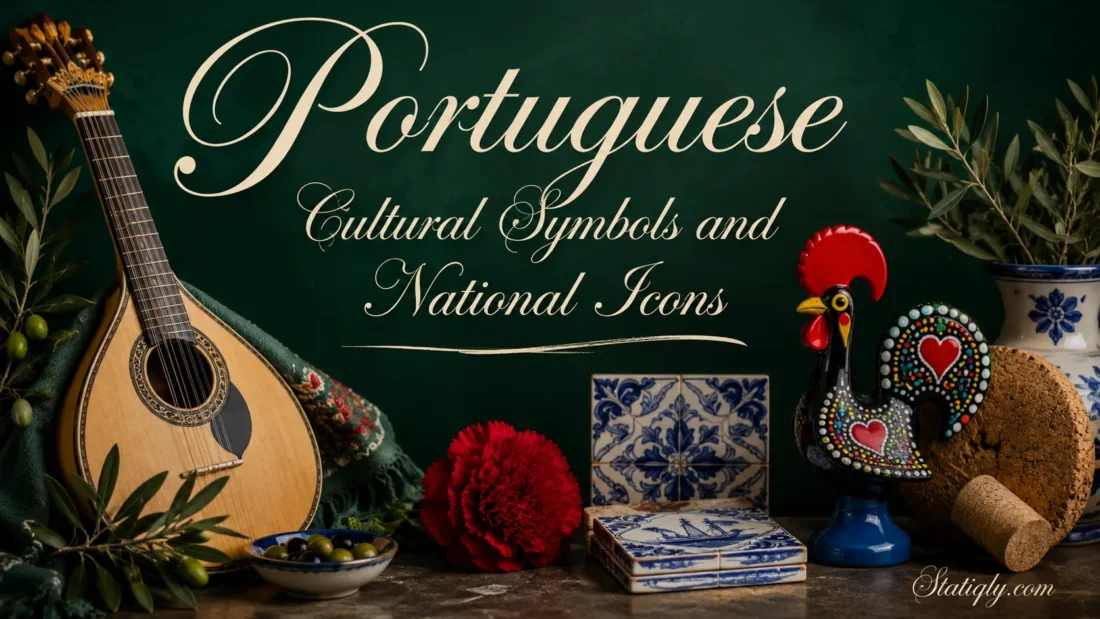
Portugal is easy to recognize, even before a map appears. A tiled wall, a black-and-white pavement, a guitar shaped like a pear, a painted rooster, a cork tree, a small custard tart, a red-and-green flag in the wind — each one says something about Portuguese life. These are not empty decorations. They are signs of craft, memory, language, music, sea travel, local pride, and everyday beauty. Some are official national symbols. Others live in streets, homes, markets, cafés, festivals, and family stories.
Portuguese cultural symbols often feel modest at first. Look closer, though, and they work like tiny doors. One opens to music. Another opens to tile art. Another to nature. Another to the Portuguese language, spoken far beyond Portugal itself. That is why the national icons of Portugal are best understood together, not as a simple list.
Portuguese Cultural Symbols In Everyday Life
| Symbol Or Icon | What It Represents | Where Visitors Often Notice It |
|---|---|---|
| National Flag | State identity, national colors, and historic heraldry | Public buildings, schools, official events, sports matches |
| Coat Of Arms | The shield, castles, and armillary sphere used in official emblems | Flag, passports, public documents, government signs |
| Fado | Voice, poetry, memory, and the feeling of saudade | Lisbon, Coimbra, cultural venues, recorded music |
| Azulejos | Tile art, architecture, pattern, storytelling, and craft | Churches, train stations, homes, palaces, streets |
| Galo De Barcelos | Folk art, fairness, luck, and colorful local tradition | Souvenir shops, ceramics, kitchens, decorative objects |
| Cork Oak | Nature, rural work, renewable material, and landscape | Alentejo, Algarve, cork products, nature displays |
| Portuguese Pavement | Urban craft and public design made with stone patterns | Squares, sidewalks, old town centers, seaside promenades |
| Pastel De Nata | Pastry craft, café culture, and shared daily pleasure | Pastry shops, bakeries, breakfast counters, cafés |
Official Symbols Of Portugal
Portugal has symbols that belong to official state use and symbols that belong to cultural life. The official ones appear on flags, public documents, ceremonies, and formal settings. They carry fixed designs and names. They are also the first symbols many people learn when they begin to study the country.
The National Flag
The Portuguese national flag uses green and red fields, with the national coat of arms placed over the line where the two colors meet. The design is instantly recognizable: bold, simple from far away, detailed up close. That contrast matters. From a distance, it works as a national marker. Up close, it tells a more layered story through the shield and the armillary sphere.
The current flag design dates to the early twentieth century. Its visual center is not only a shield. It also includes the armillary sphere, an old astronomical and navigation instrument that became closely tied to Portuguese maritime history. On the flag, it feels like a golden compass behind the shield. Small object, large meaning.
- Green and red form the main color fields.
- The shield sits in the center area of the flag.
- The armillary sphere appears behind the shield.
- The full design links state identity with older visual traditions.
The Coat Of Arms
The coat of arms of Portugal is one of the country’s most familiar official emblems. It shows a shield with smaller blue shields and castles, placed over the armillary sphere. Many people first notice it on the national flag, but it also appears in formal settings where the state needs a clear emblem.
It rewards a slower look. The shield gives the emblem a heraldic shape. The castles add a repeated border motif. The armillary sphere adds motion, science, navigation, and distance. Together, they make the emblem feel both official and deeply Portuguese.
The National Anthem
Portugal’s national anthem is A Portuguesa. It is heard at official ceremonies, international sports events, and formal national moments. Like many anthems, it gives sound to identity. It turns a public gathering into a shared moment, even when people simply stand and listen.
For visitors, the anthem may be less visible than the flag, but it carries the same purpose: it marks Portugal as a nation with its own voice, rhythm, and public memory.
Portugal Day
Portugal Day is observed on 10 June. Its official name honors Portugal, Luís de Camões, and Portuguese communities. Camões, the poet linked with Os Lusíadas, remains one of the country’s best-known literary figures. Through him, the date connects language, literature, and national identity.
The day also points beyond borders. Portuguese communities live in many parts of the world, and the celebration reflects that wider cultural family. One country, many homes for its language and customs.
Fado, Saudade and The Portuguese Voice
Fado may be Portugal’s most famous musical symbol. It blends song, poetry, and guitar in a style closely linked with Lisbon, while Coimbra has its own fado tradition. The mood often turns around saudade, a Portuguese word that suggests longing, memory, affection, and absence all at once. One word carries a roomful of feeling.
A typical fado setting feels intimate. A singer stands near the musicians. The Portuguese guitar adds a bright, trembling sound. The room listens. No need for grand staging. The voice does most of the work.
Why Fado Became A Cultural Icon
- It uses the Portuguese language with strong emotional detail.
- It connects music with poetry rather than simple entertainment.
- It belongs to neighborhoods, cafés, stages, and family memory.
- It gives visitors a direct way to hear Portuguese feeling, even without knowing every word.
Fado does not need to shout. It pulls the listener closer. That is part of its charm.
Azulejos and The Art Of Telling Stories On Walls
Azulejos are glazed ceramic tiles used across Portugal on walls, churches, palaces, train stations, houses, fountains, and public spaces. The word is linked to the Arabic al-zuleique, a term connected with smooth decorative stone. In Portugal, tile art developed into one of the country’s most recognizable forms of design.
Azulejos can be blue and white, bright and patterned, geometric, floral, religious, scenic, or modern. They may cover a whole wall or appear as a small panel near a doorway. Some tell stories. Some cool a building. Some make a plain street corner feel cared for. Tile by tile, they turn architecture into a public notebook.
Common Azulejo Themes
- Geometric patterns that repeat across walls and floors.
- Blue-and-white panels often linked with classic Portuguese tile style.
- Scenes of daily life, including markets, boats, gardens, and streets.
- Religious and historic scenes in churches, monasteries, and older buildings.
- Modern tile art in metro stations, hotels, homes, and public buildings.
What makes azulejos special is not only age. It is use. Portugal did not hide tile art behind museum glass. It placed it where people live, wait, walk, pray, work, and travel.
Galo De Barcelos and The Friendly Face Of Folk Art
The Galo de Barcelos, or Rooster of Barcelos, is one of the most familiar Portuguese folk symbols. Bright colors, a proud shape, dotted details, and a cheerful posture make it easy to remember. It appears on ceramics, magnets, textiles, kitchen pieces, and decorative objects.
The rooster comes from a folk tale linked with fairness and a surprising sign. Today, most people meet it as a symbol of good luck, local craft, and Portuguese warmth. It is not an official state emblem, yet it travels almost as far as the flag. Small enough to fit in a suitcase, strong enough to stand for a whole country.
What The Rooster Symbol Often Means
- Good fortune in everyday use and souvenir culture.
- Folk storytelling from northern Portugal.
- Hand-painted craft through color, pattern, and ceramic work.
- Friendly identity that feels informal and easy to recognize.
Cork Oak, Nature and Rural Skill
The cork oak is Portugal’s national tree. It is especially connected with landscapes in areas such as Alentejo and Algarve, where cork oak woodlands shape the countryside. The tree is valued because its bark can be harvested without cutting the tree down. Over time, the bark grows again.
This makes cork more than a material. It is a symbol of patience. A cork oak grows slowly, and cork work follows the rhythm of the tree. In a fast world, that feels almost old-fashioned. In the best sense.
Why Cork Feels So Portuguese
- It links natural landscape with skilled rural work.
- It appears in everyday objects, from stoppers to bags and home goods.
- It reflects a renewable material tradition.
- It gives Portugal a clear natural icon beyond beaches and cities.
Portuguese Language As A Living National Icon
The Portuguese language is an official language of Portugal and connects communities across several continents. For Portugal itself, the language is more than a tool for speech. It carries literature, songs, family names, place names, jokes, recipes, prayers, street signs, and daily greetings.
Visitors may notice the soft rhythm of European Portuguese in cafés, trains, shops, and old neighborhoods. Written Portuguese also gives many symbols their proper names: fado, azulejo, saudade, calçada, galo. Translate them too quickly and something slips away.
Portuguese Words That Open Cultural Doors
| Portuguese Word | Simple Meaning | Cultural Use |
|---|---|---|
| Saudade | Longing, memory, emotional absence | Often linked with fado and poetry |
| Azulejo | Decorative tile | Architecture, art, public design |
| Fado | A Portuguese song tradition | Music, poetry, voice, identity |
| Calçada | Pavement or paved street | Black-and-white stone sidewalks |
| Galo | Rooster | Folk art and Barcelos tradition |
Calçada Portuguesa and The Beauty Underfoot
Calçada portuguesa is the patterned stone pavement seen in many Portuguese towns and cities. It often uses small black and white stones arranged in waves, flowers, geometric shapes, or local designs. In Lisbon, these pavements can make a simple walk feel like moving across a handmade carpet of stone.
The craft takes planning and skill. Stones must be placed one by one, and the pattern only makes sense when many small pieces work together. That is why Portuguese pavement feels like a good metaphor for the country’s cultural symbols: many small details, one clear identity.
- Wave patterns often appear near coastal or central spaces.
- Black-and-white contrast makes the designs easy to see.
- Public squares often show larger and more detailed patterns.
- Local variation gives each town its own visual touch.
Food Icons Of Portugal Without The Noise
Food symbols in Portugal are practical, loved, and easy to find. They are not always official, and they do not need to be. A food icon earns its place when people keep returning to it. Again and again.
Pastel De Nata
The pastel de nata is a small custard tart with crisp pastry and a warm, creamy center. It is often eaten with coffee, as a snack, or as a sweet pause during the day. Its size helps its fame. It is simple, portable, and easy to love.
Bacalhau
Bacalhau, or salted cod, is one of Portugal’s best-known food traditions. It appears in many home recipes and restaurant dishes. The exact recipe changes by region, household, and occasion. That variety is part of the appeal.
Olive Oil, Bread and Soup
Many Portuguese tables also make room for olive oil, bread, soups, grilled fish, rice dishes, beans, herbs, and seasonal produce. These foods speak softly, but they say a lot about local rhythm. Meals are not only about flavor. They are about habit, place, and company.
Architecture, Maritime Motifs and The Armillary Sphere
Portugal’s buildings often carry symbols in stone, tile, metal, and wood. One of the most recognizable is the armillary sphere. It appears on the national flag and in older decorative programs, especially those linked with navigation, measurement, and maritime travel.
Visitors may also see carved ropes, shells, plants, crosses, spheres, and sea-inspired details on older buildings. These motifs do not need long explanation on the street. They simply sit there, carved into doorways and windows, reminding the passerby that Portugal has long looked toward the Atlantic.
Places Where Symbols Often Appear
- Historic train stations, especially those with tile panels.
- Town squares with patterned pavement.
- Churches and monasteries with tile, stone, and wood detail.
- Markets and craft shops selling ceramics, cork, and textiles.
- Old neighborhoods where signs, balconies, tiles, and pavements meet.
Regional Icons That Add Local Color
Portugal is compact, but its regional symbols vary a lot. The north, center, south, islands, coast, and inland areas each bring their own materials, foods, crafts, and visual signs. A symbol may be national in feeling yet local in origin.
| Region Or Place | Cultural Symbol | Why It Matters |
|---|---|---|
| Barcelos | Galo de Barcelos | A folk icon tied to ceramics and colorful craft |
| Lisbon | Fado, azulejos, calçada | Music, tile art, and pavement patterns meet in daily streets |
| Coimbra | Coimbra fado | A local form of fado linked with academic tradition |
| Alentejo | Cork oak landscapes | Tree, material, countryside, and rural skill come together |
| Madeira | Embroidery and floral identity | Island craft and garden culture shape local recognition |
| Azores | Volcanic landscapes and hydrangeas | Island nature gives the region a strong visual identity |
How To Notice Portuguese Symbols While Traveling
Portuguese symbols are not hard to find. The trick is to slow down. Look at the wall beside a doorway. Look at the pavement under your feet. Listen when a song begins in a small room. Read the names on tiles, cafés, and station signs. Portugal often speaks through surfaces and sound.
- Start with the flag and notice the shield and armillary sphere.
- Look for azulejos on public buildings, stations, churches, and houses.
- Listen for fado in Lisbon or Coimbra, especially in smaller venues.
- Walk slowly across calçada portuguesa and notice the stone patterns.
- Visit local craft shops for cork, ceramics, embroidery, and rooster designs.
- Try traditional pastries and simple local dishes in everyday cafés and bakeries.
- Learn a few Portuguese words, because some symbols make more sense in their own language.
A symbol does not always announce itself. Sometimes it waits on a wall, under a shoe, beside a coffee cup.
Common Mistakes About Portuguese National Icons
Thinking Every Famous Icon Is Official
Not every famous Portuguese icon is an official state symbol. The flag, coat of arms, anthem, and Portugal Day have formal national status. Fado, azulejos, cork, the Barcelos rooster, and pastel de nata are cultural icons. They may feel national, but they work through daily life, craft, and public recognition.
Reducing Fado To One Mood
Fado is often linked with longing, but it is not only one feeling. It can carry memory, affection, irony, tenderness, pride, and personal storytelling. The best way to understand it is to hear it, not define it too tightly.
Seeing Azulejos Only As Decoration
Azulejos are beautiful, yes. They are also practical and cultural. They protect walls, brighten interiors, record scenes, mark sacred spaces, and shape the look of streets. Decoration is only the first layer.
Treating Portugal As One Visual Style
Portugal has many regional looks. Northern ceramics, Lisbon pavements, Alentejo cork landscapes, island crafts, coastal symbols, and inland traditions all add texture. The country’s icons do not erase local identity. They collect it.
Questions People Ask About Portuguese Symbols
What Is The Most Recognizable Symbol Of Portugal?
The national flag is the most official and widely recognized symbol. In cultural life, the Barcelos rooster, azulejos, fado, and cork products are also strongly linked with Portugal.
Is The Rooster Of Barcelos An Official National Symbol?
The Rooster of Barcelos is best understood as a popular folk symbol rather than an official state emblem. It still represents Portugal widely because people recognize it through craft, travel, and souvenir culture.
Why Are Tiles So Common In Portugal?
Tiles became part of Portuguese architecture over many centuries. They add beauty, protect surfaces, help shape interiors, and turn buildings into visual stories. Their public use is one reason they feel so closely tied to Portugal.
What Does Saudade Mean In Portuguese Culture?
Saudade suggests longing, memory, affection, and emotional distance. It is often linked with fado, but the word also appears in daily speech, literature, music, and personal feeling.
What Is Portugal’s National Tree?
Portugal’s national tree is the cork oak. It is valued for its landscape role, its renewable bark, and its close link with rural work and cork products.
What Food Is Most Linked With Portugal?
Several foods are closely linked with Portugal, including pastel de nata, bacalhau, olive oil, bread, soups, grilled fish, and regional pastries. No single dish can explain the whole country, and that is part of the pleasure.