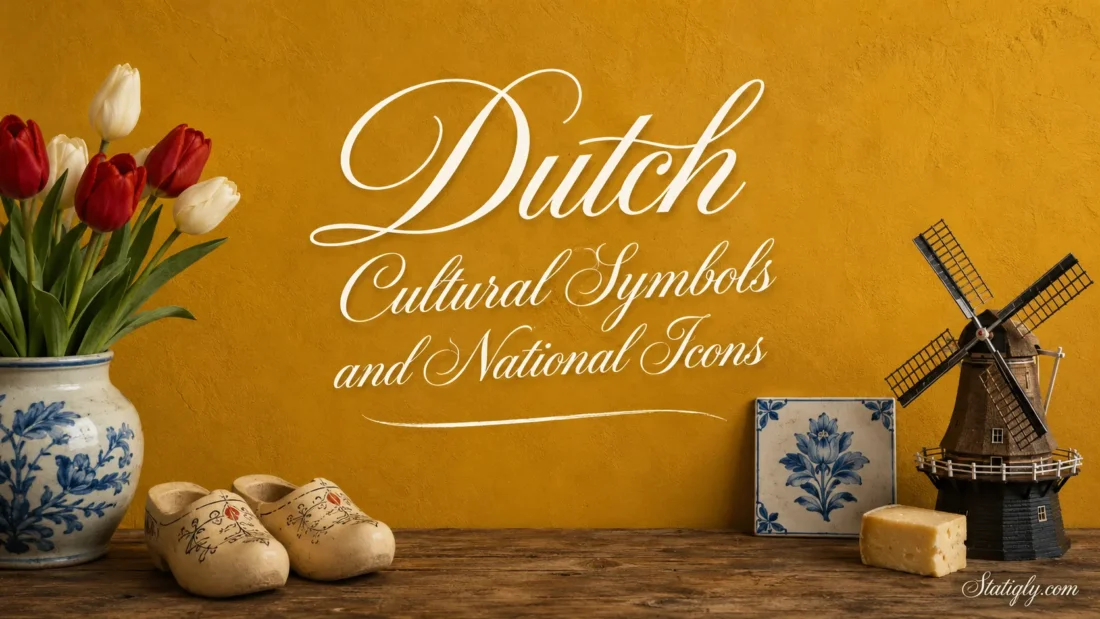
Few countries have a visual identity as easy to recognize as the Netherlands. Windmills, tulips, bicycles, canals, orange clothing, Delftware, and wooden shoes appear on everything from public celebrations to traditional crafts. Yet these symbols do not all have the same status. Some are official national emblems, while others grew from the landscape, local work, art, food, and daily habits.
Dutch cultural symbols tell a practical story. Windmills moved water and powered workshops. Wooden shoes protected feet during outdoor work. Canals supported transport and shaped cities. Even the bicycle became an icon because it remains part of ordinary life rather than a museum piece.
| Symbol | Category | Main Meaning | Common Setting |
|---|---|---|---|
| Red, White, and Blue Flag | Official symbol | Dutch national identity | Public buildings and national occasions |
| Orange | Customary national color | Shared celebration and national support | Festivals and sporting events |
| Dutch Lion | Heraldic emblem | Unity and national representation | Coat of arms and public emblems |
| Wilhelmus | Official national anthem | Ceremonial identity | National and international events |
| Windmill | Landscape and engineering icon | Water management and industry | Polders, heritage sites, and museums |
| Tulip | Horticultural icon | Flower cultivation and seasonal color | Bulb fields, gardens, and flower markets |
| Bicycle | Living cultural icon | Everyday mobility | Streets, stations, and cycle routes |
| Delftware | Craft icon | Dutch ceramic design | Pottery, tiles, and museum collections |
| Klompen | Folk craft | Practical rural heritage | Craft workshops and cultural events |
| Gouda and Edam Cheese | Food icon | Dairy production and market tradition | Cheese shops and historic markets |
| Canal Houses | Architectural icon | Urban planning and waterside life | Amsterdam and other historic cities |
| Dutch Masters | Artistic icon | Painting and visual culture | Museums and cultural institutions |
Official Dutch Symbols and Their Meaning
The Dutch Flag: Red, White, and Blue
The national flag consists of three equal horizontal bands: red at the top, white in the middle, and blue at the bottom. The first known reference to an earlier Dutch flag dates to 1572. That version used orange, white, and blue and became known as the Prince’s Flag. Red gradually replaced orange during the seventeenth century.
The present tricolor is the clearest official visual symbol of the Netherlands. It appears at public buildings, sporting events, commemorations, and national celebrations. An orange pennant may accompany it on selected royal occasions, but orange is not one of the three colors on the flag itself.
Orange: The Color That Is Not on the Flag
Why does a country with a red, white, and blue flag turn orange during major celebrations? The connection comes from the House of Orange-Nassau. Over time, orange developed into the customary national color.
Its modern use reaches far beyond formal ceremonies. People wear orange during King’s Day, international sporting events, concerts, and community celebrations. Streets, shop windows, and public spaces may also carry orange decorations. Bright and unmistakable, the color works as a shared cultural signal.
The Dutch Lion in Heraldry
A golden lion appears on the coat of arms of the Kingdom of the Netherlands. The current royal coat of arms has used its familiar form since 1907, with the lion standing against a blue field decorated with small golden rectangles.
The lion also appears in less formal settings, especially in national sporting imagery. These popular versions should not be confused with the precisely defined official coat of arms. Still, both uses have made the Dutch lion one of the country’s most familiar national icons.
The Wilhelmus as a Musical Symbol
Wilhelmus van Nassouwe, usually called the Wilhelmus, has served as the official Dutch national anthem since 1932. It contains 15 verses, although only the first verse is normally sung. On some occasions, the sixth follows it.
The song belongs mainly to ceremonial life. It is heard at national observances, formal events, and international sports competitions. Its melody and opening words are widely recognized even by people who do not know every verse.
Icons Formed by Land and Water
Windmills: Working Machines Before Monuments
The Dutch windmill began as a machine. Different mills drained low-lying land, ground grain, sawed timber, made paper, and prepared pigments. Their sails captured wind energy, while gears inside transferred that movement to pumps or workshop equipment.
The earliest recorded windmill in the Netherlands dates to 1221. Polder mills designed to move water appeared later and became closely linked with Dutch land management. More than 1,200 historic windmills remain across the country, and many can still operate.
Kinderdijk offers the best-known group. Its historic water-management landscape includes 19 drainage windmills, along with channels, dikes, sluices, reservoirs, and pumping stations. The site shows why the windmill means more than picturesque scenery. It represents applied engineering.
- Polder mills moved water from low land into higher channels.
- Grain mills turned millstones used in flour production.
- Sawmills powered mechanical saws for processing timber.
- Industrial mills supported paper, oil, pigment, and other forms of production.
Canals, Dikes, and Polders
Water itself is one of the strongest Dutch cultural symbols. Canals pass through cities, drainage channels cross farmland, and dikes form long lines across the landscape. A polder is low-lying land managed through dikes and controlled drainage. Together, these features show how water management influenced settlement, farming, transport, and town planning.
Amsterdam’s seventeenth-century canal ring was laid out in broad concentric arcs as the city expanded. The project created new building land while supporting transport and drainage. Rows of narrow houses, bridges, trees, and waterways later formed one of the most recognizable city views in Europe.
Canals are not unique to Amsterdam. Utrecht, Leiden, Delft, Haarlem, Gouda, and many smaller towns have their own waterside character. Different in detail, familiar in rhythm.
The Bicycle as Everyday Dutch Culture
Visible at schools, workplaces, shops, railway stations, and family homes, the bicycle is a living Dutch icon. It is practical transport used for short daily journeys as well as recreation.
In 2023, bicycles accounted for 27 percent of all journeys made by residents of the Netherlands. A resident aged six or older cycled an average of 266 times and covered 1,065 kilometers during that year. These numbers explain why the bicycle represents more than a travel preference. It shapes street design, parking areas, station access, and the pace of daily life.
Traditional upright city bicycles remain common, while cargo bikes, children’s bicycles, and electric models add new forms to the same culture. The design changes. The habit stays.
Tulips and the Dutch Flower Identity
Why Tulips Became Dutch Symbols
Tulips did not originate in the Netherlands. Their wild ancestors come from parts of Central Asia, and cultivated varieties reached Western Europe through wider botanical and trading networks. The Dutch connection developed through careful study, breeding, cultivation, and commerce.
Botanist Carolus Clusius arrived in Leiden in 1593 with a large plant collection that included tulip bulbs. He cultivated tulips at the city’s botanical garden, the Hortus botanicus Leiden. His work helped establish the knowledge later used by the Dutch flower-bulb industry.
Today, bands of red, yellow, pink, white, and purple flowers create one of the country’s best-known seasonal landscapes. The sight is real, but temporary. Outdoor tulip fields bloom during a limited part of spring, and growers may remove flower heads so the bulbs can develop well.
- Tulips represent Dutch bulb cultivation and spring color.
- Flower markets connect the symbol with trade and urban life.
- Botanical gardens preserve the scientific side of Dutch plant history.
- Bulb-growing regions turn horticulture into a visible part of the landscape.
Delftware, Wooden Shoes, and Cheese
Delft Blue and Dutch Ceramic Craft
Delftware is tin-glazed earthenware associated especially with the city of Delft. Dutch workshops expanded production during the seventeenth century, responding to demand for fine ceramics and drawing inspiration from imported Asian porcelain.
The familiar blue decoration appears on plates, jars, vases, tiles, and ornamental objects. Painters built images with dark outlines and lighter blue shading beneath a smooth glaze. Floral designs, landscapes, ships, animals, and scenes from daily life all became common subjects.
Not every Delftware object is blue and white. Historic workshops also made multicolored pieces, and Delftware is generally earthenware rather than porcelain. That distinction matters. Its identity comes from the clay body, glaze, firing process, and painted decoration working together.
Klompen: Wooden Shoes with a Practical Past
Klompen is the Dutch word for traditional wooden shoes. Their hard outer form offered useful protection during agricultural, fishing, and workshop tasks. Wood was also widely available and could be shaped by local craftspeople.
Shapes and painted decoration varied between communities. Some pairs remained plain work shoes, while others received carved patterns or bright colors. Decorated examples later became popular cultural objects.
Most people in Dutch cities do not wear wooden shoes as ordinary footwear. Klompen now appear more often in craft demonstrations, museums, traditional dress, gardens, and ceremonial settings. Their cultural value rests on the work they once supported and the carving knowledge preserved by makers.
Gouda, Edam, and the Image of Dutch Cheese
Large cheese wheels, wooden carrying frames, and open market squares form another familiar Dutch image. Gouda and Edam are both Dutch place names that became attached to widely produced cheese styles.
Gouda developed as an important cheese-trading center rather than the sole place where all Gouda cheese was made. Farmers and traders brought their products to market, where buyers judged and weighed them. Edam gained a similar connection with dairy trade and export.
Historic cheese markets now preserve parts of that visual tradition. The products themselves remain part of daily food culture, with differences in age, texture, milk, seasoning, and production method. One name can cover many tastes.
Architecture and Art as Cultural Icons
Canal Houses and Gabled Facades
Dutch canal houses often occupy narrow plots and extend far behind their street facades. Their vertical shape, tall windows, brick walls, and decorative rooflines create a strong architectural identity.
Several gable forms appear in historic cities:
- Stepped gables rise in a stair-like outline.
- Neck gables have a narrower upper section framed by decorative curves.
- Bell gables use a rounded form resembling a bell.
- Cornice gables finish with a horizontal classical edge.
Many canal houses also have projecting beams or hooks near the roof. These helped lift goods toward upper floors, which was useful in tall buildings with narrow stairways. Architecture here followed the needs of waterside trade and compact urban land.
Dutch Masters and Visual Memory
Painting forms another part of Dutch national identity. Works by artists such as Rembrandt van Rijn, Johannes Vermeer, Frans Hals, and Judith Leyster shaped how later audiences pictured Dutch interiors, city residents, landscapes, and group portraits.
The subjects were often close to lived experience: a quiet room, a face caught in changing light, a household object, or a broad cloudy sky. This attention to material, light, and observation remains closely associated with Dutch art.
Modern museums keep this visual heritage active through research, conservation, and changing displays. The paintings are historic objects, yet they continue to influence photography, design, film, and popular ideas about the Netherlands.
Living Traditions and Shared Color
National symbols become most visible when people use them together. During King’s Day, orange clothes, street decorations, music, and open-air markets transform towns and cities. Sporting events produce a similar sea of orange, sometimes paired with lion imagery and the Dutch tricolor.
These occasions show how an old color can gain a fresh social role. Orange may appear on a hat, scarf, bicycle, shop window, or homemade banner. No single design controls it. Recognition comes from repetition.
How National Symbols Change by Region
The Netherlands has strong regional identities, so national symbols never tell the whole cultural story. Friesland has its own language, flag motifs, sailing traditions, and ice-skating heritage. Zeeland is closely associated with the sea, dikes, and distinctive regional dress. Drenthe is known for its prehistoric hunebedden, while Limburg and North Brabant have their own local festivals and architectural character.
Traditional clothing also varies by town and region. The recognizable costumes linked with places such as Volendam and Marken should not be treated as a single national uniform. They belong to particular communities and historical settings.
The same principle applies to crafts, dialects, foods, and building styles. Dutch culture is national in some moments and strongly local in others.
How to Read Dutch Symbols Without Stereotypes
A cultural icon is a form of visual shorthand. It can introduce a country, but it cannot describe every resident or region. Windmills remain part of the landscape, yet modern pumping stations now perform much of the drainage work. Wooden shoes preserve a craft tradition, but they are not standard city footwear. Tulips are strongly Dutch in cultivation and trade, though the plant came from elsewhere.
The most revealing symbols are often those still connected with ordinary life. Bicycles continue to carry people to school and work. Canals still organize streets and neighborhoods. Cheese remains an everyday food as well as a market image. These icons have not been frozen in time. They keep finding practical uses.
Common Questions About Dutch Cultural Symbols
What Is the Main National Symbol of the Netherlands?
The red, white, and blue national flag is the clearest official visual symbol. Orange serves as the customary national color, while the lion appears in official heraldry and popular national imagery.
Why Is Orange Associated with the Netherlands?
Orange is linked with the House of Orange-Nassau. It developed into a shared national color and now appears widely during celebrations and international sporting events.
Is Holland the Same as the Netherlands?
Not exactly. The Netherlands is the country. North Holland and South Holland are two of its 12 provinces. People often use “Holland” informally for the whole country, especially in travel and sporting contexts.
Are Tulips Native to the Netherlands?
No. Tulips have botanical origins in Central Asia. Dutch growers developed a close relationship with the flower through cultivation, breeding, bulb production, research, and trade.
Are Dutch Windmills Still Working?
Many historic windmills can still operate, although their roles differ. Some continue to mill grain or assist with water management. Others function as protected heritage sites, museums, homes, or educational workshops.
Is Delft Blue a Type of Porcelain?
Historic Delftware is mainly tin-glazed earthenware, not porcelain. Its makers used glaze and painted decoration to create a smooth, bright surface that could resemble imported porcelain.
Do Dutch People Still Wear Wooden Shoes?
Wooden shoes are uncommon as everyday urban footwear. They remain visible in craft workshops, traditional events, museums, gardens, and a small number of practical rural settings.