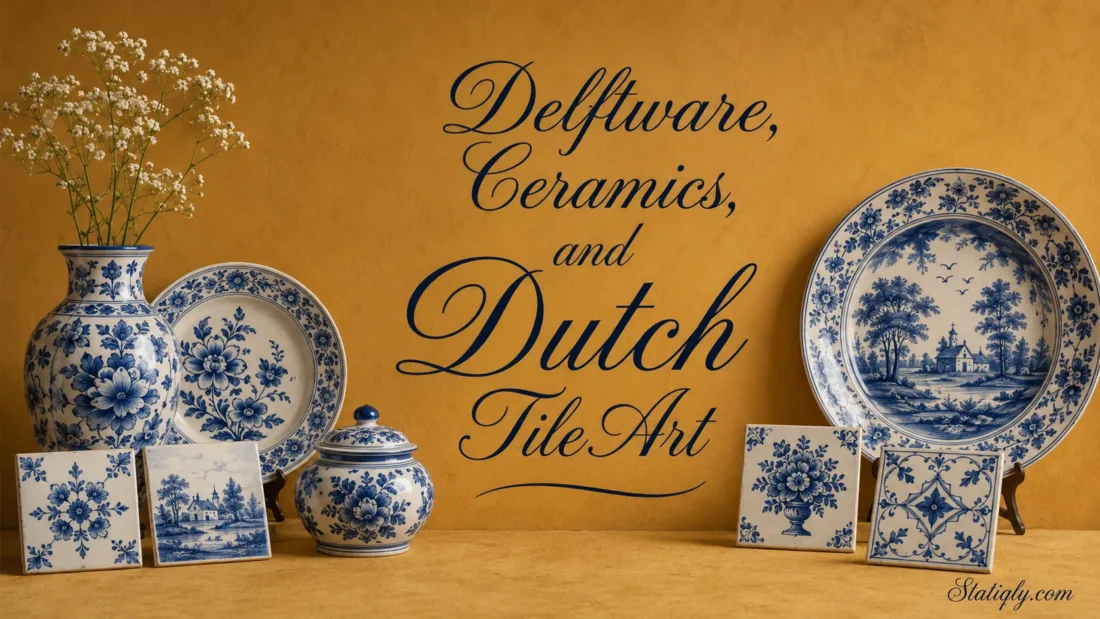
Delftware is one of the most recognizable forms of Dutch decorative art. Its clear white surface, flowing blue brushwork, and familiar scenes appear on plates, vases, tiles, plaques, and elaborate flower holders. Yet Delftware is more varied than its blue-and-white image suggests. Dutch workshops also produced pieces in yellow, green, red, purple, and manganese tones. Some objects were practical. Others were made purely to decorate a room or display skilled ceramic painting.
The name can also cause confusion. Delftware is not porcelain, and not every object called Delftware came from Delft. Understanding the material, production method, and visual language makes these ceramics much easier to identify and appreciate.
What Delftware Actually Means
Delftware is a type of tin-glazed earthenware. Makers formed an object from clay and fired it to create a porous ceramic body. They then covered the surface with an opaque white glaze containing tin oxide. This white layer concealed the clay beneath it and gave painters a bright surface for decoration.
In Dutch, Delft pottery is commonly called Delfts aardewerk. The famous blue-and-white variety is known as Delfts blauw, or Delft Blue. The term “Delftware” may also describe related tin-glazed pottery made elsewhere in the Netherlands and, in some English-language collections, similar ware produced in Britain.
| Term | Material or Meaning | How to Recognize It |
|---|---|---|
| Ceramics | The broad family of objects made from clay and hardened by firing | Includes earthenware, stoneware, and porcelain |
| Earthenware | Porous fired clay that usually needs glaze to hold liquids | Often thicker and softer than porcelain |
| Stoneware | Dense ceramic fired at a higher temperature than most earthenware | Hard body with low porosity |
| Porcelain | A refined ceramic body made with materials such as kaolin | Usually hard, white, thin, and sometimes translucent |
| Delftware | Tin-glazed earthenware associated with Dutch production | Opaque white glaze with painted decoration |
| Delft Blue | Blue-and-white Delftware | Cobalt-blue painting on a white glazed ground |
| Dutch Tile | A Dutch-made ceramic tile, often tin-glazed | Usually square, with a central scene and small corner motifs |
The material distinction matters. A Delft plate may resemble blue-and-white porcelain from a distance, but its clay body, glaze, weight, and firing method tell a different story.
How Delft Became a Ceramic Center
Tin-glazed pottery was already known in parts of Europe before Delft became closely linked with it. Italian maiolica techniques influenced workshops in Antwerp and other ceramic centers. By the late sixteenth and early seventeenth centuries, lighter wall tiles and decorated household pottery were being produced across the northern Netherlands.
Imported Chinese porcelain then attracted strong interest in Dutch homes. It was white, refined, and often decorated in cobalt blue. Dutch potters could not make the same porcelain body with their available materials, so they developed a convincing local response: earthenware hidden beneath an opaque white glaze.
The result was not simply a copy. Painters adapted imported shapes and decorative ideas while adding Dutch flowers, landscapes, animals, household scenes, and architectural details. Over time, the pottery gained its own visual identity.
Delft’s Period of Ceramic Growth
Delft developed into a leading production center during the seventeenth century. The city offered experienced painters, pottery knowledge, commercial connections, and suitable working spaces. More than 30 potteries operated there around the industry’s height near 1700.
Many workshops used distinctive names and symbols. Historical factories included De Grieksche A, De Metaale Pot, De Witte Starre, and De Porceleyne Fles. Their painters created ordinary dishes as well as large display pieces that demanded careful modeling and decoration.
The Revival of Delft Pottery
Changing tastes and the growth of porcelain and creamware production altered the ceramic market during the eighteenth and nineteenth centuries. Many Delft workshops closed, while surviving makers adjusted their methods and designs.
Founded in 1653, De Porceleyne Fles later became known as Royal Delft. By the nineteenth century it was the last surviving Delft pottery with roots in the seventeenth-century industry. Its late nineteenth-century revival combined historical decoration with new materials, forms, and artistic styles. Royal Delft continues to make hand-painted ceramics in Delft.
How Delftware Is Made
Delftware production joins several trades: clay preparation, forming, firing, glazing, drawing, and brush painting. Historical recipes differed between factories, and present-day makers do not all follow one identical process. Still, the main stages explain the character of the finished object.
- The clay body is formed. Potters shape pieces on a wheel, press or cast them in molds, or assemble several molded sections.
- The object dries. Moisture must leave the clay gradually so the form remains stable.
- The first firing creates the biscuit body. The clay becomes hard but may remain porous.
- A white surface is prepared. Historical Delftware commonly received an opaque tin glaze. Some present-day production uses a prepared ceramic body, engobe, and later glaze according to the factory’s own method.
- The design is transferred or drawn. Charcoal outlines, pierced paper patterns, or freehand drawing can establish the composition.
- The decoration is painted. Cobalt supplies the familiar blue. Other mineral pigments produce additional colors.
- The piece is fired again. Heat develops the final color and fuses the decoration with the glazed surface.
Why Cobalt Produces So Many Blues
Traditional Delft Blue painters work with a cobalt-based mixture that can look dark or almost black before firing. In the kiln, chemical reactions bring out the blue. The amount of pigment, the painter’s brush pressure, the water in the mixture, the glaze, and the firing conditions all affect the final tone.
One pigment can therefore create pale washes, soft shadows, firm outlines, and deep blue accents. This range gives hand-painted Delftware much of its depth. Look closely and the brush often moves like ink across paper: broad in leaves, thin around faces, and broken into dots for texture.
Hand Painting and Transfer Decoration
Not every decorated Delft-style object is painted entirely by hand. Transfer techniques allow a prepared design to be repeated across many pieces. Modern screen-printed transfers can also reproduce several shades of blue.
Hand-painted work usually shows natural variation. Lines may change in thickness, repeated leaves may differ slightly, and blue washes may vary in density. Transfer decoration often has more regular outlines and repeated details. Neither method alone determines artistic or practical value; it identifies how the decoration was applied.
Dutch Tile Art and Its Visual Language
Dutch tile art belongs to the wider story of tin-glazed ceramics, but it developed its own format. A typical tile presents one central subject against a white ground. Small ornaments fill the corners, helping separate one scene from the next when tiles are placed together.
Many surviving seventeenth-century tiles measure roughly 13 centimeters, or about 5 inches, across. Size varied by workshop and period, so dimensions should support identification rather than settle it.
From Patterned Floors to Painted Walls
Earlier European ceramic tiles often carried dense, multicolored patterns spread over several units. Dutch makers gradually produced thinner tiles with more open decoration. The fragile glazed face suited walls better than heavily used floors.
Tiles appeared around fireplaces, along lower walls, beside passageways, and in rooms exposed to moisture or soot. Their glazed surfaces were practical to clean, while the painted scenes added rhythm and character to otherwise plain interiors.
How Repeated Tile Designs Were Transferred
Tile painters could repeat a design through a method known as pouncing. A drawing was made on paper and its outlines were pierced with tiny holes. The paper was placed over the prepared tile, then charcoal dust was tapped through the holes. The painter followed the dotted outline with a brush.
This method kept the basic subject consistent without removing the painter’s touch. Two tiles made from the same pattern may still show different lines, shading, and facial details.
Individual Tiles and Tile Panels
An individual tile usually contains a complete miniature image. A tile panel works differently: several tiles join to form one larger composition. Lines, buildings, plants, and figures continue across the joints.
Complete panels require careful planning. The painter must consider both the full image and the grid that divides it. Slight changes between tiles are normal because each unit was formed, glazed, painted, and fired as a separate ceramic object.
| Decorative Theme | Typical Features | Where It Often Appears |
|---|---|---|
| Flowers and Foliage | Tulips, leaves, flowering branches, and arranged bouquets | Tiles, dishes, jars, and vases |
| Landscapes | Low horizons, buildings, bridges, trees, and waterways | Tiles, plaques, plates, and large panels |
| Animals and Birds | Single animals, birds among plants, and decorative creatures | Individual tiles, dishes, and ornamental objects |
| Daily Activities | Work, travel, games, and household moments | Small narrative tiles and tile series |
| Geometric Ornament | Borders, medallions, scrolls, and repeating corner designs | Tile arrangements and vessel borders |
| Maritime Scenes | Boats, sails, shorelines, and open water | Tiles, plaques, bowls, and chargers |
More Than Blue and White
Blue became Delftware’s best-known color because cobalt remained clear and expressive during firing. Yet historical Dutch pottery was never limited to one palette.
- Polychrome Delftware combines several colors, often including blue, green, yellow, red, and purple-brown.
- Manganese decoration creates purple, brown, or nearly black lines and washes.
- Colored-ground pieces reverse the familiar arrangement by placing lighter decoration against a darker field.
- Imari-inspired decoration uses dense combinations of blue, red, and gold-like accents influenced by imported Japanese porcelain.
- New Delft pottery from the late nineteenth and early twentieth centuries includes Art Nouveau forms, modeled surfaces, and experimental glazes.
Color can help date and classify an object, but palette alone is not enough. Similar combinations returned during later revivals and continue to appear in present-day ceramics.
Forms Made by Delft Potteries
Delft workshops produced far more than flat tiles and souvenir plates. Their catalog of forms ranged from everyday tableware to ambitious display objects.
- Plates and chargers: broad surfaces suited floral borders, landscapes, and figure scenes.
- Jars and covered vases: often displayed in matching groups called garnitures.
- Flower pyramids: stacked ceramic sections with several openings for individual stems.
- Plaques: flat or shaped ceramic panels painted much like small pictures.
- Bowls, jugs, and teapots: useful forms decorated for the table or cabinet.
- Animal and food-shaped vessels: modeled pieces that displayed a potter’s control of form and surface.
- Tile panels: multi-tile compositions designed as part of an interior.
Flower Pyramids and Tulip Vases
The stacked flower pyramid is among the most elaborate Delft forms. Several ceramic sections narrow toward the top, and multiple spouts allow flowers to be arranged separately. Despite the common name “tulip vase,” these vessels could hold different kinds of flowers.
Large examples served as decorative centerpieces even without flowers. Their stepped construction, painted surfaces, and repeated openings turned pottery into a form of interior architecture.
How to Examine a Delftware Object
A mark on the base can help, but it should never be read alone. The clay, glaze, painting, form, condition, and manufacturing method must agree with the proposed date and maker.
Look at the Ceramic Body
Where the glaze does not cover the foot rim, Delftware may reveal a pale buff, cream, or reddish earthenware body. Porcelain usually has a harder, whiter body. A small unglazed area can therefore tell more than the front decoration.
Study the Glaze
Historical tin glaze can appear softly white rather than perfectly bright. Minor pits, firing marks, glaze pooling, and small edge losses may occur. These features can support an assessment, but deliberate aging and later damage can imitate them. Age should never be decided from crackle alone.
Follow the Brushwork
Hand-painted lines respond to the shape of the object. A painter may strengthen an outline, thin a stem, or use diluted blue for shade. Mechanical decoration tends to repeat details with greater regularity. Magnification can help reveal whether color sits in printed dots, smooth transferred lines, or changing brushstrokes.
Check the Shape and Construction
Handles, lids, spouts, foot rings, and molded joins often carry useful evidence. A form should match the production methods of its claimed period. Large or complex pieces may show where separately formed parts were joined and finished.
Read Marks with Care
Historical marks may identify a pottery, owner, painter, production period, or model. Yet many old pieces have no mark, and the word Delft by itself does not prove age or origin. Factory symbols were also reused or imitated.
Royal Delft pieces may carry the factory’s bottle symbol, the initials “JT,” the word “Delft,” and date or painter codes. Marks changed over time, so comparison with a factory archive or museum catalog gives a firmer reading than a general online mark list.
Notice Restoration
Old repairs may include metal staples, filled chips, overpaint, joined fragments, or replaced sections. Examine changes in gloss, texture, and color under steady light. For a valuable object, a ceramic conservator can distinguish original material from later restoration without causing damage.
Common Misunderstandings About Delftware
- “All Delftware is blue and white.” Dutch makers also produced richly colored ceramics and dark-ground designs.
- “Delftware is porcelain.” Traditional Delftware is tin-glazed earthenware.
- “Every Dutch tile came from Delft.” Important tile production also took place in cities such as Rotterdam, Utrecht, Amsterdam, Makkum, and Harlingen.
- “An old-looking crackled surface proves age.” Crackle can develop for several reasons and can also appear on recent pottery.
- “Every antique piece has a factory mark.” Many historical objects remain unmarked.
- “The word Delft confirms Dutch manufacture.” The name has been used on pottery made in several countries and periods.
Caring for Delftware and Dutch Tiles
Tin-glazed surfaces can chip at rims and edges. Handle ceramic objects with clean, dry hands and support them from the body rather than a lid, handle, spout, or decorative projection.
- Remove loose dust with a soft, clean brush.
- Avoid dishwashers, abrasive pads, household sprays, and strong cleaning liquids.
- Do not soak antique earthenware; moisture can enter through chips, cracks, or unglazed areas.
- Keep plates and tiles in mounts that do not place pressure on fragile edges.
- Place soft separators between stacked ceramics.
- Keep objects away from unstable shelves, frequent vibration, and sharp temperature changes.
- Ask a ceramic conservator to treat cracks, lifting glaze, or old repairs.
Antique or decorative Delftware should not be assumed safe for serving food. Glaze composition, wear, and earlier restoration may be unknown. Use an object for food only when the maker identifies it as food-safe and its condition supports that use.
Where Delftware Can Be Studied
Museum collections allow visitors to compare materials, periods, factory styles, and forms side by side. The Rijksmuseum in Amsterdam holds a large Delftware collection that includes dishes, plaques, flower pyramids, tea wares, and unusual modeled objects.
Museum Prinsenhof Delft presents the development of Delft pottery in the city where many leading workshops operated. Archaeological material adds useful evidence about kilns, production waste, clay bodies, and local workshop activity.
The Royal Delft Museum connects historical pieces with a working ceramic factory founded in 1653. Its production displays show how clay preparation, forming, painting, glazing, and firing come together. Dutch tiles also appear in major decorative arts collections across Europe and North America.
Frequently Asked Questions
Is Delftware the Same as Delft Blue?
Not exactly. Delftware covers a broad group of tin-glazed earthenware, including multicolored pieces. Delft Blue refers to the blue-and-white branch of that tradition.
Is Delft Blue Made from Porcelain?
Traditional Delft Blue is earthenware rather than porcelain. Its white appearance comes from the prepared surface and glaze, not from a naturally white, translucent porcelain body.
Why Does Delft Blue Paint Look Dark Before Firing?
The cobalt-based painting mixture can appear dark before it enters the kiln. Heat and reactions among the ceramic body, pigment, and glaze develop the familiar blue during firing.
Were All Dutch Tiles Made in Delft?
No. Delft was famous for pottery, but Dutch tile workshops also operated in several other cities. A tile’s clay, dimensions, corner design, subject, painting style, and archaeological context may help connect it with a production center.
What Are the Small Designs in Tile Corners?
Corner motifs are small decorative forms that organize the white space around a central scene. When tiles are installed together, four neighboring corners create a repeating pattern at their meeting point.
How Can Hand-Painted Delftware Be Recognized?
Changing line width, small differences in repeated details, soft brush endings, and varied blue washes often point to hand painting. A mark may provide more evidence, though no single feature proves the production method or age.
Can Antique Delftware Be Washed with Water?
Routine soaking is not suitable for antique earthenware. Water may enter through chips, cracks, old repairs, or unglazed sections. Gentle dry dusting is safer for stable pieces, while stained or damaged ceramics should be assessed by a conservator.
Does an Unmarked Piece Have Any Historical Value?
Yes. Many genuine historical pieces were never marked. Specialists can study the body, glaze, shape, brushwork, manufacturing traces, and known comparisons to place an unmarked object within a period or workshop tradition.