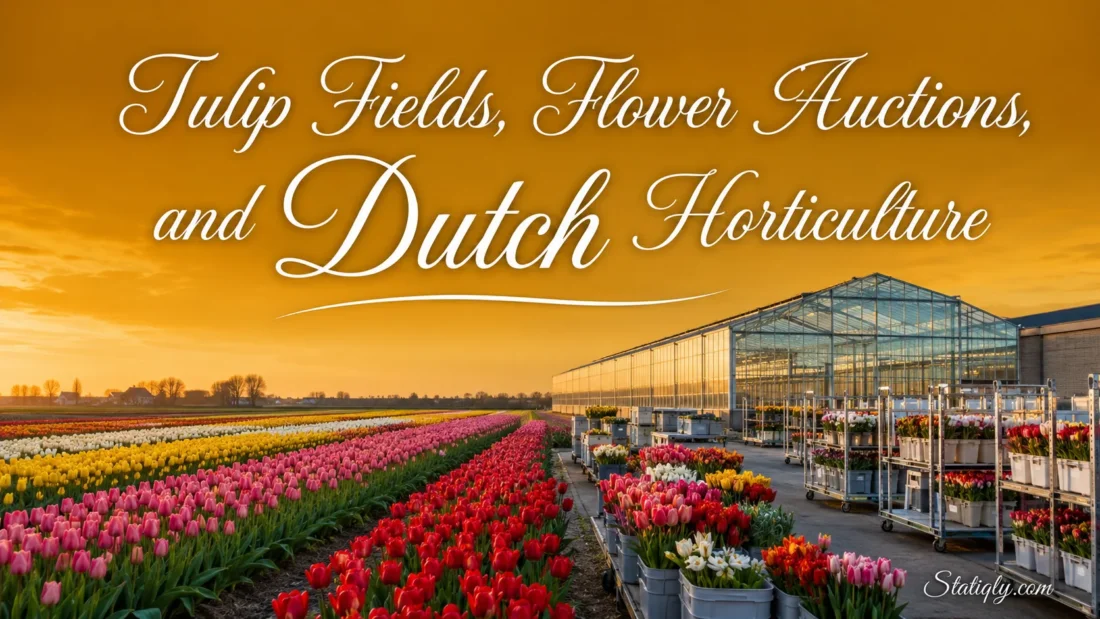
Rows of tulips may be the most familiar image of Dutch horticulture, yet they show only one part of a much larger system. Behind the spring colours stand bulb farms, plant breeders, glasshouses, digital flower auctions, transport centres and skilled growers. Together, they move flowers, plants, bulbs and fresh produce from Dutch fields and greenhouses to buyers across Europe and beyond.
Dutch tulip fields are working farms. Most are planted to produce bulbs rather than bouquets. The flower auction has a different role: it connects growers and buyers, helps form prices and directs products through a fast logistics network. Understanding this difference makes the landscape much easier to read.
How Tulip Fields Fit Into Dutch Horticulture
| Place Or Activity | Main Purpose | What Visitors Usually See |
|---|---|---|
| Commercial tulip field | Growing and multiplying flower bulbs | Long rows of one or more tulip varieties during spring |
| Display garden | Presenting planned flower combinations | Landscaped beds with early, middle and late-flowering varieties |
| Picking garden | Allowing visitors to select flowers | Marked areas where picking is permitted |
| Glasshouse | Controlled production of flowers, plants, vegetables or young plants | Crops grown under managed light, heat, water and humidity |
| Flower auction | Connecting growers with professional buyers | Digital trading, auction clocks and rapid order distribution |
The scale is larger than the visible spring display suggests. In 2024, Dutch flower bulbs occupied more than 27,000 hectares. Tulips covered about 14,740 hectares, more than half of the total bulb area. Dutch horticultural exports, including bulbs, cut flowers, plants and tree nursery products, reached an estimated €12.3 billion in 2025. That export figure includes both products grown in the Netherlands and goods brought into the country for onward trade.
Where The Main Tulip Fields Grow
Tulips grow in several Dutch provinces. Fields do not remain on the same parcels forever. Growers rotate crops to protect soil health, so an old location pin may lead to an empty or differently planted field. Current regional flower maps give a better picture during the season.
The Bollenstreek
The Bollenstreek, meaning “bulb region,” lies between Leiden and Haarlem near the North Sea coast. Lisse, Hillegom, Noordwijkerhout, Sassenheim and Voorhout are among its familiar flower-growing towns. Sandy soils behind the coastal dunes drain well, while the maritime climate brings relatively mild winters and cool springs.
Keukenhof lies in this region, but the park and the surrounding fields serve different purposes. Keukenhof is a designed display garden. Nearby commercial fields are farm crops. A park ticket never grants access to a private field.
North Holland and West Friesland
Large bulb-growing areas extend through North Holland, especially around the northern part of the province and West Friesland. Broad fields, level terrain and managed drainage support mechanised cultivation. These districts may feel less garden-like than the Bollenstreek. That is precisely the point: they reveal the working scale of Dutch bulb farming.
Flevoland and The Noordoostpolder
The Noordoostpolder in Flevoland is another major tulip area. Its straight roads and open polder landscape create wide views across the fields. A marked tulip route normally operates during the main flowering period, though its dates and course change from year to year.
Designated experience fields, variety gardens and picking gardens provide lawful access among the flowers. Ordinary production fields should be viewed from the edge.
When The Fields Usually Bloom
Weather decides the exact timing. A mild late winter may bring flowers forward, while a cold spring can delay them. Different cultivars also open at different times. Mid-April to early May is the usual main window for field tulips, but no fixed date can promise peak colour.
| Usual Period | What May Be Flowering | Planning Note |
|---|---|---|
| Early to mid-March | Crocuses and early daffodils | Most outdoor tulips are not yet open |
| Late March to early April | Daffodils, hyacinths and early tulips | Colour varies greatly between fields |
| Mid-April to early May | Main tulip varieties | Often the strongest period for field viewing |
| Late April onward | Later tulips and remaining mixed displays | Growers may already be removing flower heads |
| Late spring and summer | Few field tulips; later seasonal crops appear | Bulb lifting, sorting and storage follow |
- Check a regional bloom report shortly before travelling.
- Keep alternative dates when planning far in advance.
- Remember that display gardens use staggered planting to maintain colour longer.
- Do not assume that nearby commercial fields will match a garden’s flowering stage.
Why Growers Remove The Flower Heads
Why would a grower remove flowers just as a field reaches full colour? Because the crop beneath the soil matters most.
After the plants flower and the grower completes the required field checks, machines or workers remove the heads. This process is known as topping. It prevents the plant from spending energy on seed production. Leaves and stems remain in place so they can continue feeding the developing bulb.
Brief as it is, the colourful stage has a practical purpose. Flowering allows growers to inspect the crop for variety purity, unusual plants and visible health issues. Once those checks finish, bulb growth takes priority.
How A Tulip Bulb Crop Moves Through The Year
- Soil preparation: Growers select suitable land, prepare planting beds and plan drainage.
- Autumn planting: Bulbs enter the soil before winter, commonly during October or November.
- Cold period: Winter temperatures provide the cold exposure tulips need for normal spring development.
- Spring growth: Leaves emerge first, followed by flower stems and buds.
- Inspection and topping: Growers assess the crop, then remove flower heads to support bulb development.
- Bulb lifting: Bulbs are taken from the soil from late June into summer, depending on the crop and conditions.
- Cleaning and sorting: Soil, roots and loose outer material are removed. Bulbs are graded by size and condition.
- Storage and sale: Only after sorting do bulbs enter controlled storage, return to the field or move to professional forcers and retail markets.
Smaller bulbs often return to the ground for another growing cycle. Larger bulbs may be sold for garden planting or used for forcing, a controlled process that brings tulips into flower for the cut-flower market.
How The Dutch Flower Auction Works
The traditional Dutch auction clock starts at a high price and moves downward. A buyer stops the clock when the displayed price becomes acceptable. Speed matters: waiting may bring a lower price, but another buyer can act first.
Modern flower trading is largely digital. Professional buyers can participate from offices and trading rooms rather than sitting beside a physical clock. Royal FloraHolland’s main logistics hubs are in Aalsmeer, Naaldwijk and Rijnsburg, with an additional location in Eelde. Auction schedules usually begin early in the morning.
- The grower supplies product information such as cultivar, quantity, stem length, maturity, packaging and quality details.
- Products travel to a logistics hub or enter an agreed direct-delivery route.
- Buyers review the available lots through digital systems.
- The price falls on the auction clock until a buyer makes a purchase.
- Direct orders and presale orders are combined with clock purchases where required.
- Logistics teams divide the carts and containers into buyer orders for collection or onward delivery.
Clock Sales and Direct Trade
| Trading Method | How The Price Is Set | Typical Use |
|---|---|---|
| Auction clock | The displayed price descends until a buyer acts | Fresh daily supply and open price formation |
| Auction presale | The grower sets a price before the clock begins | Smaller advance purchases from upcoming auction lots |
| Direct day trade | Buyer and grower trade through current digital offers | Known supply for near-term delivery |
| Forward trade | Terms are arranged for a later delivery period | Seasonal programmes and planned retail demand |
| Contract trade | Parties agree on terms for a defined programme | Regular volumes, specifications and delivery schedules |
The auction clock remains visible and culturally familiar, yet it represents only part of the market. Growers may combine clock sales, advance sales and direct agreements. The digital platform Floriday supports several of these trading routes.
Why Logistics Move So Fast
Flowers continue to age after cutting. Delays affect freshness, vase life and presentation, so the chain works to shorten the time between grower and buyer. Product carts arrive, are sold, split into orders and moved toward wholesalers, florists or retailers within tight schedules.
Temperature management follows the needs of each crop. Packing, hydration, humidity and handling matter as well. A rose, tulip and potted orchid do not all require the same treatment.
The Horticulture Sector Beyond Tulips
Dutch horticulture covers far more than bulb fields. It includes ornamental plants, vegetables, fruit, tree nursery crops, propagation material and seeds. Different regions have developed their own mixtures of growers, research centres, suppliers and trading businesses.
| Horticultural Branch | Examples | Common Production Setting |
|---|---|---|
| Flower bulbs | Tulips, lilies, daffodils and hyacinths | Open fields with later cleaning and storage |
| Cut flowers | Tulips, chrysanthemums, roses and gerberas | Glasshouses, forcing facilities or outdoor plots |
| Potted and foliage plants | Flowering houseplants and green indoor plants | Managed glasshouses |
| Greenhouse vegetables | Tomatoes, peppers, cucumbers and aubergines | Climate-controlled glasshouses |
| Tree nursery crops | Shrubs, avenue trees and young fruit trees | Outdoor nurseries and container systems |
| Propagation material | Seeds, cuttings and young plants | Specialist breeding and propagation sites |
The Westland area in South Holland is closely associated with glasshouse production. Aalsmeer has long-standing ties to ornamental horticulture and flower trading. Other greenhouse and nursery clusters can be found around Oostland, Boskoop and the Venlo region.
How Dutch Glasshouses Manage Crops
A modern glasshouse acts as a managed growing environment. Sensors measure temperature, humidity, light, carbon dioxide and moisture around the roots. Computer systems adjust screens, ventilation, heating, irrigation and lighting. Growers still make crop decisions; technology gives them more precise information.
Water and Nutrient Control
Many glasshouse crops grow in substrates rather than ordinary field soil. Irrigation water carries measured nutrients to the roots. Drainage water can then be collected, treated and reused. Recirculation reduces water demand and limits the loss of nutrients.
Rainwater storage is also common. Large greenhouse roofs collect rainfall efficiently, and holding basins keep it available for later use.
Light, Heat and Climate
Movable screens help retain heat at night or reduce excessive sunlight during bright periods. Supplemental lighting extends useful growing hours for selected crops. LED systems allow growers to control light more precisely, though crop response and energy demand still shape every lighting plan.
Greenhouse businesses use different energy arrangements. These may include geothermal heat, residual heat, heat storage, electricity and combined energy systems. The practical choice depends on crop needs, location, infrastructure and the design of the glasshouse.
Biological Crop Care
Growers often release beneficial organisms that feed on crop pests. Predatory mites, beneficial bugs and tiny parasitic insects can keep unwanted insect populations under control. Monitoring cards and crop inspections show whether the balance is working.
In 2024, biological control agents were used on 94.4% of the surveyed Dutch greenhouse crop area. The survey covered major vegetables, strawberries, roses, gerberas, chrysanthemums, potted flowering plants and foliage plants. Use varied by crop, so the percentage should not be applied to every greenhouse plant without distinction.
From Breeder To Buyer
A flower sold in a shop may reflect years of work before its final growing season. Plant breeders select traits such as colour, stem strength, growth habit, flowering time, vase life and resistance to plant diseases. Promising selections then pass through repeated trials.
- Breeders develop and test new cultivars.
- Propagators multiply bulbs, cuttings, seeds or young plants.
- Growers produce saleable flowers and plants.
- Auctions and digital marketplaces connect supply with professional demand.
- Logistics companies manage temperature, packing and delivery.
- Wholesalers and retailers prepare assortments for florists, garden centres and other outlets.
The word Dutch on a trading system does not prove that every flower grew in Dutch soil. The Netherlands also serves as a marketplace and distribution centre for flowers grown in other countries. Product origin, auction location and seller location can therefore differ.
Why The Netherlands Became A Flower Trading Hub
Several practical strengths developed together. Coastal bulb soils supported field production, while glasshouses allowed growers to manage crops beyond the outdoor season. Breeding companies supplied new varieties. Grower cooperatives organised shared trading, and dense transport links connected farms with buyers.
Research and specialist suppliers added another layer. Greenhouse builders, seed companies, irrigation firms, packaging businesses, crop advisers and logistics operators could work within short travelling distances. Knowledge moved quickly between them. So did the flowers.
The result is a horticultural cluster rather than a single industry. A bulb farm, breeding laboratory, auction platform and delivery centre perform different jobs, yet each depends on reliable information from the others.
Visiting Tulip Country With Care
- Stay outside production rows. Enter only where the grower has clearly permitted access.
- Use designated picking gardens when you want to choose flowers yourself.
- Follow current bloom reports. Weather and topping can change field conditions within days.
- Park in marked places. Farm entrances, narrow roads and working yards need clear access.
- Choose a bicycle route when practical. It offers a slower view while reducing pressure on small rural roads.
- Keep paths and field edges clean. Production land is both a workplace and a living crop.
A photograph taken from the field edge can still capture the colour. More importantly, it leaves the plants untouched for the grower who raised them.
Common Questions About Dutch Flowers
Are Keukenhof and The Tulip Fields The Same?
No. Keukenhof is a planned seasonal garden with paths, display beds and pavilions. Commercial fields around the region are privately managed bulb crops. Their planting patterns, access rules and flowering schedules differ.
Are Field Tulips Grown For Bouquets?
Most broad outdoor tulip fields are grown for their bulbs. Cut tulips commonly come from forcing facilities where temperature and light help growers schedule flowering. Some outdoor crops may serve other markets, but the familiar spring fields mainly support bulb production.
Do All Tulips Bloom Together?
No. Cultivar, planting date, soil temperature, winter cold and spring weather all affect flowering. Two neighbouring fields can reach different stages during the same week.
Can Flowers Be Bought All Year?
Yes. Glasshouse production, scheduled forcing, storage methods and international supply keep many flowers available beyond their Dutch outdoor season. The assortment still changes through the year, and natural seasonal peaks remain visible.
Does Every Flower Pass Through An Auction Clock?
No. Clock sales remain active, but growers and buyers also use presales, direct digital orders, forward agreements and contracts. A single grower may use several methods for different customers or crops.
Useful Dutch Horticulture Terms
- Bollenstreek: The bulb-growing region near the coast between Leiden and Haarlem.
- Broeierij: A forcing operation that brings bulbs into flower under controlled conditions.
- Koppen: The removal of flower heads from bulb crops, known in English as topping.
- Glastuinbouw: Horticultural production under glass.
- Veilingklok: The auction clock used for descending-price sales.
- Snijbloem: A cut flower grown for bouquets and floral arrangements.
- Potplant: A plant sold while growing in its container.
- Sierteelt: Ornamental horticulture, covering flowers, plants, bulbs and nursery products.