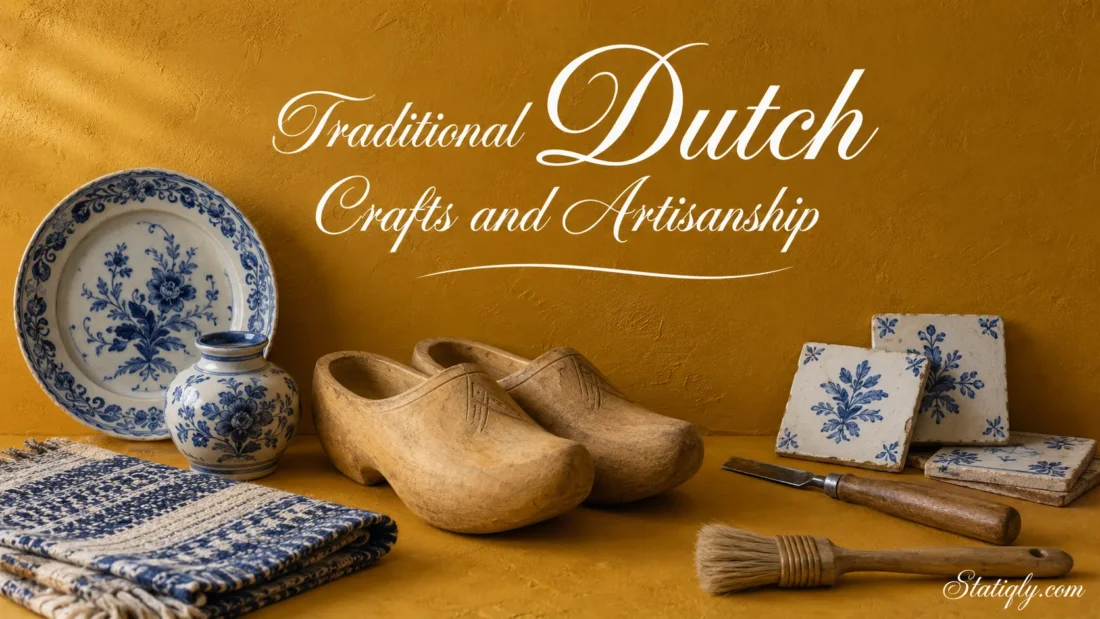
Traditional Dutch crafts grew from daily needs, regional materials, and patient handwork. Clay became painted earthenware. Willow and poplar became wooden shoes. Hemp and flax became rope, sailcloth, and household linen. In workshops across the Netherlands, makers still shape these materials with skills learned through practice rather than instructions alone.
These crafts do more than produce attractive objects. They show how people worked with water, wind, soil, textiles, and local resources. Delft Blue pottery, Hindeloopen painting, Staphorst dotwork, clog making, silversmithing, weaving, and mill operation each carry a distinct set of tools and choices. The maker must judge pressure, moisture, heat, balance, grain, or color by eye and hand. That judgment is the heart of Dutch artisanship.
Dutch Crafts by Region, Material, and Method
| Craft Tradition | Place or Region | Main Materials | Defining Hand Skill |
|---|---|---|---|
| Delft Blue pottery | Delft, South Holland | Earthenware clay, glaze, cobalt-based pigment | Freehand brush painting and controlled firing |
| Hindeloopen painting | Hindeloopen, Friesland | Wood, paint, varnish | Layered floral and scroll decoration |
| Staphorst dotwork | Staphorst, Overijssel | Fabric, paint, handmade stamps | Building patterns from repeated colored dots |
| Clog making | Several rural regions | Fresh poplar or willow wood | Shaping, hollowing, fitting, and slow drying |
| Miller’s craft | Across the Netherlands | Wooden and mechanical mill systems | Reading wind or water and controlling the mill |
| Rope, sail, and barrel making | Former Zuiderzee towns and other working ports | Plant fiber, canvas, timber, metal fittings | Twisting, stitching, shaping, and joining |
| Gold- and silversmithing | Schoonhoven, South Holland | Silver, gold, solder | Forming, joining, engraving, and finishing metal |
| Weaving and embroidery | Practised nationwide | Wool, linen, cotton, silk | Controlling thread structure, tension, and stitch |
| Papermaking and paper cutting | Practised nationwide | Fiber pulp or finished paper | Forming sheets or cutting detailed silhouettes |
The table points to a pattern: there is no single Dutch craft style. A painted cupboard from Friesland and a silver vessel from Schoonhoven may look unrelated, yet both depend on measured hand movements, material knowledge, and apprenticeship. Regional identity appears in the details.
Ceramics Shaped by Fire and Brushwork
Delft Blue Earthenware
Delft Blue, often called Delftware, is glazed earthenware rather than porcelain. Dutch potters developed blue-and-white decoration into a recognizable ceramic tradition, especially in Delft during the seventeenth century. Floral sprays, birds, ships, landscapes, and geometric borders became common motifs. Multicolored Delftware also exists, so blue and white is famous but not the only palette.
For a hand-painted piece, the decorator first places the main outlines and then works freehand with a fine brush. A cobalt-based mixture looks dark before firing. Heat changes it to blue, while the glaze melts into a clear, glass-like surface. The painter therefore works toward a color that is not fully visible at the moment of painting. Precise, yet partly predictive, is the process.
- Forming: clay is shaped, cast, dried, and refined.
- First firing: the dry clay body becomes a stable ceramic form.
- Decoration: contours and tonal details are painted by hand on selected pieces.
- Glazing: glaze covers and protects the decoration.
- Final firing: heat develops the blue color and fuses the surface.
Not every object with a blue Dutch-style design is hand-painted. Makers may use transfers or screen-printed decoration for repeatable patterns. A transfer-decorated piece can still be well made, but it represents a different method. On hand-painted work, small shifts in line weight and brush tone often reveal the painter’s movement.
Gouda Decorative Pottery
Gouda is linked with decorative pottery known as Gouds plateel. Its best-known production developed through pottery workshops and factories that employed designers, ceramic painters, and kiln workers. Many pieces use flowing plant forms, geometric bands, or dense color fields. The visual effect differs from classic Delft Blue, yet the work still depends on the close partnership between shape, surface design, glaze, and firing.
A ceramic painter must follow the curve of a vase or bowl without breaking the rhythm of the pattern. Flat on paper, a design may seem simple. Around a vessel, every line must meet its neighbor while the surface turns away from the hand.
Regional Painting and Textile Decoration
Hindeloopen Decorative Painting
In the Frisian town of Hindeloopen, artisans decorate furniture and household objects with flowers, leaves, curling stems, and fine linear accents. Backgrounds commonly appear in shades such as reddish brown, green, blue, or white, with lighter and brighter tones used for the ornament. Cupboards, trays, boxes, tables, and small wooden pieces can all carry the style.
Hindeloopen painting is not a single motif copied again and again. The craft lies in controlling the order of the decoration. The artisan prepares the wooden surface, lays down a base color, places the larger forms, adds fine lines and shading, and protects the finished work. A successful design follows the object’s shape. Decoration supports the form instead of hiding it.
Staphorst Dotwork
Staphorster stipwerk, or Staphorst dotwork, builds patterns from small stamped dots of paint. Makers press handmade stamps onto fabric, placing dots in carefully planned groups. Leaves, flowers, circles, and other folk-inspired forms emerge through repetition. Each dot is simple. Together, they create a detailed surface.
The technique became closely tied to local dress in Staphorst during the twentieth century. Color choices could carry meaning within that clothing tradition. Today’s makers also apply dotwork to accessories, ceramics, and other useful objects, using updated paints where the material calls for them. The method remains recognizable because the pattern still grows dot by dot.
Weaving, Linen, and Embroidery
Dutch textile craft includes hand weaving, embroidery, lacework, knitting, and the marking of household linen. In weaving, lengthwise warp threads sit under tension while the weft passes across them. The maker raises selected warp threads to create an opening for the weft. Small changes in this sequence alter the pattern and the behavior of the cloth.
Embroidered samplers once served as records of skill. Alphabets, numbers, borders, and small motifs gave the maker a place to practise stitches that could later mark or decorate linen. Surviving examples show both discipline and personality: a repeated border may follow a known pattern, while spacing, color, and small figures reflect the hand that made it.
Woodcraft From Shoes to Working Mills
Handmade Wooden Clogs
The Dutch wooden shoe, or klomp, began as practical footwear. A traditional clog maker works with fresh wood, often poplar or willow, because it is easier to cut before drying. The maker studies the grain, blocks out the outer profile, hollows the inside, refines the opening, and checks the shape against the foot. Wearable clogs demand knowledge of anatomy as well as carving.
- A log is cut into sections sized for the intended shoe.
- Each section is split into blocks with the grain in mind.
- The outer form is shaped with an axe and specialist knives.
- The foot cavity is bored and finished with dedicated tools.
- The pair dries slowly for weeks or, in some cases, months.
- The dry clogs may be sanded, carved, or painted.
Regional and occupational needs affected the shape. Some clogs had reinforced areas, different soles, or particular decorative treatment. Bridal clogs and finely carved examples show how a useful object could also carry ceremony and affection. A souvenir clog may imitate the outline, but a working pair must fit, balance, and survive repeated wear.
The Miller and the Millwright
A Dutch windmill is not simply a building with turning sails. It is a working system, and two crafts help explain it. The miller operates the mill, responds to wind or water, controls speed, and keeps the mechanism in working order. The millwright builds, fits, and repairs the structure and machinery. Their knowledge overlaps, but their daily work is not the same.
Millers learn to read weather, set the sails, position the mill correctly, watch moving parts, and adjust the load. Different mills may grind grain, saw timber, press oil, or move water. The Dutch miller’s craft entered UNESCO’s Representative List of the Intangible Cultural Heritage of Humanity in 2017. The recognition concerns the knowledge and practice of operating windmills and watermills, not the buildings alone.
Much of this skill is sensory. A miller listens to rhythm, feels vibration, watches the sky, and notices changes in speed. Written training matters, but the operating mill gives the final lesson.
Crafts Formed Around Water and Working Towns
Water shaped transport, food storage, farming, and trade in the Netherlands. Around the former Zuiderzee and in other working ports, a boat depended on a network of makers. The rope maker supplied lines. The sailmaker cut and stitched heavy cloth. The blacksmith formed fittings and tools. The cooper built barrels and tubs from shaped wooden staves.
Rope Making
Traditional rope making requires long, even strands and controlled twist. Fibers are prepared, spun into yarns, and combined into strands. The strands are then twisted together in the opposite direction, which helps the rope hold its form. Long ropes were made along a ropewalk, a narrow working length that gave makers room to keep the strands stretched and aligned.
Too little twist leaves a loose rope. Too much can make it kink or strain. The maker watches thickness and tension all along the line. Rope served boats, shipyards, farms, workshops, and households, so its size and finish changed with the job.
Sailmaking and Coopery
A sailmaker turns flat cloth into a surface designed to take wind pressure. Panels must be measured, oriented, joined, edged, and reinforced. The finished sail needs strength without needless weight. Repair skill matters too, since a worn area may require a shaped patch rather than a simple strip of cloth.
A cooper works in curves of another kind. Wooden staves are shaped so their edges meet closely, then drawn together with hoops to form a barrel or tub. The fit depends on geometry, grain, and careful trimming. Around fishing towns, sound barrels helped store and move preserved food. One craft supported another.
Basketry and Willow Work
Willow thrives in damp ground and bends well when prepared, making it suitable for baskets, traps, screens, and light household forms. Basket makers sort rods by length and thickness, soak or condition them, set the base, raise the side stakes, and weave the walls under steady tension. The rim must lock the structure without splitting the rods. The finished basket looks direct because the structure remains visible; every crossing has work to do.
Metal, Paper, and Fine Workshop Skills
Schoonhoven Silverwork
Schoonhoven is widely known as the Netherlands’ Silver City. Records place goldsmiths and silversmiths there centuries ago, and the town remains linked with specialist training, contemporary makers, and the Dutch Silver Museum. Silversmithing can involve sawing, hammering, raising, soldering, chasing, engraving, polishing, and setting components.
Metal moves under repeated blows. A smith may hammer a flat sheet over stakes until it becomes a bowl or hollow form, pausing to soften the work-hardened metal with controlled heat. Joins must be clean, proportions must remain true, and finishing should support the design. On a small object, there is nowhere for a careless line to hide.
Handmade Paper
Hand papermaking begins with fibers suspended in a vat of water. The papermaker lifts the mixture with a screened mould held inside a removable frame called a deckle. Water drains away while the fibers settle into a thin mat. The wet sheet is transferred onto felt, stacked with other sheets, pressed, and dried. Surface treatment may follow when the paper needs to accept ink cleanly.
Even sheet formation takes practice. The mould must move steadily so fibers spread without thin spots or heavy edges. Texture, thickness, fiber length, and drying all affect the result.
Dutch Paper Cutting
Papierknipkunst creates images by cutting paper with scissors or a knife. Folding can establish symmetry, after which the cutter may add different details on either side. Hearts, plants, birds, lettering, family scenes, and commemorative motifs appear in traditional work. The oldest known surviving Dutch paper cutting dates to 1589.
The material is modest; the planning is not. One cut can open a window, define a face, or separate a fragile connection. Skilled cutters think in both solid paper and empty space.
How to Recognize Genuine Handwork
No single mark proves that an object is handmade. A better reading combines the process, material, maker information, and visible evidence. Regularity is not proof of machine production either; an experienced artisan can repeat a form with remarkable control.
- Look for process details. Brush variation, carved transitions, hammered surfaces, woven joins, and hand-finished edges should make sense for the stated method.
- Read the maker’s description. Clear information should identify which stages were done by hand and which used moulds, machines, transfers, or prepared parts.
- Check marks in context. Pottery marks, metal hallmarks, signatures, and workshop labels can help, but each follows its own system.
- Compare pairs and repeated motifs. Handmade repetition often shows small, coherent differences rather than random flaws.
- Ask about materials. A working maker can usually explain why a certain wood, clay body, fiber, paint, or metal suits the object.
- Consider function. A usable clog, basket, sail, or vessel must perform properly as well as look convincing.
Handmade also describes a spectrum. One potter may throw a form and paint it alone. Another workshop may divide shaping, glazing, decoration, and firing among trained specialists. Both can represent skilled artisanship when the description is accurate.
Where Dutch Craft Knowledge Lives Today
Dutch craft survives through working studios, family workshops, vocational education, guilds, heritage groups, museums, and trained volunteers. Museums in Delft, Arnhem, Enkhuizen, Gouda, Schoonhoven, and smaller regional centers preserve tools and finished objects. Several also maintain active workshops where visitors can watch a process or try a supervised task.
Demonstration has real value because movement can be hard to preserve in a display case. The angle of a knife, the sound of a mill, the pull on a rope strand, and the pace of a brush stroke all carry knowledge. Seen in motion, the object becomes easier to understand.
- Delft: hand-painted earthenware and ceramic decoration
- Hindeloopen: regional painted furniture and wooden objects
- Staphorst: dotwork connected with local textile culture
- Schoonhoven: gold- and silversmithing, hallmarking, and metal design
- Arnhem: a broad view of Dutch buildings, domestic work, and craft practice
- Enkhuizen: crafts associated with life around the former Zuiderzee
- Working mills nationwide: mill operation, maintenance, and product-making in their proper setting
Contemporary artisans do not keep every tradition frozen. They adapt paints, tools, products, and teaching methods while retaining the hand skill that defines the practice. Staphorst dots may appear on a new material. A silversmith may use a modern form. A Delft painter may create an original scene with an old brush method. Tradition stays legible, even as the object changes.
Dutch Craft Terms Worth Knowing
| Dutch Term | English Meaning | Craft Context |
|---|---|---|
| Ambacht | Craft or skilled trade | A practice learned through training and repeated work |
| Ambachtsman / ambachtsvrouw | Craftsman / craftswoman | A trained maker or skilled trade practitioner |
| Klomp | Wooden shoe | Hand-shaped footwear, often made from poplar or willow |
| Delfts blauw | Delft Blue | Blue-decorated Dutch earthenware associated especially with Delft |
| Stipwerk | Dotwork | Stamped decoration formed from repeated painted dots |
| Plateelschilder | Ceramic painter | An artisan who decorates pottery by hand |
| Molenaar | Miller | A person trained to operate a windmill or watermill |
| Zilversmid | Silversmith | A maker who forms and finishes objects in silver |
| Papierknipkunst | Paper-cutting art | Decorative image-making through precise cuts in paper |
These words place the maker beside the object. That matters. Traditional Dutch crafts are not only patterns, souvenirs, or museum pieces; they are practiced ways of knowing how a material will respond, and knowing what to do next when it does.