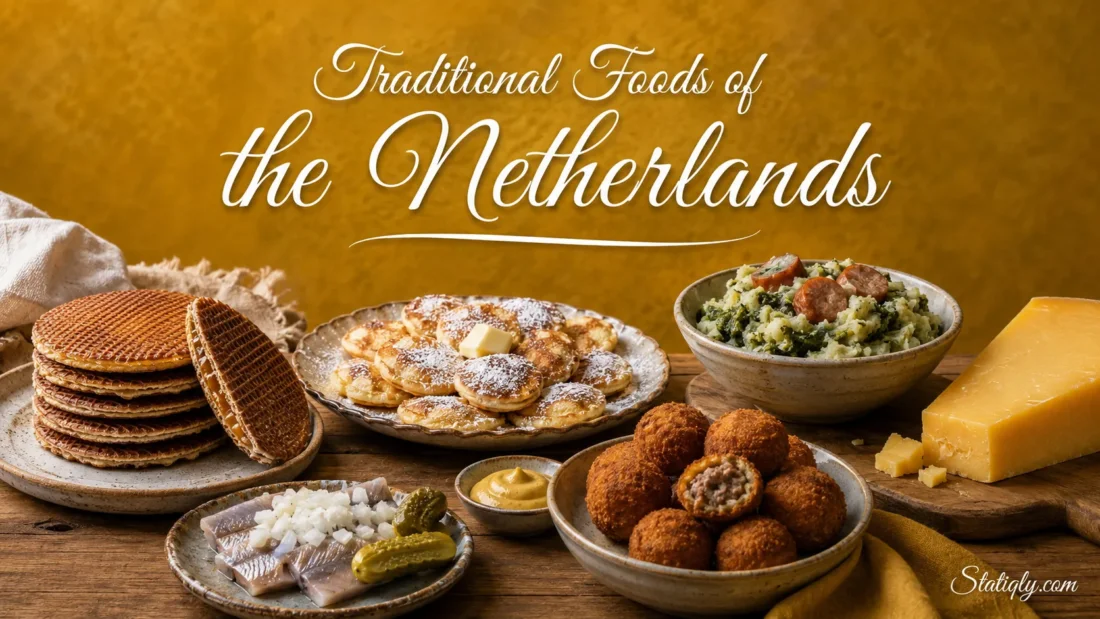
Traditional food in the Netherlands grows from familiar ingredients: potatoes, vegetables, bread, dairy, fish, meat, fruit, and warming spices. Dutch cooking often favors clear flavors over elaborate presentation. A winter meal may arrive as one generous plate of mashed potatoes and kale, while a market snack might be nothing more than freshly fried fish with sauce. Simple, yes. Forgettable, no.
Some dishes belong to the whole country. Others remain closely tied to Friesland, Zeeland, Limburg, North Brabant, Groningen, or a particular town. Exploring both sides reveals a Dutch food culture that changes with the season, the landscape, and the occasion.
| Food | Main Ingredients | Known For | Usual Time or Setting |
|---|---|---|---|
| Stamppot | Potatoes and vegetables | Soft, hearty texture | Winter dinner |
| Erwtensoep | Split peas, vegetables, and sausage | Very thick pea soup | Cold-weather meal |
| Hollandse Nieuwe | Young cured herring | Mild, salty fish flavor | Fish stalls and markets |
| Bitterballen | Ragout and breadcrumbs | Crisp shell and creamy center | Shared snack |
| Stroopwafel | Thin waffles and syrup filling | Chewy caramel-like center | Market or coffee break |
| Poffertjes | Small yeasted pancakes | Soft, airy middle | Markets and fairs |
| Limburgse Vlaai | Yeast dough and baked filling | Regional fruit or rice tart | Celebrations and coffee |
| Zeeuwse Bolus | Bread dough, brown sugar, and cinnamon | Sticky spiral pastry | Zeeland bakeries |
What Dutch Traditional Food Tastes Like
Dutch home cooking usually balances mild, savory, salty, sweet, and lightly spiced flavors. Potatoes and bread provide substance. Mustard, pickles, onions, gravy, and spices add contrast. Dairy appears in cheese, butter, milk-based fillings, and sauces.
Texture matters just as much as flavor. A crisp kroket should break open to reveal smooth ragout. A stroopwafel combines thin wafers with a chewy syrup layer. Good erwtensoep is so thick that it feels closer to a meal than a light soup.
- Winter cooking: mashed vegetables, soups, stews, and smoked sausage
- Coastal cooking: herring, mussels, shrimp, and fried white fish
- Bakery traditions: spiced biscuits, fruit tarts, syrup waffles, and regional breads
- Everyday meals: bread, cheese, eggs, soup, and simple hot dinners
- Market food: fish, fries, pancakes, and freshly made sweets
Traditional Dutch Main Dishes
Stamppot: One Method, Several Plates
Stamppot combines mashed potatoes with one or more vegetables. The ingredients are usually cooked until tender and mashed together rather than served in separate portions. Gravy often fills a small hollow in the center. Rookworst, a smoked sausage, is a familiar accompaniment, though meat-free versions are widely available.
The vegetable changes the name and character of the meal:
- Boerenkoolstamppot: potatoes mashed with finely cut kale
- Zuurkoolstamppot: potatoes mixed with sauerkraut
- Andijviestamppot: mashed potatoes combined with endive
- Hutspot: potatoes, carrots, and onions mashed together
- Rauwe Andijviestamppot: raw endive folded into hot mashed potatoes shortly before serving
Is every stamppot heavy? Not necessarily. The ratio of potato to vegetables varies, and modern kitchens may add roasted vegetables, cheese, nuts, or plant-based sausage. The familiar mashed form remains.
Erwtensoep and Snert
Erwtensoep is a thick soup made with dried split peas, leeks, celery, onions, carrots, and other vegetables. Traditional versions often contain pork and slices of rookworst. Rye bread may accompany the bowl.
The word snert commonly refers to the same style of Dutch pea soup, especially when it has become dense and deeply flavored. Families follow different recipes, so there is no single bowl that represents every household. One shared trait remains: this is winter food meant to satisfy.
Hachee
Hachee is a slow-cooked stew built around onions and tender pieces of meat. Vinegar and warm spices may add a gentle sweet-and-sour note. It is commonly paired with potatoes, red cabbage, or mashed vegetables.
Time does much of the work. Long cooking softens the onions until they become part of the sauce, giving the dish its rounded taste and soft texture.
Pannenkoeken
Dutch pannenkoeken are wider and thinner than fluffy American pancakes but usually thicker than French crêpes. They can form a full lunch or dinner rather than serving only as breakfast.
Sweet versions may include apple, raisins, or syrup. Savory choices can contain cheese, mushrooms, onions, or vegetables. The toppings or fillings often cook directly into the batter, making each pancake a complete plate.
Uitsmijter
An uitsmijter consists of slices of bread topped with fried eggs and, depending on the version, cheese, tomato, or sliced meat. It is commonly ordered for breakfast or lunch. Few decorations, little fuss, and plenty on the plate.
Dutch Fish and Seafood Traditions
Hollandse Nieuwe
Hollandse Nieuwe is young herring prepared through a controlled process of cleaning, salting, maturing, and freezing. Although people often describe it simply as raw herring, that description misses the curing process that creates its soft texture and mild flavor.
At a fish stall, herring may be served in pieces with chopped onions and pickles. A broodje haring places the fish in a soft bread roll. The well-known custom of holding a herring by its tail exists, but eating it in neat pieces is just as Dutch.
Kibbeling
Kibbeling consists of seasoned pieces of white fish coated in batter and fried. Vendors usually serve it hot with a creamy herb or garlic sauce. Cod was traditionally common, while pollock, hake, and other white fish may also be used today.
The contrast defines the snack: crisp batter outside, moist flakes of fish inside. Freshly fried kibbeling is found at markets, harbor towns, and specialist fish shops across the country.
Lekkerbekje
A lekkerbekje is a larger battered fish fillet, while kibbeling comes as bite-sized pieces. Both are usually fried to order and served with sauce. The distinction is useful at a fish counter: one is a fillet, the other a collection of smaller morsels.
Zeeland Mussels
The southwestern province of Zeeland is closely associated with mussel cultivation. Yerseke and the Oosterschelde estuary are especially well known for the trade. Dutch mussels are commonly steamed with onions, carrots, leeks, celery, or herbs and brought to the table in the cooking pot.
Bread or fries often comes alongside. Diners may use an empty mussel shell like a small pair of tongs to lift the remaining mussels from their shells.
Popular Dutch Snacks
Bitterballen
Bitterballen are small, round snacks with a crisp breadcrumb coating and a soft ragout filling. Beef ragout is traditional, though cheese, mushroom, and vegetable fillings are also common. Mustard is the usual dip.
Let them cool for a moment before biting. The outside may feel ready while the center remains remarkably hot.
Kroket
A kroket uses a filling similar to bitterballen but comes in an oblong shape. It can be eaten alone or placed in a soft bread roll with mustard. The latter is called a broodje kroket.
Patat or Friet
Dutch fries may be called patat or friet, depending partly on the region and personal habit. They are usually thick-cut and served in a paper container with a chosen sauce.
- Patat met: fries with mayonnaise
- Patat speciaal: fries with mayonnaise, curry ketchup, and chopped onions
- Patat oorlog: fries commonly served with peanut sauce and mayonnaise, sometimes with onions; recipes vary by shop
- Friet zonder: fries without sauce
Kaassoufflé
A kaassoufflé is a breaded pastry snack filled with melted cheese. Its name suggests a soufflé, but the result is closer to a crisp cheese pocket. Vegetarian diners often choose it as an alternative to meat-filled fried snacks.
Brabants Worstenbroodje
The Brabants worstenbroodje comes from North Brabant. It wraps seasoned minced meat in soft white bread dough and bakes the two together. Unlike a sausage roll made with flaky pastry, this specialty has a smooth bread exterior.
Groningen Eierbal
The eierbal is a specialty of Groningen. A whole boiled egg is covered with seasoned ragout, coated in breadcrumbs, and fried. Cut through the crisp shell and three layers appear: crumb, creamy ragout, and egg.
Bread, Breakfast, and Everyday Lunch
Bread plays a central role in many Dutch breakfasts and lunches. A typical broodmaaltijd places sliced bread on the table with cheese, eggs, sweet spreads, or sliced vegetables. Open-faced sandwiches are common, so one slice of bread may carry the entire topping.
Hagelslag
Hagelslag means small sprinkles eaten on buttered bread. Chocolate is the most familiar variety, but fruit-flavored and anise versions also exist. The butter helps the pieces stay in place. Without it, breakfast can become a rather scattered affair.
Ontbijtkoek
Ontbijtkoek is a dark, soft spice loaf commonly associated with breakfast or a daytime snack. Rye flour and spices give it a dense texture and warm aroma. Slices may be spread with butter.
Beschuit
Beschuit is a round, light, twice-baked rusk. People eat it with butter, cheese, jam, or sprinkles. Its dry crunch makes it quite different from ordinary toast.
Krentenbollen
Krentenbollen are soft bread rolls filled with currants or raisins. They work as a portable snack and may be eaten plain or with butter and cheese. Sweet bread with cheese may sound unusual. On the plate, the mild saltiness and dried fruit make an easy match.
Dutch Cheese and How It Is Described
Cheese appears at breakfast, lunch, markets, and family tables. Gouda and Edam are the best-known names abroad, but Dutch cheese counters offer many ages, milk types, textures, and added seasonings.
The age description tells more about the flavor than the color of the wax:
- Jong: young, mild, soft, and creamy
- Jong belegen: slightly matured with a fuller taste
- Belegen: firmer and more developed
- Extra belegen: stronger, drier, and more concentrated
- Oud: mature, firm, and often crumbly with small crystals
Boerenkaas refers to farmhouse cheese made on a farm from raw milk under defined production conditions. Komijnekaas contains cumin seeds, giving the cheese a warm, aromatic note. Friesland is also known for Friese nagelkaas, traditionally flavored with cloves and cumin.
Gouda is both the name of a city and a style of cheese. The name alone does not always mean that a cheese was produced in the city of Gouda. Protected names such as Gouda Holland carry more specific geographical production requirements.
Dutch Pancakes, Pastries, and Sweets
Stroopwafel
A stroopwafel consists of two thin waffle discs joined by a syrup filling. The fresh market version is warm, flexible, and larger than many packaged examples. The syrup firms as it cools but remains pleasantly chewy.
Some people rest a stroopwafel over a hot cup of tea or coffee for a short time. The rising warmth softens the center. Leave it there too long, though, and the waffle may bend into the cup.
Poffertjes
Poffertjes are small, puffy pancakes cooked in a pan with shallow round hollows. Yeast and traditionally some buckwheat flour help create their light interior. They are commonly served with butter and powdered sugar.
Dutch Appeltaart
Dutch appeltaart is usually deep and filled with sliced apples, cinnamon, sugar, and sometimes raisins. Strips of dough often form a lattice over the top. The crust is firmer and more biscuit-like than flaky pastry.
Speculaas
Speculaas is a crisp biscuit flavored with a mixture that may include cinnamon, cloves, nutmeg, ginger, cardamom, and white pepper. Bakers often press the dough into carved molds, leaving figures or decorative patterns on the surface.
Gevulde speculaas places almond paste between two layers of spiced dough. It is softer, thicker, and richer than the plain biscuit.
Tompouce
A tompouce has two rectangular pastry layers, a thick custard filling, and a smooth icing top that is usually pink. The pastry resists a neat fork cut, while the custard prefers to escape from the sides. Many people separate the layers or turn the pastry on its side before eating it.
Oliebollen
Oliebollen are round pieces of yeasted dough fried until golden and dusted with powdered sugar. Some contain raisins, currants, or apple. They are strongly linked with the final weeks of December and New Year’s Eve, when seasonal stalls appear in towns and cities.
Banketstaaf
A banketstaaf is a long roll of pastry filled with almond paste. Smaller letter-shaped versions are known as banketletters. The crisp pastry and dense almond center make thin slices more satisfying than their size suggests.
Regional Foods Worth Knowing
Limburgse Vlaai
Limburgse vlaai is a round regional bake made with yeast dough and a filling baked together with the base. Common fillings include cherries, plums, apricots, gooseberries, apple, or rice pudding.
The protected regional name applies to vlaai made in Dutch or Belgian Limburg under stated production rules. The finished bake measures between 10 and 30 centimeters across, and its base is thin enough for a slice to be held in the hand. It is flatter and more bread-like than many fruit pies.
Zeeuwse Bolus
The Zeeuwse bolus is a spiral of white bread dough rolled through dark brown sugar and cinnamon. Baking turns the coating into a sticky outer layer. It is sold throughout Zeeland and may be eaten plain or with butter.
Bossche Bol
The Bossche bol belongs to ’s-Hertogenbosch in North Brabant. It is a large round choux pastry filled with whipped cream and covered in dark chocolate glaze. Its size separates it from the smaller chocolate-coated cream puffs found elsewhere.
Frisian Oranjekoek
Oranjekoek is a Frisian sheet cake flavored with candied orange peel and spices. Despite its name, the top is often decorated with pink icing and cream. Recipes vary within Friesland, with anise, cinnamon, or ginger appearing in different local versions.
Fryske Dúmkes
Fryske dúmkes are small Frisian biscuits traditionally flavored with anise and nuts. Their name relates to the Frisian word for “thumb,” possibly referring to their shape or to a baker’s thumbprint in the dough.
Groninger Poffert
Poffert from Groningen is a firm, mildly sweet steamed or gently cooked bread-like dish containing flour, milk, eggs, and often raisins. It is sliced and served with butter and sugar or syrup. Despite the similar name, it should not be confused with poffertjes.
Foods Connected to the Dutch Seasons
- Winter: stamppot, hutspot, erwtensoep, hachee, and warm appeltaart
- Spring: white asparagus, young vegetables, and lighter egg dishes
- Early summer: Hollandse Nieuwe and fresh strawberries
- Late summer and autumn: apples, pears, mussels, mushroom dishes, and fruit vlaai
- December: speculaas, gevulde speculaas, banketstaaf, and oliebollen
White asparagus has a particularly strong spring following in Limburg and North Brabant. The spears grow under soil, which prevents them from turning green. A familiar serving combines tender asparagus with potatoes, egg, and a butter-based sauce.
Useful Dutch Food Words
| Dutch Word | Meaning |
|---|---|
| Lekker | Tasty or enjoyable |
| Eet smakelijk | Enjoy your meal |
| Broodje | A bread roll or sandwich |
| Met | With; at a fries shop it often implies sauce |
| Zonder | Without |
| Zoet | Sweet |
| Hartig | Savory |
| Gebakken | Baked or fried, depending on context |
| Gerookt | Smoked |
| Vegetarisch | Vegetarian |
Dietary and Allergen Notes
Traditional Dutch food frequently uses wheat, milk, eggs, fish, shellfish, mustard, peanuts, almonds, and other nuts. Ragout snacks may look alike while containing very different ingredients. Sauces served with fries also vary between shops.
- Ask whether stamppot contains meat stock, bacon, gravy, or sausage.
- Check the filling of bitterballen and kroketten rather than judging by the coating.
- Confirm which fish is used for kibbeling if the species matters.
- Ask whether pastries contain almond paste, especially banket products and gevulde speculaas.
- Look for the word vegetarisch when choosing meat-free snacks.
Common Questions About Dutch Food
What Is the Most Traditional Dutch Dinner?
Stamppot is one of the clearest examples of a traditional Dutch home dinner. Potatoes and vegetables are mashed together and commonly served with gravy and sausage. The exact vegetable mixture changes by household and season.
Do People in the Netherlands Eat Sweet Food for Breakfast?
Sweet bread toppings are common. Chocolate hagelslag, jam, apple syrup, and ontbijtkoek may appear at breakfast. Cheese, eggs, and other savory choices are just as familiar.
Is Dutch Herring Served Completely Raw?
Dutch herring is not simply taken from the sea and served. Hollandse Nieuwe undergoes cleaning, salting, controlled maturation, and freezing. These steps create its characteristic texture and prepare it for consumption.
What Is the Difference Between Poffertjes and Pannenkoeken?
Poffertjes are small, thick, and airy. They usually arrive as a sweet portion with butter and powdered sugar. Pannenkoeken are large, thin pancakes that may carry sweet or savory ingredients and can serve as a full meal.
Which Dutch Foods Are Vegetarian?
Poffertjes, stroopwafels, appeltaart, many cheeses, kaassoufflé, vegetable pannenkoeken, and numerous bakery products are commonly vegetarian. Recipes still vary, especially for fried snacks, soups, sauces, and stamppot, so checking the ingredients remains sensible.
Which Foods Make a Good First Tasting Selection?
A varied first selection could include a young Dutch cheese, warm stroopwafel, kibbeling, bitterballen, poffertjes, and one regional pastry. Add stamppot or erwtensoep in cold weather. That mix covers soft, crisp, sweet, savory, dairy, fish, bakery, and home-style cooking without turning the experience into an eating marathon.