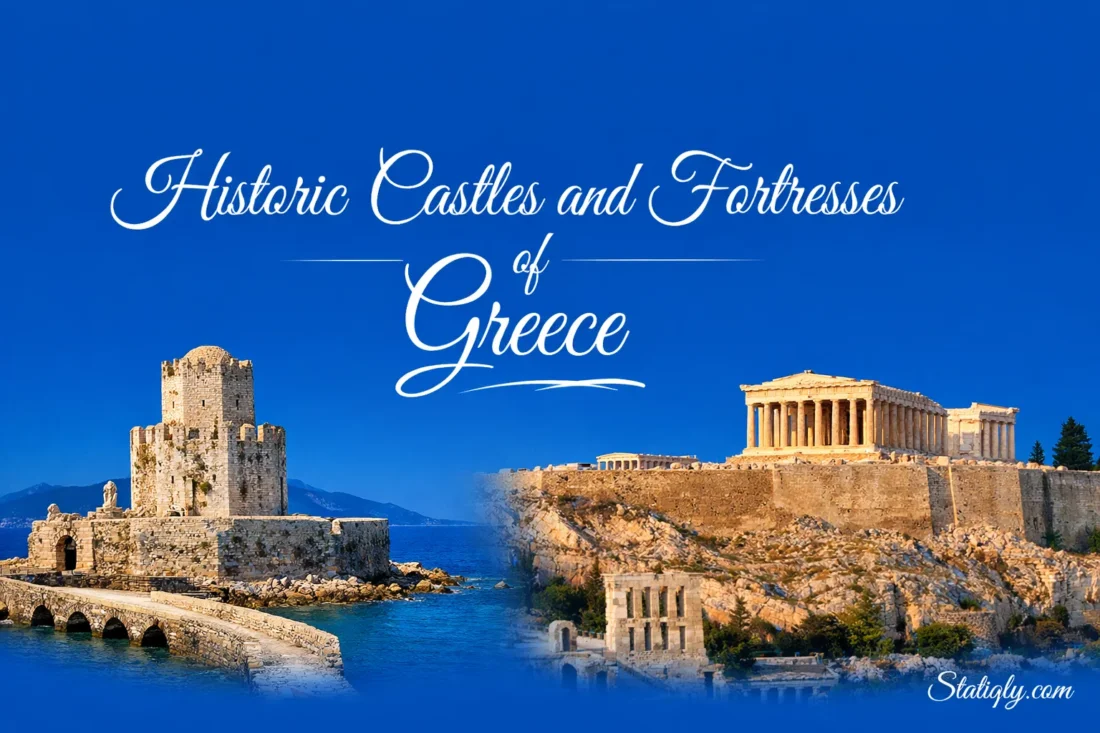
Greece does not hide its castles. They rise above harbors, cling to rock, frame old towns, and follow the edge where land meets sea. Some feel like entire settlements wrapped in stone. Others are spare and high, built for wide views and strong walls. Walk through them and one pattern becomes clear: Greek castles were shaped by landscape first. Narrow coastal passages, island ports, steep hillsides, and sheltered bays gave each fortress its own form, mood, and rhythm. That is why the historic castles and fortresses of Greece never feel all the same. They belong to one country, yes, but each one speaks with a different voice.
| Site | Region | Main Period | What It Is Known For | Best For |
|---|---|---|---|---|
| Rhodes Medieval City | Dodecanese | Medieval | Walled urban core, palace, gates, long stone streets | Visitors who want a full fortified town |
| Monemvasia | Laconia | Byzantine foundation | Rock-linked castle town with upper and lower sections | Sea views and slow wandering |
| Mystras | Laconia | 13th century onward | Hillside city, palace remains, churches, layered ruins | Travelers who like depth and atmosphere |
| Methoni Castle | Messenia | Early 13th century | Sea-facing walls, long bridge, coastal setting | Photogenic walks by the water |
| Palamidi Fortress | Nafplio | Early 18th century | Eight bastions, steep setting, wide views | Clear geometry and high lookouts |
| Acrocorinth | Corinthia | Multi-period | Huge citadel with three defensive enclosures | People who enjoy long architectural timelines |
| Chlemoutsi Castle | Elis | 13th century | Frankish design, domed halls, broad western outlook | Clean forms and quieter visits |
Why Greece Has So Many Castles and Fortresses
Look at a map of Greece and the answer feels obvious. There are long coastlines, island chains, mountain ridges, and peninsulas that push into the sea. A fort on a hill could watch a valley. A fort by a harbor could watch ships come and go. A fort at the end of a rocky spur could guard a passage almost by nature alone.
That is why Greek fortifications come in several forms. You find harbor castles, hilltop citadels, walled towns, and fortified acropoleis. Not every site was built in the same age, and that matters. Some grew in stages. Stone was repaired, gates were widened, towers were added, and churches, houses, store rooms, and water systems appeared inside the walls. A Greek fortress was rarely just a shell. Often, a small world lived within it.
What Sets a Greek Fortress Apart
Many visitors expect towers first. They remember the outline. Fair enough. Yet the most memorable parts are often the details closer to the ground: a bent entrance path, a thick gate passage, a sloping wall, a cistern, a chapel, a worn stair, a lookout where the sea suddenly opens in front of you. That is where Greek fortresses start to feel personal.
- Sea and stone work together. In places like Methoni and Rhodes, the water is part of the experience, not just the view.
- The town and the fortress often overlap. Monemvasia is the clearest example. You do not just visit walls. You move through a lived-in place.
- Topography shapes the plan. Mystras climbs a slope. Acrocorinth spreads across a massive rocky height. Palamidi steps up above Nafplio.
- Many sites carry more than one architectural layer. That mix gives Greek castles their texture. The walls may feel strict, but the story inside them is not.
Castles That Best Show the Character of Greece
Rhodes: A Fortified City That Still Feels Complete
If you want to understand how large and urban a fortified place can be, start with Rhodes. This is not just one castle standing alone on a hill. It is a medieval city within walls, with gates, streets, major public buildings, and a layout that still reads clearly today. The Palace of the Grand Master gives the site a focal point, but the wider setting does most of the work. Walk the streets, pass under stone arches, notice how the walls shape movement, and the scale begins to settle in.
Rhodes works so well because it balances monument and daily rhythm. The defenses are strong, yes, but the place never feels empty. It feels inhabited by memory. That makes it ideal for travelers who want more than a single photo stop. You can spend hours there and still find another corner, another gate, another turn in the street that changes the mood.
- Best detail to notice: the way the walls and street network create a full urban fortress, not a single isolated keep
- Best mood: early morning or late afternoon, when the stone softens
- Best for: first-time visitors to Greek fortifications
Monemvasia: The Castle Town on the Rock
Monemvasia is one of those places that hardly needs introduction once you see it. A great rock rises from the sea, linked to the mainland by a causeway, and the settlement folds into it so naturally that the built form and the landscape seem to share one outline. Founded in the Byzantine period, Monemvasia developed into a true castle town, and that matters more than any dramatic label ever could.
The lower town draws most visitors first. It is intimate, walkable, and full of turns that feel almost theatrical (in the best way). Then there is the upper section, quieter and more exposed, where the relationship between rock, walls, and sea becomes even clearer. Some fortresses impress by size. Monemvasia does something subtler. It pulls you inward. Then upward. Then outward to the horizon.
- Best detail to notice: the split between lower and upper town
- Best mood: slow wandering without a strict route
- Best for: travelers who like beauty, texture, and long walks through stone streets
Mystras: A Hillside City of Ruins, Churches, and Views
Mystras feels different from the first few steps. It spreads across a slope like an amphitheater, with layers of walls, buildings, paths, and viewpoints rising one above the other. The fortress above gave shape to the city below, and over time the site became far more than a military shell. Palaces, houses, churches, and monastic spaces turned the hillside into a full urban landscape.
It is one of the best places in Greece for visitors who enjoy spatial layering. You do not read Mystras in one glance. You read it by climbing, pausing, turning, and seeing how one part relates to the next. The route can be steep, but the reward is unusual: not one postcard view, but a sequence of them. Some close. Some broad. Some almost hidden.
- Best detail to notice: how the settlement steps down the hill rather than sitting flat inside a wall
- Best mood: a patient visit with time to look back as often as you look ahead
- Best for: visitors who enjoy ruins with depth and structure
Methoni Castle: One of Greece’s Great Sea Fortresses
Methoni has a clean, memorable silhouette. The sea wraps around it. A long stone bridge leads inward. The walls stand low and broad against the coast. Built by the Venetians in the early 13th century on a rocky point, it remains one of the most striking coastal fortress sites in Greece. The setting does half the talking. The rest comes from scale.
What makes Methoni special is the way its architecture stays readable even from a distance. The bridge, the shoreline, the open sky, the stone massing, the smaller fortified islet beyond — all of it creates a composition that feels almost too balanced to be accidental. Yet once inside, the site opens up. It is not just a picture from outside. It is a place to move through slowly, with sea air in every direction.
- Best detail to notice: the bridge approach and the sea on both sides
- Best mood: clear weather, when the coast and stone read sharply
- Best for: photography, open views, and coastal atmosphere
Palamidi: Sharp Geometry Above Nafplio
Palamidi rises above Nafplio with unusual clarity. Built by the Venetians in the early 18th century, the fortress is known for its eight bastions and for the way it commands the hill over the town. If Rhodes feels urban and Monemvasia feels organic, Palamidi feels planned. Purposeful. Crisp.
This is a fortress for people who enjoy form as much as atmosphere. Its layout reads strongly, and the views down toward Nafplio and the gulf are part of the design experience. Even when you are focused on the masonry, the landscape keeps stepping in. Quite literally, high above the town, it does not drift into the background.
- Best detail to notice: the bastion system and the controlled lines of the plan
- Best mood: a bright day with clear visibility
- Best for: visitors who like structure, order, and elevated views
Acrocorinth: The Long Architectural Timeline in One Place
Acrocorinth is vast. That is the first impression. The second is continuity. This rocky citadel above Corinth was used and adapted across many centuries, and that layered history remains visible in the enclosure system, gateways, and surviving stretches of wall. The site is known for its three defensive enclosures, which help explain its scale and depth.
Some Greek fortresses charm you at once. Acrocorinth asks for a little more attention, then gives more back. It is less about a single polished image and more about reading a place over time. If that sounds dry, it is not. Far from it. The views are wide, the stone is powerful, and the sense of duration is hard to miss.
- Best detail to notice: how one line of defense leads to another
- Best mood: an unhurried visit with proper walking time
- Best for: travelers who like large sites with visible building phases
Chlemoutsi: A Cleaner, Quieter Castle Experience
Chlemoutsi, in the western Peloponnese, offers a different kind of pleasure. Built in the 13th century, it is often praised for its strong form, open position, and better-preserved interior spaces. The domed halls and large fireplaces add a domestic note that many visitors do not expect in a fortress setting. Suddenly the place feels less abstract. More human.
It is also a good choice for travelers who want a castle that feels substantial without feeling crowded. The lines are clear, the volumes are easy to read, and the setting gives the site room to breathe. Not every memorable fortress needs a dramatic old town wrapped around it. Chlemoutsi proves that plain strength and clean geometry can stay with you just as long.
- Best detail to notice: the interior halls and how usable they still feel
- Best mood: a calm visit focused on the building itself
- Best for: travelers who prefer form, proportion, and fewer distractions
Features Worth Looking for Inside Greek Castles
A castle visit becomes more rewarding when you know what to watch for. Not the obvious skyline only. The smaller clues matter too.
- Gate sequences: entrances often turn, narrow, or rise, shaping how the site is approached
- Bastions and towers: these show how each fortress answered its landscape
- Cisterns: water storage mattered deeply in enclosed hilltop and coastal sites
- Chapels and churches: many fortresses contained places of worship within the walls
- Street patterns: in castle towns, the movement route tells as much of the story as the walls do
- Harbor edges: coastal forts often reveal their logic best when seen from the shoreline as well as from inside
- Masonry changes: different stonework can hint at repairs, additions, or later phases
Which Greek Fortress Fits Your Travel Style
- For a first castle trip: Rhodes or Palamidi
- For a romantic stone-town atmosphere: Monemvasia
- For layered ruins and long walking routes: Mystras
- For sea light and wide coastal views: Methoni
- For scale and many building phases: Acrocorinth
- For a quieter visit focused on the structure itself: Chlemoutsi
Easy Regional Routes for Castle Lovers
You do not need to cross all of Greece to enjoy its fortress heritage well. A regional route often works better. Less rushing. More looking.
Peloponnese Route
- Nafplio for Palamidi and the wider old-town setting
- Corinthia for Acrocorinth and a grand citadel experience
- Laconia for Monemvasia and Mystras, two very different fortress landscapes
- Messenia for Methoni and a sea-facing finish
Dodecanese Route
- Rhodes for the most complete walled urban experience in Greece
- Pair long walks inside the medieval city with shorter visits to gates, walls, and outlook points
Western Peloponnese Add-On
- Chlemoutsi for strong interior architecture
- Follow with nearby coastal scenery for contrast between inland height and sea horizon
How to Get More From a Castle Visit
- Look at the site from outside before entering. Greek fortresses often make more sense once you see how they sit in the land.
- Notice the approach. Bridges, ramps, gates, and turns are part of the design, not an afterthought.
- Climb when the site asks you to climb. Height changes the reading of the walls, the town, and the sea.
- Do not chase only the highest point. Side paths, lower terraces, and edge views often reveal the plan better.
- Give the stone time. At first a fortress can feel silent. Stay a little longer and details begin to speak.