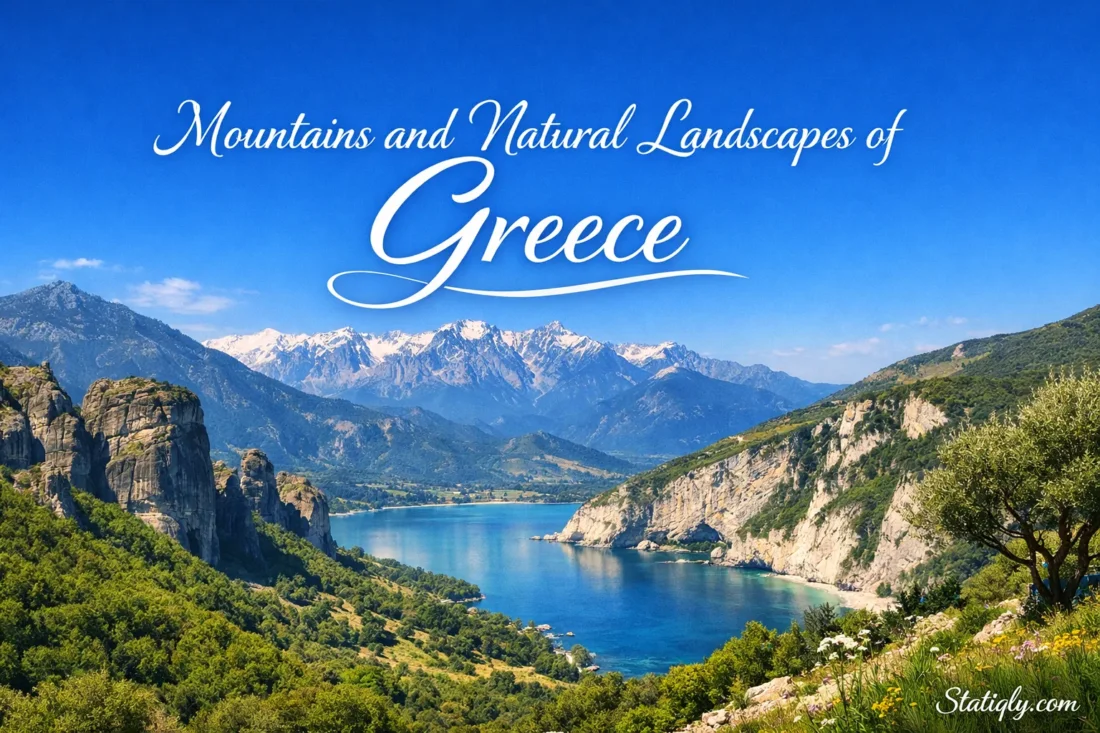
Greece changes quickly. A pale limestone ridge can rise above a dark forest, and a deep gorge can open just beyond a village square. In one region, sheer rock walls stand over a wide plain. In another, mountain lakes, quiet fir woods, and high plateaus soften the view. That fast shift in terrain is what makes the mountains and natural landscapes of Greece so memorable.
| Landscape | Region | What Stands Out |
|---|---|---|
| Mount Olympus | Thessaly and Macedonia | Greece’s highest summit, layered forests, high rocky peaks, UNESCO mixed World Heritage property |
| Northern Pindus and Zagori | Epirus | Long ridges, deep gorges, alpine lakes, stone villages |
| Meteora | Thessaly | Sandstone towers rising above the plain |
| Samaria and the White Mountains | Crete | Long gorge, sharp limestone scenery, strong sea-to-mountain contrast |
| Psiloritis | Central Crete | Crete’s highest peak, open uplands, karst terrain |
| Taygetos | Peloponnese | Long southern ridge, forests, ravines, village views |
| Prespa Lakes | Western Macedonia | Mountain-ringed lakes, wetland light, calm open space |
Why Greece Feels So Varied in a Small Space
Why does Greece feel so mixed, even over short distances? Part of the answer is shape. The land is broken into ranges, basins, peninsulas, islands, and folded uplands. Much of it rises fast. You can leave a low valley, climb through pine and beech, and stand on bare stone not long after.
Geology matters too. Limestone appears again and again, and water cuts through it with force over time. That is why Greece has so many cliffs, ravines, caves, sinkholes, and narrow passes. The result is not one mountain style, but many. Some places feel grand and open. Others feel tight, stony, and quiet.
And not every Greek landscape fits the same postcard. Beaches may draw the first glance, but the mountain country often leaves the deeper memory.
Mountains That Shape the Mainland
Mount Olympus and the Northern Edge of the Plain
Mount Olympus is the highest mountain in Greece, with Mytikas reaching 2,917 metres. It is not just one peak, either. The massif holds 52 peaks, along with deep gullies and steep upper slopes. Lower down, forests and mixed woodland give the mountain body and depth. Higher up, the landscape opens into rock, wind, and wide views.
Olympus also matters because it helped define how Greece protects mountain nature. It was the country’s first national park. That still shapes how people see it today: not only as a famous summit, but as a living mountain with clear zones, changing plant life, and a strong sense of scale. Stand below it, and it feels massive. Walk into it, and it feels even larger.
Mount Olympus UNESCO Status — 2026
In 2026, The wider area of Mount Olympus was inscribed on the UNESCO World Heritage List as a mixed property under criteria (vi) and (x). The property covers 18,938 hectares and brings together the wider Mount Olympus area and the Archaeological Site of Dion.
The two components combine Olympus’s biodiversity and mountain landforms with the cultural associations that have connected the mountain to Greek mythology and history.
The Pindus Range as Greece’s Mountain Spine
If Olympus is the famous peak, the Pindus range is the long mountain body of mainland Greece. It runs through the country like a rough backbone, linking forests, high meadows, stone villages, rivers, and deep-cut valleys. In the north, this broad mountain world reaches one of its clearest forms inside Northern Pindos National Park, the largest terrestrial national park in Greece.
This is where Greece feels less like a single destination and more like a chain of connected uplands. Slopes hold black pine, beech, and fir. Streams cut through the folds. Alpine lakes appear where you may not expect them. Smolikas, the second-highest mountain in Greece, rises here too, giving the region extra height without taking away its calm, remote feel.
There is a steadiness to Pindus scenery. Not loud. Not flat. Just layered, cool, and full of depth.
Gorges, Stone, and Vertical Landscapes
Vikos Gorge and the Stone Country of Zagori
Few landscapes in Greece show the force of erosion better than Vikos Gorge. Cut into the Pindus mountains, it is known for its great depth in relation to its width. From the rim, the gorge looks sharp and clean. Walls fall hard into the valley below, while the line of the river softens the floor.
The wider setting matters just as much. Zagori, now listed by UNESCO as a cultural landscape, spreads across the western slopes of the northern Pindus and includes 45 villages. These villages do not sit apart from nature. They belong to it. Stone bridges, forest paths, terraced ground, and village roofs all work with the mountain frame around them. It is one of the clearest examples in Greece of a landscape that feels both shaped and settled.
Meteora and Its Rock Towers Above the Plain
Meteora belongs in any discussion of Greek natural scenery, even when people first think of its monasteries. The land comes first there. Huge sandstone pillars rise almost straight from the plain, and that sudden lift gives the whole place its strange balance. UNESCO describes Meteora as a place where natural and cultural elements meet in harmony, and that phrase fits. The towers feel solid, vertical, and almost unreal at first glance. Then the eye adjusts, and their shape starts to make sense.
This is one of Greece’s most unusual landforms. Not a classic mountain range. Not a canyon. Something else entirely.
Samaria Gorge and the White Mountains of Crete
On Crete, the mountain story turns sharper. Samaria Gorge, a 16 km gorge in the White Mountains, shows how quickly the island can change from upland stone to southern coast. It begins at Xyloskalo, around 1,230 metres above sea level, and drops through a long corridor of rock toward the Libyan Sea.
Even people who never walk its full length can still understand its place in the Greek landscape. Samaria is not only a route. It is a lesson in scale. High walls, narrowing passages, sparse trees, shifting light. Crete can feel open and severe at the same time, and nowhere is that easier to see than here.
Crete’s Mountain World
Psiloritis and the Open Heart of Crete
Psiloritis, also known as Mount Ida, is the highest mountain on Crete at 2,456 metres. It stands at the centre of the island like a broad stone anchor. UNESCO lists the area as a Global Geopark, and that makes sense once you see its terrain. This is a place of karst landforms, broken rock, upland hollows, and long views rather than dense cover and soft contours.
Psiloritis feels older than it looks. Not old in a worn-out way, but in a stripped, elemental way. Dry-stone shepherd shelters, open slopes, and big skies give the mountain a plain strength. It does not need much decoration.
The White Mountains as Western Crete’s Rough Frame
The White Mountains, or Lefka Ori, shape western Crete from end to end. They are more than a backdrop to Samaria. Their ridges, upland basins, and pale rock surfaces give the west of the island its mountain identity. In some places the land feels almost bare. In others, cypress, pine, and low shrubs break the stone into softer patches.
What stands out here is contrast. A village can look sheltered, then the road bends and the terrain turns hard and exposed. A high plateau may feel almost inland, yet the sea is never truly far away. That mix is very Greek. On Crete, it becomes even clearer.
The Southern Ranges and the Softer Basins
Taygetos and the Peloponnese
Taygetos is the highest mountain in the Peloponnese, rising to 2,405 metres. Its long ridge, forested slopes, and ravines give southern Greece a mountain profile that feels different from Olympus and Pindus. The scale is still strong, but the light often feels warmer, the villages closer, and the transition to olive country more direct.
This is a range that works well for readers who want both height and texture. You get ridges, wooded sections, village edges, and open viewpoints in one connected setting. It feels grounded. Human in scale, yet still fully mountainous.
Prespa and the Quiet Power of Water Inside Mountains
Not every memorable Greek landscape is built from steep stone. Small and Big Prespa offer a calmer face of the country: lakes held inside a mountain basin, reed beds, broad water surfaces, and changing light. The area is counted among Europe’s important wetlands, and it adds balance to how Greece is usually imagined.
Prespa matters because it slows the eye down. After cliffs, gorges, and ridges, the open water feels almost surprising. Yet the mountains are still there, holding the basin in place. That mix of stillness and enclosure gives Prespa a character all its own.
Landscape Patterns Across Greece
Several terrain patterns appear repeatedly across the country:
- Limestone usually means sharp relief. Expect cliffs, gorges, caves, and bare upper slopes.
- Fast height change is common. Valleys, forests, and ridges often sit close together.
- Villages often follow the land, not fight it. In places like Zagori and Taygetos, settlement patterns make more sense once you consider the slope and water lines.
- Islands can feel alpine. Crete proves that Greek island scenery is not only coastal.
- Water changes the mood. A gorge feels narrow and forceful; a basin lake like Prespa feels open and quiet, even when mountains stand all around it.
Where Each Landscape Fits Best
- For high-mountain scale: Olympus
- For layered ridges, forests, and alpine feeling: Northern Pindus
- For gorge views and stone villages: Vikos and Zagori
- For rock formations unlike anywhere else in Greece: Meteora
- For long canyon scenery on an island: Samaria and the White Mountains
- For open uplands and raw Cretan terrain: Psiloritis
- For southern ridge scenery: Taygetos
- For quiet wetland light inside a mountain setting: Prespa
How the Seasons Change the View
- Spring brings fuller streams, greener slopes, and clearer contrast between rock and plant cover.
- Summer opens the higher routes and makes the pale stone of Greece’s mountains stand out more strongly.
- Autumn softens the forests of Pindus and Olympus and gives lake basins a calmer tone.
- Winter reminds visitors that Greece is not only sun and sea; snow on Olympus, Pindus, Psiloritis, and Taygetos changes the whole profile of the land.