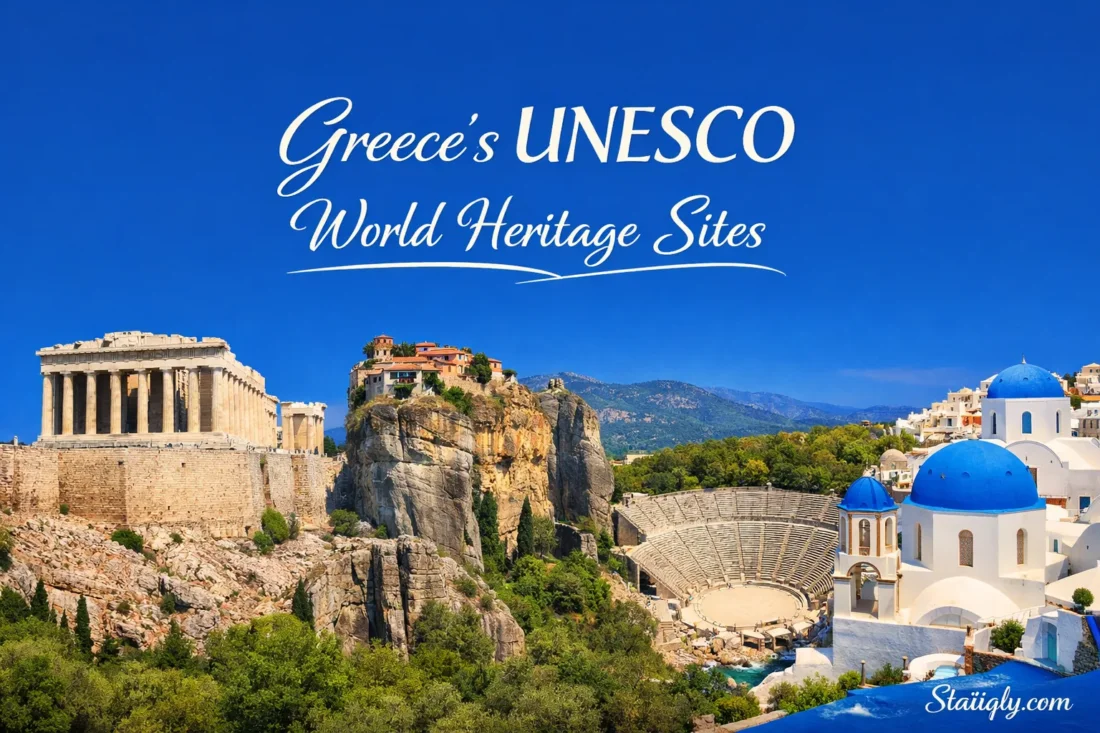
Greece’s UNESCO World Heritage Sites do not tell one single story. They tell many. Some rise from rock and sky, like Meteora. Some sit inside old street grids, like Rhodes and Corfu. Others open a path into Bronze Age Crete, classical sanctuaries, Byzantine art, and mountain villages where stone still shapes the view. For travelers, that range matters. It means a UNESCO site in Greece can be a hilltop temple, a sacred island, a monastery complex, a cultural landscape, a mixed mountain property, or a living town that still feels full of texture and memory.
UNESCO World Heritage Sites in Greece by Type and Year
| Site | Type | Year | What Stands Out |
|---|---|---|---|
| Temple of Apollo Epicurius at Bassae | Cultural | 1986 | Remote classical temple with refined design |
| Acropolis, Athens | Cultural | 1987 | Fifth-century BCE monuments above the city |
| Archaeological Site of Delphi | Cultural | 1987 | Sanctuary, oracle, and mountain setting |
| Medieval City of Rhodes | Cultural | 1988 | Walled town with layered urban history |
| Meteora | Mixed | 1988 | Monasteries on towering rock pillars |
| Mount Athos | Mixed | 1988 | Monastic peninsula with cultural and natural value |
| Paleochristian and Byzantine Monuments of Thessalonika | Cultural | 1988 | Major churches and mosaics from early Christian and Byzantine periods |
| Sanctuary of Asklepios at Epidaurus | Cultural | 1988 | Healing sanctuary and famous ancient theatre |
| Archaeological Site of Mystras | Cultural | 1989 | Late Byzantine city on a hillside |
| Archaeological Site of Olympia | Cultural | 1989 | Sanctuary linked with the ancient Olympic Games |
| Delos | Cultural | 1990 | Sacred island and major ancient port |
| Monasteries of Daphni, Hosios Loukas and Nea Moni of Chios | Cultural | 1990 | Middle Byzantine monasteries with celebrated mosaics |
| Pythagoreion and Heraion of Samos | Cultural | 1992 | Ancient city, sanctuary, and strong island heritage |
| Archaeological Site of Aigai (Modern Name Vergina) | Cultural | 1996 | Royal centre of ancient Macedon |
| Archaeological Sites of Mycenae and Tiryns | Cultural | 1999 | Palatial centres of the Mycenaean age |
| The Historic Centre (Chorá) with the Monastery of Saint-John the Theologian and the Cave of the Apocalypse on the Island of Pátmos | Cultural | 1999 | Sacred island ensemble with deep religious meaning |
| Old Town of Corfu | Cultural | 2007 | Elegant island town with strong Venetian character |
| Archaeological Site of Philippi | Cultural | 2016 | Hellenistic and Roman city on a major ancient route |
| Zagori Cultural Landscape | Cultural | 2023 | Stone villages, paths, bridges, and sacred forests |
| Minoan Palatial Centres | Cultural | 2025 | Six palatial sites on Crete tied to Minoan civilization |
| The wider area of Mount Olympus | Mixed | 2026 | Mythology, mountain landforms, and Mediterranean plant biodiversity |
Greece has 21 UNESCO World Heritage properties. 18 are cultural and 3 are mixed. The 2026 inscription of The wider area of Mount Olympus added a third mixed property, joining Meteora and Mount Athos. Greece’s list remains strongly cultural while also recognizing places where cultural meaning and natural features are inseparable.
Why Greece’s UNESCO List Feels So Varied
Greece’s UNESCO list covers several distinct forms of heritage. It moves from Bronze Age palaces and classical sanctuaries to Byzantine monasteries, fortified island towns, and mountain landscapes where villages, paths, bridges, forests, geology, and biodiversity are part of the protected property.
A first trip may focus on Athens, Delphi, and Meteora, while later visits can turn toward Vergina, Philippi, Patmos, Zagori, or Mount Olympus. These places cover different periods, landscapes, and forms of heritage without repeating the same type of visit.
- Ancient ritual and civic life appear in places like Delphi, Olympia, and Epidaurus.
- Palace culture and early state power come through in Mycenae, Tiryns, Aigai, and the Minoan centres of Crete.
- Byzantine art and religious life stand out in Thessaloniki, Mystras, Patmos, and the three major monasteries of Daphni, Hosios Loukas, and Nea Moni.
- Urban heritage takes a different shape in Rhodes and Corfu, where streets, walls, and public spaces matter as much as single monuments.
- Landscape itself becomes central in Meteora, Mount Athos, Zagori, and the wider area of Mount Olympus.
The Sites That Define Ancient Greece
If your interest starts with ancient Greece, a few sites do more than fill a checklist. They help explain how religion, city life, performance, trade, and memory worked together.
- Acropolis, Athens brings together the monuments most people picture first. Yet the real draw is not only the Parthenon. The wider complex shows how architecture, belief, and civic identity were connected on one prominent hill.
- Delphi is closely tied to its mountain setting. Its sanctuary and oracle developed in a landscape that remains central to understanding the site.
- Olympia is often associated first with sport, though it was also a major religious sanctuary. That sacred role still shapes how the ruins are understood.
- Epidaurus stands out for healing, ritual, and theatre together. Its theatre gets much of the attention, but the wider sanctuary gives the site its full context.
- Delos shows that an island could be both sacred and intensely connected. Religion, trade, settlement, and movement all meet there.
- Bassae is more remote than many classical sites and offers a close look at Greek temple architecture away from the busiest visitor routes.
Why These Places Stay So Memorable
The setting is part of how many of these properties are understood. Delphi is tied closely to its mountain location, Meteora to its rock pillars, and the Acropolis to its elevated position above Athens. Geography is not simply a backdrop at these sites; it helps explain their form, use, and historical meaning.
Palaces, Kingdoms, and Early Cities
Greece’s UNESCO list is not limited to the classical age. Bronze Age Crete, Mycenaean strongholds, and royal Macedonian sites add earlier layers that can easily be missed on a first visit.
- Minoan Palatial Centres bring six places on Crete into one UNESCO property: Knossos, Phaistos, Malia, Zakros, Zominthos, and Kydonia. Together they show how broad and organized Minoan life was across the island.
- Mycenae and Tiryns use a different architectural language. Massive walls, fortified citadels, and palace remains distinguish these sites from the later classical sanctuaries.
- Aigai (Vergina) matters for royal history, burial culture, and the story of ancient Macedon. It is especially useful for visitors who want to explore Greek history beyond an Athens-centered route.
- Philippi connects Greek, Hellenistic, Roman, and early Christian layers in one place, making changes in the city’s layout and use visible across different periods.
- Pythagoreion and Heraion of Samos pair an ancient urban centre with a major sanctuary. That combination gives the property unusual breadth for an island site.
Together, these places show that Greece’s UNESCO record extends well beyond the classical period. Bronze Age palaces, Macedonian royal sites, Roman cities, and later monuments give travelers several chronological routes through the country.
Monasteries, Stone Towns, and Living Cultural Landscapes
Many visitors associate UNESCO sites in Greece with archaeological ruins first. Several listed properties, however, belong to later periods or protect entire landscapes and settlements rather than a single monument.
- Meteora is one of the clearest examples of landscape and spiritual life being closely connected. Its monasteries occupy high rock pillars, so the geology and the monastic complex are understood together as one mixed World Heritage property.
- Mount Athos carries both cultural and natural value. It is not just a monastic centre. It is also a whole peninsula where built heritage and landscape remain tightly linked.
- The wider area of Mount Olympus, inscribed in 2026, is Greece’s newest mixed World Heritage property. Its cultural value is tied to the mountain’s place in Greek mythology, while its natural value includes limestone formations, deep gorges, varied vegetation, and plant biodiversity. The property also includes the archaeological site of Dion.
- Paleochristian and Byzantine Monuments of Thessalonika show how one city can hold major churches, mosaics, and layers of Christian art across centuries.
- Monasteries of Daphni, Hosios Loukas and Nea Moni of Chios reward close looking. Their mosaics are among the details that make these three monasteries especially useful for understanding Middle Byzantine art.
- Mystras preserves churches, palaces, houses, fortifications, and paths across a hillside settlement, allowing the site to be understood as a former city rather than as an isolated group of monuments.
- Patmos joins the historic town, monastery, and Cave of the Apocalypse into one sacred ensemble with closely connected religious and architectural elements.
- Rhodes offers an extensive urban UNESCO experience. Streets, gates, walls, public spaces, and buildings remain part of the historic city rather than being separated into one monument complex.
- Corfu presents a different form of urban heritage, shaped by its island setting, fortifications, street plan, and long Venetian influence.
- Zagori Cultural Landscape widens the meaning of heritage. Villages matter there, but so do bridges, cobbled paths, terraces, and sacred forests. These elements are protected as parts of one cultural landscape.
Why Zagori Matters So Much
Zagori, inscribed in 2023, broadened the range of Greece’s UNESCO properties by recognizing a cultural landscape rather than a single monument. Its villages, mountain routes, local stone architecture, bridges, and sacred forests work as connected parts of the same heritage landscape.
Mount Olympus as a Mixed World Heritage Site
The wider area of Mount Olympus joined the World Heritage List in 2026 under cultural and natural criteria. Mount Olympus is Greece’s highest mountain and has long been associated with the Twelve Olympian gods, Zeus, the Muses, and the Graces in Greek tradition and literature. Its UNESCO value also comes from the mountain itself: steep limestone formations, glacial cirques, karst features, deep gorges, varied vegetation, and a high concentration of Mediterranean plant diversity and endemic species.
The listed property covers about 18,938 hectares and includes two components: the wider Mount Olympus area and the archaeological site of Dion. That combination places mythology, archaeology, geology, and biodiversity inside the same UNESCO property rather than treating Olympus only as a mythological landmark.
How to Choose the Right UNESCO Sites for Your Trip
Not every traveler wants the same kind of trip, and Greece’s UNESCO list supports several different routes.
- For a first visit: start with Acropolis, Delphi, Olympia, and Meteora. These four cover several of the country’s best-known heritage themes without feeling repetitive.
- For Bronze Age and early palace history: choose Minoan Palatial Centres, Mycenae and Tiryns, and Aigai. This route shows how much happened before the classical period.
- For Byzantine art and monastic heritage: focus on Thessalonika, Daphni, Hosios Loukas, Nea Moni, Mystras, Patmos, and Meteora.
- For island-based travel: look at Delos, Samos, Rhodes, Corfu, Patmos, and the Minoan centres on Crete. Each island property represents a different period or form of heritage.
- For towns and long walks: pick Rhodes, Corfu, and Mystras. These are places where movement through streets and built space becomes part of the visit.
- For mountain landscapes: look at Mount Olympus, Zagori, and Meteora. Olympus combines mythology, geology, and biodiversity; Zagori is shaped by villages, bridges, paths, and sacred forests; Meteora joins monasteries with its rock formations.
Do not try to force all 21 into a single fast itinerary. Greece’s UNESCO map stretches across mainland regions and islands, and the list works best when you give each area enough time.
Patterns You Notice After Visiting a Few
- Height matters. Hills, cliffs, acropolises, mountain ridges, and high viewpoints appear again and again.
- Stone is everywhere. In walls, bridges, monasteries, temples, village streets, and mountain formations, it appears in very different contexts.
- Islands are central, not marginal. Delos, Rhodes, Corfu, Samos, Patmos, and Crete all show how connected island life has long been.
- The list is not only classical. Bronze Age, Byzantine, medieval, early Christian, and later landscapes account for a large share of the properties.
- Natural features can be part of cultural meaning. Meteora, Mount Athos, and Mount Olympus are all mixed properties where the landscape is directly connected with cultural or religious associations.
- Many sites reward slow looking. Mosaics, theatre layouts, village squares, mountain paths, palace courts, fortifications, and archaeological remains often reveal more with time.
Region by Region: Easy Clusters to Remember
- Athens and Central Greece: Acropolis, Daphni, Delphi.
- Peloponnese: Bassae, Olympia, Epidaurus, Mycenae and Tiryns, Mystras.
- Northern Greece: Thessalonika, Aigai, Philippi, Zagori, Meteora, Mount Athos, Mount Olympus.
- Aegean Islands: Delos, Samos, Patmos, Rhodes, Chios.
- Ionian Side: Corfu.
- Crete: Minoan Palatial Centres.
That regional view makes planning easier. It also shows a basic feature of Greece’s UNESCO geography: the 21 properties are spread across mainland regions, mountain areas, peninsulas, and islands rather than being concentrated in one part of the country.