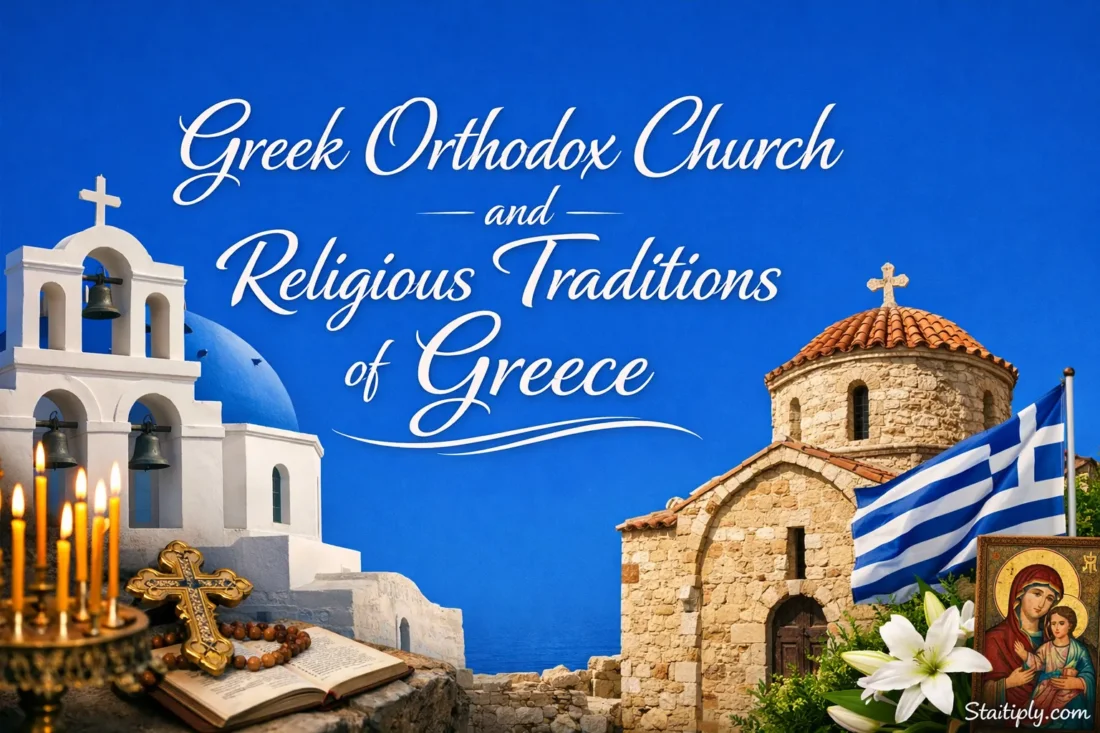
Greek religious life makes the strongest impression not only inside famous churches, but in ordinary moments too. A candle lit before work. An icon in a quiet corner of the home. A village church filling up on a feast day. In Greece, Orthodox Christianity is part of the weekly routine, the family calendar, and the way many people mark joy, memory, and belonging. You do not need to look far to notice it. It is there in the bells, the processions, the bread on the table, and the names people carry with pride.
| Tradition | When It Appears | What People Often Notice |
|---|---|---|
| Divine Liturgy | Every week, especially Sunday | Candles, icons, chanting, families gathered in the parish church |
| Name Days | On a saint’s feast day | Phone calls, visits, sweets, warm wishes, an open-door mood |
| Great Lent and Holy Week | Before Easter | Fasting meals, flower-decorated Epitaphios, evening services, candlelight |
| Pascha (Easter) | Spring | Midnight Resurrection service, red eggs, festive family tables |
| New Year and Theophany | January 1 and January 6 | Vasilopita, a hidden coin, the Blessing of the Waters |
| Family Sacraments | Throughout the year | Baptism, chrismation, marriage, godparents, close family gatherings |
The Greek Orthodox Church in Everyday Life
The Greek Orthodox Church in Greece is the Church of Greece, an autocephalous Orthodox church led by the Archbishop of Athens and All Greece and guided by the Holy Synod. In the wider Orthodox tradition, the Ecumenical Patriarchate also carries deep historical and spiritual weight. That church structure matters, of course, but most people feel the faith in a simpler way: through the local parish.
For many communities, the parish church feels less like a monument and more like a meeting point for prayer, memory, and family life. Sunday worship, feast-day liturgies, memorial candles, patron-saint festivals, and shared meals all gather around it. A church may stand in the middle of a busy city block or at the edge of a mountain village. Either way, it often holds the same place in local life: steady, familiar, close.
You see this in small details. People enter quietly and make the sign of the cross. They light a taper. They greet an icon. They pause, even if only for a minute. That habit says a lot. In Greece, faith is not always loud, but it is often visible.
The Rhythm of the Church Year
The church year gives Greek family life a clear rhythm. Some seasons feel joyful and bright. Others slow things down. Food changes. Service times change. Homes change a little as well. The year moves forward through saints’ feasts, fasting periods, village festivals, and major holy days that many people know by heart.
Great Lent, Holy Week, and Easter
No season shows the emotional depth of Greek religious life better than Great Lent and Holy Week. Lent brings a more restrained table and a quieter tone. Then Holy Week arrives, and the atmosphere shifts again. Churches fill more often. Hymns grow more solemn. The week is not rushed. It is felt.
On Good Friday, many churches decorate the Epitaphios with flowers before the evening procession. The image stays with people. Fragrance, candlelight, slow movement through the streets, and a crowd walking together in silence or low prayer. The next night, everything changes. At the midnight Resurrection service, worshippers hold lit candles and exchange the Easter greeting Christos Anesti (“Christ is Risen”). Then comes the family table, the return home, and the warmth people wait for all year.
And yes, there are the beloved Easter foods. Red eggs are part of the season in many homes, and festive breads and Easter meals bring the religious and the domestic together in one place. Very Greek, that blend. Sacred and familiar, side by side.
Christmas, New Year, and Theophany
The winter season has its own texture. Christmas is marked by church services, family meals, and a gentler, home-centered joy. Then comes the turn of the year, and with it one of the most loved customs in Greece: vasilopita, the New Year cake or bread. A coin is hidden inside, and the person who finds it is said to receive good fortune for the year ahead. It is a simple custom, but people look forward to it every time.
A few days later comes Theophany on January 6, also called Epiphany or the Feast of Lights. The Blessing of the Waters stands at the center of the day. In coastal towns, island harbors, and riverside communities, this celebration can feel especially vivid. Water, prayer, light, winter air. A strong image, and one that stays in the memory.
Name Days and the Calendar of Saints
To understand Greek religious tradition, you have to understand name days. In Orthodox practice, many names are linked to saints or holy events. When that feast day comes, the person who bears the name receives visits, messages, sweets, and blessings. Sometimes the celebration is small. Sometimes the home fills up. Either way, it turns the calendar of saints into something social and very alive.
This custom gives Greek religious life a warm, human scale. The saint is remembered in church, and the person carrying the name is remembered at home. That is a lovely bridge between worship and daily life.
Family Customs Rooted in the Church
Icons, Lamps, and the Prayer Corner
Many Orthodox homes in Greece keep a prayer corner with icons. Often you will see an icon of Christ, the Virgin Mary, and a patron saint, sometimes with a small lamp or candle nearby. These are not treated as mere decoration. They belong to prayer, memory, and the quiet order of the household. A child grows up seeing them. A grandparent stands before them in the morning. Guests notice them right away.
This part of Greek religious life is easy to miss if you look only at public ceremonies. Yet the home matters just as much. Faith does not stop at the church door. It comes home, settles into daily habit, and stays there.
Baptism, Chrismation, and Godparents
In Orthodox practice, baptism and chrismation belong closely together. For Greek families, a baptism is both a sacramental event and a deep family celebration. The child receives a Christian name, enters the life of the Church, and is welcomed by relatives, friends, and the godparent. That sponsor is not a decorative role. The bond is meant to last.
This is one reason baptisms in Greece often carry real emotional weight. They are not only about a date on the calendar. They mark belonging — to a family, to a parish, to a line of memory that keeps moving forward.
Wedding Crowns and the Joy of Blessing
The Orthodox marriage service includes the Betrothal and the Crowning. Crowns placed on the couple’s heads are among the best-known images from a Greek Orthodox wedding. The ceremony is reverent, joyful, and full of symbol. Family and friends do not just watch. They take part with presence, prayer, and shared feeling.
A Greek wedding can feel festive, but the church service itself keeps a clear seriousness. It treats marriage as a blessed union, not a stage performance. That balance is part of its beauty. Joyful, yes. Grounded, too.
Sacred Places People Return to
Greece has countless local churches and chapels, but some places hold a wider pull. They draw pilgrims, worshippers, and curious visitors year after year. Not because they are famous alone. Because they still live as places of prayer.
Meteora
Meteora is one of the most striking monastic landscapes in Greece. The first ascetics came there in the 11th century, and the area later grew into one of the country’s main monastic centers. The monasteries stand high above the plain, set on rock pillars that seem almost unreal when first seen. It is a place where the landscape itself feels like part of the religious experience.
Visitors often remember the silence first. Then the climb. Then the feeling of stepping into a space where worship has continued for centuries. Meteora is visually unforgettable, but its real force comes from continuity. Prayer has stayed there.
Patmos
Patmos carries a different kind of spiritual atmosphere. The island is closely tied to Saint John the Theologian, and the Monastery of Saint John, founded in 1088, has long been a place of pilgrimage and Orthodox learning. The monastery, the Cave of the Apocalypse, and the old town of Chora form a setting where religious memory and island life meet in a very natural way.
Patmos does not feel hurried. It invites slower attention. Walk the lanes, enter the churches, listen to the stillness for a moment, and the island begins to make sense in its own language.
Visiting Churches and Monasteries With Respect
Many travelers want more than a photograph. They want to understand what they are seeing. In Greece, that usually starts with respect for the space itself. A church may welcome visitors throughout the day, but it is still first a place of worship.
- Dress modestly, especially in monasteries and on feast days.
- Keep your voice low and move gently inside the church.
- Watch what local worshippers do before stepping forward.
- Ask before taking photos of interiors, icons, or services.
- During processions or major feast days, give the moment time. Do not rush it.
That approach opens more doors than people expect. Stand quietly during a service, notice the chant, the incense, the icons, the candles, the way grandparents guide children, the way neighbors greet one another after worship. Then the tradition stops feeling distant. It becomes human-sized. And that is when Greece’s Orthodox life is easiest to understand.