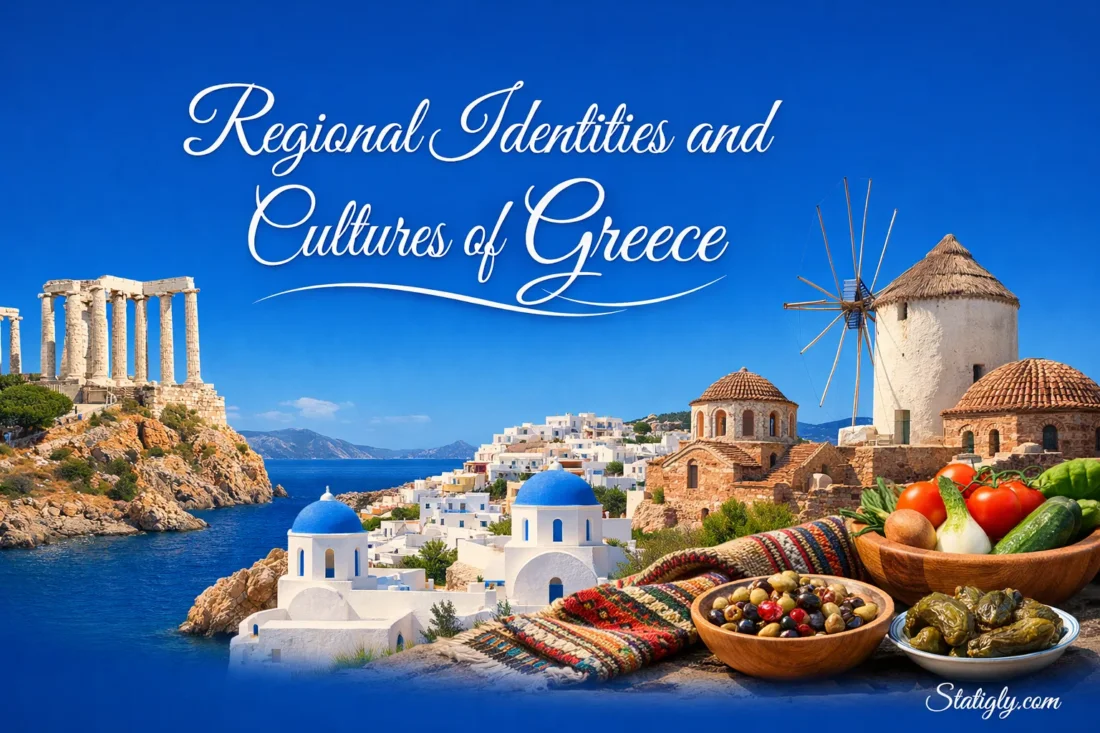
Greece may look compact on a map, yet it feels like many local worlds living side by side. Mountains cut communities apart. Seas connect islands while also giving each one its own pace. That is why regional identity in Greece is not a small detail. It shapes speech, food, music, festivals, house styles, and even the rhythm of an ordinary day. Greece officially has 13 administrative regions, but culture does not stay inside neat borders. It follows older regional names, island groups, ports, valleys, and mountain routes. In one place you hear a lyra. In another, brass bands. Somewhere else, stone villages and pies tell the story before anyone says a word.
A Short Regional Overview
| Area | What Often Stands Out | Typical Cultural Signals |
|---|---|---|
| Northern Greece | Large cities, mountain belts, fertile plains | Hearty inland cooking, strong town identity, lively local music scenes |
| Epirus | High mountains and stone villages | Pastoral traditions, pies, dairy, slate-and-stone architecture |
| Thessaly And Central Greece | Plains, market towns, mountain edges | Seasonal shepherd routes, village fairs, food shaped by grain and livestock |
| Peloponnese | Peninsulas, olive country, old fortified settlements | Local pride, varied dialect pockets, distinct dance and food traditions |
| Attica And Piraeus | Urban Greece at full speed | Port culture, layered neighborhoods, the social world linked with rebetiko |
| Ionian Islands | Green islands and elegant townscapes | Brass bands, refined urban style, strong island customs |
| Cyclades | Dry landscapes and bright island villages | White cubic houses, seafood, honey, compact village life |
| Dodecanese And North Aegean | Harbor towns, walled settlements, distinct island economies | Medieval town forms, local craft traditions, strong island-by-island identity |
| Crete | Greece’s largest island | Lyra music, mountain villages, olive oil, wild greens, strong local continuity |
Regional Identity Starts With Geography
Why does this happen so clearly in Greece? Geography, mainly. The mainland is broken by mountain chains, and the sea is everywhere. Villages that sit only a short distance apart can grow into places with different food habits, sounds, and building methods. Islands develop in another way. They look outward to harbors, trade, and seafaring routines, while mountain communities often build culture around herding, cheese, pies, wood, stone, and seasonal movement.
So the map of Greek culture is layered. There is the official state map with 13 regions. Then there is the lived map: mainland and island, mountain and coast, port and village, north and south. Greeks often recognize these differences quickly. A surname, a dish on the table, a tune at a feast, a way of pronouncing a word. Small signals. Still powerful.
- Speech and accent
- Music and dance style
- Local bread, pies, cheese, seafood, or sweets
- House shape and village layout
- Church feasts, summer festivals, and seasonal customs
- Family memory tied to a village, island, or city quarter
Main Cultural Areas Across Greece
Northern Greece
Northern Greece carries a broad inland feel. In Macedonia, food often leans toward peppers, beans, mushrooms, orchard fruit, and rich home cooking. Thessaloniki gives the north an urban center with its own habits, while the countryside adds mountain villages, market towns, and strong local loyalties. This is one reason the north never feels flat as a cultural label. City life and village life sit close together, but they do not sound the same, and they do not eat the same.
Epirus
Epirus is one of the clearest examples of geography shaping culture. It lies between the Pindos mountains and the Ionian side of the country, and its stone villages show that relationship with the land at once. In Zagori, stone, wood, and slate define the built environment. In Metsovo and other mountain settlements, local identity still feels close to craft, herding, dairy, and seasonal movement. Food here tends to be practical and deeply local: pies, cheese, yogurt, and dishes built from what mountain life offers. Quietly proud, this region is.
Thessaly And Central Greece
Thessaly and parts of Central Greece bring together plains, foothills, and old livestock routes. That matters. The memory of transhumance, the seasonal movement of herders and animals between lowland and highland zones, still helps explain local food and village timing in these areas. Some customs belong to the mountain summer. Others belong to the winter plain. Even when the old routes are no longer an everyday necessity for most people, the cultural memory remains in fairs, songs, food habits, and family stories.
The Peloponnese
The Peloponnese is not one single cultural field. It is a peninsula made of smaller identities. Coastal towns differ from inland villages. Mani stands out with its dense stone settlements and tower-house tradition. Monemvasia shows another face of the region, more enclosed and medieval in feel. In the eastern Peloponnese, older local speech survives in a few places too, including Tsakonian villages. That is rare, and it shows how long local identity can endure when communities stay rooted. Here, place sticks.
Attica And Piraeus
Attica is urban, fast, and layered. Athens gathers people from all parts of Greece, so regional culture does not disappear there; it mixes, adapts, and reappears in neighborhoods, markets, family tables, and feast days. Piraeus adds the port mood. This is also the social ground linked with rebetiko, the musical expression that UNESCO recognizes as part of living heritage in Greece. Rebetiko grew in urban settings and became part of shared social life through song, dance, and participation. That matters because it shows another side of Greek regional culture: not only village roots, but city roots too.
The Ionian Islands
The Ionian Islands feel different from the Aegean at first glance. Greener, softer in outline, often more formal in their town layouts. Corfu is the clearest example, where music in public life stands out strongly. Its philharmonic bands are not a side note. They are part of the island’s cultural identity and appear with real force during Easter customs and processions. Across the Ionian Islands, local food, old town streets, and public music create an island culture that feels polished yet deeply local.
The Cyclades
The Cyclades are what many people picture first: white cube-shaped houses, narrow lanes, dry hills, sea light, chapels, and close village life. Yet the Cyclades are not only visual. Their cuisine reflects dry island farming and the sea at the same time. Seafood, local cheeses, capers, and thyme honey tell that story well. Architecture does too. The famous whitewashed look is not decoration alone. It is part of a way of living on windy, sun-filled islands where space is tight and villages grow compact.
The Dodecanese And The North Aegean
These islands resist one simple label. Rhodes brings a strong medieval urban form, with layers visible in the townscape. Chios shows another island identity through its mastic villages and the long family-based know-how of cultivating mastic, a practice also recognized by UNESCO. Harbor life, trade memory, local craft, and distinct village patterns give these islands their own tone. One island may feel walled and urban. Another feels agricultural and close-knit. That variety is part of the point.
Crete
Crete is the largest island in Greece, and it often feels like a cultural region of its own. Music built around the lyra, village feasts, mountain routes, olive oil, wild greens, barley rusks, local cheeses, and strong family attachment to place all feed that identity. Cretan food is usually direct and land-based. The idea is simple: use what grows or grazes nearby and treat it well. The result is a cuisine that feels local in a very grounded way. Hear Cretan music for a minute and you know where you are.
Music And Dance Mark Place Very Fast
If food tells you where you are by taste, music does it by mood. Greece has national songs and shared dances, of course. Still, local sound remains one of the fastest markers of region. Rebetiko belongs to urban social life. The Cretan lyra brings a different texture, tighter and more insistent. Corfu’s bands bring ceremony into the street. Village dance traditions across mainland regions often feel more collective, with circles, steps, and songs tied to feast days and family events.
And this matters more than it may seem. A regional sound is not just entertainment. It tells people who they are with, what feast they are attending, what memories are being carried, and how a community sees itself. Different, too, are the emotions each region puts forward: restrained in one place, expansive in another, bright here, earthy there.
Food Works Like A Cultural Map
Greek food is often discussed as one national cuisine. That is true only up to a point. Regional cooking is where the detail lives.
- On many islands, seafood stands close to the center of the table.
- In mountain regions such as Epirus, dairy, pies, and meat-based village cooking carry more weight.
- In Macedonia, peppers, beans, mushrooms, and orchard products leave a clear mark.
- In the Cyclades, dry-land ingredients and the sea meet in compact, flavor-first dishes.
- In Crete, olive oil, greens, barley rusks, local cheese, and village baking shape daily food culture.
That is why the phrase Greek culture works best when it stays open enough to include many local tables. A pie in Epirus is not only a pie. It is climate, animal life, flour, labor, and family memory folded together. A tray of island seafood says something just as local, only in another language of place.
Speech, Accent, And Local Words Still Matter
Standard Modern Greek gives the country a shared spoken base, but local speech still carries identity. People often hear regional origin in accent, pace, and vocabulary before they hear it in a family story. In a few places, older speech traditions survive more sharply, as with Tsakonian in the eastern Peloponnese. Even where local varieties are less distinct than before, the signal remains. A person from Crete does not always sound like a person from Corfu. Nor should they.
Regional words for foods, tools, celebrations, and village customs also keep local memory alive. This is one reason cultural identity in Greece stays durable. It is spoken in ordinary life, not stored only in museums.
Festivals Keep The Local Calendar Alive
Across Greece, the church calendar and the village calendar often meet. Easter is the most important family festival, and many people return to their native towns and villages for it. That return matters. It refreshes local belonging year after year. Summer feasts do the same, especially the village panigiri, where food, music, dancing, and public gathering turn a local saint’s day or community celebration into a living expression of place.
The pattern repeats across the country, though never in exactly the same way. Corfu brings bands and processions into Easter. Many villages celebrate the August 15 feast with processions, dance, and shared meals. Elsewhere, local customs may look quieter, more family-based, or more village-centered. Same season. Different feeling.
Architecture Shows Regional Culture Without Words
Look at buildings and you can read Greece region by region. In Zagori, stone, wood, and slate dominate. In the Cyclades, white cube-like houses and tight lanes shape the village image. In Mani, tower houses and dense stone settlements tell a harder, more enclosed story of landscape and local society. In Rhodes, the town fabric carries a medieval urban character. In the mastic villages of Chios, settlement form connects directly with the life of cultivation.
This is why architecture in Greece is not just about beauty. It is practical memory. Roofs, wall thickness, street width, village position, and building material all reflect climate, terrain, labor, and local history. Culture becomes visible here.
How Regional Identity Lives In Greece Today
Modern life has changed movement, work, and communication across Greece. People study far from home, move to cities, travel more easily, and stay connected online. Yet regional identity has not faded into a generic national style. It still appears in Easter returns, summer village feasts, island loyalties, local food revivals, music schools, dance groups, neighborhood associations, and family kitchens.
That is the lasting truth of Greece’s regional cultures. They are not frozen pieces of folklore. They keep moving. They adapt. They stay useful. And in daily life, they still help people answer a simple question: where are you from, really?