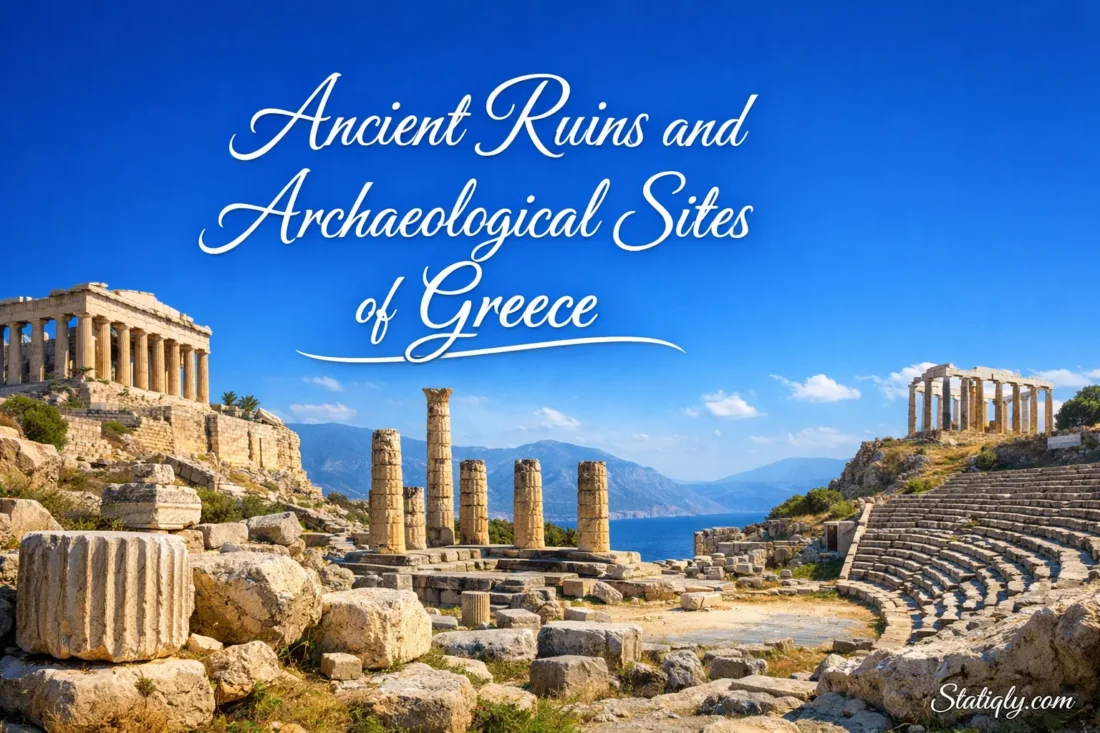
Greece does not hide its past in one corner. It leaves it on hilltops, in mountain valleys, beside olive groves, and across islands where stone still catches the same light it did thousands of years ago. Walk through the country and one pattern appears again and again: sanctuaries, theatres, palaces, citadels, and port cities were never random. They were placed with care. Some watched the sea. Some faced sacred peaks. Some ruled fertile plains. That is why the best ancient ruins and archaeological sites of Greece feel larger than a collection of old stones. They still belong to the land around them.
| Site | Region | Main Period | What Stands Out |
|---|---|---|---|
| Acropolis of Athens | Athens | 5th Century BCE | Parthenon, Erechtheion, Propylaea |
| Delphi | Central Greece | 6th Century BCE and Later | Oracle of Apollo, sacred mountain setting |
| Olympia | Peloponnese | 10th Century BCE Onward | Zeus sanctuary, stadium, Olympic heritage |
| Epidaurus | Peloponnese | 6th–4th Century BCE | Healing sanctuary, famous theatre |
| Mycenae and Tiryns | Argolis | 15th–12th Century BCE | Citadels, fortification walls, Bronze Age power |
| Knossos and the Minoan Palatial Centres | Crete | 1900–1100 BCE | Palaces, storage systems, fresco culture |
| Akrotiri of Thera | Santorini | 4th Millennium–17th Century BCE | Buried town, streets, houses, frescoes |
| Delos | Cyclades | 3rd Millennium BCE Onward | Island sanctuary and trading port |
| Aigai | Northern Greece | 11th–4th Century BCE | Royal tombs, palace, tumuli |
| Bassae | Arcadia | 5th Century BCE | Remote temple with rare design features |
Why These Sites Feel Different
Many countries have ancient remains. Greece has something more tightly woven: continuity. Bronze Age palaces, Classical sanctuaries, healing centers, theatres, island ports, and royal burial grounds all survive within one relatively compact country. You can move from a Minoan palace in Crete to a mountain oracle in Epirus, then to a stadium in the Peloponnese, and the story still holds together.
And there is another reason these places stay in memory. Their settings still work. Delphi still feels dramatic because it climbs the slope the way a sacred place should. Olympia still opens out like a ceremonial ground. Akrotiri still reads like a real town rather than a pile of fragments. Greece is strong at this. The landscape keeps explaining the ruins.
Sites That Shape The Greek Story
Acropolis Of Athens
No list starts anywhere else. The Acropolis of Athens is the image many people carry when they think of ancient Greece, and for good reason. The great monuments on the hill were built in the second half of the 5th century BCE, when the Parthenon, the Erechtheion, the Propylaea, and the Temple of Athena Nike gave the rocky summit its lasting form.
What matters here is not only the beauty of each building. It is the way the whole hill works as one statement. The entrance sequence, the change in ground level, the careful placement of temples, the way light falls across Pentelic marble — all of it turns a hill into a planned sacred and civic symbol. Seen from below, the Acropolis dominates Athens. Seen from above, it reminds you how ancient builders used height as meaning.
Delphi
Delphi sits where mountain, path, and belief meet. In antiquity, it was the pan-Hellenic sanctuary where the oracle of Apollo spoke, and it was linked to the omphalos, the “navel of the world.” By the 6th century BCE, Delphi had become a religious center and a shared symbol for the Greek world.
This is one of the best places in Greece for understanding how a sanctuary grows through movement. You do not absorb Delphi in a single glance. You climb it. The Sacred Way pulls you upward past treasuries, terraces, and temples. The theatre above widens the view. The stadium higher up pushes the site into open air. Few places show so clearly that religion, landscape, and public display once moved together. Beautifully, still it does.
Olympia
Olympia was inhabited from prehistoric times and became a center for the worship of Zeus in the 10th century BCE. It later developed into the setting for the Olympic Games, held every four years from 776 BCE. That alone gives it a special place, but the site offers much more than athletic memory.
The heart of Olympia is the Altis, the sacred enclosure. Around it stood temples, altars, treasuries, and the buildings needed for ritual and gathering. Nearby, the sports structures turn the site into a full ceremonial landscape rather than a single monument. That blend is what makes Olympia stand out. It was not only a place to compete. It was a place to assemble, to honor, to watch, and to belong.
Epidaurus
In a small valley in the Peloponnese, Epidaurus developed into the sanctuary of Asklepios, the god of medicine. The site grew from an earlier cult linked to Apollo and reached full importance by the 6th century BCE, while many of its main monuments date to the 4th century BCE.
Most visitors know the theatre first, and yes, it earns the attention. But Epidaurus is broader than one elegant performance space. The temple, the Tholos, and the healing buildings show that this was a place where ritual and care worked side by side. You can almost read the site as an ancient wellness landscape — not in a trendy way, just in a human one. People came here seeking relief, order, and hope.
Dodona
Dodona, in Epirus, is known as Greece’s oldest oracle. The sanctuary lies below Mount Tomaros in a narrow valley, and that setting gives it a quieter, more inward mood than Delphi. Where Delphi feels theatrical, Dodona feels older, earthier, and more rooted in the landscape.
The site is closely tied to Zeus and to the long sacred life of the region. If you enjoy places where myth, worship, and terrain feel tightly joined, Dodona leaves a strong impression. It also rewards travelers who want something less crowded and more reflective. Large theatre. Open valley. Deep past. A fine combination.
Mycenae And Tiryns
The ruins of Mycenae and Tiryns carry you back to the Mycenaean civilization, which dominated the eastern Mediterranean from the 15th to the 12th century BCE. These are not polished Classical sanctuaries. They are older, heavier, and more fortress-like.
Mycenae is the site many people remember for its commanding position and monumental entrance, while Tiryns is admired for its great fortification walls and palace remains. Together they help explain a Bronze Age world built around authority, defense, storage, and elite rule. The mood changes the moment you arrive. Less airy grace, more mass and command. Greece needs both chapters to make sense.
Knossos And The Minoan Palatial Centres
Crete tells a different story from mainland Greece, and Knossos is the clearest doorway into it. Official Greek heritage sources describe Knossos as the largest preserved Minoan palatial centre. Today UNESCO groups six Cretan palace sites — Knossos, Phaistos, Malia, Zakros, Zominthos, and Kydonia — under the Minoan Palatial Centres.
These sites date broadly from 1900 to 1100 BCE and show how the Minoans built administrative, economic, and religious hubs with advanced architecture, urban planning, storage systems, early writing, and vivid fresco culture. Knossos is the most famous, but the wider group matters because it shows a network rather than a single capital. Crete was not improvising. It had organized centers, maritime links, and a clear visual language of power.
For many travelers, Minoan archaeology is where Greece becomes more surprising. The buildings feel less like later temple architecture and more like living complexes: courts, staircases, magazines, work areas, light wells, movement in every direction. Palace, yes — but also something closer to a machine for daily life.
Akrotiri Of Thera
On Santorini, Akrotiri offers one of the clearest windows into prehistoric Aegean urban life. The settlement began in the Late Neolithic period and grew into a major Bronze Age town and port. After severe earthquakes and the volcanic eruption in the 17th century BCE, the settlement was buried, which helped preserve buildings, frescoes, and everyday objects.
That preservation changes the experience completely. At many sites you imagine the town. At Akrotiri, you can actually follow it. Streets, multi-storey buildings, drainage systems, storage areas, and wall paintings make the place feel immediate. It is often compared to Pompeii, but Akrotiri has its own character: Aegean, sea-facing, and deeply tied to island trade. If you want to picture ordinary and elite life together, few Greek sites do it better.
Delos
Delos is tiny in size and large in cultural weight. In Greek tradition it is linked with Apollo, and in historical terms it became both a sanctuary and a prosperous trading port. The island preserves traces from the 3rd millennium BCE to the early Christian era, which gives it unusual depth.
What makes Delos special is density. Sanctuaries, houses, port remains, public spaces, and commercial life stand close together, so the island reads almost like a compact map of the ancient Aegean. It feels cosmopolitan. Not by modern slogan, but by archaeological fact. Trade, worship, movement, and exchange all met here.
Pythagoreion And Heraion Of Samos
On Samos, the paired site of Pythagoreion and Heraion brings together an ancient fortified port, Greek and Roman remains, and the sanctuary of Hera. UNESCO also highlights the island’s striking tunnel-aqueduct, one of the features that makes the site so memorable.
This is a good place to see how religion and infrastructure could live side by side. A sanctuary alone tells one story. A port alone tells another. Samos gives you both, along with engineering that still feels bold. For readers building a Greece itinerary beyond the usual first stops, it deserves real attention.
Aigai
Aigai, near modern Vergina in northern Greece, was the first capital of the ancient Kingdom of Macedonia. The main remains include a monumental palace and a burial ground with more than 300 tumuli. One royal tomb inside the Great Tumulus is identified with Philip II.
Aigai stands apart because it combines court life and burial culture in one place. You do not only see where power was displayed. You also see how it was commemorated. That pairing gives the site unusual weight, especially for anyone interested in royal architecture, funerary monuments, and the ceremonial side of statehood in the ancient Greek north.
Temple Of Apollo Epicurius At Bassae
High in the Arcadian mountains, Bassae feels remote in the best way. The Temple of Apollo Epicurius was built around the middle of the 5th century BCE and is known for blending older and newer architectural ideas, including the oldest Corinthian capital yet found.
This site works for travelers who enjoy precision and isolation. It does not rely on an urban setting or a large complex. One temple, one mountain environment, one powerful sense of focus. Sometimes Greece speaks in crowds of monuments. Here it speaks in a single structure.
How To Choose The Right Sites For Your Trip
- For first-time visitors: Acropolis, Delphi, and Olympia create a strong foundation.
- For Bronze Age archaeology: Knossos, the wider Minoan palatial network, Akrotiri, Mycenae, and Tiryns make the clearest route.
- For sacred landscapes: Delphi, Dodona, Epidaurus, and Delos stand out.
- For theatre lovers: Epidaurus and Dodona are easy priorities.
- For island history: Delos, Samos, Akrotiri, and Crete offer very different coastal stories.
- For travelers who want something quieter: Aigai, Bassae, and Dodona often feel more spacious and less hurried.
What To Notice When Walking Through A Greek Archaeological Site
- Look at the setting first. Ask why the site stands exactly there: hilltop, valley, plain, harbor, or island crossing.
- Watch the route in. Ancient sites were designed to guide movement. Entrances matter.
- Separate sacred, public, and domestic space. Temples, theatres, stoas, storage rooms, workshops, and houses each tell a different part of the story.
- Notice what the builders valued. At some sites it is symmetry. At others, defense, storage, ritual sequence, or access to water.
- Read the landscape as part of the ruin. In Greece, mountain, sea, and stone rarely act alone.
Common Threads Across The Best Greek Ruins
The strongest archaeological sites in Greece share a few traits. They are usually tied to movement, whether by sea route, pilgrimage path, or ritual procession. They also connect architecture to purpose very clearly. A healing sanctuary does not feel like a citadel. A Bronze Age palace does not feel like a Classical hilltop temple. The forms change because the lives inside them changed.
That is why Greece remains so rewarding for travelers who care about ancient history. The country offers variety without losing coherence. You can stand in a Minoan court at Knossos, walk a buried street at Akrotiri, climb toward Apollo at Delphi, or look across the stadium at Olympia, and each site adds another layer without breaking the larger picture. Old, yes. Distant, not really.